Portable Air Conditioner Versus Window Unit For Renters
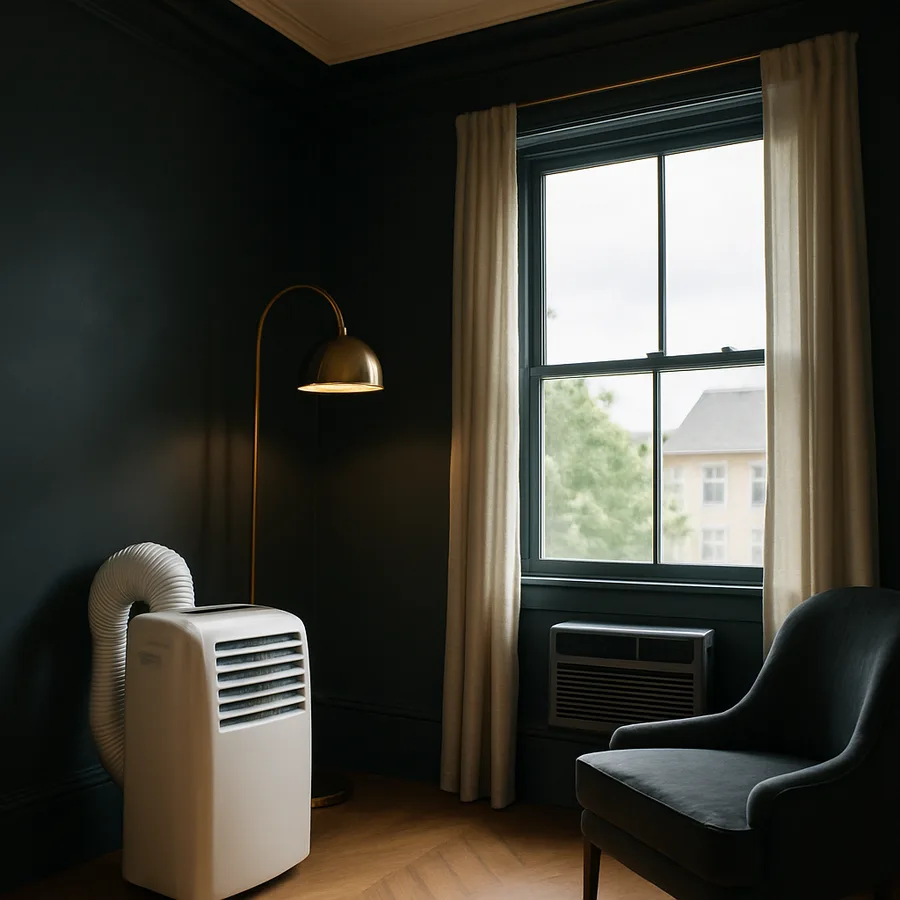
If your lease forbids permanent modifications and your landlord shrugs at central air, you are probably staring down two familiar choices once the thermometer climbs: a rolling portable air conditioner or a boxy window unit. Both promise relief, both plug into a standard outlet, and both come home from the same big-box store. The similarities mostly end there. The two technologies cool rooms in different ways, demand different installation effort, and pull dramatically different amounts of electricity to deliver the same comfort. Choosing the wrong one can mean a hot bedroom, a noisy living room, a security headache, or a summer power bill that feels like a second rent payment.
How Each Unit Actually Cools a Room
A window air conditioner is, mechanically, the simpler machine. The compressor, condenser coil, and hot-side fan all hang outside the window, and only the cold evaporator coil and a small blower point into your apartment. Hot indoor air passes across the cold coil, releases its heat to refrigerant, and that heat is dumped straight outside. A portable unit, by contrast, sits entirely inside the room and reaches outside only through a flexible exhaust hose clamped into a window kit. Because the whole machine lives in the conditioned space, every watt of waste heat the compressor produces has to be pushed back out that hose.
That single architectural difference drives most of the performance gap you will feel. Independent testing by Consumer Reports has consistently found that single-hose portable models cool roughly half as effectively per BTU as comparable window units, because the unit also pulls already-cooled room air and blows it outside through the exhaust, creating a slight negative pressure that sucks hot air in around your doors and trim. Dual-hose portables narrow the gap but still trail window units. So when a portable advertises 12,000 BTU and a window unit advertises 8,000 BTU, the smaller window unit often wins on real-world cooling.
The U.S. Department of Energy notes that proper sizing matters more than chasing the biggest number on the box, and oversizing a unit actually leaves rooms clammy because the compressor short-cycles before it can dehumidify. DOE's room air conditioner guidance recommends roughly 20 BTU per square foot as a baseline, then adjusting up for sunny exposures, high ceilings, and busy kitchens.
Installation, Lease Language, and Landlord Politics
Window air conditioners are the older, heavier, and more politically charged of the two. A 50- to 80-pound metal box wedged into a sash window is a real structural intervention, and many urban leases explicitly ban them, particularly above the first floor. Building codes in cities like New York require approved support brackets, and falling units have caused serious injuries. If your landlord allows them at all, expect to provide your own bracket, foam side panels, and weather sealing. Removing one in October and storing it in a closet is the other half of the chore.
Portables sidestep almost every one of those concerns. The exhaust hose runs through a slim plastic window kit that drops into the existing sash without bolts, brackets, or drilling, and the machine itself sits on caster wheels you can roll to a different room. For renters in high-rises, basement apartments with awning windows, or sliding-door studios where a window unit physically will not fit, the portable is sometimes the only legal option. Have you read the air conditioning clause in your own lease lately? It is surprisingly common to find that window units require written consent while portable units are not addressed at all.
One often-overlooked installation factor is window orientation. Casement and sliding windows that crank outward cannot accept a standard window AC at all, and even some double-hung windows are too narrow for the smallest models. A portable unit's hose, by contrast, will adapt to almost any opening with the right plate, including sliding glass doors when paired with an aftermarket panel.
Efficiency, Energy Use, and the Electric Bill
This is where the comparison gets uncomfortable for portable fans. The ENERGY STAR program rates window units using a Combined Energy Efficiency Ratio (CEER) and portable units using a separate, stricter test procedure that finally accounts for the cooled-air-out-the-hose problem. According to ENERGY STAR program data, certified window units typically deliver a CEER between 12 and 15, while certified portable units rarely break a CEER of 7 to 8. In plain terms, a portable can use nearly double the electricity to remove the same amount of heat from your apartment.
Over a hot summer in a humid climate, that gap is not theoretical. The EPA estimates that air conditioning accounts for about 12 percent of average U.S. home energy expenditures, and the ENERGY STAR room AC product page projects that choosing a certified window model over a non-certified one can save a typical household roughly 70 dollars across the unit's lifetime. For renters running a portable as their only cooling source for ten or twelve hours a day, the differential against a window unit can compound to well over a hundred dollars per season.
Smart features close some of the gap. Both categories now offer Wi-Fi scheduling, occupancy sensors, and variable-speed inverter compressors that ramp gently instead of slamming on and off. Inverter portables in particular have made real efficiency strides in the last three years, though they still cost more upfront. If you plan to keep the unit through several leases, paying extra for an inverter model is usually worth it.
Noise, Comfort, and Living With the Machine
Noise is the dimension renters most often underestimate at the store and most often regret at 2 a.m. A window unit places its loudest component, the compressor, on the far side of the glass, so the indoor sound is mostly fan whoosh in the 50 to 55 decibel range. A portable keeps the compressor in the room, and even quiet inverter models typically measure 52 to 58 decibels on low and climb past 62 on high. That is the difference between background hum and a constant presence in a small bedroom.
Comfort also depends on how the unit distributes air. Window units blow horizontally from a fixed position high in the wall, which works well in rectangular rooms but leaves dead zones around the corners. Portable units sit on the floor, blow upward, and can be rotated to follow you across an open floor plan. If you sleep with the bedroom door closed and the unit cannot reach you, no amount of BTU will solve the problem.
Humidity removal is the quiet third axis of comfort. Both unit types dehumidify as a side effect of cooling, but portables collect that condensate in an internal tank or evaporate it out the hose, and tanks can fill quickly in muggy climates. A unit that shuts itself off every six hours to demand emptying is not the upgrade you were hoping for. Check the drainage method before buying.
Security, Storage, and the Off-Season
A window unit is, by definition, a hole in your security envelope. The side panels are thin accordion plastic, the unit can be pushed inward by a determined person, and ground-floor installations are especially exposed. Renters insurance underwriters do not love them. A portable leaves your window mostly intact, with only a slim kit panel that still allows the sash to be locked closed in the off-season.
Storage cuts the other way. A window unit at 60 pounds is awkward to lift down and stash on a closet shelf, but it occupies relatively little floor space when stored. A portable is lighter, but its footprint, hose, and accessories take up a meaningful corner of a small apartment for nine months of the year. If your storage is a single closet shared with a vacuum and a winter coat, measure twice.
Resale and portability also favor the portable when you move. Window units are sized to a specific opening, often will not fit the next apartment, and are a hassle to transport. A portable just rolls onto a moving truck. For renters who change addresses every year or two, that flexibility alone can justify the efficiency penalty.
Insurance and liability considerations are worth a sentence too. Most renters insurance policies cover personal property inside the unit but not damage to the building, and a window unit that falls or causes water intrusion through improper sealing can produce a claim that the building's policy refuses and your policy excludes. Some buildings now require tenants to sign a separate window-unit addendum acknowledging liability, and a few insurance carriers have begun asking about cooling type at renewal. A portable unit largely sidesteps this exposure because it never leaves the floor.
Choosing the Right Unit for Your Specific Apartment
Start with the constraint, not the catalog. If your lease forbids window units, the decision is made for you and the question becomes which portable, not whether to buy one. If your windows are casement or sliding, same answer. If your landlord allows window units, your windows are standard double-hung, and you can safely install a bracket, the window unit will almost always be cheaper to run, quieter, and more effective per BTU.
Room size is the next filter. For a single bedroom of 150 to 250 square feet, a 5,000 to 8,000 BTU window unit or a 10,000 BTU portable will both do the job. For an open-plan living area over 400 square feet, the math tilts hard toward a larger window unit or, if rules require, a dual-hose portable rather than a single-hose model. The Air-Conditioning, Heating, and Refrigeration Institute (AHRI) publishes capacity certifications that let you verify a manufacturer's BTU claim against independent testing.
Budget should be considered across the full ownership horizon, not just the sticker. A 350-dollar window unit running at CEER 13 will quietly beat a 550-dollar portable running at CEER 7 within two summers in most U.S. climates. But if the portable is the only unit your apartment can legally accept, the comparison is moot. Buy the most efficient portable you can afford, ideally a dual-hose inverter model, and accept that the premium is the cost of renter-friendly cooling. Are you optimizing for the lowest upfront price, the lowest summer bill, or the least friction with your building? Each answer points to a different shelf at the store.
Conclusion
The honest summary is that window air conditioners win on pure performance and efficiency, while portable units win on flexibility and lease compatibility. For a renter, that trade-off is rarely abstract. It is dictated by the specific windows in your apartment, the specific language in your lease, and the specific tolerance your downstairs neighbor has for a compressor humming above their bedroom. Knowing which constraint binds you first, before you start comparing BTU ratings, will save more money and frustration than any spec-sheet research.
If you have flexibility, lean toward a window unit and accept the installation labor as a one-time cost in exchange for lower bills every month it runs. If you do not have flexibility, choose a dual-hose portable with an ENERGY STAR rating and an inverter compressor, and treat the higher purchase price as insurance against a rejected lease addendum. Either way, measure your window before you go shopping, photograph the opening, and bring the dimensions on your phone. Returning a 60-pound air conditioner because it does not fit is a small tragedy that happens every June.
Finally, do not forget the maintenance routine that keeps either unit performing close to its label. Clean or replace the filter monthly during heavy use, vacuum the coils at the start and end of the season, and check the drainage path for clogs before the first humid week. A neglected unit can lose 10 to 15 percent of its capacity within a single summer, according to EPA indoor air quality guidance, and that lost capacity shows up as a hotter apartment and a higher bill. Pick the right machine for your specific apartment this week, install it before the first heat wave, and put a reminder on your calendar to clean the filter the same day you pay rent. Comfort, in a rental, is almost always an act of preparation rather than a purchase.
More Articles You May Like



Comments
Post a Comment