Window Film Privacy Frosted Versus Decorative Pattern Compared
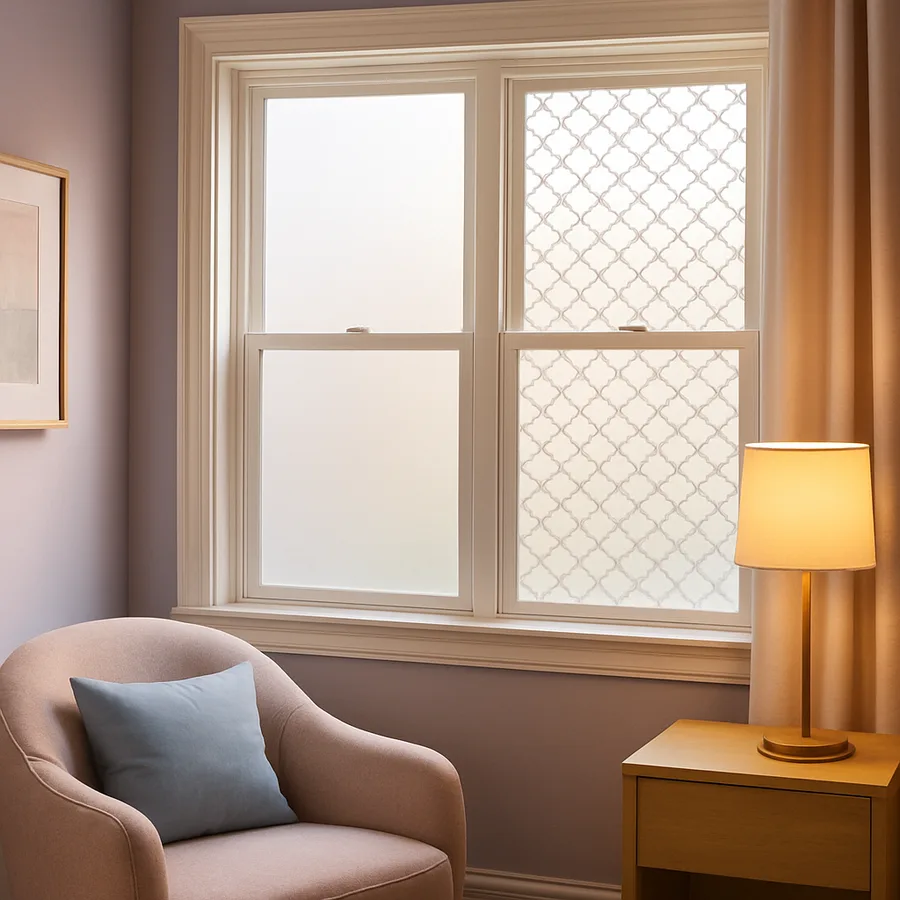
Window film is the most underrated upgrade in the residential design toolkit. For a fraction of the cost of replacing a window or installing custom drapes, a roll of self-adhesive film can convert a clear pane into a privacy surface that still passes daylight, blocks ultraviolet rays, and resists glare. The technology has improved significantly over the past decade, and the two dominant categories - frosted film and decorative pattern film - now serve overlapping but meaningfully different roles in a home.
According to the International Window Film Association, residential film installations have grown at roughly 6% annually over the past five years, driven primarily by demand for street-level privacy in dense urban housing and by homeowners seeking to reduce solar heat gain without darkening rooms. Designers at Better Homes & Gardens have flagged decorative film as one of the highest-impact, lowest-effort upgrades for rentals and starter homes specifically because it is removable and lease-friendly.
What Frosted Film Actually Is And How It Works
Frosted film is a thin polyester layer with a microscopically textured matte surface that scatters light as it passes through. The eye reads the result as a continuous, even haze that obscures details but transmits roughly 70 to 85% of the visible light from the other side. Standard residential frosted films are between 4 and 8 mils thick (a mil being one thousandth of an inch); thicker films are more durable but slightly harder to install without trapping bubbles.
The privacy effect is one-directional in a limited sense. From the inside looking out, silhouettes and large shapes are barely visible; from the outside looking in, the film reads as opaque white glass during the day. At night, with interior lights on and the outside dark, the film becomes more translucent and silhouettes can show through, particularly within three feet of the glass. Plan window film installations alongside curtains or blinds for nighttime privacy in bathrooms, bedrooms, and ground-floor street-facing rooms.
Frosted film comes in two main installation styles: adhesive film, which is applied wet with a soapy water solution and squeegeed flat, bonding permanently or semi-permanently to the glass; and static cling film, which uses surface tension to hold without adhesive and peels off cleanly. Adhesive films last longer (often 10 to 15 years) and resist edge lifting better; static films are renter-friendly but generally need replacement every two to four years.
What Decorative Pattern Film Offers Beyond Privacy
Decorative film extends the same base technology into the realm of visual design. Instead of a uniform frost, the film carries a printed or etched pattern: geometric grids, botanical motifs, stained-glass effects, frosted bands, gradient fades, and increasingly, custom designs printed to order. The pattern provides privacy in roughly the same way frosted film does, but it also turns the window into a piece of intentional decor.
Pattern selection matters more than people anticipate. Dense patterns with small repeating elements - fine grids, small dots, tight botanical motifs - produce a privacy effect close to true frosted while still adding visual texture. Sparse patterns with large open areas - widely spaced stripes, scattered geometric shapes - preserve more outward visibility but offer less privacy from the street. For bathrooms and street-facing bedrooms, choose a dense pattern; for transom windows and decorative interior glass, sparse patterns work beautifully.
The category has expanded dramatically since the early 2010s. Architectural Digest has featured residential applications using custom-printed films that mimic etched glass, fluted glass, and even reeded glass - finishes that would cost ten to twenty times as much to achieve with actual specialty glazing. For period homes, decorative films can simulate Victorian stained glass or Art Deco geometric patterns without replacing the original window assembly.
Performance Comparison: Privacy, Light, And Solar Control
On pure privacy, frosted film usually wins by a small margin. The continuous matte surface obscures more detail than any pattern, and the privacy is consistent regardless of viewing angle. Decorative patterns with dense, fine details come close, but very sparse or large-element patterns leave gaps where silhouettes can be discerned. If absolute privacy is the goal - for a ground-floor bathroom window directly facing a sidewalk, for example - frosted film is the safer choice.
On light transmission, both perform similarly. Standard frosted films transmit 70 to 85% of visible light; decorative films range from 60 to 80% depending on pattern density. Both dramatically outperform curtains and blinds, which often block 60 to 100% of incoming light when drawn. The ability to maintain daylight while gaining privacy is the single most compelling argument for film over fabric in any application.
On solar control, the categories differ. Many frosted films include UV-blocking layers that filter 95 to 99% of ultraviolet radiation, which protects furniture, art, and flooring from fading. Higher-end frosted films also include solar heat-rejection layers that reduce summer cooling loads by 10 to 30%. Decorative pattern films traditionally focused on aesthetics over solar performance, but newer products combine both. Two stats worth knowing: the U.S. Department of Energy estimates that solar films can reduce summer cooling costs by up to 30% in sun-exposed windows, and the International Window Film Association notes that high-quality residential films can extend furniture and flooring lifespan by blocking the UV that causes most fade damage. Have you measured how much your sun-facing rooms heat up between 2 and 5 p.m. in summer?
Installation: DIY Versus Professional
Both frosted and decorative films are within reach of a careful DIY installer for windows up to approximately 30 inches wide by 60 inches tall. The technique is straightforward: clean the glass meticulously, spray it with a slip solution of water and a few drops of baby shampoo, apply the film, squeegee out bubbles working from the center outward, trim the edges with a sharp blade. Total time for a competent first-time installer is roughly 30 to 45 minutes per window.
Above 30 inches wide, professional installation becomes worthwhile. Larger panels are harder to keep flat during application, and trapped bubbles in big sheets are much more noticeable and harder to chase out. Professional installers also have access to commercial-grade films that often outperform retail products and frequently come with longer warranties - typically 10 to 15 years for residential applications versus 3 to 5 years for DIY products.
Cost ranges vary widely. Retail frosted film runs $1 to $3 per square foot; mid-range decorative films run $3 to $8 per square foot; custom-printed and architectural-grade films can run $10 to $25 per square foot. Professional installation typically adds $3 to $8 per square foot in labor. For a standard 3-by-5-foot bathroom window, expect total cost between $30 (DIY frosted) and $200 (professional decorative custom).
Best Rooms And Use Cases For Each Type
Frosted film excels in bathrooms, ground-floor bedrooms facing public sidewalks, garage windows where contents need to be hidden, home office windows directly facing neighbors, and any glass partition where consistent privacy with maximum light is the goal. It also works well as a permanent solution because the appearance is timeless and unlikely to look dated a decade from now.
Decorative pattern film shines in entry sidelights, kitchen pantries, glass closet doors, transom windows above doors, glass cabinet fronts, French door panels where light transmission with style is desired, and home office or den glass walls where pattern adds personality. Patterns that mimic etched or fluted glass are particularly popular because they evoke higher-end architectural finishes at film prices.
For street-facing living rooms, a hybrid approach often wins: a band of frosted or decorative film along the bottom 30 to 40 inches of the window (the seated sightline from outside) leaves the upper portion clear for unobstructed views of trees and sky. This is sometimes called a privacy band and is widely featured in House Beautiful ground-floor window treatments. The effect preserves daylight and view while eliminating the gaze of passersby.
Durability, Cleaning, And Long-Term Performance
Quality film should last 10 to 15 years on residential applications with minimal maintenance. The most common failure mode is edge lifting in high-humidity bathrooms where the seal between film and glass eventually weakens; using a film specifically rated for wet environments largely solves this. The second common issue is fading or yellowing of low-cost films exposed to direct south-facing sun; UV-stabilized films from reputable manufacturers do not yellow noticeably over their warranty period.
Cleaning is gentler than for bare glass. Use a soft microfiber cloth and a mild solution of water with a few drops of dish soap or a 50/50 water and white vinegar mix. Avoid ammonia-based glass cleaners (most blue spray cleaners), abrasive pads, and razor blades. Squeegee streaks usually clear after a single wipe with a dry microfiber cloth. Total cleaning time is roughly the same as cleaning the glass itself; the film does not significantly increase maintenance burden.
Removal, when the time comes, is straightforward. Adhesive films lift away after the corner is loosened with a fingernail or plastic scraper; residue is cleaned with isopropyl alcohol or a citrus-based adhesive remover. Static cling films peel off in a single sheet. Most removals take under 20 minutes per window, which means film is a low-risk experiment - if a pattern does not work or tastes change in five years, replacing it is a half-day project rather than a renovation.
Conclusion
Frosted film and decorative pattern film solve the same fundamental problem - privacy without losing daylight - but they solve it for different rooms and different temperaments. Frosted is quieter, more permanent-feeling, and more uniformly private. Decorative is more expressive, more architectural, and turns a functional upgrade into a design moment. Both significantly outperform curtains and blinds for daylight retention, and both cost a small fraction of replacement window or specialty glass.
For most households, the right answer is a mix. Frosted in the bathroom and any window where pure privacy is the only goal; decorative in entry sidelights, glass doors, and rooms where pattern adds personality. This room-by-room approach keeps the home from looking like a commercial office where every window has the same matte finish, while still capturing the privacy benefits everywhere they are needed.
Quality matters more than category. A cheap decorative film will bubble, yellow, and peel within two years; a high-quality frosted film from a reputable manufacturer will look exactly the same a decade after installation. Spend slightly more for branded films with long warranties and UV stabilization, especially on south-facing and west-facing windows that take the worst sun exposure. The cost premium is small and the longevity payoff is substantial.
A few additional considerations are worth flagging before the final commitment. First, check whether your windows are dual-pane and gas-filled before applying any solar-control film; certain dark or highly reflective films can cause thermal stress that voids manufacturer warranties on insulated glass units. Reputable film brands publish compatibility charts, and many will void their own warranty if applied to incompatible glazing. Second, factor in the orientation of the room: a north-facing window benefits less from solar-control film than a west-facing one, and the pattern you love in a sunny showroom may read differently against the cooler, less directional light of a north exposure. Third, remember that homeowners associations and historic-district overlays sometimes regulate the appearance of exterior-visible window treatments, including films; a five-minute call to the relevant authority is cheaper than removing a fully installed film. None of these caveats should deter the project, but each prevents a small mistake from becoming an expensive one.
Ready to try film? Pick one window this weekend, measure it carefully on all four sides, and order a sample of both frosted and at least one decorative pattern from a reputable supplier with a clear return policy. Live with both for a few days, observing how each looks at morning, midday, and evening light, before committing to the rest of the house. Subscribe to Interior Bliss for more practical, room-by-room design guides delivered weekly, and share this article with anyone whose ground-floor windows have been covered with bedsheets, butcher paper, or hastily hung curtains for too long.
More Articles You May Like



Comments
Post a Comment