
Tankless Water Heater Sizing For Whole Home Demand
Tankless Water Heater Sizing For Whole Home Demand
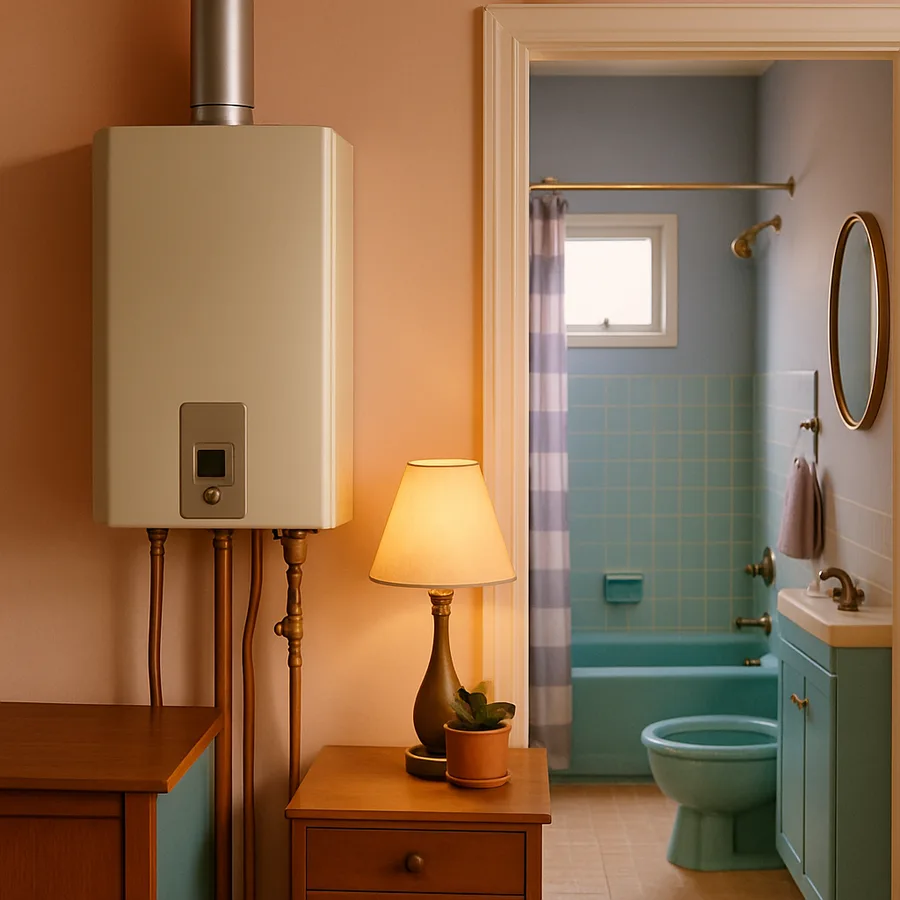
A tankless water heater that is correctly sized feels like magic the first time you run a shower and the dishwasher at once and nothing flinches. A tankless unit that is undersized, by contrast, will give the cold-water sandwich its name, drop your shower to lukewarm whenever the kitchen sink opens, and frustrate everyone in the household within a week. Unlike a storage tank, which buys you time with a reservoir of pre-heated water, a tankless water heater must heat every gallon at the exact moment of use. Sizing is therefore not a casual decision. It is the single most important specification you choose, and getting it wrong is expensive to correct after the unit is mounted on the wall.
Why Tank Sizing Logic Does Not Apply
If you have ever replaced a storage water heater, you know the drill: count bedrooms, pick 40, 50, or 75 gallons, and move on. That heuristic is useless for tankless units because there is no reservoir. A tankless heater is rated by two numbers, gallons per minute (GPM) of hot water output and the temperature rise it can deliver at that flow. The unit has to satisfy your peak simultaneous demand at your local groundwater temperature, all in real time, all without storing a drop.
This means the same model that works perfectly in Phoenix may struggle in Minneapolis, because incoming groundwater in winter can be 35 degrees colder. The U.S. Department of Energy notes that tankless heaters typically deliver 2 to 5 GPM of hot water output, and the actual number on any given day depends on how cold the water is when it arrives. DOE's guidance on demand-type water heaters recommends sizing for the simultaneous peak rather than total daily usage, which is the opposite of how tank heaters are sized.
Have you ever counted how many hot-water taps your household actually opens at the same time on a busy morning? Most people guess one or two. The honest answer in a family of four is often three or four: a shower upstairs, a kitchen sink rinsing breakfast plates, a bathroom sink for someone brushing teeth, and a washing machine starting a load. That is the number you must design for.
Calculating Peak Simultaneous GPM Demand
Begin by listing every hot-water fixture in the house and writing its typical flow rate next to it. Standard figures used by plumbing engineers and confirmed by the EPA WaterSense program are: a low-flow showerhead at 1.8 to 2.0 GPM, a kitchen faucet at 1.5 to 2.2 GPM, a bathroom faucet at 1.0 to 1.5 GPM, a dishwasher at roughly 1.0 GPM during fill cycles, a clothes washer at 1.5 to 2.5 GPM, and a tub filler at 4.0 GPM or higher. Older fixtures predating WaterSense can run 50 percent higher than these numbers.
Next, build a realistic worst-case scenario. Walk through a weekday morning. If two showers, a kitchen faucet, and a dishwasher all run at the same time, your peak demand might be 2.0 + 2.0 + 1.5 + 1.0 = 6.5 GPM. That is the GPM your tankless heater must deliver, and it must deliver it at a sufficient temperature rise. Per the EPA WaterSense fixture standards, choosing certified low-flow fixtures can shave that peak demand significantly, which directly reduces the size and cost of the tankless unit you need.
One useful rule of thumb from the Plumbing-Heating-Cooling Contractors Association (PHCC): multiply your fixture count by 0.7 to estimate realistic peak rather than theoretical maximum. A house with eight hot-water fixtures rarely has all eight running at once, so the 0.7 diversity factor prevents you from buying a comically oversized unit. For most three- and four-bedroom homes, peak simultaneous demand lands between 5 and 8 GPM.
Temperature Rise and Your Local Groundwater
Temperature rise is the second half of the sizing equation and the part homeowners most often skip. A tankless heater rated "9.5 GPM" delivers that flow only at a specific temperature rise, usually 35 degrees. Ask it to raise water 70 degrees instead and the deliverable flow drops, sometimes by half. Manufacturers publish a flow-versus-rise chart for every model, and reading that chart is non-negotiable.
Your local groundwater temperature is the starting point. The USGS publishes regional groundwater temperature data, and the American Society of Plumbing Engineers (ASPE) consolidates it into design tables. Roughly speaking, the southern third of the U.S. sees groundwater in the 65 to 75 degree range year-round, the middle third in the 50 to 60 degree range, and the northern tier in the 35 to 45 degree range during winter. Most households set their hot water at 120 degrees per OSHA and CDC scald-prevention guidance.
So a household in Minneapolis with 40-degree winter groundwater wanting 120-degree taps needs an 80-degree rise, while a Houston household with 70-degree groundwater needs only a 50-degree rise. The same family with the same fixtures will need a substantially larger unit in Minneapolis. This is the single most common sizing failure: a homeowner reads "9.5 GPM" on the box, installs it in a cold climate, and discovers it delivers only 5 GPM when the snow flies.
Gas, Electric, and the Limits of Each Fuel
Fuel choice constrains how much heat you can put into the water in a given second. Whole-home gas tankless units, both natural gas and propane, can produce 180,000 to 199,000 BTU of input, enough to support 7 to 11 GPM at moderate temperature rises. They require either a dedicated 3/4-inch or larger gas line and a Category III stainless or PVC vent path approved per IAPMO Uniform Plumbing Code and the manufacturer's listing.
Whole-home electric tankless units exist but face hard physical limits. Producing 6 GPM at a 70-degree rise requires roughly 27 kilowatts, which translates to about 113 amps at 240 volts. That is more than the total service of many older homes. The NFPA 70 National Electrical Code requires service capacity calculations that account for this load, and in many retrofits the cost of upgrading the electrical service exceeds the cost of the heater itself. For most whole-home applications in cold climates, gas remains the more practical fuel.
Heat pump tankless models, often called hybrid demand heaters, have begun entering the U.S. market in the last two years but currently top out at flow rates suitable for small apartments rather than whole houses. They will be worth revisiting as the technology matures. For now, gas wins on capacity and electric wins only in warm climates or for point-of-use applications like a remote bathroom.
Venting, Gas Supply, and Hidden Costs
The unit itself is often less than half the installation cost, and the sizing decision drives the rest. A high-BTU gas tankless requires a properly sized gas line all the way back to the meter. The International Fuel Gas Code tables specify pipe diameter by BTU load and pipe run, and a 199,000 BTU unit at the end of an old 1/2-inch line will starve under load. Many installations require upsizing to 3/4-inch or even 1-inch black pipe, plus a new pressure regulator.
Venting adds further cost. Direct-vent condensing models can use 3-inch PVC and exit through a sidewall, dramatically simplifying retrofits. Non-condensing models require stainless Category III vent that costs four to six times as much per foot. ENERGY STAR certifies condensing tankless models at thermal efficiencies above 0.90, compared to about 0.82 for non-condensing, and the fuel savings typically pay back the price premium within five to seven years for an active household.
Make-up air is the quiet third cost. A high-BTU appliance pulling combustion air from a tight modern utility closet can starve itself or, worse, depressurize the space and back-draft other appliances. The NFPA 54 National Fuel Gas Code specifies minimum combustion air openings, and many installations now use sealed-combustion units that pull air directly from outside through a concentric vent. Specify this at sizing time, not after the unit is mounted.
Recirculation, Multiple Units, and Cascading
For larger homes, especially those over 3,000 square feet or with bathrooms more than 50 feet from the heater, a single tankless unit can technically meet flow demand but still deliver hot water slowly. Recirculation solves this. Some tankless models include a built-in recirculation pump and a learning timer that primes the line before peak-demand windows, cutting wait time at distant taps from 90 seconds to under 10.
For very large homes or households with multiple simultaneous shower events, cascading two or more tankless units in parallel is increasingly common. The units share a control bus, fire in sequence, and present as a single virtual heater to the plumbing system. This approach exceeds the capacity of any single residential model and provides redundancy: if one unit faults, the other carries the load at reduced capacity rather than shutting the house down. The WQA (Water Quality Association) and NSF International both publish guidance on integrating tankless systems with whole-house water treatment and softening, which becomes important in hard-water regions where scale shortens heater life.
Are you planning to add a hot tub, a second laundry room, or an in-law suite within the next five years? Size for that future demand now, or at minimum, pre-plumb for a second cascaded unit. Adding capacity later costs roughly double what it costs to specify correctly during the original installation.
Water quality is the other lever that quietly determines how long your sized capacity actually lasts. Hard water deposits scale on the heat exchanger of every tankless model, narrowing internal passages and forcing the unit to fire harder to maintain flow. Most manufacturers void or limit warranty coverage above 7 grains per gallon of hardness, and a softener or scale-inhibiting filter upstream is mandatory in much of the country. Annual descaling with a vinegar or commercial citric-acid flush through the service valves is a 30-minute task that can add a decade to the heat exchanger's life. Skip it in hard water and your perfectly sized unit will deliver progressively less of its rated GPM each year, until at some point it no longer meets the peak demand you designed for, even though the spec sheet has not changed at all.
Conclusion
Sizing a tankless water heater for whole-home demand is fundamentally an exercise in honesty about how your household actually uses water, paired with an accurate read on your local climate and fuel infrastructure. The math is not complicated, but skipping any piece of it produces the same disappointing result: a unit that looked great on the box and underperforms on the busiest morning of the week. Walk the house, count the fixtures, identify the worst-case simultaneous scenario, and apply a realistic diversity factor before you ever open a manufacturer catalog.
Once you know your peak GPM, look up your groundwater temperature, calculate the required rise to a 120-degree setpoint, and read the manufacturer's flow-versus-rise chart at that rise, not the headline number on the front of the box. From there, fuel choice is usually obvious: gas for whole-home in any climate that sees cold groundwater, electric only for warm climates or point-of-use, and condensing over non-condensing whenever your venting path allows. Budget for the supporting work, gas line upsizing, venting, combustion air, and recirculation, because those line items often equal or exceed the cost of the heater.
If your peak demand exceeds what a single residential unit can deliver, do not force a marginal sizing decision. Cascade two units instead and gain both capacity and redundancy. The incremental cost at installation is modest compared to retrofitting a second unit five years later when the household has grown.
Before you sign a quote, ask your installer to show you the GPM calculation, the temperature-rise chart for the proposed model, the gas-line sizing worksheet, and the vent-path schematic, all on paper. Any contractor who hesitates at that request is not the contractor you want on a 25-year appliance. A correctly sized tankless heater is one of the most satisfying upgrades a home can make. An incorrectly sized one is a daily annoyance for the life of the unit, and the difference between those two outcomes is a single afternoon of careful arithmetic before purchase.


Comments
Post a Comment