Outdoor Cushion Storage Bench Or Deck Box Comparison
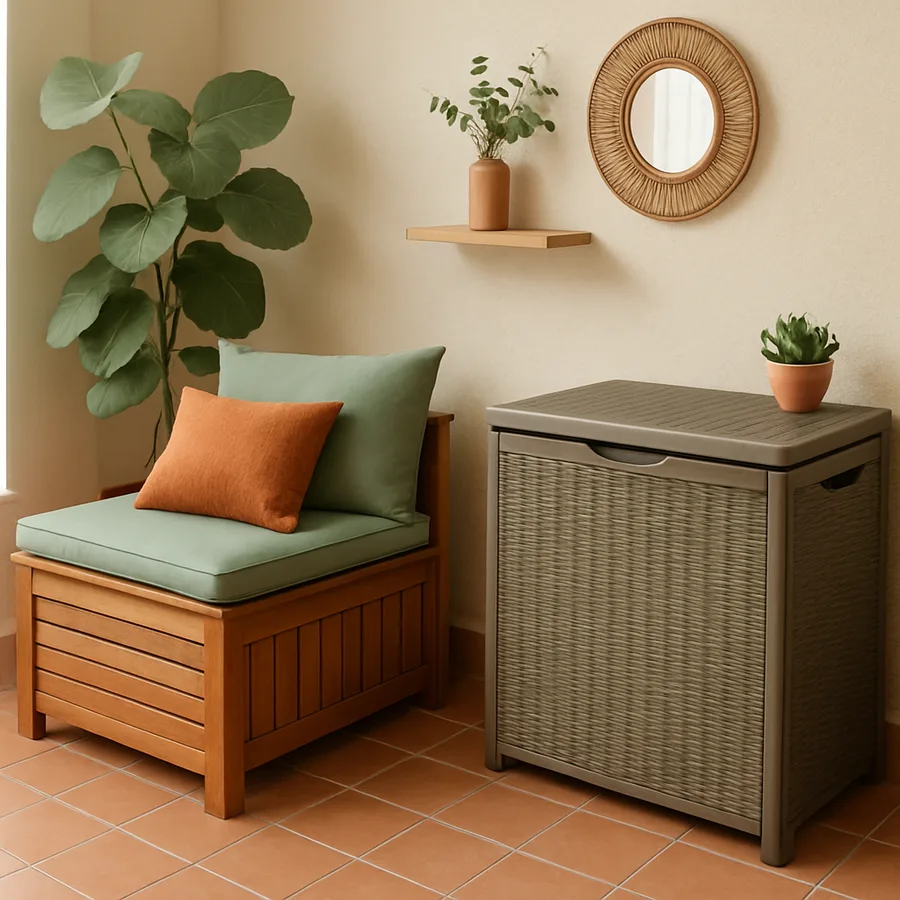
Every outdoor living space hits the same crossroads eventually: you have accumulated a beautiful collection of throw pillows, lounge cushions, picnic blankets, and pool toys, and you have nowhere sensible to put them between uses. The decision usually narrows to two options - a storage bench that doubles as additional seating, or a dedicated deck box built purely for capacity. They sound similar. They are not. Choosing the wrong one means either constant frustration with overflowing storage or wasted floor area on a piece that does too little.
This comparison breaks down the real-world tradeoffs across capacity, construction, weatherproofing, dual-function value, and longevity. By the end you should be able to walk into a showroom or browse a catalog and know within thirty seconds which category - and which feature set within that category - fits your space.
Capacity And Dimensions In Honest Numbers
The single most misleading specification in this category is "storage capacity in gallons." Marketing language has settled on this metric because it produces large-sounding numbers, but a gallon of liquid does not behave like a folded cushion. A deck box advertised at 150 gallons might hold only four to six standard 24-inch chair cushions because cushions resist compression and waste interior volume at corners.
Translate gallons to a more useful unit: how many of your specific cushions and accessories actually fit. For planning purposes, a typical dining chair cushion occupies roughly 8 to 12 gallons of effective storage. A deep-seat lounge cushion can occupy 15 to 25 gallons. A folded outdoor blanket adds 5 to 10. With those benchmarks in mind, a 150-gallon deck box realistically stores six to eight chair cushions plus a few accessories, not the dozen the marketing copy might imply.
Storage benches generally offer less interior volume than freestanding deck boxes because the seating surface, backrest support structure, and ergonomic seat depth all consume space that a pure storage box would use. Expect a typical 4-foot storage bench to provide 50 to 80 gallons of usable volume, compared to 100 to 200 gallons for a similarly sized deck box. If your primary need is sheer capacity, the deck box wins decisively.
Depth and reach also matter more than the gallon spec suggests. A deep deck box with a small lid opening can become a black hole where items at the bottom are functionally lost - too inconvenient to retrieve, then forgotten until next spring. The best designs in either category use either a full-width lifting lid or front-access doors that let you see the entire interior at a glance and reach every corner without climbing partway in. When evaluating a unit in person, open the lid and try to imagine retrieving a folded blanket from the back corner; if that motion feels awkward, daily use will be a frustration.
Materials And Long-Term Weather Performance
Both categories are sold in roughly the same material families, but each material behaves differently depending on whether it is supporting weight (bench) or simply containing contents (box).
Resin and high-density polyethylene (HDPE) dominate the value tier in both categories. These plastics are weatherproof by nature, do not require sealing, and shrug off rain. The downside is structural: cheap resin warps under sustained heat or load, and a bench that flexes when you sit on it telegraphs that flex into the lid seal, eventually breaking the weather seal. Look for double-wall construction and reinforced steel hinges, especially on benches.
Treated wood and cedar deliver the most attractive aesthetic and the best feel underfoot. Cedar and teak have natural rot resistance; pressure-treated pine is more affordable but requires annual sealing in wet climates. Wooden boxes and benches breathe better than plastic, which reduces interior mildew, but the same breathability means cushions inside are not fully sealed from humidity. The American Home Furnishings Alliance publishes care standards for outdoor wood furniture that are equally applicable to storage pieces.
Metal - usually powder-coated steel or aluminum - produces the most rigid, longest-lasting frame, and is the dominant material for premium benches with internal storage. Aluminum resists rust entirely; steel benefits from a quality powder coat but will telegraph rust at any chipped point within a few seasons in damp climates.
Wicker, both natural and synthetic, appears mostly in the bench category. All-weather synthetic resin wicker over an aluminum frame holds up well; natural rattan and unprotected wicker fail rapidly outdoors and should be considered indoor-only despite occasional marketing claims.
Hardware quality is the differentiator that most shoppers overlook. The hinges, gas struts, and latches on a storage piece take more punishment than any other component. A gas strut that loses pressure means the lid no longer holds itself open, which means cushions get crushed when the lid drops unexpectedly during loading. A hinge with insufficient corrosion protection seizes after a winter or two and the lid becomes a one-person fight. Specify stainless or zinc-plated hinges with replaceable pins, and gas struts rated for the lid's actual weight with a usage cycle count in the tens of thousands.
Drainage Architecture Inside The Box
This is the spec that separates storage solutions that protect cushions from those that ruin them. A sealed, fully waterproof interior sounds appealing until you store a slightly damp cushion in one - the trapped moisture has nowhere to go, and mildew blooms within weeks.
The best storage benches and deck boxes feature one of three drainage strategies:
- Vented floor design: small drainage holes in the bottom panel let any infiltrating water exit and allow passive air circulation. This is the simplest and most reliable approach.
- Elevated interior platform: a perforated false floor lifts cushions an inch or two above the actual base, so even if water enters, the cushions never sit in it.
- Active ventilation gaps: deliberate small gaps near the lid hinge or under the bottom rail that allow air exchange without admitting driving rain.
Premium models combine all three. Budget models often omit drainage entirely in the belief that "fully sealed" is a selling point, when in reality it is a design defect for any environment where humidity exists.
An inexpensive but underrated upgrade for either category is a moisture-absorbing accessory inside the storage cavity. A small breathable bag of activated charcoal, silica gel, or calcium chloride absorbs ambient humidity through the off-season and dramatically reduces the risk of mildew on cushions stored long-term. Replace or recharge these absorbers at the start of each storage cycle. Combined with proper drainage, this small habit closes the moisture loop almost entirely.
Before you buy, ask yourself: where will rain go if some inevitably gets in? If the answer is "nowhere," keep shopping.
Seating Function Tradeoffs With Benches
The headline advantage of a storage bench is that it provides seating, doubling the value of the floor space it occupies. In a small balcony or compact courtyard where every square foot matters, this dual function is decisive. A 4-foot bench gives you a place for two adults to sit and stores cushions inside - a deck box of the same footprint stores more but seats no one.
The hidden cost of the bench's seating function is structural. Every time someone sits down, the lid (which doubles as the seat) flexes downward and the seal stresses. Cheap benches develop a sag in the seat panel within two seasons, and the seal begins to leak. Higher-quality benches use a thick, reinforced lid with internal cross-bracing that distributes weight, but you pay for it: expect to spend 50 to 100 percent more for a storage bench rated for daily seating use than for a comparable storage-only deck box.
Comfort is another tradeoff. A storage bench typically does not allow for a backrest cushion in storage position, because the cushion would have to be moved every time someone wanted to access the storage. As a result, bench seating tends to be casual and short-duration - fine for putting on shoes or watching a sunset, less ideal for an hour-long conversation.
Aesthetic Integration And Curb Appeal
Storage benches generally read as furniture: they belong in the visual conversation of the outdoor room, alongside the dining set or sofa group. A well-chosen bench in matching material or complementary tone can elevate a space the same way a console table elevates an entry hall.
Deck boxes, by contrast, read as utility. The best deck boxes are visually quiet - neutral colors, simple forms, designed to recede. Place a deck box prominently in a refined patio and it announces "storage" with the same subtlety as a garden hose reel. Place it behind a planter, beside a screened utility wall, or tucked under a stair, and it disappears.
This is where many homeowners get the choice wrong. They buy a deck box for its capacity, place it in the center of a beautiful patio, and the box becomes the visual focal point. The right placement strategy is to map your patio first - identify the area that will be seen most often and from the most vantage points - and then decide whether a piece in that location should look like furniture (bench) or whether storage can move to a secondary, less-visible location (box).
The publication Architectural Digest has covered the rise of integrated outdoor storage as part of broader trends toward refined outdoor rooms; the underlying lesson is consistent - visible storage should be furniture-grade, hidden storage can prioritize capacity.
Total Cost Of Ownership And When To Choose Which
Pricing in this category varies widely. A serviceable resin deck box runs $150 to $300. A premium HDPE or wood deck box ranges $400 to $900. Storage benches start higher: $300 to $500 for entry-level resin, $700 to $1,500 for quality wood or wicker-over-aluminum, and well beyond $2,000 for designer or built-in installations.
Industry data summarized by the National Association of Home Builders places outdoor storage solutions among the higher-ROI accessory purchases for homes with active outdoor living spaces, particularly in regions where seasonality drives frequent cushion movement. The return is largely indirect - protected cushions last two to four times longer, postponing replacement of $80 to $300 cushion sets.
Use this decision framework:
- Choose a storage bench when floor space is constrained, when you need additional casual seating, when visual integration matters, and when storage volume needs are modest (one set of dining cushions, blankets, accessories).
- Choose a deck box when capacity is the dominant requirement, when you have a secondary location that can hide the box, when you store bulky items like deep-seat cushions or pool gear, and when you want to invest more dollars in protective volume rather than seat construction.
- Choose both in larger patios - a visible bench for daily-access items and a discreet deck box in a secondary zone for bulk and off-season storage.
Conclusion
The choice between a storage bench and a deck box is rarely a close call once you frame the question correctly. Ask first whether your outdoor space needs more seating, then whether the chosen location is a primary visual zone, then how much storage volume you actually require in honest cushion-count terms. The answers reliably point to one solution or the other.
What separates a satisfying purchase from a regrettable one is matching the construction quality to your climate and use frequency. A flimsy resin piece in a wet, windy environment will fail in a single season regardless of which category it falls into. A well-built bench or box in any material lasts a decade with minimal maintenance, protects hundreds of dollars of cushions, and either adds seating capacity or removes visual clutter - sometimes both, in the same patio, with two complementary pieces.
Take the time this week to measure your space, count your cushions honestly, and identify your dominant placement zone. Then commit to the spec sheet: double-wall construction, reinforced hinges, drainage architecture, and weather-rated hardware. Buy once, buy correctly, and let the storage solution disappear into the rhythm of your outdoor seasons rather than becoming an annual frustration. A small investment in clarity tonight pays dividends every spring and fall for as long as you live in your home.
More Articles You May Like



Comments
Post a Comment