
Bellows And Poker Set Display Versus Hidden Storage
Bellows And Poker Set Display Versus Hidden Storage
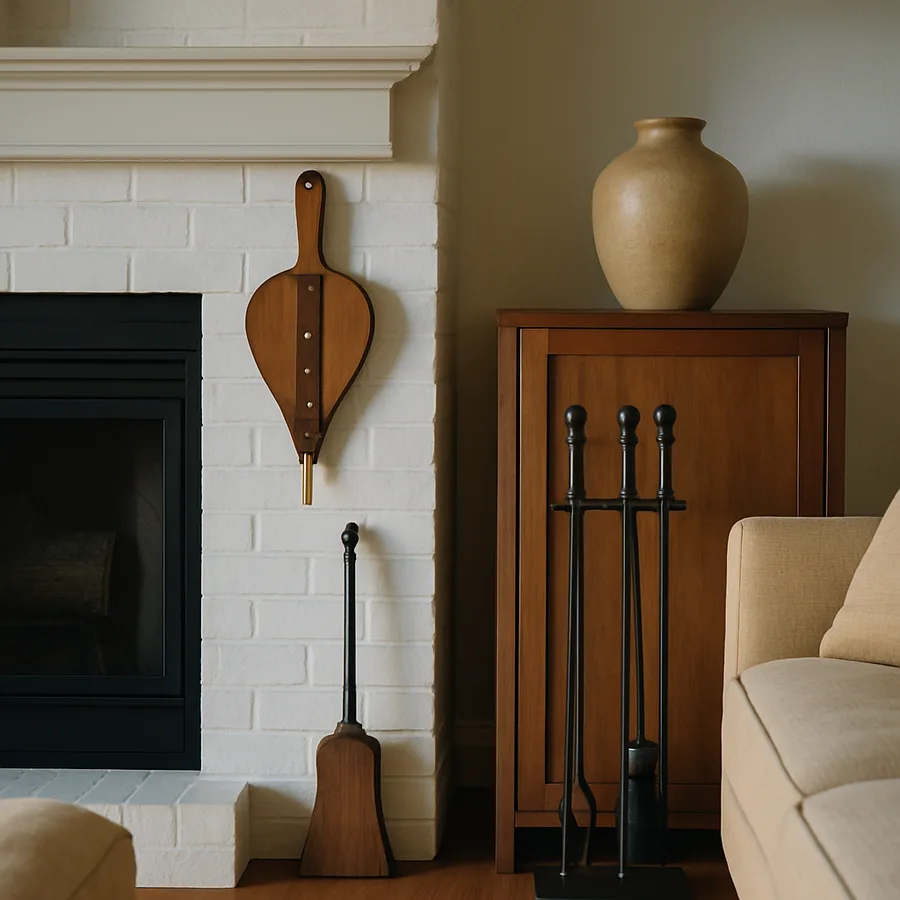
Few decisions in a hearth-centered room provoke as much quiet debate as where to keep your fireplace tools. On one side sits the timeless image of a brass bellows hanging beside the mantel and a wrought-iron poker set standing in a sculpted stand. On the other sits a clean, minimalist room where every tool tucks neatly into a concealed cabinet, drawer, or built-in niche. Both approaches can be done beautifully, and both can be done badly. The right answer depends on how often you light fires, who lives in the home, and the broader visual story you want your living room to tell.
According to the Hearth, Patio & Barbecue Association, roughly 74% of homeowners with a working fireplace use it at least once a week during the heating season, a figure that has stayed remarkably steady across the last decade. That kind of regular use changes the equation: tools you reach for every other evening behave very differently from ornaments dusted twice a year. Before deciding between display and concealment, it helps to look honestly at frequency, family composition, room style, and the maintenance reality of soot, ash, and creosote dust.
The Case For Open Display Of Fireplace Tools
Displayed tools are, first and foremost, decorative. A well-made fireplace tool set can read like sculpture, especially when the finish complements the mantel hardware, the andirons, and the wall sconces nearby. Hand-forged iron with a hammered texture, polished brass with a satin patina, or matte black powder-coat all signal a different mood, and each can anchor a room when staged thoughtfully. Designers often treat the tool stand as a deliberate accent piece, on par with a vase or a small chair.
Practically speaking, displayed tools are also faster to reach. If you lay a fire on a cold Tuesday evening, you do not want to crouch and open a cabinet to find the poker. A stand placed a comfortable arm's length from the firebox keeps the workflow intuitive: light, prod, adjust, sweep, and rest the tool back in its hook. That fluidity matters more than people expect, because friction in the routine is one of the quiet reasons homeowners stop using their fireplaces.
Displayed sets also tell guests something about the home. Have you ever walked into a room with a working hearth and immediately registered that the family actually uses it? The tools are usually the giveaway. A clean stand with no soot at all reads as staged, while a stand with a lightly dusted poker and a slightly darkened brush reads as lived-in. Both signals are valid; the question is which one you want the room to send.
The Case For Hidden Storage Of Fireplace Tools
Concealed storage, by contrast, prioritizes visual calm. In contemporary interiors, where mantels are often deliberately spare and the firebox itself is the focal point, a freestanding tool set can feel like clutter no matter how beautiful it is. Built-in cabinetry beside the chimney breast, a hinged hearthside bench, or a drawer integrated into a custom surround all let the architecture stay quiet. The fire becomes the only moving thing in the room, which is exactly the effect modern designers chase.
Hidden storage also helps with cleaning. Ash drifts. Even a tightly sealed firebox releases fine particulate during loading, stoking, and tending, and any tool standing in the open will collect a film of dust that combines with airborne moisture into a sticky residue. A 2024 indoor air quality brief from the U.S. Environmental Protection Agency noted that wood-burning appliances are a meaningful source of fine particulate inside the home, and that surfaces near the hearth accumulate measurable deposits over a single heating season. Tools tucked behind a door collect far less of that residue.
EPA Burn Wise guidance reinforces that ash management and tool hygiene are part of safe operation, not just aesthetics. If anyone in the household has asthma or environmental allergies, the case for concealed storage becomes stronger, because every wiped surface is one fewer reservoir of irritant. Have you noticed how often the brush on an open stand looks gray rather than black? That gray is mostly dust from the room, not ash from the fire.
Safety Considerations With Children And Pets
This is where the debate stops being about taste and starts being about responsibility. A poker is, by design, a long metal rod with a sharpened hook on one end. A shovel has an edge. Tongs have pinch points. The National Fire Protection Association repeatedly emphasizes in its home heating safety materials that any tool kept near a hearth should be considered as part of the overall fire safety plan, not as a separate decorative decision.
If toddlers, curious pets, or guests' children move through the room regularly, an open stand is a genuine hazard. A poker tipping out of a stand onto a small foot is a real emergency-room visit, and a child swinging a bellows into a glass door panel can shatter ceramic glass that costs hundreds of dollars to replace. Hidden storage, especially with a soft-close drawer or a magnetic catch the child cannot easily defeat, removes the temptation entirely.
For households without small children, the calculus shifts. A stable, weighted stand with deep tool wells, placed at least 18 inches from the nearest seat, typically poses minimal day-to-day risk. The Chimney Safety Institute of America recommends that homeowners walk the hearth zone before each fire and confirm that nothing flammable, including newspapers, baskets, or pet beds, sits within the radiant heat field. That same walk-through is a good moment to check whether a displayed tool set has drifted into a path of foot traffic.
Material Choices That Make Either Approach Work
Material drives much of whether a displayed set succeeds or fails. Solid wrought iron is the traditional benchmark: heavy, blackened, and forgiving of soot because dark marks read as patina rather than damage. Polished brass is beautiful but punishing, since every fingerprint and every fleck of ash shows, and the polishing routine becomes a weekly chore. Antiqued brass with a brushed finish is a smart compromise that retains the warmth of the metal without demanding constant care.
For hidden storage, the relevant material is the cabinetry itself. Solid hardwood with a fire-rated finish performs well in the warm zone beside a firebox, as do stone-clad built-ins and steel cabinets with insulated liners. Particleboard and thin veneers should be avoided within the immediate hearth zone because long-term radiant heat can cause delamination. Many custom-fireplace builders recommend a minimum 6-inch standoff between any concealed storage compartment and the masonry face of the firebox.
Bellows themselves deserve a specific note. A traditional leather-and-wood bellows is gorgeous on a wall hook but vulnerable to dryness: in a heated room, the leather can crack within a single winter if not occasionally conditioned with a neutral leather balm. Stored inside a cabinet, the same bellows lasts decades. If you love the look of a displayed bellows, plan on a quick conditioning ritual two or three times during the cold months.
Designing The Hearth Zone As A Whole
Whether you display or hide your tools, the surrounding zone needs to be designed as a system. The hearth extension, the surround, the mantel, and the tool location all interact. A deep hearth of 20 inches or more gives you room for a tool stand without crowding the firebox opening, while a shallow hearth of 12 inches essentially forces concealed storage if you want to keep the floor clear.
Lighting matters too. Tools displayed in a dim corner can look forgotten, while tools displayed under a wall sconce or an in-ceiling downlight read as intentional. If you opt for hidden storage, consider whether the cabinet door itself becomes a design moment: a beautifully grained wood panel, a fluted reeded front, or a hammered metal inset can earn its place even when closed.
Smell is the often-forgotten variable. A leather bellows kept inside a closed drawer with residual ash can develop a sour, smoky odor that transfers to anything stored beside it. Either store tools in a dedicated compartment with a ventilated back, or accept that a displayed bellows will off-gas its smokiness into the room air rather than into a drawer of throw blankets.
Maintenance Routines For Each Approach
An honest comparison has to include the cleaning schedule each approach demands. A displayed set needs a weekly wipe-down during heating season with a dry microfiber cloth, followed by a monthly deeper clean with a soft brush along the joints and welds. Polished metals need a separate polish appropriate to the alloy, applied every four to six weeks. Skip this, and the set begins to look neglected even if the room around it is spotless.
Hidden tools need cleaning too, but on a different cadence. Because they collect less ambient dust, a quarterly cleaning is usually enough, but the inside of the storage compartment itself needs attention. Ash dust will settle on the cabinet floor, and over time a thin black film accumulates on the inside walls. Vacuuming this compartment with a HEPA-filtered shop vac twice a season prevents the dust from becoming airborne every time the door opens.
The brush is the part of any tool set that wears out first, displayed or hidden. Natural-bristle brushes used regularly should be replaced every two to three years, and any brush that has come into contact with active embers should be inspected for scorched bristles before being returned to its stand or drawer. A scorched bristle can smolder undetected and is one of the more overlooked fire risks in routine hearth maintenance.
Regional And Climate Factors That Shift The Decision
Where you live influences this decision more than most homeowners expect. In humid coastal regions, displayed metal tools corrode faster regardless of finish, and even quality stainless steel will show pitting within a few seasons if salt air infiltrates the home. Hidden storage in a sealed compartment with a small silica gel desiccant pack dramatically slows this corrosion and keeps the tools usable for decades rather than years. In dry mountain climates, the opposite challenge appears: leather bellows can crack within a single winter, and wooden tool handles can split if left in the radiant heat field too long.
Climate also affects how often the fireplace is used, which is the variable underneath everything else. In the upper Midwest and Northeast, a primary residence may see fires lit on more than 100 nights per heating season, making fast access non-negotiable and displayed tools the practical choice. In milder Sun Belt climates, the same fireplace may host fewer than a dozen fires a year, and the aesthetic argument for hidden storage usually wins because the tools spend most of their lives being looked at rather than used by anyone.
Altitude has a small but real effect as well. At elevations above 5,000 feet, fires burn cooler and less efficiently due to reduced oxygen, which produces more particulate and faster soot accumulation on any displayed surface near the hearth. Mountain homeowners who insist on displayed tools should plan for a more aggressive cleaning cadence and consider darker, soot-forgiving finishes such as blackened iron or matte bronze rather than polished brass or chrome that will show every fleck of fine ash within hours of a burn.
Local building traditions matter too. In parts of New England with deep colonial heritage, a displayed wrought-iron tool set reads as historically appropriate and even expected by guests familiar with the regional vernacular. In the Pacific Northwest, where contemporary timber-frame and Scandinavian-influenced interiors dominate newer construction, hidden storage in custom built-ins is more aligned with the regional design language. Neither tradition is universal, but ignoring local context tends to produce hearth zones that feel slightly off to anyone with a trained eye.
Conclusion
There is no single right answer to the display-versus-storage question, and the choice rarely needs to be permanent. Many homeowners begin with a displayed set during the years they entertain heavily and the fireplace is a centerpiece, then transition to hidden storage when small grandchildren arrive or when a renovation simplifies the room's visual language. The hearth zone is one of the few areas of the home where personal ritual, safety, and design intersect with equal weight, and each household resolves that intersection differently.
What matters most is honesty about how the fireplace is actually used. If you light fires three times a week, the tools earn their place in the room and a beautiful displayed set is a quiet pleasure every time you reach for the poker. If you light fires three times a year, hidden storage keeps the room calm and the tools protected for the moments they are needed. Neither approach is wrong, but mismatched approach and usage will always feel slightly off, and a perceptive guest will notice without being able to name why.
Consider walking your living room this week with fresh eyes. Notice where the tools sit, how often you actually use them, who else moves through the space, and whether the current arrangement reflects how the room is really lived in. If you spot a mismatch, treat it as an invitation to redesign the hearth zone deliberately rather than letting habit decide. Pull out a measuring tape, photograph the space, and sketch one display option and one storage option before committing to either. The fireplace will reward the thought for many winters to come.


Comments
Post a Comment