Workstation Sinks With Integrated Cutting Boards and Colanders
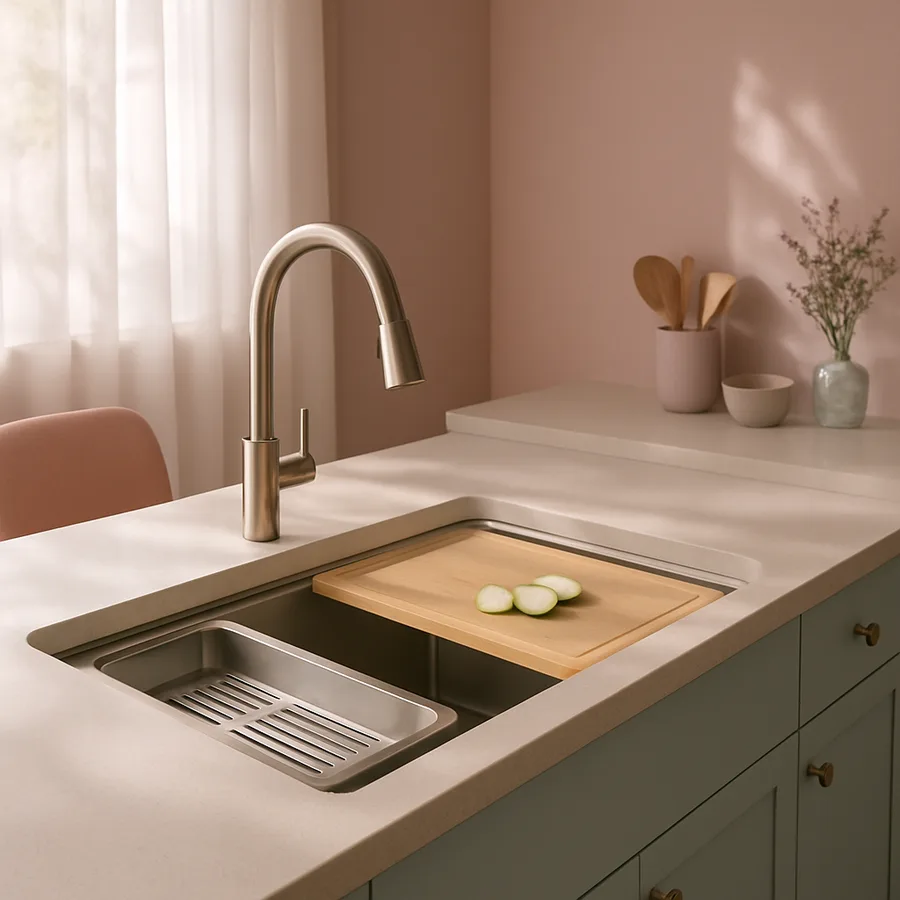
The kitchen sink used to be a place where dirty things went and clean things came out, and not much more was expected of it. The workstation sink proposes something different: that the basin itself can be a working surface, that prep, washing, draining, and cleaning can all happen in the same horizontal real estate, and that the right combination of integrated accessories can recover counter space that would otherwise go to cutting boards, colanders, and drying racks. The idea is not new, but the execution has improved dramatically in recent years, and the workstation sink has become one of the most consequential kitchen design developments of the decade.
What separates a true workstation sink from a conventional sink with a few add-on accessories is the integrated ledge. A workstation sink has machined ledges on two sides of the basin, set below the counter level, that accept sliding accessories. A cutting board can sit on the ledge directly above the basin and slide along its length. A colander can hang from the same ledge to drain washed produce. A drying rack, a serving tray, a roll-up dish mat, and increasingly a sous vide bath setup can all dock at the same ledge. The basin itself becomes a workshop where the accessories slide in and out as the task demands.
The Anatomy Of An Integrated Ledge
The ledge is the defining feature, and ledge geometry varies meaningfully between manufacturers. Most workstation sinks have a single tier ledge, set roughly three quarters of an inch below the counter surface, sized to accept accessories of standardized depth. The ledge is recessed into the basin walls so that accessories slide along it without protruding into the basin's interior, leaving the sink's working depth uncompromised. The ledge runs the full length of two opposite sides of the basin in most designs, allowing accessories to slide along the full sink length.
Some premium workstation sinks have a two-tier ledge system, with a primary ledge for active accessories and a secondary lower ledge for stacked storage. Two-tier ledges allow a cutting board to be in active use while a colander rests below it, ready to receive ingredients as they are cut. The complexity adds cost but allows true multi-task workflows that the single-tier designs only approximate. Houzz survey data on kitchen renovations indicated that workstation sinks have grown from a small specialty category to roughly fifteen percent of premium kitchen sink installations, driven primarily by homeowners who cook frequently.
The ledge depth, the basin depth below the ledge, and the relationship between the two are critical specifications. A shallow ledge with a deep basin gives a long drop from cutting board to basin, which can make heavy items difficult to lift from the basin and onto the board. A deep ledge with a shallow basin reduces working depth in the basin itself. The optimal balance, according to design guidance from the National Kitchen and Bath Association, is a ledge depth of three quarters to one inch below the counter and a basin depth of nine to ten inches below the ledge.
Cutting Board Materials And Integrations
The cutting board is the most-used workstation accessory and the one that gets the most daily abuse. Most workstation sinks ship with a hardwood cutting board, typically maple or walnut, sized exactly to the ledge dimensions. Hardwood is the right material for cutting because it self-heals around knife marks and resists bacteria when properly maintained. The wood board is also the accessory most likely to fail prematurely, because it lives in a wet environment and absorbs water if not dried promptly after each use.
Bamboo cutting boards are an alternative that resists water better than hardwood but blunts knives faster, since bamboo is harder than maple or walnut. Composite cutting boards made of compressed paper resin like Richlite or Paperstone are the most durable choice, virtually impervious to water and resistant to deep knife scoring, but they offer less of the tactile feedback that cooks accustomed to wood prefer. Plastic and silicone cutting boards are also available, and while they are dishwasher-safe and bacterially clean when sanitized, they degrade visually within a year of regular use.
Some workstation sinks include multiple cutting boards in different materials, allowing the cook to select based on the task. A thin bamboo board for delicate prep, a heavier maple board for heavy chopping, and a composite board for raw meat are a common combination. The American National Standards Institute, working with NSF International, sets food-contact safety standards for cutting board materials, and any cutting board sold with a workstation sink should carry NSF certification for food-contact use. Verifying that mark is a small step that prevents the surprisingly common purchase of decorative wood boards that have not been treated for kitchen use.
Colanders, Strainers, And Drying Accessories
The colander is the second integrated accessory, and the design varies from a simple wire basket that hangs on the ledge to elaborate multi-piece systems that nest within each other. A basic colander provides a place to wash produce while water drains directly into the basin, eliminating the conventional ritual of carrying a colander from sink to counter and back. A premium colander system might include a coarse mesh for greens, a fine mesh for grains, and a deep stainless basket for parboiling vegetables.
The colander's placement matters as much as its design. A colander hung directly under the faucet is positioned for easy filling and rinsing. A colander positioned at the end of the basin opposite the disposal is positioned for transferring drained ingredients to a cutting board on the ledge. Premium workstation sinks often allow the colander to slide along the ledge to either position depending on the task, while budget models fix the colander in one location. The mobility of the colander is a meaningful daily-use distinction.
Drying racks designed for workstation ledges expand the sink's role into post-meal cleanup. A roll-up rubber-coated wire rack can be deployed across the ledge after dishes are washed, draining directly into the basin, and rolled up and stored when not needed. The roll-up design is favored because it requires no dedicated storage space and adapts to ledges of varying length. Houzz survey data indicated that homeowners who used workstation drying racks reported eliminating the conventional countertop drying mat in roughly seventy percent of cases, recovering counter space for other uses.
Material Choices For The Sink Body Itself
Workstation sinks are produced primarily in stainless steel, with limited but growing options in fireclay, granite composite, and copper. Stainless steel dominates because the precise machining required for ledge integration is most economical in stainless, and the durability of stainless against the wear of sliding accessories is unmatched. Sixteen-gauge stainless steel is the standard for premium workstation sinks, with eighteen-gauge appearing in budget models. Sound-deadening pads on the underside of the basin reduce the noise of items striking stainless, which is a more pronounced issue with workstation sinks than with conventional sinks because of the volume of activity in the basin.
Fireclay workstation sinks are a recent development and remain a small share of the market. Fireclay's resistance to staining and its visual warmth are attractive in kitchens with a more traditional or transitional aesthetic, but the material's weight, cost, and limited ledge geometry options constrain the choice. A fireclay workstation sink typically costs sixty to a hundred percent more than a stainless equivalent, and the integrated ledges are usually fewer in number and shorter in length. Granite composite workstation sinks split the difference, offering stain resistance similar to stainless with the visual character of stone, and the ledge integration in granite composite is now mature enough to compete with stainless for design quality.
Have you considered how the sink material will react to the daily impact of accessory placement? Stainless tolerates accessory abuse without visible damage. Granite composite tolerates abuse but can develop subtle wear patterns at the ledge over years of use. Fireclay can chip if a heavy accessory is dropped onto the ledge, and chips in fireclay are not field-repairable. The material choice should reflect not just appearance preferences but realistic expectations about how accessories will be handled in daily use. NSF International publishes material standards for kitchen surfaces that confirm food-contact safety across all common workstation sink materials.
Single Bowl Versus Double Bowl Configurations
Workstation sinks favor single-bowl configurations because the integrated ledge system is most effective in a wide single basin. Double-bowl workstation sinks exist but are less common because the divider between the bowls reduces the effective length of the ledge and limits accessory mobility. A single thirty-three to thirty-six-inch bowl with full-length ledges on both sides accommodates the widest range of accessories and provides the most flexible workflow.
The argument for double-bowl is the traditional one: one bowl for washing, the other for rinsing or for piling dirty dishes. In a household that washes dishes by hand without a dishwasher, the double bowl remains useful. In a household with a dishwasher, where most dish washing is offloaded from the sink, the single bowl is almost universally the better choice, and the workstation sink magnifies that preference because the ledge accessories effectively replace the second bowl's function. The decision often hinges on whether the home has and uses a dishwasher, and most renovations that include a workstation sink also include a dishwasher.
Sink width matters more than bowl count in workstation choices. A thirty-inch single-bowl workstation sink has roughly twenty-four inches of usable ledge length per side, which fits one cutting board or one colander but not both at once. A thirty-six-inch sink has thirty inches of usable ledge per side, which can accommodate a cutting board and a colander side by side. The width up-charge from thirty to thirty-six inches is typically two to four hundred dollars, and for a household that cooks frequently, the daily benefit of the larger sink usually justifies the cost. The American Society of Interior Designers has noted that sink size is among the most underestimated specifications in kitchen renovations.
Faucet, Drain, And Disposal Coordination
The faucet for a workstation sink benefits from the same height and reach considerations as any kitchen faucet but with one additional constraint: the faucet must clear the cutting board when the board is in use on the ledge. A faucet spout that drops water directly above the cutting board is a daily annoyance, while one positioned over the open basin allows the cook to fill pots and rinse produce without moving the cutting board. A pull-down or pull-out spray faucet provides the most flexibility, allowing water to be directed wherever needed without compromising the ledge geometry.
Drain placement affects workflow more in a workstation sink than in a conventional sink. A center drain places the disposal directly below the typical cutting position on the ledge, which is convenient for clearing prep waste directly into the disposal. A rear or corner drain leaves more usable basin floor for soaking pots and pans but requires sweeping waste across the basin to reach the disposal. The design choice depends on the household's prep style; cooks who do extensive vegetable prep typically prefer center drains, while cooks who do more pot soaking and dish washing prefer rear drains.
The disposal itself should be sized for the prep volume the workstation sink encourages. A standard half-horsepower disposal handles light prep waste, but workstation sinks tend to increase the volume of vegetable trimmings and food scraps reaching the disposal because the cutting board work happens directly above it. A three-quarter or full-horsepower disposal handles the higher volume without jamming. NSF International certifies disposals for food-handling sanitation, and the certification is worth confirming on any disposal serving a workstation sink. The certification also covers noise insulation standards, which matters because a louder disposal in an active kitchen is a daily friction.
Conclusion
The workstation sink represents a real evolution of how the kitchen's most-used fixture earns its space on the counter. By integrating the cutting board, colander, and drying surfaces directly into the sink itself, the design recovers counter space, shortens prep workflows, and concentrates wet work in a single zone where water and waste are managed rather than spread across the kitchen. The benefit is meaningful in any kitchen but transformative in smaller kitchens where every inch of counter is contested.
The decision to choose a workstation sink rests on cooking habits more than on aesthetics. Households that cook frequently from raw ingredients, that do significant vegetable and meat prep, and that value efficient workflows benefit substantially from the integrated accessories. Households that cook lightly or that rely heavily on pre-prepared foods will use the ledge system less and benefit less from the additional cost over a conventional sink. The honest assessment of cooking patterns is the right starting point.
Cost ranges from roughly five hundred dollars for a basic stainless workstation sink without accessories up to three thousand or more for a premium fireclay or granite composite sink with a full accessory package. The accessory choice deserves attention separate from the sink selection itself; many manufacturers sell a base sink and a separate accessory bundle, and the accessory bundle is often the difference between a sink that gets used as designed and one that operates as a conventional sink with a fancy ledge that nobody touches. Plan the sink and the accessories together.
If you are evaluating a workstation sink for an upcoming renovation, request the manufacturer's accessory specifications, confirm NSF certification on cutting boards and disposals, and review project photographs and design guidance on the National Kitchen and Bath Association site, the American Society of Interior Designers, and inspirational kitchens on Houzz showing workstation sinks in active use.
More Articles You May Like



Comments
Post a Comment