Magnetic Tool Strips and Shadow Boards for Garage Organization
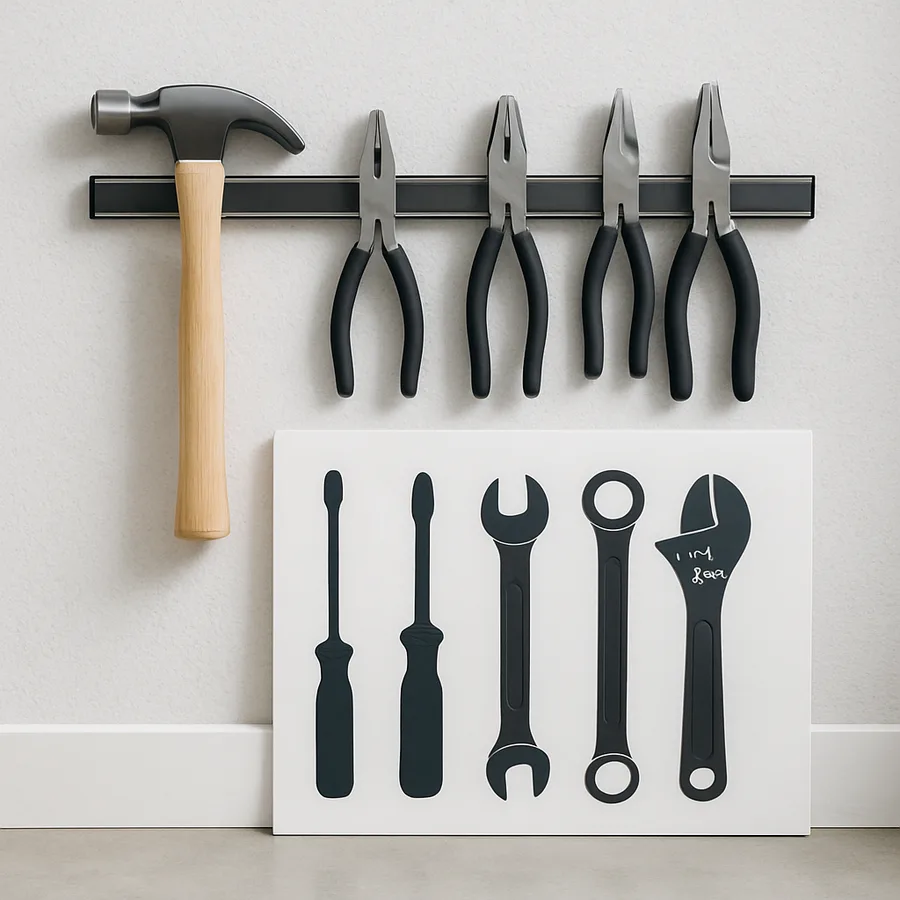
There is a moment in every home workshop when you stop tolerating a tool drawer and decide that every wrench, driver, and chisel deserves a visible home. That moment is the dividing line between a cluttered garage and a space that actually works. Two organizational methods lead the field for anyone who crosses that line: the magnetic tool strip and the shadow board. The first exploits physics by letting steel tools snap to a strip of rare-earth magnets mounted to the wall. The second exploits human perception by cutting a silhouette of each tool into a contrasting backer, so the eye immediately notices anything missing or misplaced. Together they are the signature of a serious workshop, and separately they are both affordable weekend projects with outsized impact.
This article explores when to reach for each method, which materials actually hold up, and how to combine them for maximum effect. It also draws on industrial organization practices borrowed from lean manufacturing, because the shadow board concept itself comes from the factory floor and has been refined over decades. The techniques that keep a Toyota production line running are just as useful above a garage workbench, scaled down to the tools you actually own. By the end you will know exactly how to set up both systems and what they cost in time and money.
Why These Two Methods Beat Drawers and Bins
Open a typical garage tool drawer and watch what happens. Tools slide when you pull the drawer, the items you use most bury themselves under the items you use once a year, and every project begins with a five minute search. Bins on shelves have the same problem in a different posture. The best organizational systems put every tool in plain view at arm's reach, because visibility drives use, and use drives mastery.
Magnetic strips put steel tools in plain view on any wall near the work. Shadow boards take visibility one step further by showing where a tool belongs even when it is missing, which triggers return behavior. Both methods reduce search time, both reveal what you own, and both encourage you to retire duplicates you forgot about. Surveys published by the National Association of the Remodeling Industry (NARI) consistently find that homeowners who invest in visible tool storage use their workshops more frequently than those who rely on closed storage, and the behavioral gap is meaningful. The Family Handyman editorial team regularly ranks visible tool storage as the single highest-impact organization upgrade in a home shop, above shelving, above cabinetry, and above tool chests.
How Magnetic Tool Strips Work and Where They Shine
A magnetic tool strip is a bar, usually 12 to 24 inches long, embedded with powerful neodymium magnets behind a thin protective face. Mount the strip to the wall with two screws into a stud, and every ferrous tool you press against the face will stick. The grip is remarkable: a modern 18 inch strip can hold pliers, wrenches, screwdrivers with magnetic shafts, hex keys, chisels, utility knives, and even small hand planes. The strength of neodymium magnets comes from the rare-earth element content and the way they are sintered, and the American Society for Testing and Materials (ASTM) publishes standards that legitimate manufacturers reference on their product pages.
Strips shine in spots where you reach for tools while your hands are full, such as above a workbench, next to a drill press, or along the side of a miter saw station. Placement matters more than quantity. Two well-placed 18 inch strips above the bench edge are more useful than six strips spread across the room, because tools belong where you use them. Have you ever found yourself walking 15 feet to grab a particular pair of pliers, every single project? That walk is a placement problem that a $25 strip can eliminate permanently. The magnetic approach also works surprisingly well in detached or unheated garages because magnets are not bothered by humidity or temperature swings that can warp wood accessories.
How Shadow Boards Work and Where They Win
A shadow board is a rigid panel, typically painted or laminated, with the outline of each tool cut, printed, or engraved on the board in a high-contrast color. The tool is held in place by a peg, a clip, a magnet, or simply by a friction-fit recess. The eye registers a missing tool instantly because the silhouette remains visible. This idea comes straight from lean manufacturing, where Toyota popularized the practice decades ago as part of the 5S system (sort, set in order, shine, standardize, sustain).
Home shadow boards win in three specific scenarios. The first is a tool set you use as a complete kit, such as a socket set, a bit set, or a chisel set, because a shadow board makes it immediately obvious when a piece is missing at the end of a project. The second is a set of tools that would be dangerous or annoying to lose, such as craft knives, scalpels, punches, or specialty marking tools. The third is a set of tools shared among family members, because the board creates a social nudge that returns the tool to its home. The NARI home workshop surveys find that shared family garages benefit disproportionately from shadow boards, because the friction of returning a tool to its outline is lower than the friction of returning it to an unlabeled drawer.
Materials That Hold Up in Real Garages
The cheapest magnetic strips on the market use ferrite magnets in a plastic housing and barely hold a pair of pliers. Skip them. Look for strips with rare-earth neodymium magnets and a magnetic face at least 1/8 inch thick. Reputable brands typically publish a per-linear-inch pull strength spec, and anything rated above 25 pounds per linear foot is genuinely useful in a shop. Stainless steel or powder-coated steel faces resist scratches and last for decades. Plastic or thin aluminum faces look fine for a year and then show wear. Expect to pay $20 to $45 for an 18 inch premium strip, which is trivial compared to the daily utility.
Shadow board materials split into three tiers. At the low end, painted 1/2 inch MDF with vinyl decals is fast, cheap, and perfectly suitable for a home shop. A 4x8 sheet of MDF plus a roll of vinyl cutter stock runs about $40 to $80. Mid-tier boards use laminated plywood or phenolic-faced panels that shrug off spills and scratches, and they run $80 to $200 for the same wall area. The premium tier, sometimes specified by ANSI-aligned industrial organization consultants for professional shops, uses two-tone laser-engravable plastic that reveals a contrasting underlayer when cut, typically $200 to $500 per panel for a professionally produced board. For most home garages, the mid-tier route is the sweet spot of durability and cost. The Society of Manufacturing Engineers has long promoted shadow board discipline as foundational to workshop organization, and the basic principle is identical whether you build the board from MDF or from premium stock.
Installation and Layout That Actually Gets Used
Installation is simple, but layout is where most DIY attempts fall short. A magnetic strip mounted three feet above the bench is visible but inconvenient. A strip mounted six inches above the bench surface is perfect for items you grab constantly. The goal is reach-in-place: you should be able to take a wrench from the strip without stepping back from your work. For shadow boards, mount them at eye level in a permanent zone, not near dust-generating machines or over splash-prone areas.
Use a stud finder to locate framing before drilling. Both systems must be screwed to studs for any load above a few pounds. Drywall anchors will hold a magnetic strip temporarily, but over months the weight of tools plus the pull of the magnet concentrated at two fastener points will work loose. The OSHA guidance on workplace tool mounting, while written for professional environments, directly informs home best practice: attach to structure, use fasteners rated for the load, and inspect annually. A spare fastener check takes two minutes per strip and prevents the annoying failure where a loaded strip pulls away from the drywall during a project.
Combining Both Systems for a Complete Solution
The smartest garages use both methods in concert. Magnetic strips handle the chaotic, mixed collection of ferrous hand tools that accumulate over time, where the exact inventory changes from month to month as you buy and retire items. Shadow boards handle the curated sets where completeness matters: the socket set, the bit drawer, the chisel lineup, the specialty tool rolls. The two systems complement rather than compete, because they solve different visibility problems.
A practical layout for a two-car garage might include two 24 inch magnetic strips above the main bench for general hand tools, a dedicated shadow board for the complete socket wrench set mounted at the automotive side of the garage, a smaller shadow board for chisels and marking tools above the woodworking bench, and a third shadow board for bits and drivers near the drill press. Total material cost sits between $150 and $400, depending on board tier, and total install time is a long Saturday if you are prepared with designs drawn on paper beforehand. Do you have specific tool sets you always seem to lose pieces from? Those sets are your shadow board candidates, and identifying them is the quickest way to justify the investment in time and materials.
Conclusion: Make Every Tool Visible and Watch the Shop Wake Up
The best-organized garages are not the ones with the most cabinetry. They are the ones where every tool has a visible, obvious home, where you can see at a glance what you own and what is missing, and where returning a tool is easier than setting it down on the bench. Magnetic strips and shadow boards accomplish both goals with modest investment and a single weekend of work. They also reveal a delightful secondary benefit: you will retire duplicate tools, rediscover tools you forgot you owned, and stop buying replacements for items that were simply misplaced.
Start with an inventory pass. Pull every tool out of drawers and bins, lay them out on the floor, and group them by function. Circle the sets that belong on shadow boards. The rest of the ferrous tools are candidates for magnetic strips. Measure your available wall space, sketch a layout on paper, and commit to zones: general hand tools above the main bench, automotive sockets near the automotive zone, fine tools near the woodworking bench. Good zoning is invisible to visitors but unmistakable to anyone who actually works in the space.
Buy the materials in one trip. For the magnetic strips, spend on quality neodymium strips rather than cheap ferrite imposters. For the shadow boards, pick the material tier that matches your ambition and your budget, and do not let perfectionism prevent a serviceable MDF-and-vinyl solution from happening this month. Install during a single Saturday session, then live with the layout for two weeks before finalizing the shadow board cutouts. Real use reveals layout mistakes that design does not. Commit to one weekend this month, one inventory pass, and one serious layout, and watch your entire workshop become a place you actually want to spend time.
For deeper reading on lean organization principles adapted for home shops, see coverage from This Old House, practical guides from Family Handyman, and the broader safety vocabulary maintained by OSHA. Between those resources and a careful afternoon with a tape measure, every garage wall can become productive. One last practical note that catches many homeowners off guard: strong neodymium magnets can erase credit cards, interfere with pacemakers at very close range, and attract steel filings from nearby grinding, so mount strips away from wallets, hearing aids, and bench grinders if possible. The same magnets can also hold ferrous dust that gradually builds a fuzzy halo on the strip face, and a quick pass with a stiff brush every few months keeps the strip looking sharp. Shadow boards have their own quirk worth noting: if you change out a tool for a newer model with a different profile, either refit the silhouette or replace the panel section entirely, because an outdated outline erodes the discipline that made the board valuable in the first place.
More Articles You May Like



Comments
Post a Comment