Whiskey Bar Cart Styling With Decanters and Glassware Sets
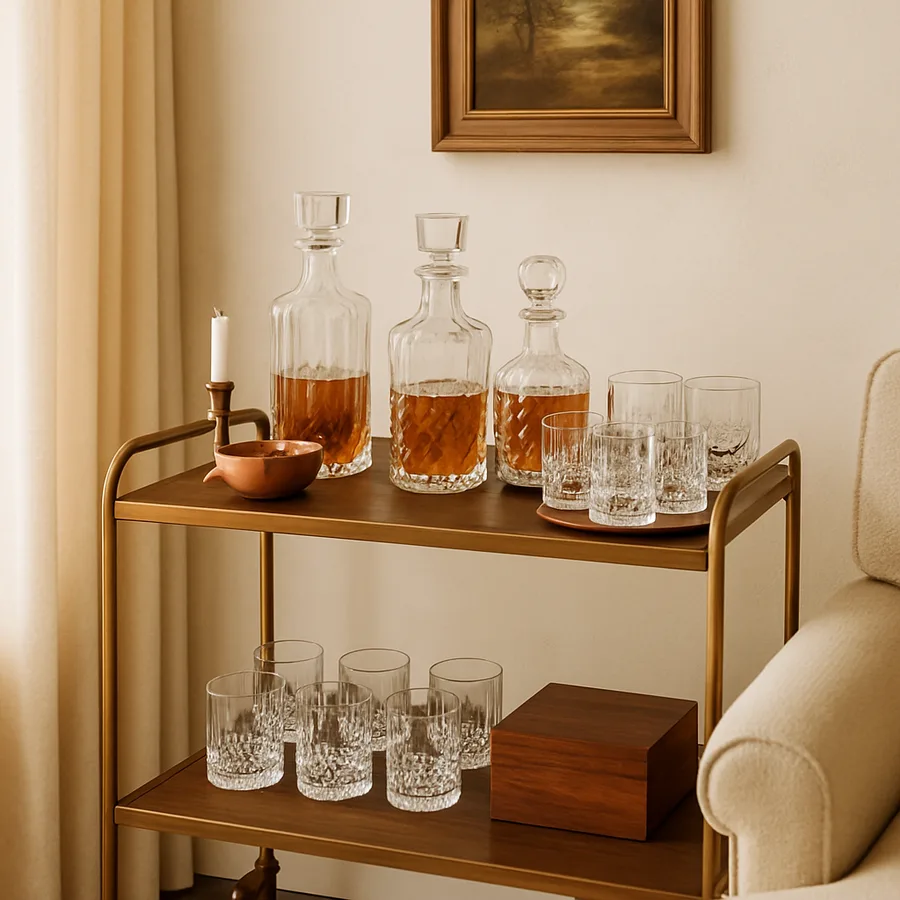
Few pieces of furniture announce a homeowner's taste quite like a well-styled whiskey bar cart. Once dismissed as a relic of mid-century cocktail culture, the bar cart has roared back into fashion, with the National Kitchen and Bath Association (NKBA) reporting that home bar features now appear in nearly 60% of upscale renovation requests. The whiskey-focused cart in particular has emerged as a signature element in living rooms, libraries, and home offices, blending the warmth of amber spirits with the gleam of crystal decanters and the sculptural form of well-chosen glassware sets.
What distinguishes a striking whiskey bar cart from a forgettable one is not the price of the bottles but the discipline of the styling. A great cart tells a story in three layers: the bottles, the glassware, and the small accessories that bring the whole composition together. Each layer rewards patient curation, and the cumulative effect is a piece that anchors a room and invites guests to linger near it. Have you ever walked into a friend's home and immediately gravitated toward their bar cart without quite knowing why? The pull is real, and it is by design.
This guide walks through six core moves for styling a whiskey bar cart that performs as both functional bar and visual focal point. Each section addresses a different layer of the styling, from selecting the cart itself to maintaining the ritual over years of use.
Selecting the Right Bar Cart for Your Space
The cart itself is the foundation of everything that follows, so it deserves more thought than most buyers give it. Bar carts come in three broad silhouettes: the wheeled trolley, the fixed sideboard cart, and the wall-mounted floating bar. Each delivers a different aesthetic and serves a slightly different purpose. The classic wheeled trolley in brass and glass channels mid-century energy, the sideboard cart provides more storage for a serious whiskey collection, and the wall-mounted version saves floor space in tight rooms.
Scale matters as much as style. A cart that is too small disappears against a sofa or large piece of art, while one that is too large overwhelms the room and creates traffic problems. As a general rule, plan for a cart that is between 30 and 38 inches wide and 30 to 36 inches tall, which gives enough surface for two or three decanters and a glassware set without crowding. Allow at least 36 inches of clearance in front for opening doors and pouring without bumping into adjacent furniture.
Material and finish should echo at least one other element in the room to keep the cart from feeling like an afterthought. If your coffee table is brass, choose a brass cart. If your shelving is walnut, choose a walnut cart with brass or glass accents. Architectural Digest has long advocated for this kind of material echo because it stitches a room together visually. Skip this step and the cart will read as a stand-alone object floating awkwardly in space.
Choosing Decanters That Earn Their Place
Crystal decanters are the unmistakable signature of a serious whiskey bar cart, and they perform double duty as both functional vessels and sculptural objects. A traditional decanter holds between 750 milliliters and one liter, roughly the equivalent of a single bottle of whiskey, and pours with a satisfying weight that adds ceremony to every cocktail. The best decanters feature heavy bases, intricate cut patterns, and tight-fitting stoppers that preserve the spirit's flavor for months.
Curate two or three decanters rather than a row of five or six. A focused collection looks intentional and gives each piece room to breathe. Many designers featured by the American Society of Interior Designers (ASID) recommend selecting decanters in slightly different shapes to create visual rhythm: perhaps one tall and slender, one short and squared, and one rounded ship's decanter. The variety telegraphs care without descending into clutter.
Label each decanter with a small silver or brass tag identifying the spirit inside. Tags are inexpensive but instantly elevate the cart from amateur to refined, and they prevent the embarrassment of pouring scotch when a guest asked for bourbon. Wine Spectator applies similar labeling logic to decanters used for wine service, noting that the small detail signals seriousness and protects against pouring errors. The same principle holds for whiskey. For a deeper dive on spirits storage and presentation, see Wine Spectator's beverage editorial.
Building a Glassware Collection With Purpose
Glassware is where the whiskey bar cart becomes truly personal, because the choices reveal how you actually like to drink. The foundational set includes four to six rocks glasses for whiskey on the rocks or short cocktails like an Old Fashioned, two to four highball glasses for tall pours like a whiskey highball, and two Glencairn or copita glasses for neat tasting. This trio covers nearly every occasion and gives guests the right vessel for whatever they order.
Quality matters more than quantity. A set of six well-made rocks glasses with a thick base and a thin rim feels significantly better in the hand than a dozen flimsy ones, and they refract light beautifully when arranged on the cart. Crystal is traditional, but high-end lead-free glassware now performs comparably and avoids the toxicity concerns associated with leaded crystal. Better Homes & Gardens (BHG) regularly highlights this shift in their entertaining stories, noting that modern glassware delivers the look without the trade-offs.
Display the glassware in two staggered rows or stack them upside down on a small linen-lined tray. Avoid lining them up in a single straight row, which reads as a restaurant supply rather than a curated collection. Have you ever noticed how the most elegant home bars always feel slightly asymmetrical in their styling? That intentional imbalance is what gives the composition movement and keeps it from looking sterile. Aim for that same quality on your own cart.
Adding Accessories That Complete the Story
Once the cart, decanters, and glassware are in place, the supporting accessories transform the composition from bar to bar experience. The foundational accessories include a bar tool kit (jigger, bar spoon, strainer, and muddler), a small ice bucket with tongs, a citrus knife and small wooden cutting board, and a stack of cocktail napkins or small linen squares. Group these tools on a tray or in a designated section of the cart so they read as a curated set rather than scattered utility.
A book or two on whiskey adds intellectual texture and gives guests something to thumb through while you mix drinks. Display them on the lower shelf of the cart, perhaps with a small brass bookend or paired with a single coaster. The presence of books signals that whiskey is a passion to be studied rather than just consumed, and that small detail elevates the entire cart.
Garnishes deserve their own consideration. A small dish of orange peels, a jar of brandied cherries, and a tiny bowl of bitters bottles add color and signal readiness for cocktails beyond the simple pour. The National Association of Home Builders (NAHB) has noted that hospitality-focused features like dedicated bar zones consistently rank among the highest-satisfaction renovation choices, suggesting that the social return on a well-styled cart is genuine. Around 71% of homeowners surveyed in recent renovation studies say they entertain more often after upgrading a beverage zone, which mirrors the trend in coffee and tea stations.
Lighting and Placement Within the Room
The position of the bar cart within the room dramatically affects how often it gets used and how beautiful it appears. Place the cart in a spot that sees natural foot traffic during gatherings but that is not so central that it disrupts conversation flow. The corner of a living room near a sofa, the wall behind a dining table, or the niche beside a fireplace all work beautifully. Avoid placing the cart directly under a window where prolonged sun exposure can damage labels and degrade spirits over time.
Lighting deserves equal attention. A small picture light installed above the cart or a freestanding table lamp on a nearby surface casts the kind of warm glow that flatters amber spirits and cut crystal. Many designers recommend warm-temperature bulbs in the 2700 Kelvin range because they bring out the honey and copper tones in whiskey while softening the cool gleam of glass. The lighting can be the difference between a cart that disappears at night and one that becomes the visual anchor of the entire room.
Have you considered how your bar cart will look at different times of day? Walk past it in morning light, afternoon sun, and evening lamp light to evaluate how each configuration reads. Adjust the position or the styling until it performs across all three conditions. Architectural Digest has covered this kind of multi-condition styling extensively in their interior features, and the principle applies whether you are styling a cart, a bookshelf, or an entire room. For more on residential styling principles, the Architectural Digest archive is a strong reference.
Maintaining and Refreshing the Cart Over Time
A whiskey bar cart rewards regular attention. Wipe down the cart frame weekly with a soft cloth and a mild cleaner appropriate to the material, whether that is brass polish, wood oil, or glass cleaner. Inspect bottles and decanters monthly for sediment, evaporation, or signs of light damage, and rotate stock so the spirits you actually drink stay fresh. Whiskey kept in cut-crystal decanters with leaded glass should be moved into glass bottles after a few months due to lead leaching concerns, a detail many homeowners overlook.
Refresh the styling seasonally. In autumn and winter, lean into darker wood accessories, heavier glassware, and the deeper amber and peated whiskeys displayed prominently. In spring and summer, lighten the palette with woven coasters, lighter spirits like bourbon and rye, and perhaps a small herb garden in a brass planter for cocktail garnishes. Small seasonal shifts keep the cart from feeling static without requiring any structural changes.
Document your favorite bottles, tasting notes, and cocktail recipes in a small leather notebook kept on the lower shelf. Over years, the notebook becomes its own design object and a record of the whiskeys you have explored. Guests inevitably pick it up, flip through, and start conversations that never would have happened around a less considered piece of furniture. That conversational gravity is the deepest reward of styling a bar cart with care.
Conclusion
A great whiskey bar cart is an exercise in restraint as much as in selection. The temptation is to crowd the cart with every bottle, glass, and accessory you own, but the most striking carts in design publications consistently show the opposite: a few exceptional pieces, beautifully arranged, with breathing room between them. That discipline is what transforms a piece of furniture into a focal point and what gives a home bar its sense of intentionality.
Begin your own styling project by editing what you already have. Pull every bottle, decanter, and glass off the cart, clean the surfaces thoroughly, and then reintroduce only the pieces you genuinely love or use. The pieces that did not make the cut can either be donated, gifted, or stored elsewhere. This editing pass is often the single highest-impact move you can make, and it costs nothing.
Beyond the aesthetics, a whiskey bar cart is an invitation to slow down with friends. The act of mixing a cocktail or pouring a measured neat dram demands more attention than grabbing a beer from the fridge, and that slower pace tends to deepen conversation. Friends comment on the decanters, ask about the bottles, and linger at the cart in a way that they rarely do at a refrigerator. The cart becomes a small social magnet within the room.
Take one concrete step this week. Order a single set of matching rocks glasses, find one beautiful decanter at a flea market or estate sale, or simply rearrange what you already own with fresh eyes. The best whiskey bar carts are not assembled in an afternoon. They are layered over months and years as you refine your taste, find pieces that feel right, and build a small collection that reflects who you are. That ongoing process is exactly what gives the finished cart its soul, and it is the reason this design moment continues to resonate so strongly with homeowners across the country.
More Articles You May Like


Comments
Post a Comment