Console Table Lamp Pair vs Single Lamp Symmetry Choices
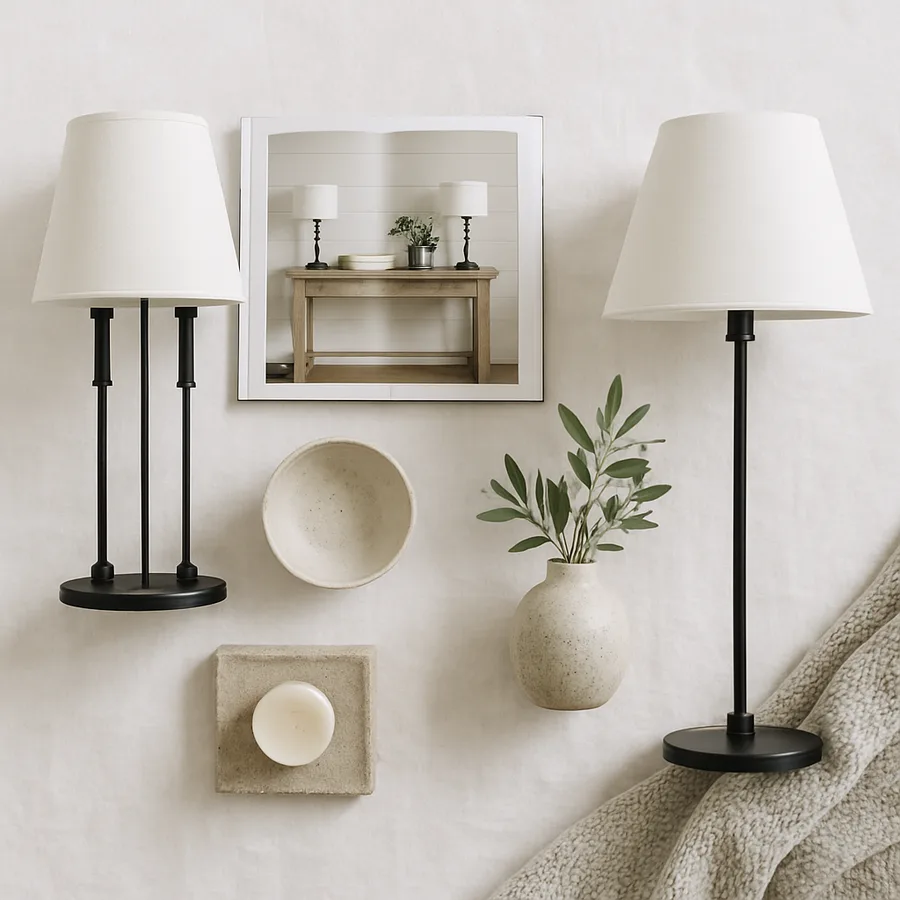
The console table is one of the most photographed surfaces in any home, and the lamp choice you make on top of it sets the emotional temperature for the entire entryway, hallway, or living room wall it anchors. A matched pair of lamps signals tradition, ceremony, and balance, while a solitary lamp leans into asymmetry, modernity, and a more curated, gallery-like sensibility. Neither approach is universally correct, but each carries specific implications for how the eye reads the vignette, how guests interpret the room, and how the lighting actually performs after sunset.
This guide walks through the classical symmetry argument, the modern asymmetry counterpoint, the math of scale and proportion, the practical lumen output you need at a console, and the styling moves that elevate either choice from generic to intentional. By the end you will have a clear decision framework rather than a vague preference, and you will know exactly which fixtures, shades, and accessories to pair with your final pick.
The Case for the Matched Pair
A pair of identical lamps creates what designers call bilateral symmetry, the same kind of mirrored balance you find in classical architecture, the human face, and most formal portraiture. When the eye perceives bilateral symmetry, the nervous system reads the scene as stable, intentional, and complete. That is why pairs feel calming, even when the rest of the room is busy with pattern, art, or color.
According to a guide on entryway styling from Better Homes and Gardens, paired lamps are the default move for traditional, transitional, and Hamptons-style homes precisely because they communicate hospitality and order to anyone walking through the door. The American Society of Interior Designers (ASID) has long noted in its educational materials that symmetrical arrangements make small rooms feel more curated and large rooms feel more grounded, two effects that are surprisingly hard to achieve with a single statement piece.
A pair also gives you twice the practical light. If your console sits in a hallway with no overhead fixture, two lamps with 60-watt-equivalent LED bulbs will deliver roughly 1,600 combined lumens, enough to illuminate a 6-foot-wide passage at a comfortable 30 to 50 lux for circulation, the level the Illuminating Engineering Society (IES) recommends for residential corridors. A single lamp simply cannot match that spread without becoming uncomfortably bright at its source.
Pairs also forgive styling mistakes. If your art is slightly off-center, your mirror is a touch too small, or your console is a few inches longer than ideal, the lamps absorb the visual imperfection by reasserting symmetry on the horizontal axis. They are, in effect, a safety net for vignettes that have not yet been fully resolved.
The Case for the Single Statement Lamp
A single lamp does the opposite of a pair. It introduces asymmetrical tension, which is the design language of contemporary galleries, Scandinavian interiors, and the kind of editorially photographed homes you see in House Beautiful. One lamp says the homeowner is confident enough to leave half the console open, to let a sculptural object or a leaning artwork carry the other side, and to trust the eye to find balance through weight rather than through mirror imaging.
The single-lamp approach works best when the lamp itself is sculptural enough to function as art. Think of a tall ceramic gourd lamp, a brass arc fixture with a heavy marble base, or a vintage Murano glass piece with a pleated linen shade. The lamp is not just providing light; it is the focal point of the entire console vignette, and everything else on the surface plays a supporting role.
Have you ever walked into a room and felt that the styling was trying too hard? That feeling often comes from over-symmetry, from too many matched pairs stacked on top of each other. A single lamp breaks the pattern and gives the eye a place to rest, which is why so many design-forward homes use one lamp paired with a stack of art books, a small bowl of organic objects, or a single tall branch in a heavy vessel.
Scale and Proportion Math
Whether you choose one lamp or two, scale is non-negotiable. The cardinal rule, taught in every interior design program and reinforced in ASID continuing education materials, is that the total height of the lamp plus the console table should be roughly 58 to 64 inches from the floor, which puts the bottom of the shade at average eye level for a seated viewer and just below eye level for a standing one. This is the height range where the bulb is shielded from direct view but the light still spreads outward across the surface.
For a pair, the lamps should occupy no more than two-thirds of the console length. On a 60-inch console, that means each lamp base should be roughly 8 to 12 inches wide, with at least 6 inches of breathing room between the lamp and the edge of the table. For a single lamp, the base can be larger, often 12 to 16 inches wide, because it is doing the work of two and needs visual mass to hold its own.
Shade diameter follows a different rule. A pair of shades should be narrower, typically 12 to 14 inches across, so the two together do not overwhelm the console. A single shade can stretch to 16 or even 18 inches because there is no second shade competing for attention. The Carpet and Rug Institute, in its room-planning guidance, notes that oversized shades on small consoles are one of the most common scale errors in residential lighting, and the fix is almost always to size down rather than up.
Light Output and Bulb Choice
Lighting is not just decoration; it is the functional core of the console vignette. The IES recommends a layered approach for entryways and hallways, with ambient light providing 30 to 50 lux for circulation and accent or task light boosting specific zones to 100 to 200 lux. A pair of lamps with 60-watt-equivalent LEDs (roughly 800 lumens each) will hit the upper end of that range, while a single lamp at the same wattage will hit the middle.
Color temperature matters even more than lumens. For a console in a residential setting, stick to 2,700K to 3,000K warm white, which mimics the soft incandescent glow people associate with hospitality. Anything cooler, like 4,000K or 5,000K, will feel clinical and undermine the welcoming effect the lamps are supposed to create. Always confirm the color rendering index (CRI) is 90 or higher; lower CRI bulbs make wood, fabric, and skin tones look flat and lifeless.
Should the lamps be on a dimmer? Almost always yes. A wall-mounted dimmer or a smart bulb with app-based dimming lets you take the console from bright morning task light down to a 20 percent evening glow, which is the kind of layered control that separates a designed room from a furnished one.
Styling the Surface Around the Lamps
Once the lamp decision is made, the rest of the console comes together with surprising ease. For a pair, treat the space between the lamps as a stage. A horizontal mirror or a wide piece of art behind the console reinforces the symmetry, and a low object in the center, like a tray with a stack of books or a sculptural bowl, anchors the composition without competing for height.
For a single lamp, the styling logic flips. Place the lamp on one third of the console, ideally the third opposite the room's main traffic flow. Fill the other two thirds with a layered grouping of objects at varying heights: a stack of three or four hardcover books topped with a small object, a medium-height vessel with a single tall branch, and a low bowl or tray that catches keys and mail. The eye should travel from the lamp across the surface in a gentle arc, not a straight line.
Texture variation is the secret weapon in both approaches. Pair a smooth ceramic lamp with a rough linen shade, a polished brass base with a pleated paper drum, or a matte black metal lamp with a raw silk shade. The console itself benefits from the same logic: a glossy lacquered table gains depth from a nubby textile runner, and a rough reclaimed wood console softens with the introduction of a smooth marble or polished stone object.
Common Mistakes and How to Avoid Them
The most common mistake with paired lamps is buying them too small. Homeowners often select lamps based on how they look in the showroom, where ceilings are high and consoles are oversized, and then bring them home to a residential context where they read as undersized. Always measure your console, calculate the 58 to 64 inch total height, and shop with those numbers in hand rather than relying on visual estimation.
The most common mistake with single lamps is going too small in the opposite direction, choosing a tasteful but visually weak lamp that cannot hold the asymmetry it is being asked to anchor. If you are committing to a single lamp, commit fully and choose something with presence, weight, and a shade large enough to balance the empty side of the console.
Another frequent error, regardless of pair or single, is mixing finishes carelessly. A brushed nickel lamp on a console with brass hardware will read as accidental rather than intentional. The fix is either to match the metals exactly or to introduce a third metal somewhere in the vignette, like a bronze object or an iron tray, so the mix becomes a deliberate three-metal palette rather than a two-metal mismatch.
Finally, do not forget the cord. A visible black or white cord snaking down the back of a console is the fastest way to undo all the styling work above the surface. Use cord covers, route the cord through a hole in the console back, or position the lamp so the cord falls behind a stack of books or a vase. Have you checked your own console lately to see how the cord is hidden?
Conclusion
The pair-versus-single decision is ultimately a question of what story you want your entryway, hallway, or living room console to tell. Pairs whisper tradition, hospitality, and considered balance, and they are the safest choice for homes that lean classical, transitional, or formal. A single lamp speaks of confidence, edited restraint, and contemporary sensibility, and it rewards homeowners who are willing to style the surrounding objects with real intention.
Both approaches can be executed beautifully or poorly, and the difference almost always comes down to scale, light quality, and the supporting cast of objects on the console. Get the height right, choose warm dimmable bulbs with high CRI, and treat the rest of the surface as a composition rather than a collection, and either choice will photograph and live well.
If you are still on the fence, walk into your space and ask yourself one honest question: does this room want to feel calm and balanced, or does it want to feel curated and a little bit unexpected? Your answer is your lamp count. And once you have committed, give yourself permission to live with the choice for a few weeks before second-guessing it; symmetry and asymmetry both take time to settle into a room.
Ready to commit? Measure your console tonight, write down the 58 to 64 inch total height target, and start shopping with confidence. Save this guide, share it with anyone in your household who weighs in on these decisions, and tag your finished console on social media so other readers can see how the symmetry math plays out in real homes.
One last consideration worth flagging: the lamps you choose today will likely outlive the console table itself. Quality lamps with solid ceramic, brass, or stone bases routinely last thirty or forty years and can move from one home to another, while console tables tend to be replaced more frequently as styles and households change. Treat the lamp purchase as a long-term investment, even if the console is more disposable. A pair of timeless ginger jar lamps in a neutral palette will read beautifully against a traditional walnut console today, against a modern marble console in five years, and against a vintage rosewood console in twenty. The lamps anchor the entire trajectory of the home's evolving style, which is why this decision deserves more thought than most homeowners give it on the first pass.
More Articles You May Like


Comments
Post a Comment