Leather Wrapped Countertops for Bar Tops and Library Desks
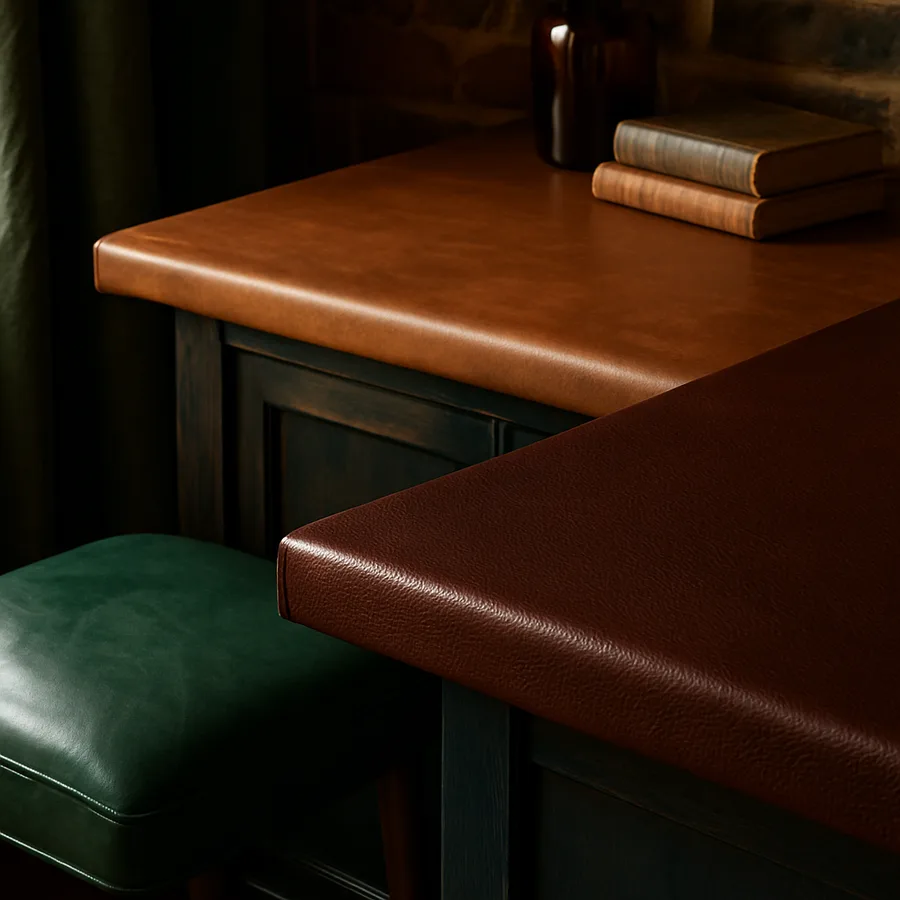
Leather is the unexpected luxury surface that keeps quietly returning to high-end residential design. While stone and engineered quartz dominate the kitchen, leather wrapped countertops have established a small but devoted niche in spaces where ambiance matters more than washability: home bars, libraries, executive home offices, and the kind of private clubrooms that increasingly anchor whole-home renovations. Few materials deliver the same combination of warmth, acoustic softness, and tactile pleasure.
This article walks through the entire arc of designing, fabricating, and living with a leather-wrapped surface. We cover hide selection, substrate construction, edge wrapping techniques, conditioning, and the design contexts where leather genuinely earns its specification. Throughout, we draw on guidance from the American Society of Interior Designers and the National Association of Home Builders, both of which have published recent material on luxury millwork and integrated leather surfaces.
Where Leather Belongs in a Home and Where It Does Not
The most important conversation to have at the start of a leather countertop project is about use case. Leather is not a suitable material for any surface that will see regular water exposure, raw food preparation, or heavy oil contact. It belongs nowhere near a kitchen sink, a stovetop, or a cutting zone. What it excels at is occupying surfaces that host glasses, books, papers, lamps, and the things people gather around rather than work over.
The two strongest applications, by long tradition, are bar tops and library desks. A leather-wrapped home bar provides a uniquely warm landing for cocktail glasses, dampens the click of bar shakers and ice tongs, and develops a beautiful patina around the most-used drink positions. A leather library desk, in turn, delivers the writing surface that wood and stone simply cannot match: a slight give beneath a pen, no glare under task lighting, and an instantly recognizable signal of considered design.
Other valid applications include the tops of game tables, billiards rails, executive home office desks, and the inset writing pads on built-in study desks. According to the ASID, leather has been one of the fastest-growing specified materials in the luxury home office category since 2022, particularly in projects with substantial millwork programs. Have you ever sat down at a leather-topped desk in a hotel suite and immediately wanted one in your own home? You are far from alone.
Choosing the Right Hide for the Job
Not all leather is suited to countertop wrapping. The hide must be thick enough to wrap edges without creasing, supple enough to conform to corners cleanly, and durable enough to survive years of contact with hands, glassware, and the occasional dropped object. The standard for serious work is full-grain saddle leather, typically vegetable-tanned bovine hide between 4 and 6 millimeters in thickness. The leather industry sometimes refers to this weight as 10 to 14 ounces per square foot.
Vegetable tanning, the older of the two main leather processing methods, uses tannins extracted from oak, chestnut, and other plant sources. The resulting leather is firmer, more dimensionally stable, and develops a richer patina than chrome-tanned alternatives. According to the Leather Working Group, the leading global certifier of responsible leather sourcing, vegetable-tanned leathers also carry a substantially smaller chemical footprint than their chrome-tanned counterparts and are easier to verify against environmental claims.
Color selection is more consequential than most clients expect. Leather darkens significantly during the first year of use, especially in the most-handled zones, so a hide that looks like a perfect saddle tan in the showroom may settle into a deep cognac after eighteen months. For library desks and home bars, the most enduring color choices are mid-range tans, chestnuts, and warm browns, all of which age gracefully. Black leather looks dramatic on day one but tends to show every scratch and fingerprint as it ages, making it harder to live with in heavy-use settings.
Hide grading is the other variable that quietly shapes the finished result. Top-tier full grain hides preserve the natural surface texture of the animal, including subtle scars, range marks, and pore variation that give the finished countertop its character. Lower-grade hides are typically corrected, embossed, or pigment-coated to disguise imperfections, which produces a more uniform but less authentic appearance. For an heirloom-quality bar or desk top, the higher grade is well worth the modest premium, since the character marks become part of the design language rather than flaws to be hidden. Ask any prospective fabricator to walk you through the grading hierarchy and to show finished samples in two or three grade tiers side by side.
Substrate, Adhesive, and the Mechanics of Wrapping
The leather itself is only part of a successful installation. Beneath it sits the substrate, typically a kiln-dried hardwood plywood or MDF panel between three quarters and one and a quarter inches thick. The substrate edges are routed to the desired profile, sanded smooth, and sealed with a thin coat of shellac to prevent moisture migration. Any irregularity in the substrate will telegraph through the leather, so this step is where many projects succeed or fail.
The leather is bonded to the substrate using a combination of contact cement and, for the perimeter wrap, hand-driven decorative nails or hidden tacks. Skilled fabricators wet the leather slightly during installation, which makes it more pliable and allows tighter wrapping around corners and edges. As the leather dries, it shrinks marginally and tightens against the substrate, producing the seamless, drum-tight surface that defines the highest-end installations.
Edges are where craftsmanship is most visible. The classic library desk treatment is a folded mitered corner, executed by a single seam tucked invisibly under the leather. A simpler alternative is the banded edge, which uses a separate strip of leather wrapped around the perimeter with a visible seam line at the top. Bar tops often use a brass-rail edge, where the leather meets a polished or unlacquered brass strip that protects the corner from glassware impact and adds visual definition.
Decorative hardware along the edges is more than ornament. Hand-driven brass nails set at regular intervals around the perimeter, a tradition borrowed from antique club furniture, perform the structural job of pinning the leather permanently to the substrate while also delivering an immediately recognizable visual signature. Spacing typically falls between two and three inches center-to-center, with closer spacing producing a more formal, traditional look and wider spacing reading more contemporary. The choice of nail head size, finish, and pattern is often the single design decision that establishes the visual personality of the finished piece.
The Conditioning Routine That Keeps Leather Alive
Leather is a once-living material, and like any organic surface, it responds to humidity, temperature, and conditioning over time. Without periodic care, the surface will dry out, lose suppleness, and eventually crack. With the right routine, a properly installed leather countertop will look better at twenty years than at two. The maintenance cycle is genuinely simple, but it requires consistency.
A general guideline endorsed by most professional leather conservators is to condition twice a year, ideally at the start of the heating season and the start of the cooling season, when ambient humidity changes most dramatically. Use a high-quality leather conditioner formulated for furniture or saddle leather, applied sparingly with a soft cloth and worked in small circular motions. Allow the conditioner to absorb for several hours, then buff lightly with a clean cotton cloth to remove residue.
Between conditioning sessions, daily care consists of dusting with a dry soft cloth and immediately blotting any liquid spills with absorbent paper. Avoid wet cleaning whenever possible. According to the Smithsonian Museum Conservation Institute, water is one of the most damaging substances to leather over time, even in small quantities, because it disrupts the natural oils and accelerates fiber breakdown. If a stain truly requires intervention, consult a professional leather conservator rather than improvising with household cleaners.
Designing the Room Around the Leather
A leather countertop is rarely the only character-defining element in a room, and the surrounding palette deserves equal attention. For library desks, the strongest pairings are quarter-sawn white oak, walnut, and rift-cut mahogany cabinetry, each of which echoes the warmth of vegetable-tanned leather without competing for attention. Bookcases in matching wood, brass picture lights, and an oriental or kilim rug ground the room in the kind of timeless library aesthetic that no decorating trend can date.
Bar tops respond well to slightly more dramatic surroundings. Deep green, burgundy, or near-black painted millwork, marble or honed soapstone backsplashes, and antiqued mirror behind the bottle display all create the kind of intimate, club-like atmosphere that leather was made for. Brass and unlacquered nickel hardware, antique decanters, and a small collection of vintage barware complete the scene. The NAHB has noted in its luxury home features reports that integrated home bars with leather-wrapped surfaces are among the most resale-positive non-essential rooms in homes above the seven-figure price point.
Lighting is the secret ingredient. Leather absorbs light rather than reflecting it, so spaces with leather-wrapped surfaces need both ambient and task layers tuned to warm color temperatures. Picture lights for the library desk, a single drop pendant or pair of sconces above the bar, and dimmable controls everywhere will let the leather glow without ever feeling clinical. Have you noticed how the best hotel libraries always seem to have leather and warm lamplight in equal measure? The pairing is no accident.
Cost, Sourcing, and Lifespan Expectations
Leather wrapped countertops are firmly in the luxury bracket of residential surfaces. Installed pricing typically runs between $200 and $400 per square foot, with the variation driven by hide quality, edge complexity, and the experience of the fabricator. About half of that cost is the leather itself, with the remainder going to substrate fabrication, wrapping labor, and any custom hardware such as brass rails or decorative nails. According to a 2024 cost survey by Remodeling Magazine, average installed costs for residential leather surfaces increased roughly 18 percent over the previous three years, driven primarily by hide pricing.
Lifespan with proper care is genuinely impressive. A well-installed and well-conditioned leather desk top will easily exceed twenty years of daily use, with many examples in heritage libraries and gentlemen's clubs documented at fifty years and beyond. The leather itself outlasts most of the wood furniture surrounding it. When eventual re-leathering is needed, a skilled fabricator can typically replace the wrap on the existing substrate at a fraction of the original installation cost.
Finding the right fabricator is the harder challenge. Few stone or millwork shops handle leather wrapping at a high level, and the work historically belongs to a small community of specialty desk and library makers, billiard table builders, and occasional saddle makers who have moved into architectural work. Ask any prospective fabricator for examples of past work at least five years old, and request to inspect the patina, the edge integrity, and the corner construction in person if possible.
Conclusion
Leather rewards rooms that prioritize feeling over showroom perfection. The slight give beneath a glass, the absorption of room sound, the visual warmth that no synthetic surface can imitate, and the slow patina that ties the room to the people who use it most are the qualities that justify the cost and the craftsmanship. Few materials in modern residential design carry such a strong sense of intentional, considered choice.
The trade-offs are clear and easy to plan around. Leather does not belong in wet zones, food prep areas, or rooms with extreme humidity swings. It demands twice-yearly conditioning and gentle daily care. It will scratch, it will darken, and the most-used spots will look subtly different from the perimeter. For the right rooms, those qualities are not flaws but features.
If a leather-topped bar or library desk is on your wish list, begin by sourcing hide samples from a reputable supplier and a fabricator portfolio with at least five years of completed work. Bring the samples home, sit with them under your actual lighting, and imagine the room six months and six years from now. Schedule a consultation with a specialty leather fabricator before your next renovation begins; the lead times and the quality of the result are both worth the early planning.
More Articles You May Like



Comments
Post a Comment