Kids Bedroom Loft Bed Designs With Desk and Reading Underneath
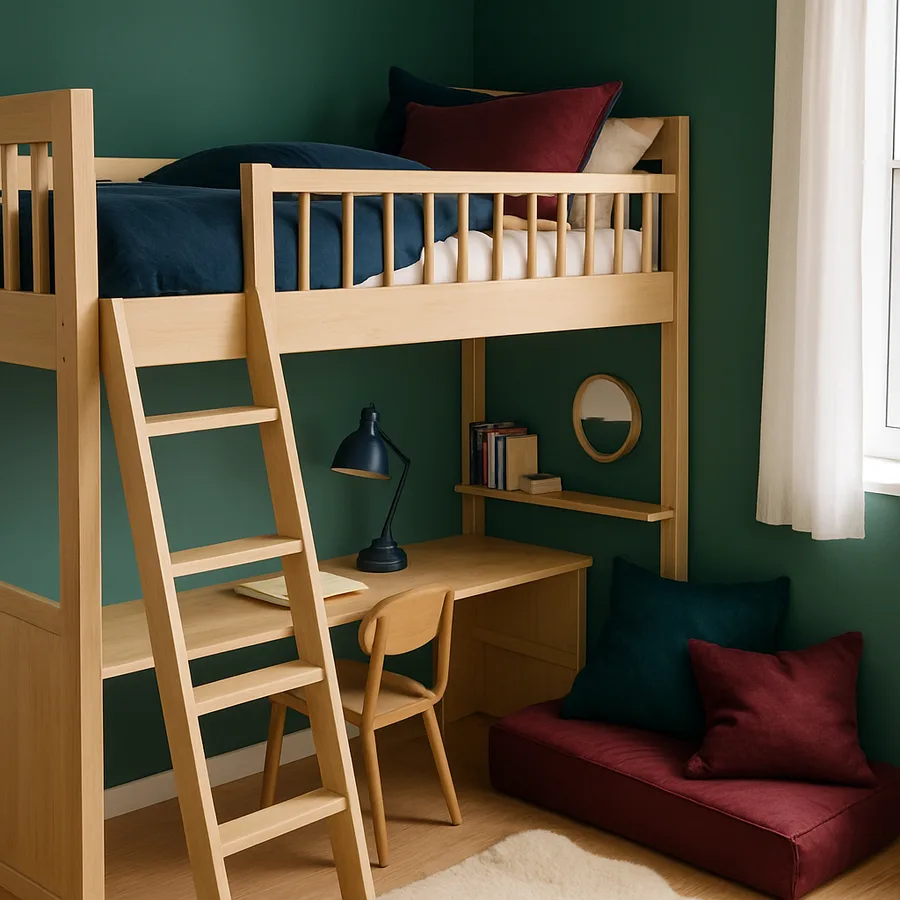
The footprint problem in a child's bedroom rarely changes: roughly 100 square feet of floor must absorb sleep, study, storage, play, and quiet decompression. A well-designed loft bed with a desk and reading nook tucked beneath can reclaim 35 to 50 percent of that floor area, depending on the configuration. According to a 2024 housing report from the National Association of Home Builders, the median new-construction child's bedroom has shrunk to just 132 square feet, down from 159 a decade ago. That compression is exactly why parents are rediscovering vertical thinking.
What follows is a working playbook for designing a loft setup that genuinely supports a growing child, not just a Pinterest screenshot. Every measurement here is drawn from published consumer-product safety guidance, ergonomic data from the American Academy of Pediatrics, and the lived experience of designers who specialize in small-footprint family rooms. The goal is a bed your child can climb safely, a desk that fits real homework, and a reading nook they actually choose to use.
Choosing the Right Loft Height for Your Ceiling
The first decision is vertical clearance, and it sets every other dimension downstream. A standard loft bed places the sleep surface between 60 and 72 inches above the floor. To allow an adult to comfortably tuck sheets, you want a minimum of 30 inches of air between the top of the mattress and the ceiling. Under the bed, the desk zone needs at least 42 inches of standing clearance for a school-age child and closer to 54 inches if you want the setup to last into the teen years.
Run the math against your actual ceiling. A typical 8-foot ceiling (96 inches) leaves you with 96 minus 30 minus 8 (mattress) which equals a 58-inch usable cavity below. That is excellent for a desk-and-reading combo. A 9-foot ceiling lets you push the bed deck higher and add overhead pendant lighting. Anything lower than 8 feet, including the popular 7'6" basement-conversion ceiling, generally rules out a true loft and pushes you toward a mid-sleeper design with the deck at 48 to 54 inches and a smaller seated-only desk underneath.
Don't forget the climb. The U.S. Consumer Product Safety Commission reports roughly 36,000 bunk and loft bed injuries treated in U.S. emergency rooms each year, and the majority involve falls during ascent or descent. A higher loft is not inherently more dangerous, but it does demand a longer ladder run and a wider top guardrail, both of which take floor and wall space you must budget upfront.
Desk Dimensions That Match Your Child's Age
A desk under a loft only saves space if a child can actually use it for years. The single most common mistake is buying a tiny "kid desk" that becomes useless by third grade. Instead, treat the under-loft cavity as a built-in workstation and size it to grow.
For ages 5 to 8, the seated work surface should sit 22 to 24 inches off the floor with the chair seat 12 to 14 inches up. For ages 9 to 12, raise the desk to 26 inches and the seat to 16 inches. By the teen years, you want adult dimensions: a 29 to 30 inch desk with an adjustable chair. The simplest way to future-proof a built-in is to choose a height-adjustable desk top or to mount cleats on the wall every two inches so the deck can be repositioned.
Depth matters as much as height. A real homework surface needs 24 inches front-to-back, ideally 30, to accommodate a laptop, a notebook, and a desk lamp without elbow conflict. Width should be at least 36 inches; 48 inches is the sweet spot. If the loft bed is positioned along a long wall, a full-width desk spanning the entire underside is almost always the right call. Add a single 6-inch deep wall ledge above the desk for pencil cups and your child gains usable surface without sacrificing legroom.
Building a Reading Nook That Children Actually Use
Most under-loft "reading nooks" fail because they were designed for photos rather than reading. A child reads in a nook for one of three reasons: it is dim and den-like, it has a soft surface, or it is a place no one else can easily intrude on. A successful nook delivers all three.
Plan for a floor zone of at least 36 inches deep and 48 inches wide if you want a child to lie down comfortably. A captain's mattress topper, a 4-inch foam cushion cut to size, or even two oversized floor pillows works far better than a single beanbag, which compresses unevenly. The back wall should be soft. Mount a quilted panel, a tapestry, or even acoustic felt tiles to absorb sound and signal "this is a quiet zone." The American Academy of Pediatrics notes in its literacy guidance that children read 20 to 30 percent longer in dedicated, sensorially distinct spaces than at multipurpose tables.
Lighting is non-negotiable. Pediatric optometrists generally recommend at least 300 to 500 lux at the reading surface for sustained reading, which translates to a 60-watt-equivalent LED in a directional fixture. Avoid a single overhead bulb; the loft platform will cast shadows. Instead, use a clip-on adjustable lamp or a recessed puck light mounted to the underside of the bed deck. Add a wall-mounted bookshelf within arm's reach of the cushion: a child who has to stand up to grab a new book will eventually stop trying.
Storage Integration Without Overwhelming the Room
The temptation with any loft is to fill every cubic inch with drawers, cubbies, and pegs. Resist. A child's room that reads visually as a wall of compartments produces decision fatigue and, paradoxically, more clutter, because nothing has a clear home. Instead, group storage into three distinct zones tied to specific behaviors.
The desk zone needs only what supports homework: a single shallow drawer for pencils and erasers, a stacking tray for finished and in-progress work, and a vertical file holder for school papers. The reading zone needs a low bookshelf and a small basket for the current book, a water bottle, and a pair of headphones. The sleep zone on top of the loft benefits from a single fabric cubby attached to the inside guardrail for a flashlight, a journal, and a stuffed animal. That is it. Three zones, three storage solutions, no overlap.
For the under-bed perimeter, consider leaving the back wall open rather than lining it with bins. A clear back wall makes the cavity feel like a room rather than a closet, which dramatically increases the chance the child will actually use it as a den. If you need additional storage, push it to the room's perimeter via a low under-window bench with toy bins, freeing the loft cavity to feel spacious.
Material and Finish Choices for Long-Term Durability
Loft beds take a beating. The frame, the ladder rungs, and the desk surface all see daily impact, friction, and the occasional dropped LEGO. Material choice determines whether the piece looks like a hand-me-down in three years or still looks intentional in ten.
For frames, solid hardwood (maple, birch, or oak) outperforms pine and engineered composites for both lifespan and structural integrity. Pine softens, dents, and squeaks at the joints within two to four years of heavy use. MDF and particleboard frames can sag at the bed deck under repeated jumping, which children will absolutely do regardless of the rules. If budget rules out hardwood, look for a steel-frame loft with a hardwood ladder; the steel handles the structural load while the wood gives the climbing surface a warmer, less industrial feel.
For finishes, choose low-VOC paints and water-based polyurethanes certified by GREENGUARD Gold or equivalent, particularly given that the child sleeps mere feet from any off-gassing surface. The Better Homes and Gardens editorial team has consistently recommended matte and eggshell finishes over gloss for kids' furniture because they hide scuffs and fingerprints. For the desk surface specifically, a laminated or sealed surface is forgiving of marker leaks and craft glue; raw wood inevitably stains. Round every accessible corner to a quarter-inch radius minimum to soften the inevitable head bumps.
Safety Standards and Installation Best Practices
The single most important number in loft-bed design is the guardrail height. The ASTM F1427 standard, which governs bunk and loft bed safety in the United States, requires a continuous guardrail rising at least 5 inches above the top of the mattress on the open side. In practice, designers and pediatricians both recommend exceeding the minimum: aim for 7 to 9 inches above the mattress, especially for children under 12 who roll in their sleep.
The ladder is the second critical element. ASTM specifies that ladder rungs be no more than 12 inches apart and at least 1.5 inches in tread depth. An angled ladder at 70 to 75 degrees from the floor is significantly safer and easier for young children than a vertical ladder, though it consumes more floor space. If floor space is truly tight, consider a staircase loft with built-in drawer treads; it costs more but reduces injury risk meaningfully and adds storage. The CPSC explicitly recommends that children under six should not sleep in any elevated bed, regardless of guardrail height.
Installation matters as much as design. Anchor the loft to a wall stud using a minimum of two L-brackets, even if the manufacturer says it is freestanding. Tighten all bolts at the four-week mark, the three-month mark, and then twice per year, because wood and joints settle. Check the mattress thickness against the manufacturer's specification: an oversized mattress reduces the effective guardrail height and is implicated in a meaningful share of fall injuries.
Common Layout Variations and When to Choose Each
Beyond the basic full-over-desk layout, several variations solve specific room problems. The L-shaped loft places the bed perpendicular to the desk, freeing the front of the cavity for an open reading nook. This works well in corners and in rooms where the long wall is interrupted by a window. The twin-XL high-loft uses a longer mattress on a higher deck, providing 60 inches of clearance below for a true standing workstation; it suits taller children and teens who want a desk they can stand at while studying. The low-profile mid-sleeper sets the deck at 48 inches, accommodating low ceilings while still creating a meaningful play and storage cavity beneath, though without the standing-desk option.
Choose the configuration that matches your child's actual daily patterns rather than the most photogenic option. A child who reads for an hour every night benefits more from the open reading nook of an L-shape than from a fully enclosed under-bed cavity. A child who does heavy homework benefits more from a deep, well-lit desk surface than from extra storage drawers. Walk through a typical day mentally and design around the activities that actually occur, not the activities you wish would occur.
Conclusion: Building a Loft That Earns Its Square Footage
A successful loft bed setup is not really about the bed at all; it is about whether the cavity beneath it becomes a real room within a room. The best ones we have seen share three traits: thoughtful vertical clearances that respect a growing child, a desk that scales from kindergarten through high school, and a reading nook with proper lighting and a soft, sound-dampened back wall. When those three elements are in place, parents consistently report that their children spend more time in the bedroom and treat it as a refuge rather than a place to escape.
The most common regret we hear from families a year into living with a loft setup is undersizing the desk. The second is underestimating ladder safety. Both are easy to get right at the design phase and almost impossible to fix without dismantling the unit, so spend the extra hour with a tape measure now. Have you measured your ceiling height and confirmed it can support a true loft, or will a mid-sleeper serve your child better? And have you walked through the climb with your child to make sure they can ascend safely in the dark?
If you are ready to commit, start by sketching your room to scale on graph paper, then mock up the loft footprint with painter's tape on the actual floor. Live with the tape outline for three days before ordering anything. Subscribe to our weekly small-space design newsletter for room-by-room walkthroughs and downloadable measurement worksheets, including the loft-bed planning grid we use with our own clients. The right loft, sized to your room and your child, can give back hundreds of usable square feet over the years it serves them.
More Articles You May Like



Comments
Post a Comment