Wallpaper Murals for Nurseries That Don't Feel Babyish at Five
The mural you hang in a newborn's nursery has a problem the brochure does not warn you about: by the time your child can name the things on the wall, they may already think those things are babyish. A pastel cloud mural that felt soft and dreamy in month two often reads as juvenile by month forty-eight, and at exactly the moment your child wants opinions about their own room, you face the choice of redecorating or living with a wall they have outgrown.
The solution is to choose a mural designed for the four-year-old's eye, not the newborn's. Babies do not see wall art clearly until around four months, and even then their visual development cannot resolve the kind of detail that makes a great mural. The mural is for you in year one and for your child in years three through six. Designed correctly, a single mural can carry the room from nursery through early childhood without ever feeling like the room needs to "grow up."
Choose Subjects That Age With Your Child
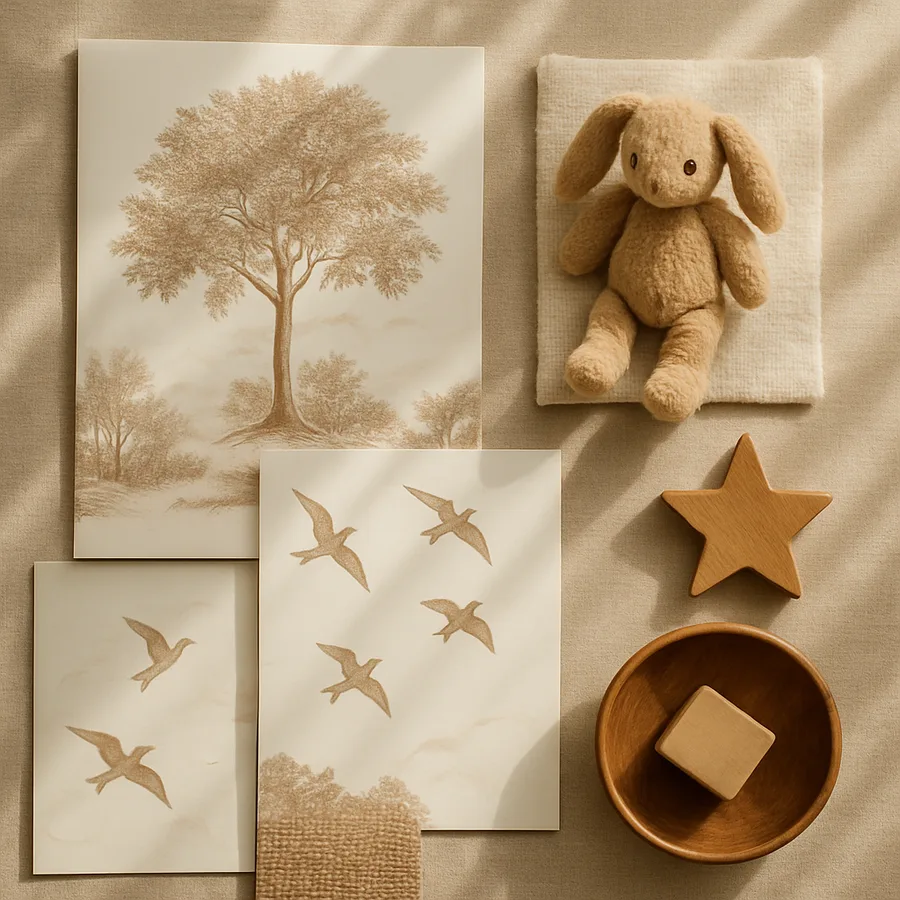
The mural subjects that hold up across early childhood share a common quality: they are real things rendered beautifully, not cartoonish versions of things. A mural of a botanical illustration of native ferns ages well. A mural of a smiling cartoon caterpillar does not. A topographic map of a mountain range ages well. A mural of a unicorn jumping over a rainbow does not. The principle is consistent: representation that respects the subject reads as sophisticated at every age.
The strongest categories for nurseries that grow up gracefully are botanical and natural history illustrations, landscape paintings, maps and cartographic art, abstract patterns, and architectural renderings. All five categories are genuinely interesting to look at as an adult, which is most of what makes them interesting to a child as well. Children read parental energy more than design theory, and a mural their parents genuinely enjoy looking at is a mural the child will absorb as legitimate art rather than as decoration aimed at them.
Avoid mural subjects that are specifically childlike - cartoon animals with oversized eyes, primary-color ABC patterns, fairy-tale scenes with sparkles. These are not bad choices for a baby; babies do not care. But they become the wallpaper your six-year-old asks you to take down, and removing wallpaper at six is more expensive and disruptive than choosing wisely at zero. The Better Homes & Gardens kids' room archive consistently recommends "art a parent would hang" as the test for any nursery decor with a multi-year lifespan.
Get the Scale Right
Scale is the single most overlooked dimension of mural selection. A mural with a pattern that repeats every 12 inches feels busy and overwhelming on a full wall, while a mural with a single dominant image scaled to the wall reads as art. As a general rule, the focal element of the mural should occupy roughly 40 to 60 percent of the wall, leaving generous breathing room around it.
For a standard nursery wall - typically 8 to 10 feet tall and 10 to 14 feet wide - this means a hero element of roughly 4 to 6 feet in its longest dimension, surrounded by quieter background or negative space. Murals that fill the wall edge-to-edge with detail look impressive in catalog photos but feel claustrophobic in a real room with furniture in front of them. The American Society of Interior Designers, known as ASID, has emphasized that scale is most often the difference between a mural that elevates a room and one that overwhelms it.
Pay attention to the ceiling line and crib position when planning scale. A crib placed against the mural wall will block roughly the bottom 36 inches of the mural, so put any important detail above that line. Above the crib, a parent leaning over to lift the baby will see the mural at close range - design choices in that zone read most strongly. The transition from "useful at the crib" to "decorative at the ceiling" is where great mural placement happens.
Pick a Color Palette for Long-Term Living
Murals come in palettes that range from very soft to very saturated. The instinct in a nursery is to go soft - pale pinks, pale blues, pale greens - because these read as gentle and calming. The problem is that very pale palettes also read as very babyish, and they limit what other colors you can introduce as the room evolves.
The most versatile mural palettes for nurseries are muted earth tones, moody jewel tones with neutral grounds, and monochromatic palettes in a single color family with high tonal variation. Forest greens, terracotta, dusty blues, warm grays, and deep botanical greens all photograph beautifully in a baby's room and continue to look intentional in a six-year-old's room. They also pair with virtually any furniture or bedding choice, which is critical because furniture and bedding will change multiple times during the years the mural stays up.
Avoid pure pastels and avoid neon. Pastels date quickly because they signal "baby" so strongly, and neon overwhelms the soft tones of nursery furniture and textiles. A 2025 paint industry color forecast noted that the strongest-performing colors for children's rooms across multiple age groups are sage green, terracotta, dusty rose, and warm putty - colors with enough chroma to feel rich but enough neutrality to age well.
Decide Between Removable and Traditional
The wallpaper category has split into two distinct technologies: traditional paste-the-wall paper and peel-and-stick removable vinyl. They look superficially similar in the showroom but behave very differently in the room and over time.
Traditional paper, properly installed, is the higher-quality finish. The texture is paper-like, the seams are nearly invisible, and a quality install lasts 10 to 15 years without lifting or fading. The downside is that installation is a real skill and removal requires steam, scoring, and patience. For a nursery you intend to keep as a child's room through age ten or older, traditional paper is the right investment.
Peel-and-stick removable vinyl is the better choice for renters, for parents who expect to change the mural in a few years, and for parents who want to install the mural themselves. The texture is slightly more plasticky than paper, the seams are more visible at close range, and the lifespan is shorter - typically 3 to 7 years before the adhesive begins to lift at edges. But it removes cleanly, often with no wall damage, and you can replace it without the construction-grade hassle of traditional removal. The U.S. Consumer Product Safety Commission has documented some adhesive concerns with very low-quality peel-and-stick products, so the CPSC's broader guidance on chemical safety in children's environments applies - buy from reputable manufacturers and verify any safety certifications.
Verify the Material Is Safe for a Baby's Room
Wallpaper sits in a baby's environment 24 hours a day for years, which makes the material chemistry matter. The two specifications to look for are VOC-free or low-VOC inks and certifications that confirm independent testing. Volatile organic compounds off-gas from inks and adhesives, and a poorly chosen wallpaper can contribute to indoor air quality problems for months after installation.
GREENGUARD Gold certification is the gold standard for children's environments - it limits emissions to levels considered safe for sensitive groups including infants. Many premium nursery wallpaper brands now carry this certification specifically because parents are asking. The American Academy of Pediatrics has emphasized indoor air quality as a meaningful factor in infant respiratory health, and choosing certified low-emission materials is one of the higher-leverage decisions in a nursery.
Also consider the adhesive separately. Peel-and-stick murals use a backing adhesive that stays in place for the life of the install, while paste-on murals use a separately purchased adhesive that varies widely in toxicity. Wheat-based and starch-based adhesives are the lowest-VOC options for traditional wallpaper, while some synthetic adhesives off-gas significantly. Ask the installer or the retailer specifically what adhesive they use, and request a low-VOC alternative if needed. Standards from organizations like ASTM govern many aspects of consumer paint and finish chemistry, and reputable wallpaper manufacturers will reference relevant compliance documentation on request.
Plan the Install for Real-World Conditions
A great mural badly installed becomes a daily eyesore. Plan the install carefully and, if you are not confident in your skills, hire a professional. The cost of professional installation for a single accent wall is typically $200 to $500 - much less than the cost of redoing the install yourself if it goes wrong.
Prepare the wall properly. The wall must be smooth, clean, and primed with a wallpaper-grade primer. Patch any holes, sand any rough spots, and let the primer cure for the full recommended time before installation. Skipping prep is the single most common cause of mural failure - adhesive lifts, seams open, and bubbles appear within months. The fifteen minutes you save by skipping prep cost you the entire install.
Plan the seam locations deliberately. Most large murals come in panels of 24 to 36 inches wide that are installed side by side. The seams should fall in unobtrusive locations - not down the center of the focal image, not at eye level when standing at the crib. A good installer will dry-fit the panels before adhering anything to confirm the seam placement works with the wall and the furniture layout. If you are installing yourself, lay the panels on the floor first and rehearse the install before any panel touches the wall.
Choose your install timing carefully. Wallpaper installation produces noticeable adhesive odor for the first 24 to 72 hours, even with low-VOC products, and a baby should not sleep in the room until the smell has fully dissipated. Plan the install at least two weeks before the baby's expected arrival, with the windows open during installation and for several days afterward. If you are doing the work after the baby is already in residence, plan a temporary sleep relocation for at least three nights and air the room aggressively before returning. The convenience of a quick weekend install is not worth the air quality compromise to a developing respiratory system.
Document the install for the future. Take clear photos of every panel, including the order of installation, the seam locations, and any trim adjustments you made. Save these alongside the original purchase information and any leftover panels. If the wall is damaged in five years - by a piece of furniture, by a door swung too hard, by the inevitable toddler with a marker - you will be able to patch the affected area rather than replacing the entire mural. Many parents discard the leftover scraps from a mural install assuming they will never need them; those parents are usually wrong, and the unscarred patch material is the difference between a quick repair and a full re-do.
Conclusion
A great nursery mural is a piece of furniture-grade decor that should serve the room for years. The choices that matter - subject, scale, palette, material, install - all bend toward longevity rather than babyhood. Choose a subject your child will still find interesting at five. Scale the focal element to leave breathing room. Pick a palette that pairs with whatever the room becomes. Verify the materials are safe for sustained close exposure. Install with the patience the wall deserves.
The murals that fail are not failures of taste; they are failures of time horizon. A parent who chooses for the newborn period will choose pastels and cartoons, and that parent will be repainting in three years. A parent who chooses for the four-year-old period will choose botanical art and earth tones, and that parent will have a wall the child grows into rather than out of. Both choices are valid. Only one of them is likely to still be hanging at the end of preschool.
Two questions worth asking before you commit: Would I hang this mural in a room that was not for a baby? If yes, it will probably age well. Will my child want to choose their own decor at age six, and what will they think of this then? The answer is honest only if you imagine your child as a person with opinions, which they will be sooner than you think.
Order a sample first. Most reputable wallpaper makers ship 8x10-inch samples for under $10. Tape three or four candidates to the wall, live with them for a week, and notice which one your eye keeps returning to. The mural that wins that quiet test is the mural worth committing to, because the wall it lives on will become part of your family's daily landscape for years.
More Articles You May Like



Comments
Post a Comment