Interior Dutch Doors as Charming Nursery and Pantry Entries
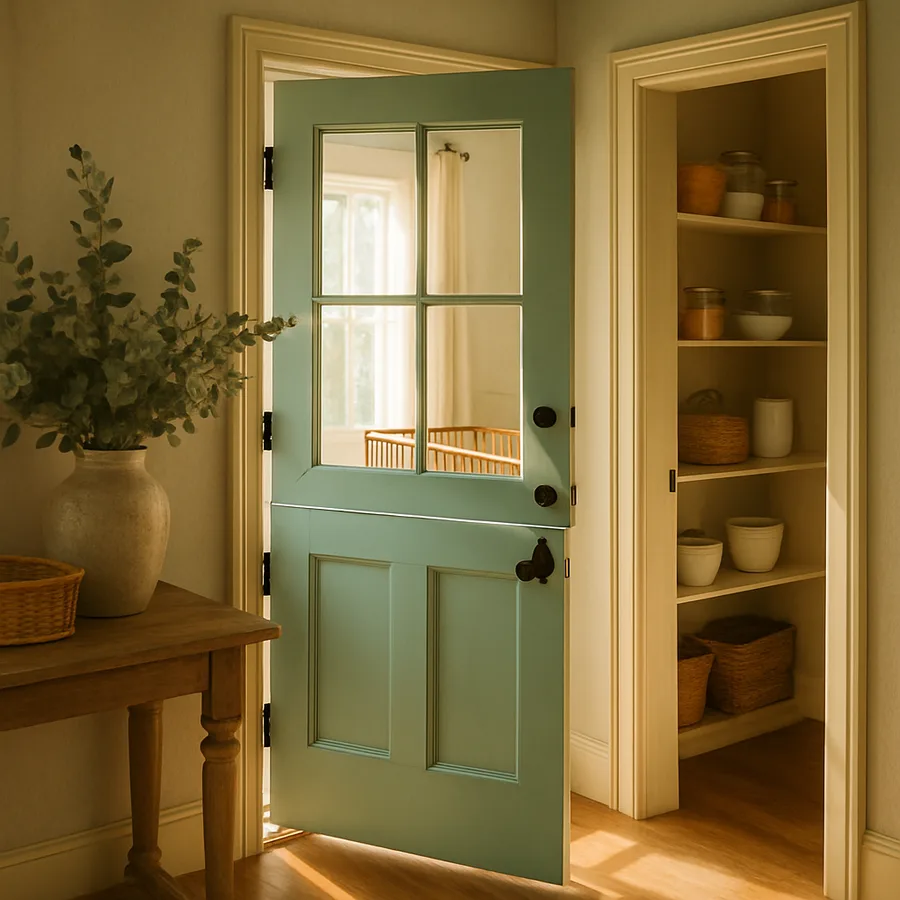
Few architectural details carry as much storybook weight as an interior Dutch door, and few solve so many quiet domestic problems at once. Splitting a doorway into upper and lower leaves used to be a pragmatic solution to keeping livestock out and fresh air in. Today the same geometry has migrated indoors, where it has become a beloved feature for two of the most surveillance-sensitive rooms in any home: the nursery and the walk-in pantry. In both spaces, the half-open posture of a Dutch door turns a simple threshold into a living window, letting parents listen for a fussing infant or a chef monitor a pre-warming oven without surrendering the privacy and containment that solid doors provide.
The American Time Use Survey from the U.S. Bureau of Labor Statistics has documented for years that parents of young children spend more than 7 hours per day in caregiving and food-related activities combined, much of it in or near the kitchen. That overlap is exactly where Dutch doors earn their keep. Charm is the obvious selling point, but the sustained appeal of these doors comes from how often they save a trip across the house, how reliably they soften the acoustic transition between busy and quiet zones, and how cleanly they integrate with the rest of a thoughtfully designed home.
Why a Nursery Calls for the Dutch Door Geometry
A nursery has competing requirements that a single solid door rarely resolves. Parents want to hear a baby breathing without standing in the doorway. They want airflow without leaving the door wide open to a curious household pet. They want to enter quietly during nap windows without the whoosh of a fully swung slab disturbing a sleeping infant. The split-leaf design addresses each of these in a single elegant detail. Open the upper leaf and the room ventilates while the lower leaf still blocks the family dog. Crack the upper leaf an inch and ambient sound leaks through to the hall, supplementing electronic monitors with the low-tech reliability of an open ear.
Pediatric sleep specialists affiliated with the American Academy of Pediatrics have long emphasized that consistent sleep environments support infant rest. The Dutch door supports that consistency by allowing parents to check on a child with minimal door movement, reducing the bright hallway light wash that often wakes light sleepers. Have you considered how many times a night you currently open the nursery door fully just to glance inside? For many parents the answer is well into double digits, and replacing a swing door with a Dutch door eliminates most of those disruptions because a quick lean over the lower leaf delivers the same information.
The geometry also supports older infants and toddlers as they transition out of the crib. The closed lower leaf prevents a newly mobile child from wandering into a hallway without parental knowledge while the open upper leaf preserves the warm presence of the household soundscape. Many families report that the visible upper opening reduces separation anxiety because the child can hear and occasionally see the parent moving about the home.
Pantry Doors That Earn Their Place
Pantries have evolved from afterthought closets into the secondary command centers of modern kitchens. A Dutch door at a walk-in pantry entry pulls double duty: it offers visual access to inventory while you cook, and it physically blocks pets, toddlers, and stray dust from reaching open packaged goods. The open upper leaf becomes a serving surface during entertaining, where guests can pass refilled platters across the meeting rail without entering the working zone. How often do you cook from memory only to find yourself peeking into the pantry mid-saute? A glassed upper leaf removes that interruption entirely, since a quick glance from the cooktop reveals shelf contents without breaking your stance.
Functionally, pantry Dutch doors solve a humidity problem that solid doors create. Closed pantries can develop subtle moisture pockets from canned goods, root vegetables, and warm appliance exhaust drifting under the slab. Leaving the upper leaf cracked through the day allows the pantry to breathe with the rest of the kitchen, reducing the conditions that attract pantry moths and accelerate stale-goods turnover. Energy auditors who follow the U.S. ENERGY STAR indoor air guidance often note that small ventilation pathways between conditioned interior rooms reduce trapped-moisture issues without measurable penalty to whole-home efficiency.
For households that lean into vintage detailing, a pantry Dutch door painted in a saturated heritage color and trimmed with bin pulls becomes an unmistakable focal point. Designers operating within the American Society of Interior Designers network frequently use the pantry door as the punctuation mark of an otherwise restrained kitchen, where the half-open silhouette telegraphs a working, lived-in space.
Sizing the Split for Visual Balance
The default 50/50 split through the middle of an 80-inch door rarely produces a satisfying nursery or pantry result. For nurseries, dropping the meeting rail to roughly 36 to 40 inches gives a generous upper opening that delivers light and sound while keeping the lower leaf at toddler-shoulder height. For pantries, raising the meeting rail to 44 to 48 inches creates a comfortable counter-height pass-through where serving platters can rest momentarily during a hectic dinner service. Either way, the meeting rail height should be confirmed against the actual humans and pets who use the room rather than against catalog defaults.
Trim profile matters more than first-time buyers expect. A Dutch door is essentially two doors that must align perfectly when closed, and any drift in the meeting rail telegraphs across the room. Specify a flat T-astragal with a rabbeted overlap to accommodate seasonal wood movement without binding. Plan the trim casing so the visual weight at the head and feet of the frame balances the meeting rail, otherwise the door reads as off-center even when it is technically square. The American Institute of Architects publishes detailing guides that walk through how casing widths interact with door splits, and any thoughtful millwork shop can produce a sample frame before final commitment.
Glazing, Light, and Privacy Tradeoffs
Solid Dutch doors carry strong farmhouse character but starve adjacent hallways of borrowed light. A half-glazed upper leaf, traditionally divided into a six- or nine-light grid, opens up the visual field while maintaining the option of closing both leaves for full enclosure. Frosted or seeded glass softens views into a nursery without darkening the room, an especially helpful option for nurseries that share a wall with a brightly lit hallway. Some designers specify a tilt-and-turn glazing element on the upper leaf, which lets parents ventilate from the top edge without fully opening either leaf, a neat trick during cold-weather midnight feedings.
Pantry glazing follows different logic. Clear glass on the upper leaf provides at-a-glance inventory checks but reveals every shelf chaos to dinner guests. Reeded or fluted glass preserves the half-door silhouette and ventilation benefit while blurring contents into pleasing vertical stripes. How tidy do you actually keep your pantry shelves on a busy Tuesday? Honest answers should drive glazing choice. For most households, reeded glass is the right compromise between the romance of a glassed pantry and the reality of weeknight stockpiles.
Hardware Choices That Support Daily Use
Nursery and pantry Dutch doors share several hardware priorities. The shootbolt that locks the leaves together for full swing operation must operate quietly so it does not wake sleeping children or interrupt conversation in the kitchen. Choose a forged brass or solid stainless shootbolt with a soft-detent action rather than a spring-loaded snap. A magnetic catch on the lower leaf holds it shut without requiring the latch to engage on every pass-through, which extends the latch's life dramatically and prevents the household from training itself to leave the lower leaf ajar.
For nurseries, install handles at adult height with a child-safe shootbolt key kept on a hook just outside the door. This prevents a curious toddler from learning the trick of releasing the upper leaf and climbing through. For pantries, the lower leaf benefits from a shelf on top of the meeting rail, ideally six to eight inches deep, which serves as a counter for setting down a serving bowl while you grab one more ingredient. Avoid extending this shelf far enough that a determined cat can leap onto it and access the pantry interior.
Cost, Lead Times, and Working with the Right Trades
Custom interior Dutch doors typically cost between 2,000 and 5,000 dollars installed, depending on species, glazing, and hardware. Pre-hung catalog options can land closer to 900 to 1,800 dollars but require careful jamb verification because Dutch doors amplify any out-of-square framing. Lead times for custom millwork have stretched in recent years; the National Association of Home Builders trade surveys regularly note custom door lead times of 8 to 14 weeks for higher-end shops, so plan early if the door is part of a nursery prep timeline.
Engage a trim carpenter who has installed at least three Dutch doors before, ideally with photographs of completed work. The hinge alignment, meeting rail planing, and shootbolt mortise work do not forgive shortcuts. Many remodelers credentialed through the National Association of the Remodeling Industry publish portfolio examples on their member pages, which simplifies vetting. If your home has settled or has known framing irregularities, ask the carpenter to scribe and shim the rough opening before the door arrives so install day proceeds on a square reference.
Budget for a follow-up visit four to six weeks after installation. Wood doors move with humidity, and the meeting rail almost always benefits from a small adjustment after the first seasonal swing. Reputable shops include this service in the original quote. The U.S. Department of Energy publishes ambient humidity targets for residential interiors that, if maintained with a whole-home humidifier, dramatically reduce the magnitude of that seasonal movement.
Color and finish strategy compounds the long-term satisfaction. A nursery Dutch door painted in a soft heritage tone reads as gentle and warm, while a pantry Dutch door in a saturated jewel color becomes a punctuation mark in an otherwise neutral kitchen. Specify a high-quality acrylic enamel or alkyd paint with a satin or semi-gloss sheen so fingerprints, formula spills, and floury hands wipe clean without leaving residue. Avoid flat finishes on either door because they hold dirt aggressively and require touch-up painting on a tight cycle. The American Society of Interior Designers recommends specifying paint product, sheen, and exact color name on a printed schedule kept with the homeowner manual so future repaints maintain the original finish without guesswork.
Conclusion
An interior Dutch door is one of those rare details that delivers practical value and stylistic charm in nearly equal measure. In a nursery, it lets parents listen, glance, and ventilate without the disruption of a full swing. In a pantry, it offers visual inventory access, ventilation, and a serving pass-through that elevates everyday cooking and special-occasion entertaining alike. The split geometry rewards the small daily moments that solid doors interrupt, and it accumulates that benefit over thousands of pass-throughs each year.
The fundamentals are simple but unforgiving. Size the meeting rail to the humans and pets who actually use the room. Specify forged hardware and quiet shootbolts. Choose glazing that respects how the room will look during real life rather than catalog photography. Engage a carpenter with documented Dutch door experience and budget for a seasonal adjustment. Each decision compounds into a door that performs as beautifully on its tenth birthday as it did on installation day.
If a nursery or pantry remodel is on your near-term horizon, request samples of meeting rail profiles, glazing options, and hardware finishes from a credentialed millwork shop this month. Walk through the existing doorway with a tape measure and note where your eye, your child's eye, and your pet's nose actually land. Bring those measurements into the design conversation so the resulting door reflects your household, not a generic template, and you will end up with a threshold that earns its charm every time you pass through.
More Articles You May Like



Comments
Post a Comment