Removable Wallpaper in Closets and Cabinet Interiors for Fun
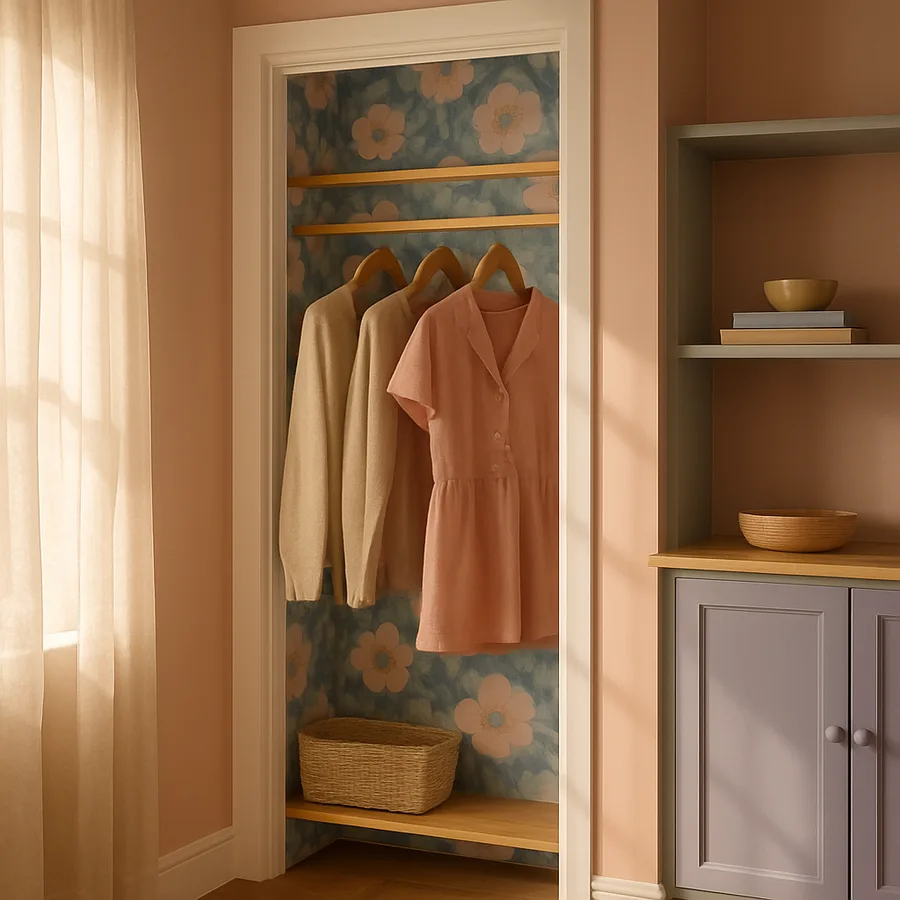
There is a particular kind of joy that hits when you open a kitchen cabinet and see a sky-blue toile pattern lining the back panel. It is a private design moment, invisible to guests until you open the door, and that secrecy is exactly what makes it delightful. The interior of a cabinet, the back wall of a coat closet, the underside of an open shelf - these are the surfaces nobody thinks to decorate, and they are precisely where removable wallpaper earns its most charming work.
This is not a new idea. Pattern-lined drawers and closets show up in interiors from the Victorian era, when wealthy households used silk and printed paper to dress storage spaces. What is new is the accessibility. Peel-and-stick technology means you no longer need a wallpaper paste table, an extra set of hands, or a weekend. You need a roll, a ruler, and about thirty minutes per cabinet. According to a 2023 Houzz industry survey, nearly 41 percent of homeowners and renters who completed a kitchen refresh in the past year added some form of decorative liner to interior surfaces, a category that has grown each year since the survey began tracking it.
Why Hidden Surfaces Are the Best Place to Take Risks
Walls are public. Cabinet interiors are private. That distinction changes the design calculus entirely. On a public wall, you naturally hedge toward patterns that will read well in photos, please your guests, and not exhaust you at month six. Inside a closet, none of those constraints apply. You can choose a pattern so saturated, so maximalist, or so unexpected that you would never put it on a visible surface, because the only person it needs to please is you.
This freedom matters more than design writers usually admit. House Beautiful ran a feature in 2024 on what it called the rise of the secret-pattern aesthetic, profiling homeowners who used loud florals, vintage botanical prints, and even custom photo wallpapers inside cabinetry. The unifying theme was personal joy. One designer interviewed described it as the interior equivalent of wearing a great pair of socks under a conservative suit.
Have you ever opened a friend's closet and felt the small shock of seeing a pattern you would not have expected? That tiny surprise is what hidden-surface wallpaper delivers, and it costs almost nothing.
The Best Cabinets and Closets to Line
Not every interior surface is equally rewarding. Some give you a daily dose of pleasure. Others give you a one-time hit and then disappear into routine. The most rewarding candidates share a few characteristics. They open frequently, they have a clean back panel without too many shelves obstructing the view, and they are at eye level or above so the pattern reads at a glance.
The kitchen pantry is the runaway favorite. You open it multiple times a day, the back wall is usually a single uninterrupted plane, and a soft pattern behind your jars and boxes adds visual order to what is often a chaotic space. Glass-front cabinets are the opposite of hidden, but lining the interior back panel turns them into curated displays where every plate or glass sits against an intentional backdrop. Better Homes and Gardens highlighted this technique in a 2024 kitchen feature, noting that it adds the perceived value of custom millwork at a fraction of the cost.
Coat closets are underrated. They are usually painted a flat builder white, lit by a single bare bulb, and they greet you and your guests at the front door. A patterned back wall transforms a utility space into a small moment. Linen closets benefit similarly, especially if you keep folded towels and sheets in coordinating colors that sit in front of the pattern like a still life.
Pattern and Scale: What Works Inside a Small Space
The instinct most people have is to choose small-scale prints because the space is small. The opposite is usually true. Inside a confined area, a small busy print can feel claustrophobic, while a medium or even large-scale pattern feels expansive because your eye reads fewer repeats and the print breathes. The American Society of Interior Designers has published guidance for small-space treatments suggesting that pattern repeats roughly equal to the width of your hand often work best inside cabinetry.
Color saturation is the second variable. Inside a cabinet, you have very little ambient light, so colors read darker than they did on the sample swatch. If you fall in love with a soft sage in the showroom, expect it to look closer to forest green inside a cabinet lit by a single bulb. Either embrace this and choose deliberately light or warm patterns, or install a battery-operated puck light inside the cabinet to bring the color back to its true value. The puck light trick is a small upgrade that pays disproportionate dividends.
Pattern direction matters too. Vertical patterns make a tall narrow cabinet feel taller. Horizontal patterns widen a short wide one. Apartment Therapy has covered this principle extensively in its small-space guides, and the rule applies inside cabinetry exactly as it does on full walls. Match the pattern direction to the proportion you want to emphasize.
Brands and Sources Worth Knowing
For small projects, you do not need a full roll. Several brands now sell pre-cut peel-and-stick panels specifically sized for shelves and cabinet backs, which eliminates waste and brings the per-project cost under twenty dollars. Chasing Paper sells what it calls peel-and-stick samples in two-foot squares, perfect for a single cabinet back. Spoonflower offers a swatch program where you can buy a small panel, and its custom-print option means you can use a beloved photograph or a piece of family artwork as the lining.
For higher-end projects, Schumacher and Cole and Son have begun licensing select archival patterns to peel-and-stick manufacturers, putting designer-grade prints into the removable category for the first time. The price per square foot is higher than the entry-level brands, but for a single cabinet you might use less than ten dollars of paper, making a museum-quality pattern surprisingly affordable.
Which brand is right for your project? It depends on the surface. Painted MDF cabinet interiors take adhesive beautifully and forgive most brands. Raw plywood, common in older or builder-grade cabinetry, is grippy and can cause adhesive to bond too aggressively. For raw plywood, choose a higher-quality woven substrate that releases more easily, or apply a single coat of primer and a topcoat of satin paint before installing the wallpaper.
A Step-by-Step Approach for a First-Time Project
Choose a small cabinet for your first attempt. The pantry door interior is ideal because it is flat, accessible, and forgiving. Measure the back panel exactly, then cut your wallpaper panel about half an inch larger on every side. The trim allowance gives you wiggle room to align without committing to a final cut prematurely.
Wipe the surface with a microfiber cloth and let it dry. Peel the backing back about eight inches, position the top edge against the top of the cabinet panel, and press lightly. Slowly peel the backing away while smoothing the paper with a felt squeegee or a soft cloth, working from the center toward the edges. The trick inside cabinetry is to avoid pressing too hard before alignment, because once peel-and-stick is firmly stuck, repositioning is fiddly.
Once the panel is flat and aligned, trim the excess with a sharp utility knife guided by a metal ruler. Use a fresh blade and replace it after the first two cuts to keep edges crisp. The whole process for a single cabinet back, start to finish, takes about twenty to twenty-five minutes once you have done it a few times. Better Homes and Gardens and Architectural Digest both publish how-to guides aligned with this approach, and the consensus method works equally well for closets, drawer bottoms, and the back walls of bookshelves.
Maintenance, Removal, and Refreshing the Look
Inside cabinets, peel-and-stick wallpaper sees almost no traffic, which means it lasts essentially forever in terms of wear. The main maintenance issue is humidity in kitchens and bathrooms, which can lift edges over time. A small dab of clear-drying craft glue under any lifted edge solves the problem in seconds. Wipe the surface occasionally with a slightly damp cloth to keep dust from settling into the pattern.
Removal works the same way it does on walls. Lift a corner with a fingernail or the tip of a butter knife and pull the panel away at a low angle, around forty-five degrees. Cabinet interiors typically release more easily than walls because the surface is usually melamine, painted MDF, or finished plywood, all of which bond less aggressively than drywall. Any residual adhesive lifts with a damp microfiber cloth and a drop of dish soap.
Refreshing the pattern is part of the appeal. Where you would commit to a wall pattern for years, you can change a cabinet liner every season if the spirit moves you. Some homeowners line different cabinets in different patterns, treating the kitchen as a small gallery of design moments. Are you the kind of person who would enjoy a different pattern in every cabinet, or would that feel chaotic? Both answers are valid, and the low cost of the project means you can experiment without consequence. Architectural Digest has profiled designers who treat cabinetry as a rotating gallery, and the technique adds personality that paint alone cannot deliver.
Conclusion
Lining a closet or cabinet interior with removable wallpaper is one of the smallest design projects you can take on, and it returns disproportionate joy. The cost is low, the installation is fast, the removal is clean, and the result is a private design moment that belongs to you and the people you let into your private spaces. Hidden surfaces are the right place to take pattern risks because the consequences of a bold choice are limited to the few seconds you spend opening a door.
For your first project, pick the surface you open most often. The pantry, the bathroom medicine cabinet, the entry coat closet - these are the spots where a small dose of pattern delivers a daily lift. Choose a print at a slightly larger scale than your instinct suggests, account for the dim interior light, and use a fresh blade for clean trim cuts. The investment is under thirty dollars and under an hour, and the satisfaction lasts for years.
Ready to add a small dose of joy to your storage spaces? Order a single peel-and-stick sample panel from Chasing Paper or Spoonflower, line one cabinet, and see how it feels before you commit to more. Subscribe to our weekly newsletter for project ideas, brand reviews, and printable cutting guides that take the guesswork out of small wallpaper projects.
More Articles You May Like

Comments
Post a Comment