Peel-and-Stick Wallpaper on Stair Risers for a Quick Upgrade
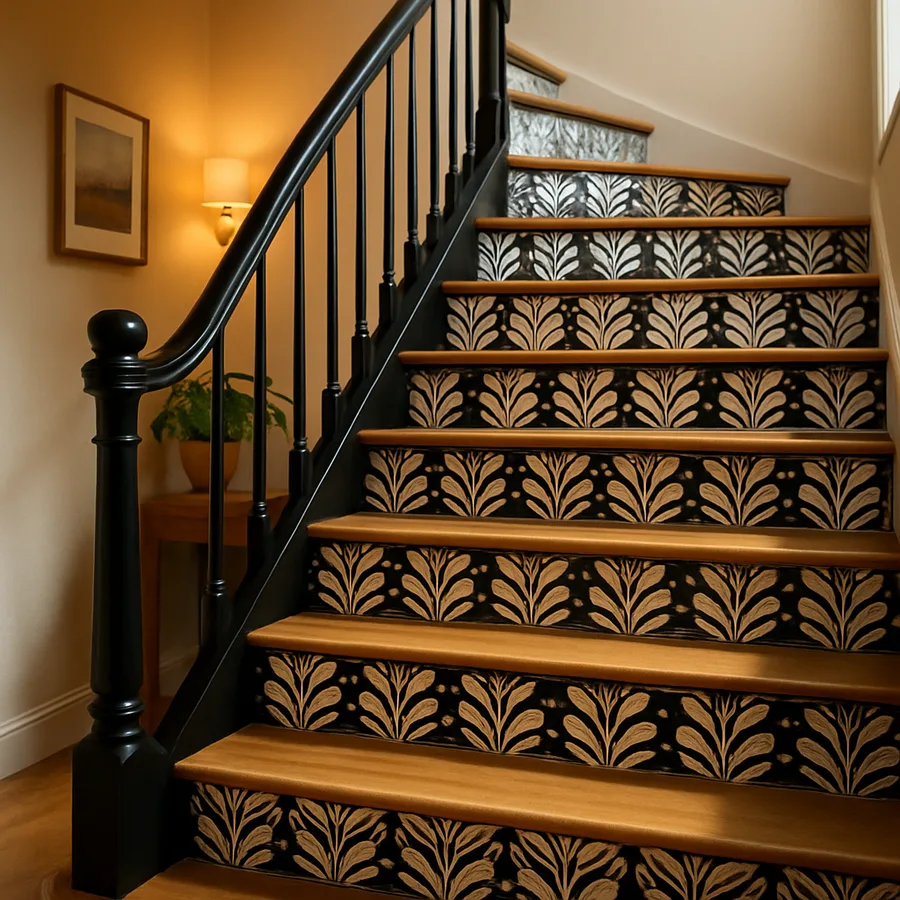
Stair risers are one of the most overlooked surfaces in a home. They are the small vertical panels between each tread, usually painted whatever color the trim happens to be, and they pass through life invisibly until somebody decides to make them into a feature. When that happens, a flight of stairs stops being a circulation path and becomes a piece of architecture. Peel-and-stick wallpaper on stair risers is one of the fastest, most affordable ways to make that transformation, and it works whether you live in a Victorian rowhouse with thirteen steep treads or a midcentury split-level with a half-flight to the family room.
The technique has deep design roots. Patterned stair risers appear in Moroccan riads, Portuguese azulejo houses, and English Arts and Crafts cottages going back more than a century. The contemporary version uses peel-and-stick technology to deliver the same visual richness without ceramic tile, without traditional wallpaper paste, and without the commitment that stops most homeowners from attempting it. According to a 2024 reader survey conducted by Better Homes and Gardens, projects that visually transform an entryway or staircase rank in the top five most-shared content categories on its platform, with stair riser projects specifically driving disproportionate engagement.
Why Stair Risers Reward Pattern More Than Almost Any Other Surface
Most surfaces in a home reward pattern in moderation. Stair risers reward pattern in abundance, and the reason is geometric. Each riser is a small rectangle, typically seven inches tall by thirty to forty inches wide. That is a very contained canvas, which means even a bold or busy pattern reads as charming rather than overwhelming. The repetition of multiple risers stacked vertically also turns a single pattern choice into a rhythmic visual pulse, like a strip of wallpaper but framed by the wood treads above and below.
This containment is what allows risers to handle pattern choices that would feel excessive on a wall. Saturated florals, intricate Moroccan tile reproductions, layered geometrics, even hand-painted-looking watercolors all work on risers because the eye sees them in small doses rather than as a continuous field. House Beautiful has profiled designers who treat the riser as the most flexible decorative surface in the house, precisely because the constrained format gives even amateur designers a high probability of a good outcome.
Have you ever been to a home where the stairs themselves became the conversation piece? That is what patterned risers do, and the project is achievable in a single afternoon for under one hundred dollars on most domestic staircases.
Choosing a Pattern Strategy: Matching, Mixing, or Telling a Story
There are three established strategies for designing patterned risers, and choosing among them is the most important decision in the project. The first is the matching strategy, where every riser uses the same pattern. This is the easiest to execute and produces a unified architectural feature that reads as designed rather than improvised. The matching strategy works well in formal homes, in homes with traditional millwork, and in any context where you want the stairs to feel like a single deliberate gesture.
The second is the mix-and-match strategy, where each riser uses a different but coordinating pattern. This approach has been popularized by designers in Mediterranean revival homes and bohemian interiors, and it requires more curatorial discipline than it appears. The patterns must share a common color palette and a similar visual weight, or the staircase looks chaotic rather than intentional. The American Society of Interior Designers has published guidance on coordinating multiple patterns, and the consistent advice is to limit the palette to three or four colors that repeat across all patterns even when the motifs differ.
The third is the storytelling strategy, where the pattern progression tells a small narrative as you climb the stairs. A common version starts with quieter patterns at the bottom and escalates to bolder ones at the top, drawing the eye upward. Another version groups patterns by color so the staircase moves through a deliberate gradient. Architectural Digest has featured several Brooklyn brownstones using this approach, and the consensus from interviewed designers is that the storytelling strategy requires the most planning but produces the most memorable result.
Surface Preparation That Matters Specifically for Risers
Stair risers are usually painted wood, painted MDF, or in older homes, plaster on wood lath. All three substrates can accept peel-and-stick wallpaper, but each has quirks worth knowing. Painted wood and MDF are the easiest, requiring only a wash with mild soap and water followed by a thorough dry. The adhesive bonds reliably to satin and eggshell paint, while semi-gloss paint can sometimes resist adhesion until it is lightly scuff-sanded with a fine-grit sponge.
Plaster risers in older homes deserve more attention. The surface may be pitted, slightly powdery, or finished in a chalky paint that releases small amounts of pigment when rubbed. If you can wipe the surface with a damp cloth and see white residue on the cloth, the wall needs a coat of primer before peel-and-stick will adhere reliably. A single coat of acrylic primer dries in two hours and solves the problem permanently.
Inspect each riser for cracks, paint chips, or proud nail heads before you start. Any imperfection larger than a hairline will telegraph through the wallpaper, sometimes immediately and sometimes weeks later as the adhesive settles. Spackle small imperfections, sand smooth, and touch up with paint at least twenty-four hours before applying paper. This inspection step takes ten minutes per staircase and prevents the most common cause of disappointment in riser projects.
Cutting and Installing Without the Math Headache
The most intimidating part of a riser project is the math. Every riser is a slightly different height, every staircase has a different number of steps, and the temptation to over-plan can stop a project before it starts. The simpler approach is to measure one riser, cut a paper test panel, and use it as a template for the rest. Most staircases have risers within an eighth of an inch of one another, so a single template works for the whole flight with minor trim adjustments at the top and bottom.
Cut each panel slightly oversized, about half an inch larger than the measured riser on every side. Apply the panel by aligning the top edge first, smoothing downward with a felt squeegee or soft cloth, and trimming the excess with a sharp utility knife guided by a wide putty knife held flush to the tread. The trim cut is what separates a finished-looking riser from a homemade one, so use a fresh blade and replace it after every two or three risers.
For staircases with carpeted treads, the carpet often slightly overhangs the riser, which complicates the trim cut. The cleanest solution is to cut the wallpaper to the visible riser height plus a quarter inch, then tuck the bottom edge under the carpet overhang with a stiff putty knife. This hides the cut edge entirely and gives the riser a finished look that competes with custom millwork.
Patterns and Brands That Work Especially Well on Stairs
Not every wallpaper pattern translates to risers. The best riser patterns share a few qualities. They have a clear central motif that reads at small scale, they are not so directional that they look strange on a wide horizontal panel, and they hold visual interest even when repeated dozens of times in close proximity. Moroccan tile reproductions, encaustic cement tile patterns, vintage botanicals, geometric grids, and watercolor florals all tend to perform well in this application.
For brands, Spoonflower deserves special mention because its custom-print option lets you order risers in patterns scaled specifically for the dimensions of your staircase. Tempaper and Chasing Paper both stock Moroccan and tile-look patterns sized appropriately for risers. Wallpops, a budget-friendly brand sold widely at home improvement retailers, offers tile-look stair-riser kits specifically pre-cut for standard riser dimensions, which can save the cutting step entirely for renters and beginners.
Higher-end designers have also entered the space. Apartment Therapy has covered the rise of designer-licensed peel-and-stick patterns, and several major design houses now offer riser-friendly patterns through partnerships with peel-and-stick manufacturers. Whichever brand you choose, order one extra panel beyond what you calculate, because the redundancy gives you margin for cutting errors and patches if a riser is damaged years later.
Maintenance, Wear, and How Long the Project Lasts
Stair risers see one specific kind of wear that other wallpaper applications do not, which is incidental scuffs from shoes. Most peel-and-stick papers handle this well, especially vinyl or vinyl-coated substrates that resist marks. Wipe risers monthly with a damp microfiber cloth and a drop of dish soap to keep grime from accumulating, and address scuffs immediately with the same cloth before they set.
For high-traffic households, especially homes with kids, pets, and frequent visitors, consider a topcoat of clear acrylic sealer applied with a foam brush after installation. This adds a layer of physical protection and makes the surface fully wipeable, at the cost of slightly altering the matte finish of the wallpaper. The trade-off is usually worth it on well-trafficked stairs, and the sealer can be removed with the wallpaper when the time comes for a change.
Most riser projects look fresh for five to seven years before the homeowner is ready for a change anyway, regardless of physical wear. The peel-and-stick format means refreshing the look is a one-afternoon project, not a renovation. Better Homes and Gardens has interviewed homeowners who have refreshed their riser patterns three or four times over a decade, treating the staircase as a rotating design feature rather than a permanent installation. This reframing is one of the underrated benefits of the medium.
Conclusion
Patterned stair risers are one of the highest-impact, lowest-cost design projects available to a renter or homeowner, and peel-and-stick wallpaper has made the technique accessible to anyone with an afternoon and a sharp utility knife. The geometry of a staircase rewards pattern more than almost any other surface in a home, the repetition turns a single pattern choice into rhythmic architecture, and the relatively small surface area keeps both cost and risk low.
The choice of pattern strategy matters more than the choice of any specific pattern. A matching strategy delivers unified elegance, a mix-and-match strategy delivers bohemian character when the palette is disciplined, and a storytelling strategy delivers a memorable narrative experience for guests climbing the stairs. None of the three is objectively better, and the right one depends on the architectural style of your home and the personality you want the staircase to project.
Surface prep, careful trim cuts, and a fresh utility blade are the small disciplines that separate a professional-looking result from a charming one. None of them takes long. None of them costs much. All of them pay back disproportionately in how the finished staircase reads. With reasonable maintenance, the project lasts five to seven years, and refreshing the look later is a single afternoon's work.
Ready to give your staircase the personality it deserves? Measure one riser, count your treads, and order a single roll of peel-and-stick wallpaper in a pattern you love. Apply it to one riser as a test before committing the whole flight, and let it sit for a week. If the test panel still makes you smile after seven days, finish the staircase. Sign up for our newsletter for downloadable riser-pattern planners and curated brand recommendations across price tiers.
More Articles You May Like



Comments
Post a Comment