Walk-In Pantry Lighting From Motion Sensors to Display Spots
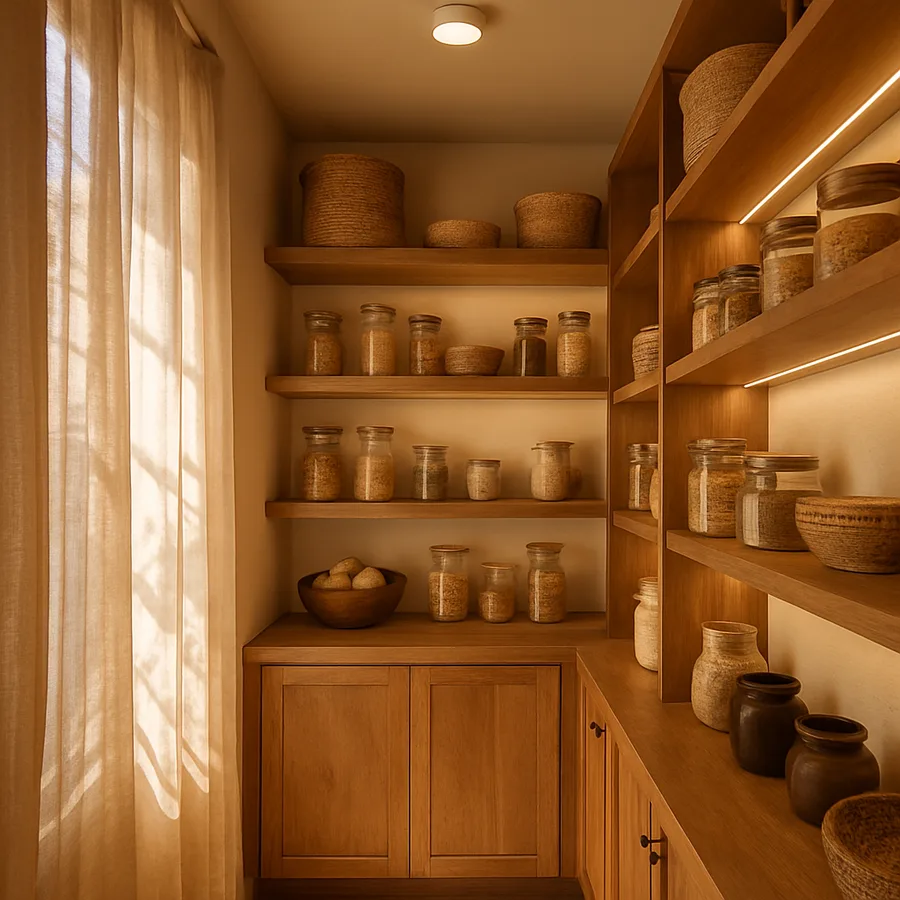
Walk-in pantries fail more often from poor lighting than from poor shelving. A pantry with twenty linear feet of beautifully built adjustable shelves is functionally useless if a single ceiling bulb casts shadows that hide the back third of every shelf. The fix is layered lighting designed around how people actually use the room: a hands-free overhead layer that activates the moment the door opens, an under-shelf task layer that eliminates cave-effect shadows, and an optional accent layer that highlights display-worthy contents. Done correctly the entire system costs less than two thousand dollars installed and transforms how often you can find what you stored.
This guide walks through the four lighting layers that belong in a serious walk-in pantry, the controls and sensors that make them effortless to use, the color temperature and color rendering choices that make food readable, the energy and code implications, and the installation sequence that integrates lighting with shelving without locking either one in place. By the end you will be able to brief your electrician with specifications precise enough to avoid the most common pantry lighting regrets.
Why Pantry Lighting Goes Wrong
The default lighting plan handed off by most builders consists of one ceiling-mounted fixture, usually a basic LED disc, controlled by a wall switch on the inside of the door jamb. That single fixture might deliver eight hundred to twelve hundred lumens, distributed in a roughly conical pattern that lights the floor and the front edge of shelves directly below the fixture. Every shelf above eye level and every shelf along walls perpendicular to the fixture position falls into shadow. The result is a pantry where the cook reaches in blindly and pulls out cans by feel.
The Illuminating Engineering Society (IES) recommends a minimum of thirty foot-candles at the working plane in residential storage spaces, with fifty foot-candles preferred where the contents include small text labels or ingredient lists. A single overhead fixture rarely delivers more than fifteen foot-candles at the back of a typical shelving wall, which is roughly half the IES minimum. The shortfall is not subtle. Anyone who has stood in a pantry trying to read a baking soda label past its expiration date has experienced exactly this failure.
The second common failure is color temperature. Builder-grade fixtures often install with warm white bulbs in the twenty-seven hundred kelvin range, which renders fresh produce, herbs, and packaged food in dull yellow tones that make freshness hard to judge. Pantries benefit from three to four thousand kelvin, which the National Kitchen and Bath Association (NKBA) documents as the preferred range for kitchen task surfaces because it renders food colors more accurately while staying warm enough to feel residential rather than commercial.
Layer One: Motion-Activated Overhead Ambient Light
The first layer is overhead ambient lighting controlled by a motion sensor rather than a wall switch. The reason is simple: anyone walking into a pantry is almost always carrying groceries, a casserole, or a stack of plates. Hands are full. A wall switch requires putting items down or balancing them awkwardly. A motion sensor solves that with no behavioral change required from the user.
For pantries up to forty square feet, two four-inch LED downlights spaced four feet apart along the centerline of the room deliver adequate ambient coverage. For pantries between forty and eighty square feet, three or four downlights spaced equally provide the necessary distribution. Each fixture should produce six hundred to nine hundred lumens at three thousand kelvin with a color rendering index above ninety. The CRI rating matters because it determines whether the apple in your hand will look like a real apple or like a faded photograph of one.
Motion sensors come in two configurations. Door-jamb-mounted sensors trigger when the door opens and turn off after a delay, which works well for narrow walk-ins where every entry uses the door. Ceiling-mounted occupancy sensors trigger on motion anywhere in the room and work better for larger pantries where someone might be standing motionless reading a label. Have you ever stood still in a pantry and had the lights snap off mid-task? That is the failure mode of an undersized occupancy sensor with too short a timeout. The fix is a fifteen-minute timeout rather than a five-minute one.
Layer Two: Under-Shelf Task Lighting
Even with strong overhead ambient light, the bottom of every shelf casts a deep shadow on the items below it. The fix is continuous LED strip lighting mounted to the underside of every shelf except the very top one. The strips throw light directly down onto the items below, eliminating the cave-effect shadows entirely and making every label readable from a comfortable standing position.
LED strip selection matters. The strip should produce at least four hundred lumens per linear foot, run at three thousand kelvin to match the overhead layer, and carry a CRI of ninety or higher. The strips should be mounted in an aluminum channel with a frosted diffuser, both for thermal management and for eliminating the visible dot pattern of the individual LEDs. A pantry with six shelves at four feet wide each requires twenty-four linear feet of strip, which costs roughly two hundred and fifty dollars in materials and runs on a single twelve-volt or twenty-four-volt low-voltage transformer.
Wiring the under-shelf strips deserves planning. The cleanest approach is a small low-voltage transformer mounted in the ceiling above the pantry, with a single power feed running down the back corner of the shelving system to a junction at each shelf level. From each junction, a short jumper feeds the strip on that shelf. The whole system runs on a single twenty-amp branch circuit shared with the overhead layer, well under the National Electrical Code limit. The American Society of Interior Designers (ASID) reports that pantries with under-shelf task lighting score significantly higher in post-occupancy surveys than those without, even when the overhead layer is otherwise identical.
Layer Three: Accent and Display Lighting
The third layer is optional but transforms a working pantry into something that pleases the eye every time the door opens. A small adjustable spotlight aimed at a glass-front shelf, a row of decorative jars, or a shelf of cookbooks creates a focal point that elevates the room from utility to design. Track-mounted MR16 LED spots in the eighteen- to twenty-five-watt-equivalent range work well, with adjustable heads that can be repositioned as contents change.
The accent layer should run on a separate dimmer switch from the ambient and task layers, because accent lighting is most effective at low intensity. A spotlight running at thirty percent output draws the eye without competing with the ambient fill. Many designers use the accent layer with a smart-home dimmer that automatically reduces output during evening hours, creating a soft glow that makes the pantry feel like a designed space rather than a closet.
If the pantry includes a baking station, a coffee zone, or a small countertop area, the accent layer can include a small pendant fixture over that work surface. A single seven-inch-diameter pendant at counter height adds task light precisely where chopping or coffee preparation happens, plus visual punctuation that signals the room is meant for something more than passive storage.
Controls, Sensors, and Smart Integration
The control architecture for a layered pantry lighting system breaks down into three switches or their smart-home equivalent. The first controls the motion-activated overhead ambient layer, which is wired through the motion sensor and rarely requires manual override. The second controls the under-shelf task layer, which can either run continuously with the ambient layer or operate on its own dimmer for situations where soft fill light is preferred over full task brightness. The third controls the accent layer with its own dimmer.
Smart-home integration is straightforward and worth the modest extra cost. A pantry zone in a Lutron, Caseta, Brilliant, or similar system can run the ambient layer on full automatic with the motion sensor, the task layer on full automatic synchronized to the ambient layer, and the accent layer on a scheduled dim profile that stays low during the day and brightens slightly during evening hours. The total cost premium for smart integration over conventional switching runs roughly four to seven hundred dollars in a typical pantry, and the user experience improvement is significant.
Battery-powered alternatives exist for retrofit situations where running new wiring is expensive. Battery-powered LED puck lights with built-in motion sensors install with adhesive or screws and provide reasonable performance for two to four months between charges. The National Association of the Remodeling Industry (NARI) reports that retrofit pantry lighting upgrades using battery-powered fixtures are one of the most popular weekend projects among DIY remodelers, with average project cost under two hundred dollars and typical install time under three hours.
Energy, Code, and Long-Term Maintenance
The total connected load for a fully layered pantry lighting system rarely exceeds one hundred and fifty watts, which is less than a single old-style incandescent reading lamp. Annual energy use depends on how often the pantry is entered, but for a household using the pantry ten times a day with average door-open times of two minutes, the annual electricity cost runs less than fifteen dollars at typical residential rates. The motion sensor and dimming controls make the actual usage much lower than the connected load might suggest.
Code compliance is straightforward. The National Electrical Code permits low-voltage strip lighting in residential spaces with no special restrictions beyond standard insulation and clearance requirements. The overhead fixtures and motion sensor must be on a circuit protected by a standard fifteen- or twenty-amp breaker, with the motion sensor wired in line with the switch leg. If the pantry includes any countertop or work surface, the code requires standard receptacle spacing that does not apply to pure storage rooms. Local jurisdictions occasionally add requirements for energy-efficient fixtures, but standard LED downlights and strips meet every state and federal energy code currently in force.
Maintenance is minimal. Quality LED fixtures rated for fifty thousand hours of life will run for fifteen to twenty years in typical pantry use without replacement. The motion sensor is the most likely failure point, with typical service life of seven to ten years. Replacement is a fifteen-minute job that any electrician can complete without disrupting the rest of the lighting system. Houzz remodeler surveys consistently show pantry lighting upgrades among the highest satisfaction projects per dollar spent, with the layered approach scoring higher than any single-fixture solution according to Houzz remodeler ratings.
Conclusion: Specify the System Before Construction
A walk-in pantry lighting plan worth installing has at minimum two layers and ideally three. The motion-activated overhead layer ensures the room lights up the moment someone enters, hands full. The under-shelf task layer eliminates the shadows that hide contents and forces the cook to dig blindly. The optional accent layer transforms a working room into a designed space and makes the pantry feel like part of the home rather than a forgotten storage closet behind the kitchen.
The single most important planning decision is to specify the lighting system at the framing stage rather than as an afterthought after shelving is installed. Running low-voltage cable to each shelf level is straightforward when the wall is open and impossibly disruptive once shelves are mounted and stocked. The same applies to the motion sensor and to any smart-home wiring. A two-hour conversation with the electrician during rough-in phase prevents the multi-thousand-dollar regret of trying to retrofit task lighting later.
Color temperature and color rendering deserve their own emphasis. Specify three thousand kelvin and CRI ninety or higher for every fixture in the system. The cost difference over basic builder-grade LED is small and the visual difference is dramatic. Food looks like food, labels are readable at a glance, and the pantry feels like a continuation of the kitchen rather than a separate utility space with worse lighting.
If you are about to start a kitchen project that includes a walk-in pantry, request a layered lighting plan from your electrician with specific fixture model numbers, lumen output, color temperature, CRI, and motion sensor specifications. Verify the plan with your kitchen designer to ensure the fixture locations coordinate with the planned shelving layout. The investment in detailed specification at the planning stage delivers a pantry that is genuinely pleasant to use, every single day for the next twenty years.
More Articles You May Like



Comments
Post a Comment