Motion Sensor Closet Lights for Walk-In and Reach-In Closets
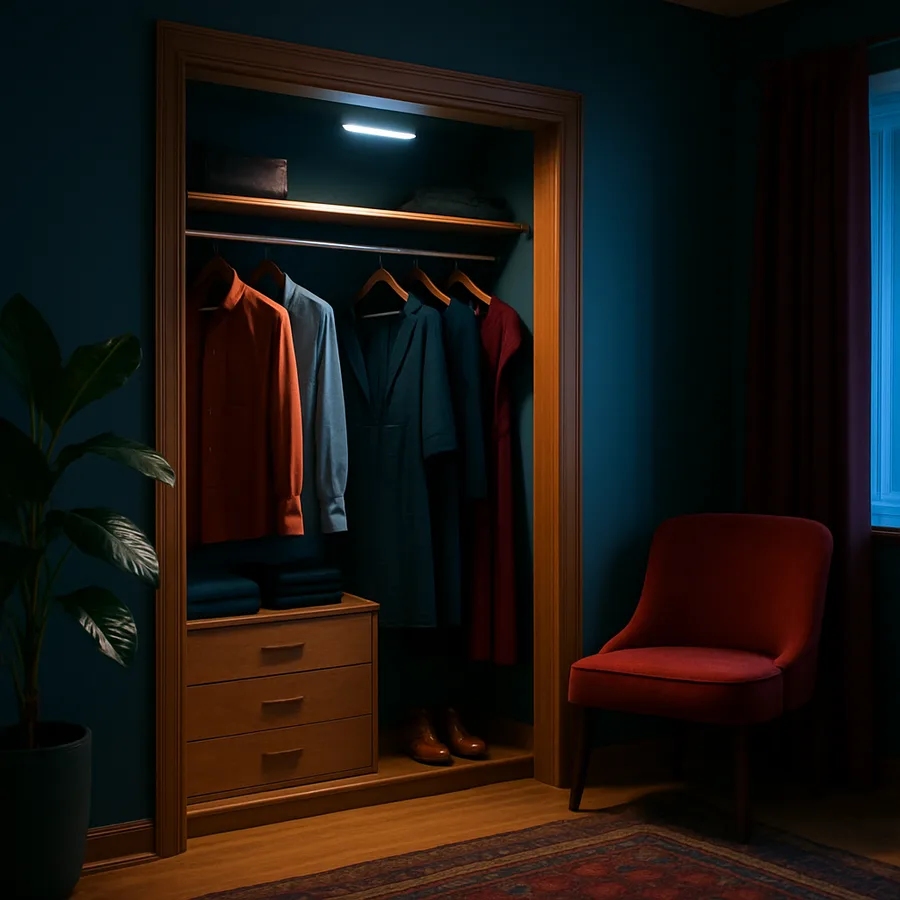
There is a quiet absurdity in the fact that most homes contain at least one closet that requires the occupant to reach into total darkness and fumble for a pull chain, a wall switch that is inexplicably located outside the closet, or a light that simply does not exist. Motion sensor closet lights eliminate every version of this friction by detecting human presence and activating automatically, illuminating the closet interior before the occupant takes a single step inside. No switch to find, no chain to pull, no hands occupied with toggling when they should be reaching for garments. The technology that makes this possible, passive infrared motion detection, has been a standard feature of commercial lighting and security systems for decades and is now available in compact, battery-operated fixtures that install in residential closets without any electrical work. The Illuminating Engineering Society identifies automatic occupancy-based switching as one of the most effective strategies for reducing unnecessary lighting energy consumption in both commercial and residential buildings, noting that motion-sensor-controlled lights reduce fixture run time by 40 to 60 percent compared to manually switched alternatives in intermittently occupied spaces.
How Passive Infrared Motion Sensors Detect Presence
The motion sensors used in closet lighting fixtures are almost universally passive infrared (PIR) sensors, which detect the infrared radiation naturally emitted by the human body. Every object with a temperature above absolute zero emits infrared radiation, and the human body, at approximately 98.6 degrees Fahrenheit, radiates strongly in the wavelength range of 8 to 14 micrometers. A PIR sensor contains a pyroelectric element behind a segmented Fresnel lens that divides the sensor's field of view into alternating detection zones. When a warm body moves across the boundary between zones, the sensor registers a change in infrared energy level and triggers the connected circuit. This detection method is entirely passive, meaning the sensor emits no energy of its own, consuming essentially zero power while waiting for motion. This passive operation is what makes PIR sensors ideal for battery-powered closet lights, because the sensor draws current only during the brief processing of a detection event.
The detection range of a PIR sensor in a closet light fixture typically extends 8 to 15 feet, with a detection angle of 100 to 120 degrees. For reach-in closets with depths of 24 inches or less, a sensor mounted on the interior header above the door opening can detect motion from a person approaching the closet from several feet away, activating the light before the door is fully opened. This anticipatory activation is one of the most satisfying aspects of motion-sensor closet lighting: the light is already on and the closet interior is already visible by the time the user reaches in or steps forward. For walk-in closets, the sensor's range easily covers the full depth and width of the space, detecting motion at the entrance and maintaining activation as the occupant moves between storage zones inside.
The timeout period, the interval of no detected motion after which the sensor deactivates the light, is a critical parameter that varies between fixtures and directly affects both convenience and battery life. A timeout that is too short results in the light shutting off while the user is standing still examining garments, a frustrating experience that forces an arm wave or a step to reactivate the sensor. A timeout that is too long wastes battery power by keeping the light on after the user has left the closet. Most quality closet motion sensor lights offer an adjustable timeout between 15 and 120 seconds, with 30 seconds being the most commonly recommended setting for closets. This duration is long enough to cover a typical closet visit without the light cycling off during a brief pause in movement, yet short enough to conserve battery power effectively.
False triggering is a concern that varies by installation environment. PIR sensors can be activated by rapid temperature changes from heating vents, by pets passing near the closet, or by convection currents from warm surfaces. In a well-installed closet application, false triggers are rare because the enclosed environment of a closet is thermally stable and typically accessible only through a single door. However, closets with louvered doors that allow air circulation from the room, closets adjacent to heating registers, or closets accessible to household pets may experience occasional false activations. Positioning the sensor to face the closet interior rather than the door slats, and adjusting the sensitivity setting if the fixture provides one, minimizes false triggers without reducing the sensor's responsiveness to actual human presence.
Selecting Motion Sensor Lights for Reach-In Closets
Reach-in closets, the single-door or bifold-door closets found in most bedrooms, hallways, and entryways, present a specific set of requirements that narrow the field of suitable motion sensor light fixtures. The defining characteristic of a reach-in closet from a lighting perspective is its shallow depth, typically 22 to 28 inches from the back wall to the door plane. This shallow depth means the user's body is partially inside and partially outside the closet during use, and the motion sensor must be positioned to detect this partial entry reliably. A sensor mounted on the interior header above the door opening, angled slightly downward and toward the closet entrance, achieves the most reliable detection geometry for reach-in applications because it captures the arm and upper body movement that occurs during normal closet use.
The limited interior surface area of a reach-in closet restricts both the size and the number of fixtures that can be installed without encroaching on storage space. Compact fixtures measuring under four inches in diameter or width are the most practical choice, and a single fixture with a lumen output between 150 and 300 lumens is typically sufficient for a standard reach-in closet. Higher lumen output is not necessarily better in a small, enclosed space with reflective white walls: an excessively bright fixture in a closet measuring three feet wide by two feet deep creates a harsh, glaring environment that is uncomfortable to look into directly from the darker room outside. The American Society of Interior Designers suggests that closet lighting should be bright enough to read garment care labels without straining, but not so bright that it creates a jarring contrast with the ambient light level of the adjacent room.
Mounting location within the reach-in closet determines both the light distribution pattern and the sensor's detection effectiveness. The three most common positions are the header above the door opening (provides even downward light and excellent sensor detection of approaching users), the ceiling center (delivers the most uniform light distribution but may be shaded by the top shelf and places the sensor where it detects vertical movement less effectively), and the underside of the top shelf (positions light close to the hanging rod for best garment illumination but limits the sensor's field of view to the interior of the closet). For most reach-in applications, the header position offers the best compromise between light coverage and sensor performance, and it keeps the fixture visible and accessible for battery changes or recharging.
Do your reach-in closets have a light of any kind, or do you rely entirely on spill light from the adjacent room when selecting clothing? According to a survey conducted by the American Institute of Architects, approximately 40 percent of secondary bedroom closets in homes built before 2000 have no dedicated lighting fixture, and even those with ceiling-mounted fixtures often use a single incandescent bulb that provides inadequate illumination by current standards. A single motion sensor LED fixture can transform these dark spaces at a cost of $15 to $40 per closet, with no wiring and no tools required.
Optimizing Motion Sensor Placement in Walk-In Closets
Walk-in closets range from compact four-by-six-foot spaces to expansive dressing rooms of 100 square feet or more, and the motion sensor placement strategy must scale accordingly. The core challenge in walk-in closet lighting is that the occupant moves through the space, changing position relative to the sensor over the course of a single closet visit. A single sensor positioned at the entrance may detect the initial entry but fail to register the occupant's presence when they move to a far corner, particularly if they stand still while examining items on a shelf or selecting garments from a side wall. This creates the frustrating experience of lights switching off mid-use, requiring the occupant to wave their arms or walk back toward the sensor to reactivate the lights.
The most reliable approach for walk-in closets larger than 30 square feet is a multi-fixture system with sensors positioned to create overlapping detection zones. Two fixtures, one near the entrance and one at the far end of the closet, ensure that at least one sensor maintains detection of the occupant regardless of their position within the space. The entrance fixture handles initial activation and continued detection while the occupant is in the front half of the closet, while the rear fixture detects presence in the back half. The overlapping zone in the middle provides redundant coverage that eliminates dead spots. Both fixtures should use the same timeout period to ensure synchronized deactivation after the closet is vacated.
Ceiling mounting is strongly preferred for walk-in closet motion sensor lights because it provides the widest sensor field of view and the most uniform light distribution. A ceiling-mounted fixture with a 120-degree sensor angle positioned at the center of a six-by-eight-foot walk-in closet covers the entire floor area within its detection zone, and the downward-facing orientation is optimal for detecting the horizontal movement patterns of a person walking through the space. Wall-mounted fixtures in walk-in closets are less effective because their lateral detection angle creates blind spots along the wall where the fixture is mounted, and their light distribution pattern produces uneven illumination with a bright zone near the fixture and dim zones on opposing walls.
For large walk-in closets and dressing rooms, zoned lighting with independently triggered motion sensors allows different sections of the closet to illuminate based on which zone the occupant enters. A three-zone system might divide the closet into a hanging section, a shelving section, and a seating or dressing area, with each zone activated by its own sensor and equipped with lighting optimized for its specific function. The hanging zone uses bright, neutral white light for color-accurate garment selection. The shelving zone uses multiple fixtures or a light strip to eliminate shelf shadows. The dressing area uses warm, diffused light that flatters skin tones and simulates the ambient conditions where outfits will be worn. This zone-based approach adds complexity and cost but delivers a dressing experience that rivals professional wardrobe studios.
Power Sources and Runtime Expectations
Motion sensor closet lights are available in battery-powered, rechargeable, and hardwired configurations, and the choice between them involves balancing installation simplicity against long-term maintenance effort and maximum light output. Battery-powered models using disposable AA or AAA batteries remain the most popular category due to their zero-installation simplicity, the batteries slide in, the adhesive backing sticks to the closet surface, and the fixture is operational. Runtime varies by battery capacity and fixture brightness, but a typical three-AAA model producing 100 lumens delivers approximately 60 to 90 hours of cumulative illumination. With a motion sensor limiting operation to actual occupancy periods, this translates to three to six months between battery changes for a closet used four to six times daily with an average visit duration of two minutes.
Rechargeable models with built-in lithium-ion batteries offer the same installation simplicity as disposable-battery units with the added benefit of USB recharging that eliminates ongoing battery purchases. A rechargeable closet motion sensor light with a 1,500 to 2,000 mAh battery provides approximately eight to twelve hours of cumulative illumination per charge, translating to six to twelve weeks of normal use between charges. The recharging process takes one to three hours depending on the battery capacity and charging circuit design. The main practical consideration with rechargeable models is the charging logistics: the fixture must either be removable from its mount for tabletop charging or positioned where a USB cable can reach it while it remains mounted. Models with magnetic mounting bases that allow easy snap-on/snap-off removal for charging are the most convenient for regular recharging cycles.
Hardwired motion sensor closet lights connect to the home's electrical circuit through a junction box, providing unlimited runtime and maximum brightness without any battery-related maintenance. These fixtures are the standard choice for new construction, where the electrician installs a junction box and wire during the rough-in phase at minimal incremental cost. For existing homes without closet wiring, adding a hardwired fixture requires running new wire from the nearest circuit, which typically costs $200 to $500 depending on the wire routing distance and the complexity of the wall construction. The National Kitchen and Bath Association recommends hardwired closet lighting as a standard specification for all new custom closet designs, noting that the incremental cost during new construction or renovation is a fraction of the retrofit cost and eliminates a lifetime of battery maintenance.
A hybrid approach gaining popularity combines a hardwired primary fixture with battery-powered supplementary motion sensor lights in specific zones. The hardwired ceiling fixture provides general illumination for the overall closet space, while smaller battery or rechargeable motion sensor lights mounted under shelves, inside drawers, or above shoe racks provide targeted supplementary lighting that activates independently when the occupant approaches that specific zone. This combination delivers the reliability and brightness of hardwired lighting for primary illumination while using the flexibility and simplicity of battery-powered units for accent and task lighting in areas that would be impractical to hard-wire.
Ambient Light Sensors and Daylight-Aware Operation
Some motion sensor closet lights include a secondary sensor, an ambient light sensor (also called a photocell or lux sensor), that measures the existing light level in the closet and suppresses activation when sufficient natural or artificial light is already present. This feature is primarily relevant for walk-in closets with windows, skylights, or translucent doors that admit daylight during certain hours. During these daylight hours, the ambient light level inside the closet may be adequate for basic visibility, and activating the LED fixture would add minimal benefit while consuming battery power unnecessarily. The ambient light sensor detects this condition and inhibits the motion sensor from triggering the light, preserving battery life for the low-light conditions where artificial illumination is genuinely needed.
The lux threshold at which the ambient sensor suppresses activation is either factory-set or user-adjustable, depending on the fixture model. A typical factory-set threshold of 20 to 30 lux (approximately equivalent to dim indoor lighting) works well for most closet applications, as it allows the fixture to activate in conditions where visibility is meaningfully impaired while remaining dormant in conditions where the existing light is sufficient for basic tasks. User-adjustable models offer a potentiometer or button-sequence adjustment that allows the homeowner to calibrate the threshold to their personal sensitivity, a useful feature for individuals who prefer brighter illumination than the factory setting would trigger for or who want the fixture to activate even in moderate ambient light conditions.
The practical impact of ambient light sensing on battery life depends heavily on the closet's exposure to daylight. For an interior closet with no windows and no natural light sources, an ambient light sensor provides negligible benefit because the closet is always dark when the door is closed and the sensor will never suppress activation. For a walk-in closet with a window that receives several hours of direct or indirect sunlight daily, the ambient sensor can reduce daily activation cycles by 30 to 50 percent during daylight hours, extending battery life proportionally. In the specific case of a walk-in closet with a skylight, which may receive adequate natural light for much of the day, the ambient sensor transforms the motion sensor light from a full-time fixture into a supplementary evening and night fixture that activates only when natural light is insufficient.
Is your walk-in closet located on an exterior wall with a window, or is it an interior space that never receives natural light? This single characteristic determines whether an ambient light sensor adds meaningful value to your motion sensor closet light selection. For windowless closets, which represent the majority of residential closet configurations, the ambient light sensor is a neutral feature that neither helps nor harms performance. For windowed closets, it is a genuine battery-life optimization that should factor into the product selection decision.
Common Installation Mistakes and How to Avoid Them
The simplicity of motion sensor closet light installation creates a deceptive sense that placement decisions are inconsequential, when in fact the difference between an optimally placed fixture and a poorly placed one is the difference between a system that works flawlessly and one that generates daily frustration. The most common placement error is mounting the fixture too far from the closet entrance in a reach-in configuration, which delays activation until the user is already reaching into the dark closet. PIR sensors have a minimum detection distance of approximately 6 to 12 inches, below which the sensor's field of view is too narrow to register movement reliably. Mounting the fixture at the back wall of a reach-in closet places it 24 or more inches from the user, within detection range, but the light activates only after the user has already spent a second or two reaching into darkness. Positioning the fixture on the header above the door opening eliminates this delay entirely.
A second frequent error involves sensor orientation relative to the direction of approach. PIR sensors are most sensitive to movement that crosses their field of view laterally, perpendicular to the sensor's facing direction. They are least sensitive to movement that approaches or recedes directly along the sensor's central axis. In a closet context, this means a sensor facing outward from the back wall toward the door detects a person walking directly toward the closet less reliably than a sensor facing sideways across the closet opening. Mounting the fixture on the side wall near the door, facing across the opening, produces the most reliable activation because the user's approach crosses the sensor's field of view laterally. If ceiling or header mounting is preferred, angling the fixture slightly to the side rather than pointing it straight at the approaching user improves detection reliability.
Incorrect timeout settings generate the most user complaints after installation. A timeout of 15 seconds, which some fixtures ship with as a factory default for maximum battery conservation, is too short for any closet visit that involves more than grabbing a single garment. Standing still while examining options, coordinating an outfit, or selecting accessories triggers the timeout and plunges the closet into darkness. Increasing the timeout to 30 or 45 seconds accommodates normal browsing behavior while still providing automatic shutoff shortly after the user departs. Walk-in closets used for extended dressing sessions may require timeouts of 60 to 90 seconds. Setting the timeout once during installation, based on how the closet is actually used rather than on the factory default, eliminates the mid-session darkness that causes most users to abandon motion sensor lights in frustration.
Before finalizing the placement of your motion sensor closet light, tape the fixture temporarily in the planned position and walk through your normal closet routine to verify that the light stays on throughout and activates promptly on approach, because this five-minute test reveals detection gaps before the adhesive is committed and saves you from repositioning difficulties later.
Conclusion
Motion sensor closet lights represent the most hands-free, maintenance-minimal approach to resolving the pervasive darkness that affects the majority of residential closets. The passive infrared detection technology that powers these fixtures is mature, reliable, and specifically well-suited to the intermittent, brief-duration usage pattern of closet spaces, where manual switching is a perpetual nuisance and lights left on by forgotten switches waste energy for hours. Whether installed in a compact reach-in closet that needs a single fixture or a spacious walk-in that benefits from a multi-zone system with overlapping detection coverage, motion sensor lights deliver illumination that begins the instant it is needed and ends the moment it is not.
The selection process is straightforward when guided by the specific characteristics of the closet being illuminated. Reach-in closets favor compact, header-mounted fixtures with short detection ranges and moderate lumen output. Walk-in closets benefit from ceiling-mounted fixtures with wider detection angles, longer timeouts, and higher brightness. The power source decision, battery versus rechargeable versus hardwired, follows the homeowner's tolerance for maintenance balanced against willingness to invest in electrical installation. Each configuration delivers the same core benefit: automatic, hands-free light that transforms a dark cavity into a functional, welcoming space.
The broader significance of motion sensor closet lighting lies in its contribution to the livability of every room it serves. A bedroom with a well-lit closet is a room where morning routines proceed without frustration. A hallway with an illuminated coat closet is a space where guests feel welcomed rather than awkward. A mudroom with sensor-activated storage lighting is an entry point that functions smoothly in daylight and after dark. These improvements are individually modest but collectively they represent a home that has been thoughtfully calibrated to support the daily patterns of the people who live in it, and that calibration is the essence of good residential design.
More Articles You May Like



Comments
Post a Comment