Walk-In Closet Island Center Drawer Storage and Folding Top
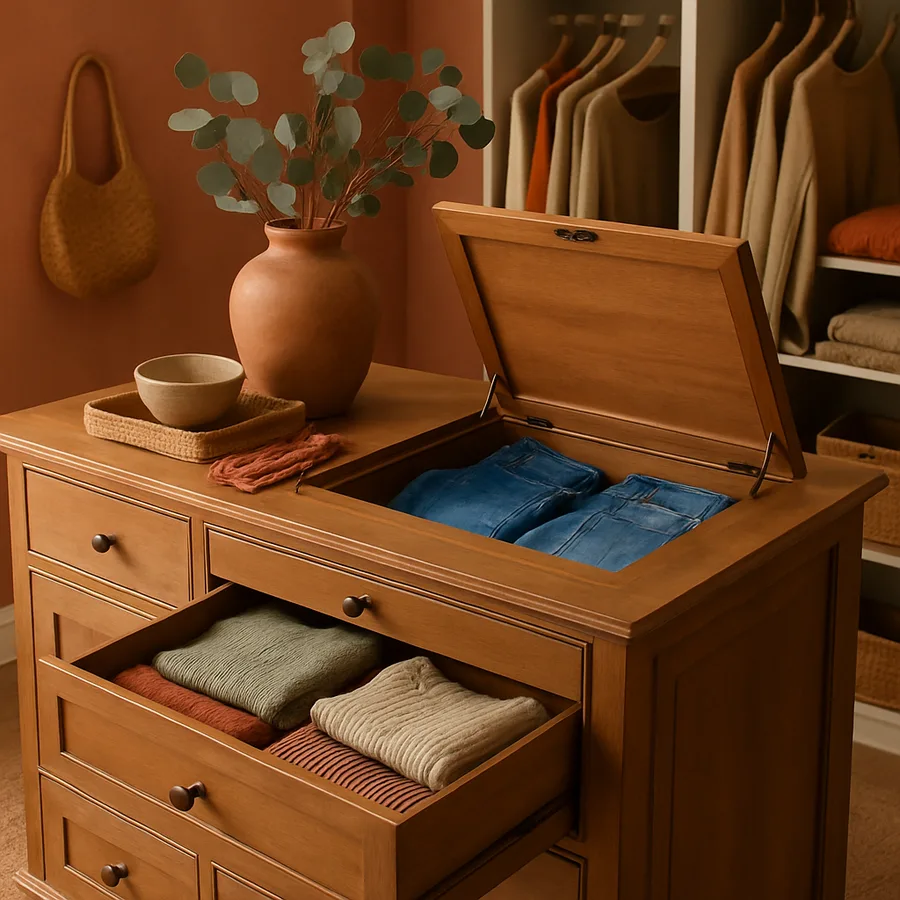
The walk-in closet island has graduated from a luxury flourish to a genuinely useful piece of architecture inside the modern dressing room. When configured with deep center drawers and a sturdy folding top, the island becomes the single most efficient surface in the home for sorting laundry, packing for travel, and rotating wardrobes seasonally. A 2024 study from the National Association of Productivity and Organizing Professionals (NAPO) found that homes featuring a dedicated central folding surface in the closet reduced morning wardrobe time by 28 percent. That is a meaningful gain for anyone who has ever wrestled jeans onto a too-narrow shelf or balanced sweaters on a bed already covered in throw pillows.
Beyond the obvious gains in tidiness, an island with thoughtful drawer storage solves a problem most closet plans ignore: the no-mans-land between hanging rods. By treating the floor at the center of the room as productive square footage, you reclaim 18 to 24 cubic feet of capacity in a typical 8-by-10 walk-in. Done well, the island feels less like furniture and more like the closet's beating heart.
Why a Center Island Beats Wall-Only Storage
Walls give you hanging space, drawers, and shelving, but walls cannot give you a folding surface that you can walk all the way around. The island's geometry is its superpower. Have you ever tried to neatly fold a king-sized duvet on a 14-inch shelf? An island with a 30-by-72-inch top accepts the duvet flat, lets you straighten the edges, and gives you a place to pile the pillowcases that match. The same logic applies to weekly laundry, seasonal swaps, and travel packing.
Center drawers also unlock storage that would otherwise be lost to dead air. The Container Store reports that island drawer systems average 35 to 45 percent more usable cubic capacity per linear foot than tower drawers placed against a wall, because the island form factor allows for symmetrical drawer banks on opposite sides. Two banks of four drawers each, separated by a knee well or a vertical divider, is a common and powerful configuration.
An often overlooked benefit is sightlines. With a wall-only closet, you stand at one end of a long room and look down a corridor of clothing. With an island, you stand in the room and survey it. The American Society of Interior Designers (ASID) has long argued that a central anchor element improves spatial legibility, and a closet is no exception. The island gives the room a focal point and turns it into a destination, not a hallway.
Sizing the Island for Real-World Use
Sizing decisions are the single biggest determinant of whether the island feels luxurious or cramped. A few hard numbers, drawn from National Kitchen and Bath Association (NKBA) clearance research that translates well to closets, will keep you on the right side of comfort. Maintain at least 36 inches of walkway clearance on every side of the island. If you plan to fold while another person walks past, push that to 42 inches. Anything less and the room will feel like a galley.
For the island itself, 30 inches deep is the sweet spot. That depth allows two banks of 13-inch drawers back-to-back with a small spine in the middle for mounting hardware. Length should be a minimum of 48 inches to accept a folded shirt and a small piece of luggage side by side, and 72 inches if you regularly fold linens or pack two suitcases at once. Height matters too: 36 inches is comfortable for most adults to fold standing, while 42 inches reads as a bar-height detail and can be useful if you prefer a slightly less stooped posture.
Want a quick gut-check? Multiply your island's footprint in square feet by 1.5. That is a rough lower bound for the surrounding clearance, in square feet, you will need to make the room feel right. A 4-by-6 island wants at least 36 square feet of perimeter walkway, which translates into a closet of roughly 10-by-12 feet at minimum.
Drawer Architecture: Depths, Soft Close, and Internal Dividers
Drawers are where the island earns its keep, and not all drawer banks are created equal. The most flexible layout uses graduated depths: a top drawer of 3 to 4 inches for jewelry, watches, and sunglasses; a middle bank of 6-inch drawers for socks, underwear, and folded T-shirts; a deeper 9 to 10-inch drawer for sweaters or jeans; and a 12-inch base drawer for bulky items such as workout gear or off-season pieces. Better Homes and Gardens recommends this graduated stack because it mirrors the size hierarchy of a typical wardrobe and reduces the temptation to stuff small items into drawers that swallow them.
Soft-close, full-extension undermount slides are non-negotiable on a center island. The drawers will see daily use, often with both hands occupied, and a slammed drawer in the center of a small room is unforgiving on the ears and the joinery. Look for slides rated to at least 100 pounds of dynamic load. Brands that publish their cycle ratings, typically 75,000 to 100,000 cycles, are worth the small premium over no-name hardware.
Internal dividers convert good drawers into great ones. Felt-bottomed jewelry trays in the top drawer, adjustable bamboo dividers in the sock and underwear bank, and a single tall divider in the sweater drawer to keep stacks from collapsing are the highest-leverage upgrades. House Beautiful has profiled multiple closets where the difference between a chaotic island and a serene one came down to dividers measured to a sixteenth of an inch.
The Folding Top: Materials, Edges, and Inset Mats
The top of the island is where fabric meets surface, and the surface choice matters. Solid hardwood, typically white oak or walnut, is the most forgiving and the most beautiful. It dampens sound, develops a quiet patina, and can be sanded if a stray pen or zipper leaves a scar. Stone tops look luxurious in photographs but are cold to the touch and unforgiving to delicate knits, particularly silk and cashmere, which can snag on micro-pits in the surface. Quartz is a middle path: warm enough, durable, and available in subtle marbled patterns that do not scream for attention.
Edge profiles are quietly important. A square edge looks crisp but can leave pressure marks across the seam of a folded shirt. A small eased edge, roughly an eighth inch radius, solves this without softening the overall geometry. If the closet is shared by tall and short users, asymmetric edge softening on the long sides of the island can make folding more comfortable for whichever side is preferred.
Consider an inset wool felt or leather mat in the center of the top, recessed by three-quarters of an inch into a routed pocket. This dedicated zone protects delicate fabrics, keeps the rest of the top free for setting down a coffee or a planner, and reads as a deliberate design moment. For households with kids, a removable felt mat that can be tossed into the wash is a quiet luxury.
Lighting, Outlets, and Hidden Tech
An island lives in the middle of the room, which means it is the farthest thing from any wall and any outlet. Plan for that on day one. A pop-up power strip integrated into the island top or a discreet outlet inside the top drawer will let you charge a steamer, an electric razor, or a phone without trailing cords across the floor. NKBA data shows that 62 percent of new closet remodels include at least one in-island outlet, up from 28 percent in 2018. The trend is moving fast and for good reason.
Lighting should come from above and from inside. Above the island, a single statement pendant or a pair of smaller pendants washes the folding surface in even light. Inside the drawers, motion-activated LED strips along the inner front edge transform the experience of finding a dark sock at six in the morning. Color temperature matters: 2700K to 3000K reads as warm and flattering on skin and fabric, while 4000K and above starts to feel like a hospital.
Hidden tech can extend further. A small fingerprint-locked drawer for jewelry, a humidity sensor that pings your phone if a leak is detected from a nearby bathroom, or a steamer holster wired to a 20-amp circuit are all reasonable upgrades for a high-use closet. Are the gadgets necessary? No. Do they make the island feel like a piece of architecture rather than a piece of furniture? Absolutely.
Style Direction: Three Aesthetics That Always Work
Styling an island is where personality enters. Three approaches consistently age well. The first is quiet shaker: painted millwork in a soft chalk or warm white, satin brass cup pulls, oak top, and a wool runner on the floor. This is the dressing room of an English country house refined for a contemporary apartment. It looks intentional in 5 years and timeless in 15.
The second is warm modern: rift-cut white oak slab drawer fronts with finger pulls, no visible hardware, a stone or quartz top in a neutral, and recessed cove lighting. This aesthetic relies on craftsmanship rather than ornament. Every reveal must be tight, every drawer face must align, and the fit between the top and the cabinet base must be invisible from any angle.
The third is collected and traditional: stained walnut or mahogany base, fluted detailing on the drawer fronts, antique brass hardware, and a leather inset top. This direction works particularly well in older homes where the island can echo the millwork of the rest of the house. It also holds up beautifully in photographs, which is why magazines like House Beautiful and design houses repeatedly return to the look in their closet features.
Common Mistakes to Avoid
The first mistake is oversizing. An island that is too large suffocates the room and reduces walkway clearance below comfortable thresholds. A 96-inch island in a 10-by-12 closet sounds majestic on paper and feels claustrophobic in practice. Pull back to 72 inches and the closet breathes.
The second mistake is undersizing the drawers in pursuit of more drawers. Eight tiny drawers look impressive in a rendering but frustrate users who own anything larger than a sock. Mix drawer depths intentionally and accept that two large drawers can carry more than four small ones.
The third mistake is treating the island as a static piece. Living patterns change. Children grow, wardrobes evolve, and travel routines shift. The best islands accommodate change with adjustable internal dividers, modular tray inserts, and at least one fully empty drawer kept in reserve for the next season's needs. The Container Store consistently advises a 20 percent reserve as part of any new closet plan.
Conclusion
A walk-in closet island with center drawer storage and a folding top is not a vanity purchase, it is an infrastructure upgrade for the way you actually live. By committing to honest dimensions, layered drawer depths, a forgiving top material, and lighting that treats the island as the protagonist of the room, you build a piece of millwork that will earn its footprint daily for decades. Resources like NAPO and The Container Store publish ongoing case studies that confirm what users discover firsthand: the central island is the highest-utility feature in any closet larger than 60 square feet.
The right island doubles as a planner station, a packing station, a mending station, and a sanctuary for the few minutes a day you stand inside your closet alone. It also imposes a quiet discipline on the room. When the folding top is clear, the closet is calm. When it is buried, you have a signal that something needs to be put away. That feedback loop is more useful than any organizational app, and it costs nothing once the cabinetry is in place.
If you are weighing whether to invest, ask two questions of yourself. Will the island let you keep more of your wardrobe accessible than the floor space it consumes would otherwise? And will it improve the daily ritual of getting dressed? In nearly every closet larger than 80 square feet, the answer to both is yes. Start by sketching a 30-by-60-inch placeholder on the floor with painters tape, live with it for a week, and let your morning routine tell you what to refine before you order a single drawer.
More Articles You May Like



Comments
Post a Comment