Broom Closet Layout With Mop Hooks and Vacuum Storage
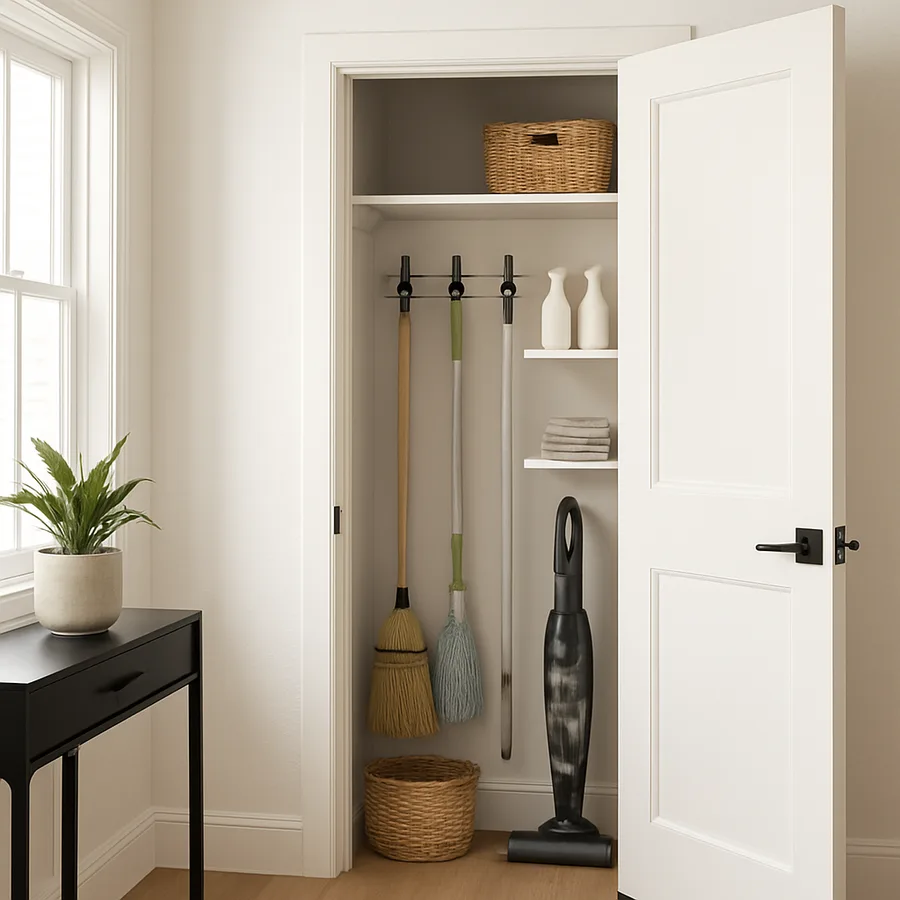
The broom closet is the most underestimated room in the modern home. Builders often treat it as leftover space, a narrow rectangle squeezed between the laundry room and the powder bath, with a single shelf and a hook glued to the wall. Yet anyone who has ever wrestled an upright vacuum, a string mop, a cordless stick, and a pile of microfiber cloths into one of these closets knows that thoughtful planning here pays back daily. A well-laid-out broom closet keeps a household running, and a poorly laid-out one quietly trains everyone in the house to leave cleaning tools in the corner of the kitchen instead.
This article maps out how to plan a broom closet that works hard. We will look at minimum and ideal dimensions, mop and broom hook geometry, vacuum docking, ventilation, lighting, and the small details that turn a closet into a system. Whether you are remodeling, reconfiguring, or simply re-outfitting an existing utility closet, the principles here will help you pull more capability out of fewer square feet.
Minimum and Ideal Dimensions for a Functional Closet
Before you outfit anything, you need to know whether your closet has the bones for what you are asking it to do. A truly functional broom closet starts at 16 inches wide by 24 inches deep by 84 inches tall. At those dimensions, you can fit a slim upright vacuum, a broom, a mop, a duster, and one shelf for cloths and detergents. Anything narrower and you are choosing between vacuum and mop; anything shallower and the door will not close on a standard upright.
The ideal closet, however, measures 24 inches wide by 28 inches deep by full ceiling height. That extra eight inches of width transforms the space because it allows side-by-side storage of two cleaning tools, leaving the back wall free for hooks and the upper third for shelving. The extra four inches of depth accommodates robot vacuum docking stations, which now ship with empty-bin towers that can be over 18 inches deep on their own.
If you are working with an existing closet, take the time to measure the actual interior, not the rough opening. Drywall, baseboards, and door jambs typically eat between 3 and 5 inches off the framing dimension. The National Association of Home Builders recommends adding a 2-inch buffer in any closet shorter than 7 feet to account for the swing arc of long-handled tools, a detail that is easy to miss until you try to lift a mop into a corner and find the handle hits the ceiling.
Mop and Broom Hooks: Geometry, Materials, and Spacing
Hooks are deceptively important. A broom propped against a wall ages twice as fast as one hung properly, because the bristles deform and the handle bows. The right hook system extends tool life by years and keeps the closet floor clear for the vacuum and robot dock.
The two dominant hook styles are spring-loaded grippers (which clamp the handle as you push it up into the slot) and peg-and-slot hooks (which require a hole in the handle or a hooked end). Spring-loaded grippers are more versatile because they grab any handle from 0.6 to 1.2 inches in diameter, which covers virtually every broom, mop, duster, and Swiffer made in the last decade. Mount them at 54 to 60 inches off the floor so that even tall mop handles clear the floor without scraping bristles.
Spacing matters as much as height. Allow 4 to 5 inches between hook centers so that bristle heads do not crush each other when stored. A common mistake is to mount hooks 2 inches apart, which fits handles fine but mashes the bristles together, accelerating splay. For households with a wide tool inventory, a horizontal rail with adjustable hook positions outperforms a fixed five-hook strip every time.
For materials, choose powder-coated steel or solid stainless. Plastic hooks fail under load within a year, especially when they hold a wet mop overnight. The National Association of Productivity and Organizing Professionals publishes a downloadable utility-closet checklist that flags hook material as a top-three predictor of system longevity in client homes.
Vacuum Storage: Upright, Stick, and Robot Docking
Vacuum storage strategy depends entirely on which vacuum you own, and most households now have two or three. The upright is still common in homes with significant carpet square footage, while cordless stick vacuums dominate hard-floor homes, and robot vacuums sit somewhere in between. A modern broom closet should accommodate at least two of these formats simultaneously.
For uprights, dedicate a 14-inch-wide by 14-inch-deep floor bay against one side wall, with a wall-mounted "kickback strap" 30 inches up to keep the handle vertical. Without that strap, the vacuum tips forward when you grab a broom, creating the classic falling-tool cascade that broom closets are infamous for.
For cordless sticks, the manufacturer's wall-mount dock is usually the right answer. Mount it on the inside of the closet door or on a side wall at 48 to 52 inches off the floor, with a power outlet within 18 inches. The dock keeps the battery charged and the tool ready, and removes the floor footprint entirely.
Robot vacuum docks deserve their own zone. The latest auto-empty towers from iRobot, Roborock, and Eufy measure 17 to 22 inches tall and need 18 to 24 inches of clear runway in front for the robot to enter and exit. If your closet floor is too narrow for the robot's approach lane, place the dock just outside the closet under a bench or behind a piece of furniture, and use the closet only for the empty-bin tower.
Shelving, Bins, and Cleaning Supply Organization
Above 60 inches off the floor, you have shelf country. This is where you store the things you grab less than once a week: bulk paper towels, surface-cleaning concentrates, replacement vacuum bags or filters, and microfiber cloth reserves. Shelving here should be adjustable, because the inventory in a cleaning closet shifts every time you switch a product line.
Use clear plastic or open-weave wire bins to group items by use case: "kitchen and counters," "bathrooms," "windows and glass," "floors." Labeling makes it possible for any household member to grab what they need without rummaging. According to Better Homes and Gardens reader surveys, organized cleaning closets reduce the average cleaning session by 12 to 18 minutes, simply by eliminating the search time at the start of each task.
One question I get often is, "How many cleaning products do I really need?" The honest answer is that most homes overstock cleaning supplies by 200 to 300 percent. A right-sized arsenal is one all-purpose cleaner, one bathroom cleaner with a disinfectant claim, one glass cleaner, one wood-floor cleaner, one tile-floor cleaner, plus dishwashing and laundry products stored elsewhere. Anything beyond that is usually a duplicate from a forgotten shopping trip.
Ventilation, Lighting, and Power
Three infrastructure items separate amateur broom closets from professional ones: ventilation, lighting, and power. Ignore them and the closet smells musty, the wrong tool gets grabbed, and the cordless dock has no outlet to plug into.
For ventilation, a passive solution is usually enough: a louvered door, or a 6-inch grille at the top and bottom of a solid door. Cleaning closets retain moisture from wet mops and damp microfiber cloths, and without airflow, the closet starts to smell within weeks. If your closet shares a wall with a bathroom or laundry, mechanical ventilation tied to the existing exhaust run is the gold standard.
Lighting is non-negotiable. A simple motion-activated LED puck or strip mounted to the upper interior side wall solves the problem of fumbling for tools in a dark closet. Look for a 3000K to 4000K color temperature at 200 to 400 lumens, which is bright enough to read product labels without blowing out the eyes. The American Society of Interior Designers consistently recommends task lighting in utility closets as a low-cost, high-impact upgrade that improves daily function.
Power requires planning. A single GFCI outlet on the side wall, ideally tied to a switched circuit, supports a cordless vacuum dock, a robot empty tower, and a future steam mop charger without resorting to extension cords. If you are building new, ask your electrician for a dedicated 20-amp circuit; if you are retrofitting, an in-wall battery-backed outlet retrofit is a workable alternative.
Door Hardware, Floor Material, and the Inside-the-Door Zone
The closet door is prime real estate that most people leave empty. The inside of a standard hollow-core or solid-core door supports up to 25 pounds of load if you use proper anchors, which translates to a full over-door rack of dust pans, ironing supplies, lint rollers, or pet-cleaning kits. Mount a narrow over-door rack with adjustable bins as your default and customize as your inventory shifts.
For door hardware, choose a self-closing hinge if the closet is in a high-traffic hallway, because the door will stay open otherwise and you will get hallway clutter creeping in. A magnetic catch keeps the door from drifting open mid-day, especially if the floor is not perfectly level. Have you considered whether your current closet door swings into the kitchen and blocks a key path?
Floor material deserves a thought. The closet floor takes more abuse than almost any other in the house: dripping mop heads, dropped cleaning bottles, the wheels of a robot vacuum, and the occasional spilled bag of pellets. Choose a sealed concrete, luxury vinyl plank, or porcelain tile finish, and avoid carpet at all costs. House Beautiful has run multiple features showing how a continuous run of LVP from the laundry room into the broom closet creates a visual flow that makes both rooms feel larger.
Conclusion
A broom closet is a small room that asks one big question of you: do you want cleaning to feel like work, or like a system? When the closet is laid out properly, with hooks at the right heights, vacuums docked rather than leaned, shelving sized to your real product inventory, and lighting that actually turns on, the entire household's relationship to chores improves. People grab the right tool faster, put it back faster, and stop hiding tools in the corner of the kitchen.
The dimensions, hook geometry, and vacuum docking strategies in this article apply equally to a brand-new build and a 60-year-old retrofit. The non-negotiables are airflow, lighting, and power, plus a hook system that respects the bristle geometry of the tools you actually own. Skip those and the closet underperforms regardless of how much money you spend on the rest of the build.
Walk into your current broom closet and time yourself completing one cleaning task, from grab to return. If it takes more than four minutes, your layout is the bottleneck. The fixes are usually inexpensive: a $40 hook rail, a $25 motion light, a $60 over-door rack. Sequence those three upgrades and the difference is visible within a week.
Want to start tonight? Pull every tool and product out of the closet, sort into "use weekly," "use monthly," and "use rarely or never," and discard the third group ruthlessly. Then mount your hook rail, install the light, and reload the closet by use frequency, with weekly tools at hand height and monthly tools above. You will save fifteen minutes a week for the next decade.
One detail worth mentioning is how the broom closet interacts with adjacent rooms. In most homes, the closet sits between the kitchen and the laundry room or near a back hallway, which means the door swing affects the flow between two high-use rooms. If you are remodeling, request a pocket door or a bi-fold door rather than a standard hinged door. Pocket doors disappear into the wall and free up the swing zone for traffic, while bi-fold doors fold flat to the side and reduce the swing arc by half. Both options improve the kitchen-to-laundry workflow noticeably, and the cost difference compared to a standard door is under $200 in most markets.
Another commonly missed upgrade is a small dehumidifier or moisture absorber for closets in basements or below-grade utility areas. Cleaning closets in damp climates collect moisture from wet mop heads and damp microfiber cloths, and even with passive ventilation, the closet can stay above 60 percent relative humidity for hours after each cleaning session. A small rechargeable desiccant unit (the kind sold for wardrobes and gun safes) costs under $40 and prevents the slow mildew problem that plagues closets in older homes. Some NAPO-affiliated organizers recommend pairing the desiccant with a small humidity sensor, which adds visibility into the moisture problem and helps you catch issues before they become odors.
More Articles You May Like



Comments
Post a Comment