Under-Bed Rolling Storage Bins Sizing for Standard Frames
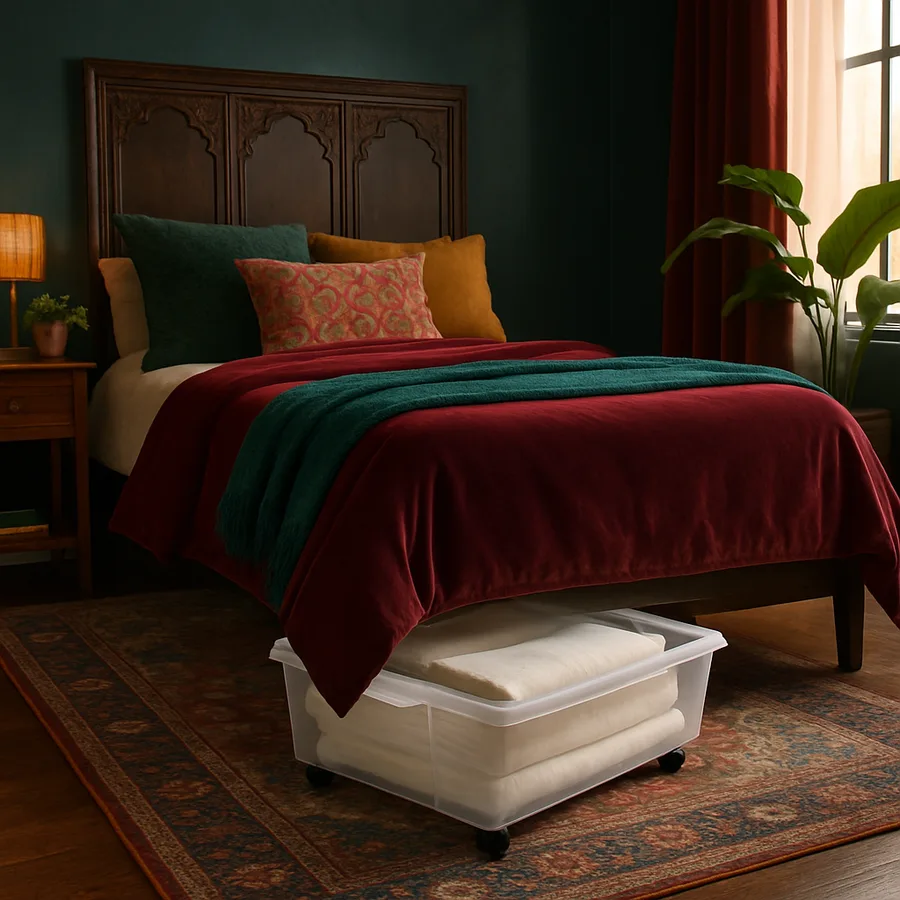
Under-bed real estate is one of the most consistently underused storage zones in residential bedrooms, and rolling bins are the tool that unlocks it for daily-access items. Surveys summarized by the National Association of Productivity and Organizing Professionals indicate that more than half of American households store nothing under their beds despite having usable clearance, citing access difficulty and dust as the two main reasons. Rolling bins solve both problems: wheels eliminate the access barrier, and lidded designs keep bedding, shoes, and seasonal items dust-free between uses.
The catch is that rolling bins fail more often than they succeed when sizing is wrong. A bin that is too tall jams against the frame; a bin that is too long catches on the bed leg; a bin with the wrong wheel type sticks on carpet or rolls erratically on hardwood. This guide walks through bin sizing for the four standard mattress sizes, the clearance math that prevents jamming, and the wheel and material variables that determine whether a bin earns daily use or gets shoved permanently into a corner. By the end, you should be able to specify the right bin for your bed without trial and error.
Why Rolling Bins Beat Static Containers
Static under-bed bins, the kind without wheels, are cheaper but rarely deliver on their promise. Pulling a loaded bin across carpet or hardwood requires kneeling, gripping a low handle, and dragging weight that catches on every imperfection in the floor. The result is that most static bins get accessed once or twice a year, which makes them long-term storage rather than active storage. Rolling bins shift that calculation entirely. A loaded rolling bin can be pulled out with one hand from a standing position, opened, and pushed back in under 30 seconds.
The wheel system is the variable that makes the difference. Caster-mounted bins with four wheels at the corners roll predictably in any direction and handle uneven floors well. Bins with two wheels at one end and runners at the other roll smoothly in one direction but bind when angled. Bins with embedded glides instead of wheels work on hardwood but stick on carpet. The right choice depends on your floor, the bin's loaded weight, and how you actually access the under-bed space day to day.
There is also a frequency-of-use argument. Rolling bins turn under-bed space into something closer to a drawer than a closet, which means you can store daily-access items there: workout shoes, off-season pajamas, current-season sweaters, even a stack of often-read books. The American Home Furnishings Alliance has noted in member trend reporting that under-bed access systems are among the fastest-growing storage categories in residential bedrooms, driven primarily by smaller home footprints and the rise of platform beds without built-in storage.
Mattress Size And Available Bin Length
The first sizing variable is bin length, which is bounded by mattress size and frame design. Most bed frames extend a few inches beyond the mattress, but the usable rolling-bin length is roughly equal to the mattress dimension minus 4 to 6 inches for bed-leg clearance and frame supports. The specific numbers for the four standard mattress sizes break out as follows.
A twin mattress measures 38 by 75 inches, which leaves usable bin lengths up to about 70 inches along the long side and bin widths up to about 33 inches along the short side. In practice, bins for twin beds usually run 28 to 36 inches long because longer bins are awkward to maneuver and store fewer practical items than two shorter bins. A full mattress measures 54 by 75 inches, which expands the usable width to about 50 inches but keeps the same length envelope as a twin.
A queen mattress measures 60 by 80 inches, supporting bin widths up to 56 inches and lengths up to 76 inches. Queen beds typically host two side-by-side bins each measuring roughly 28 by 36 inches, or three smaller bins along the length. A king mattress measures 76 by 80 inches, which is wide enough for two large bins side by side, each measuring up to 36 by 36 inches, or three bins arrayed across the width.
Have you mapped how many bins you actually want under your bed, and how you would access them? A king bed with three bins along one long side is far more useful than two giant bins, because each bin can hold a single category of items rather than a mixed jumble. Resources from Better Homes & Gardens include floor-plan diagrams of bin arrangements for each mattress size that are worth reviewing before purchasing.
Clearance Math For Bin Height
Bin height is bounded by the floor-to-frame clearance under your bed, minus a buffer for slat sag, dust ruffles, and mattress weight compression over time. Most platform beds have between 4 and 8 inches of total under-bed clearance. Most traditional frames with box springs have 8 to 12 inches. Beds raised with risers add to this baseline directly: a 5-inch riser on a 7-inch platform bed yields 12 inches of total clearance.
The buffer math matters. Subtract one inch from total clearance for safety, which gives you the maximum bin exterior height. So a bed with 10 inches of clearance accepts bins up to 9 inches tall. Bin manufacturers specify exterior height including lid and wheels, but verify by measuring the actual product if you can; tolerances vary, and a bin marketed as "fits 6-inch clearance" may actually measure 6.5 inches at the lid.
The most common bin heights cluster around 4 inches (flat fabric bins for shoes), 6 inches (standard plastic bins for sweaters), 8 inches (taller plastic bins for folded clothing or bedding), and 12 inches (large bins for luggage or seasonal items). Match the bin height to your usable clearance with margin to spare, because bins that scrape the bed frame on every pull-out develop dents and worn lids quickly. According to general durability guidance from groups including the National Association of Home Builders in residential storage publications, smooth movement under load is a key predictor of long-term storage system reliability.
Wheel Types And Floor Surface Considerations
Wheel selection is where rolling bins succeed or fail in daily use. The four common wheel types are hard plastic casters, soft rubber casters, embedded glides, and integrated rollers. Each has a clear best-case scenario.
Hard plastic casters roll smoothly on hardwood and tile but skid noisily and leave occasional marks. They struggle on carpet, especially deep-pile carpet, where the small wheel diameter sinks into the pile and the bin stops moving. Soft rubber casters are quieter on hard floors and handle carpet better because the rubber compresses slightly and grips the pile rather than sinking into it. Soft rubber casters are the most universally compatible wheel type and worth the small price premium for most bedrooms.
Embedded glides, sometimes called felt sliders, work only on hardwood, tile, and laminate. They stop entirely on carpet and should never be specified for any room with carpet. Integrated rollers, which are wheels mounted directly into the bin's underside without separate caster hardware, are common in budget bins and work acceptably on hard floors but tend to fail before the bin itself does. The American Society of Interior Designers has noted that storage hardware quality is one of the top variables in long-term satisfaction with organizational systems, which is consistent with the budget-bin failure pattern.
Floor type also affects wheel diameter selection. Larger wheels (1.5 inches or more) roll more smoothly across transitions between flooring types, such as a carpet-to-tile transition between a bedroom and a bathroom. Smaller wheels (under 1 inch) catch on transitions and on cord covers, baseboards, and rug edges. If your bed sits on or near a rug, prioritize larger-wheel bins for everyday access.
Bin Material And Lid Considerations
Bin material affects weight, durability, and aesthetic. The three main categories are rigid plastic, fabric over a wire frame, and structured cardboard with fabric covering. Each performs differently under daily use.
Rigid plastic bins are the most durable and the easiest to wipe clean. They handle heavy loads (20 to 40 pounds) without distortion, they stack when not in use, and clear plastic versions let you see contents at a glance, which dramatically improves the practical usability of the storage system. The downside is aesthetic: clear plastic looks utilitarian, and even colored plastic reads as bargain-store regardless of brand. Most rigid plastic bins suit utility storage rather than display.
Fabric-over-wire-frame bins are the aesthetic upgrade. Fabric bins in linen, cotton canvas, or jute look intentional and integrate into bedrooms with thoughtful styling. The wire frame holds shape, the fabric exterior absorbs incidental scuffs without showing damage, and zippered lids keep dust out. The trade-off is load capacity, typically 15 to 25 pounds, and the difficulty of cleaning fabric exteriors when something spills.
Structured cardboard with fabric covering, sometimes marketed as "decorative storage cubes" sized for under-bed use, is the lightest and cheapest option but the least durable. Cardboard bins develop creases at stress points, the fabric covering separates from the cardboard along seams, and any moisture exposure causes permanent warping. They work for short-term storage of light items but are not the right answer for daily-access setups.
Lid design matters as much as bin material. Hinged lids that flip open are easier to access in tight under-bed clearance than fully removable lids, because removable lids require pulling the bin out enough to lift the lid clear, which adds floor space requirements. Zippered lids work well on fabric bins because they keep dust out tightly, but the zipper itself becomes a wear point over years of use.
Organizing Bin Contents For Real Use
The bins you buy are only as useful as the system you put inside them. Loose-pile storage, where items get tossed in without internal organization, defeats the purpose of bins because you end up rummaging for what you need just like you would with a drawer. The fix is internal compartmentalization, either purchased dividers or improvised with shoe boxes and small open containers.
For seasonal bedding, fold sheets and duvet covers into rectangles sized to the bin's interior dimensions, then stack with the most-used items on top. For shoes, vertical orientation in a long flat bin holds 6 to 10 pairs in the space that horizontal placement holds 3 to 4 pairs. For sweaters and bulky clothing, vacuum-compression bags reduce volume by 50 to 70 percent and let you fit a full season's wardrobe in one bin where you would otherwise need three.
Have you thought about labeling? A small label on the front of each bin, identifying contents at a glance, eliminates the "which bin has the winter scarves" moment that otherwise causes you to open three bins before finding what you want. The National Association of Productivity and Organizing Professionals consistently identifies labeling as one of the highest-leverage interventions in home organization, and bins are an ideal place to apply it because the bin label is invisible until you pull the bin out. Resources from Apartment Therapy include detailed labeling and bin-content systems worth modeling for your specific storage categories.
Practical Sizing Recipes For Each Mattress Size
To make this concrete, here are recommended bin configurations for each standard mattress size, assuming a target under-bed clearance of 8 to 10 inches and daily-access use cases. These are starting points; your specific frame, room layout, and storage needs may justify different configurations.
For a twin bed, two bins each measuring roughly 28 by 32 by 6 inches deliver good capacity without crowding. Place one bin along each long side of the bed, leaving the foot end clear for cleaning access. For a full bed, two bins measuring 28 by 36 by 6 inches arrange similarly, with each bin holding roughly the same volume as a small dresser drawer.
For a queen bed, three bin configurations work well: two large bins (each 28 by 36 by 8 inches) along the long sides, three medium bins (each 28 by 24 by 6 inches) arrayed along one long side, or four smaller bins (each 18 by 28 by 6 inches) in a 2x2 grid. The choice depends on whether you want fewer-larger or more-smaller storage units, which in turn depends on what you are storing.
For a king bed, two bins each measuring 36 by 36 by 8 inches deliver maximum capacity, while three bins each measuring 24 by 36 by 8 inches deliver better category separation. Larger king beds with longer footprints can also accommodate four bins in a 2x2 grid, but coordinating four bins of access often becomes more annoying than productive in practice. Two or three bins is usually the sweet spot.
Conclusion
Rolling under-bed bins are the right tool for converting unused under-bed space into daily-access storage, but the result depends entirely on getting the sizing right. Bin length is bounded by mattress size, bin height is bounded by under-bed clearance with a one-inch buffer, and bin width depends on whether you want one-bin-per-side or multiple bins per side. Get those three numbers right and almost any quality bin will deliver years of useful service.
The wheel and material decisions matter more than most buyers realize. Soft rubber casters work on every floor type and outlast hard plastic casters by a substantial margin. Fabric-over-wire-frame bins integrate into thoughtfully styled bedrooms in a way that bare plastic does not, and they hold up well under reasonable load limits. The premium for these upgrades is small in absolute dollars and large in long-term satisfaction.
If you are planning your under-bed storage system, take this sequence into the bedroom: measure your floor-to-frame clearance, identify your mattress size precisely, decide what categories of items belong under the bed, and choose a bin configuration that matches both the available volume and the access frequency. Make those measurements and decisions before you shop, and the bins you buy will fit, roll smoothly, and earn their keep through daily use rather than gathering dust as failed organizational ambitions. Under-bed storage rewards specificity more than any other home storage zone, and rolling bins are the highest-yield tool for unlocking it when sized correctly for your specific bed.
More Articles You May Like



Comments
Post a Comment