
Patio Umbrella Selection Cantilever Versus Center Pole
Patio Umbrella Selection Cantilever Versus Center Pole
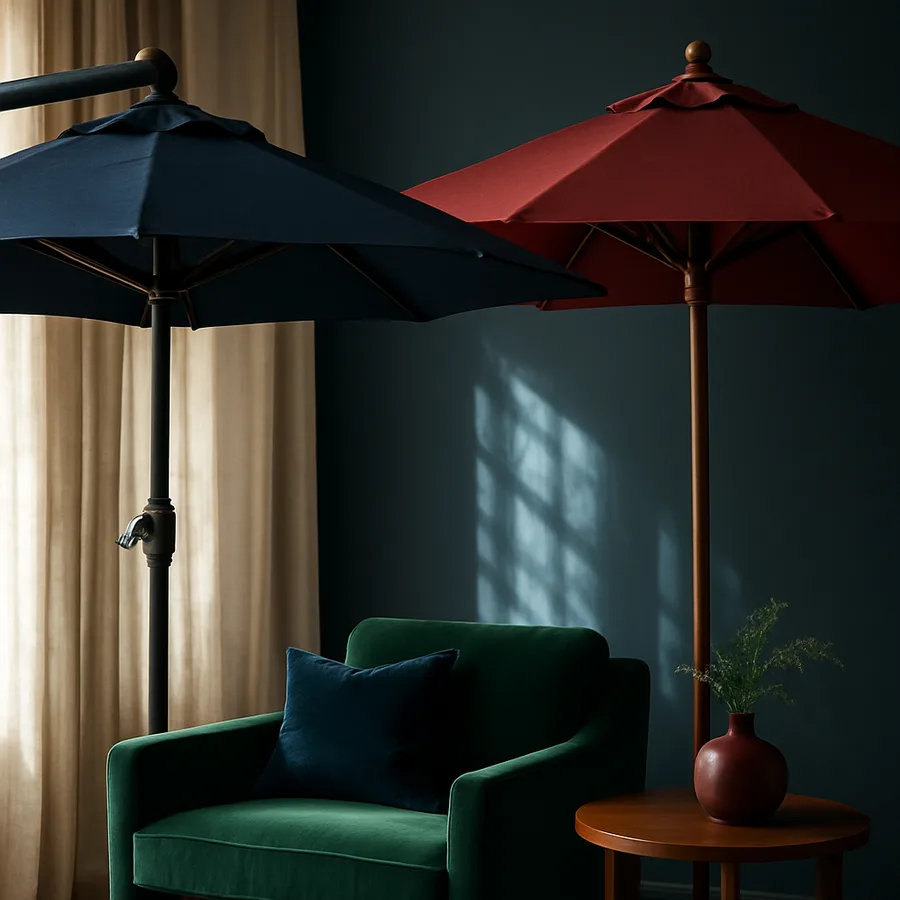
An outdoor table without shade is a beautiful piece of furniture that nobody sits at after 11 a.m. Shade is what transforms a patio from a photo opportunity into a place where you actually spend time. The two dominant shade strategies for residential patios are the cantilever umbrella, which suspends a canopy from an offset arm anchored beside the seating area, and the center pole umbrella, which rises through the middle of a table or stands free on a weighted base. They look superficially similar from across a yard. In use, they are entirely different products.
This guide walks through the structural, functional, and aesthetic tradeoffs so you can choose the right shade system for your specific layout, climate, and how you actually use the patio. We will cover base mechanics, canopy reach, wind tolerance, fabric science, placement strategy, and the operational details - cranks, tilts, rotation - that separate a daily-use umbrella from one that lives in storage.
Two Different Engineering Problems
A center pole umbrella solves a relatively simple structural problem. The pole transmits all forces - gravity, wind lift, wind shear - directly down through the table or a freestanding base into the ground or deck below. The canopy is balanced symmetrically around the central axis, so the loads stay vertical and predictable. Construction can be light, the mechanism can be a simple crank or push-up system, and the price stays modest.
A cantilever umbrella solves a much harder problem. The canopy sits several feet horizontally away from its support point. Every gust applies a lever-arm force that tries to tip the umbrella sideways. The base has to be heavy enough, low enough, and wide enough to resist that torque without rocking. The arm itself has to handle bending stresses that a center pole never sees. The result is a more complex, more expensive, but vastly more flexible piece of furniture - one that puts shade where you need it without requiring a hole in the middle of your table or a pole in the middle of your conversation.
This engineering distinction drives almost every other difference between the two categories. Once you understand that a cantilever is essentially a small piece of structural architecture and a center pole is essentially an enlarged hand umbrella, the rest of the decisions follow logically.
Pricing reflects the difference. Quality center pole umbrellas in the 9-foot range with solution-dyed canopies start around $250 and top out near $700 for premium models. Cantilever umbrellas in the 10- to 13-foot range with comparable canopy fabric start near $700 and easily exceed $2,000 for premium dual-rotation models. Bases add another $100 to $500. Budget for the full system, not just the umbrella, and the cantilever premium becomes obvious. The question is whether the shade flexibility it delivers is worth that premium for your specific patio - for many homeowners it clearly is, and for many others a well-chosen center pole is the smarter dollar.
Base Weight And Anchoring Reality
Base requirements diverge dramatically between the two systems. A standard center pole umbrella in an 8- to 9-foot canopy diameter typically needs 50 to 75 pounds of base weight when used with a stable dining table that provides additional anchoring, or 75 to 125 pounds when used freestanding. Most homeowners get away with the lower end on calm days and only learn the hard way during the first storm.
A cantilever umbrella in the popular 10- to 13-foot diameter range needs dramatically more base weight: 220 to 450 pounds is standard, and large 13-foot square models often require 500 pounds or more. This is not a number you achieve with a small concrete-filled plastic base. Cantilever bases are typically four heavy cross-shaped slabs of concrete or steel that interlock around a central post, or a single massive plate-style base designed to be filled with sand or paving stones on site.
For deck installations, cantilever umbrellas frequently require a bolt-down or in-ground sleeve installation rather than a freestanding base, because no portable base can deliver enough torque resistance without becoming unmanageably large. The American Society of Landscape Architects publishes resources on outdoor structure anchoring that emphasize this point: large cantilever shade structures should be treated as semi-permanent installations, not as freely portable furniture.
Have you ever tried to scoot a fully assembled cantilever umbrella from one corner of the patio to another? Most homeowners attempt it exactly once, then plan their layouts around the umbrella's permanent location.
Canopy Reach And Coverage Geometry
Canopy coverage is where cantilevers earn their keep. Because the pole is offset, the entire canopy is usable shaded area - there is no central pole interrupting the table surface, no walking path obstacle through the seating zone. A 10-foot square cantilever delivers roughly 100 square feet of shade with zero obstruction. A 9-foot octagonal center pole umbrella delivers approximately 57 square feet of shade with a central pole that occupies prime table real estate and prevents the use of a serving platter, candelabra, or centerpiece taller than the canopy hub.
The cantilever shines over seating areas that have no table - sectional sofas, lounge chairs, pool decks, hammock zones. It can also cover an existing dining table without requiring an umbrella hole or a specially designed table base. Many cantilever models also rotate 360 degrees around their pole, so you can chase the sun across the afternoon without moving the base.
The center pole umbrella excels over tables specifically designed with an umbrella hole. The combined assembly is structurally interconnected - the table stabilizes the pole and the pole's base sits hidden under the table, leaving floor space around the seating completely clear. For tight dining areas where every inch of walking path matters, this clarity is valuable.
The choice often comes down to a single question: are you shading a table or shading a seating area? Tables favor center poles. Seating areas favor cantilevers.
Wind Ratings And Storm Behavior
Both umbrella types are vulnerable to wind, but they fail differently. A center pole umbrella in moderate wind tends to flex and rattle; in strong gusts the canopy inverts, ribs bend, and the entire umbrella can lift out of the base if the base is undersized. Damage tends to be progressive - small problems become large ones over a season of repeated wind events.
A cantilever umbrella in moderate wind feels remarkably stable because the heavy base resists rocking. In strong wind, however, the failure mode is more dramatic. If a gust exceeds the design rating, the offset arm exerts enough force to rotate the entire base, and the whole umbrella tips sideways. A 300-pound base sliding across a patio is a serious property and personal safety event.
This is why every quality cantilever umbrella ships with a closure protocol and recommendation: close and secure the umbrella whenever you are not actively using it, and absolutely close it before any wind event. Many premium cantilevers include a wind vent at the top of the canopy that allows pressure to equalize during gusts, modestly raising the wind tolerance, but no design exempts the user from closing the umbrella when storms approach.
For both categories, look for fiberglass or hybrid aluminum-fiberglass ribs rather than pure steel ribs. Fiberglass flexes under wind load and returns to shape; steel ribs bend permanently. The difference shows up after the first serious wind season.
Build a habit around closing the umbrella whenever you leave the patio for the day, and especially overnight. Sudden storms develop faster than weather apps predict, and an umbrella left open during an unanticipated 2 a.m. thunderstorm is one of the most common avoidable damage events in residential outdoor living. Many homeowners install their umbrella with the closure ritual treated as part of the meal cleanup - wipe the table, close the umbrella, secure the cover - so it becomes automatic rather than a decision. Insurance adjusters routinely cite umbrella damage in property claims following severe weather; the protective habit costs nothing and the savings compound over years.
Canopy Fabric Selection
The fabric on a patio umbrella is not just a sun screen - it is the surface that takes the most punishment from UV, rain, pollen, and tree sap over the umbrella's life. The fabric choice determines whether the canopy looks new in five years or chalky and faded in two.
Three fabric tiers dominate the residential market:
- Polyester: the entry-level fabric, typically 150 to 200 GSM. Acceptable for occasional-use, low-UV environments. Fades within two seasons in direct sun and lacks the water repellency of higher tiers. Price-driven choice.
- Olefin: a mid-tier synthetic with significantly better UV stability and water resistance than polyester. A reasonable compromise for moderate-use patios in temperate climates.
- Solution-dyed acrylic: the premium standard, with Sunbrella being the best-known brand. Color is integral to the fiber rather than applied to the surface, so fading is dramatically slower. Comes with multi-year warranties against fading and degradation. The right choice for any high-sun environment or for any umbrella you expect to keep for more than five years.
Look for a UV protection factor (UPF) rating on the canopy: 50+ is the standard for premium fabrics and blocks 98 percent of UV radiation. The American Academy of Dermatology notes that effective shade is a meaningful component of skin cancer prevention, and umbrella shopping is one of the few household decisions where a UV spec actually matters for daily health.
Placement Strategy And Operational Details
The right umbrella in the wrong placement is still a frustrating umbrella. Plan placement around three factors: where the sun is during the hours you use the patio, where the seating actually sits, and what obstacles (walls, planters, traffic paths) limit base location.
For dining patios used primarily for lunch, sun in summer is nearly overhead, so a center pole or a small cantilever placed close to the table works well. For dinner-hour patios used as the sun drops, you need a canopy that can reach westward over the seating from a base positioned to the east - a strong argument for an offset cantilever with a tilt mechanism.
For lounge or pool areas, the sun moves substantially across the afternoon, and a rotating cantilever with 360-degree pivot lets one umbrella shade different zones at different times. A center pole umbrella in this setting requires either moving the base (impractical) or accepting that the shade is fixed in one location.
Pay attention to the operational mechanism. A smooth, well-engineered crank should open and close the umbrella with consistent moderate effort. If the crank feels rough or skips in the showroom, it will fail in your yard. Look for replaceable cranks and hubs on premium models - the cheapest models use molded plastic parts that cannot be repaired.
For tilt mechanisms, prefer a continuous pivot system over the older "push-button at three positions" approach. Continuous tilt lets you track the sun precisely. For cantilevers, prefer foot-pedal or gas-strut rotation systems over pure manual push systems on heavier canopies - anything 11 feet or larger gets tiring to rotate manually.
Conclusion
The cantilever-versus-center-pole decision is fundamentally a question of what you are trying to shade. Center pole umbrellas are the right choice for tables designed to accept them, in moderate climates where the umbrella will be opened daily and closed in any wind event, and where budget is a meaningful constraint. They are simple, affordable, and reliable when used as designed.
Cantilever umbrellas are the right choice for seating zones without tables, for spaces where you want to keep the floor area beneath the canopy fully clear, and for installations where you are willing to commit to a semi-permanent base location. They cost more, they require more substantial anchoring, and they reward careful operation. In return they deliver shade flexibility that a center pole simply cannot match.
Take a Saturday afternoon, walk your patio with a notebook, and observe exactly where the sun falls hour by hour during the times you actually use the space. Identify the seating zones that need shade, note the obstacles that constrain base placement, and check whether your existing table is umbrella-ready. With those observations in hand, the right category becomes obvious. Choose the engineering that matches your patio's geometry, invest in premium canopy fabric, and the umbrella becomes the quiet enabler of a patio you actually enjoy. Skip the engineering analysis, and you will be back at the home center next season choosing a replacement.


Comments
Post a Comment