Picture Light Mounting on Frames vs Wall Above Artwork
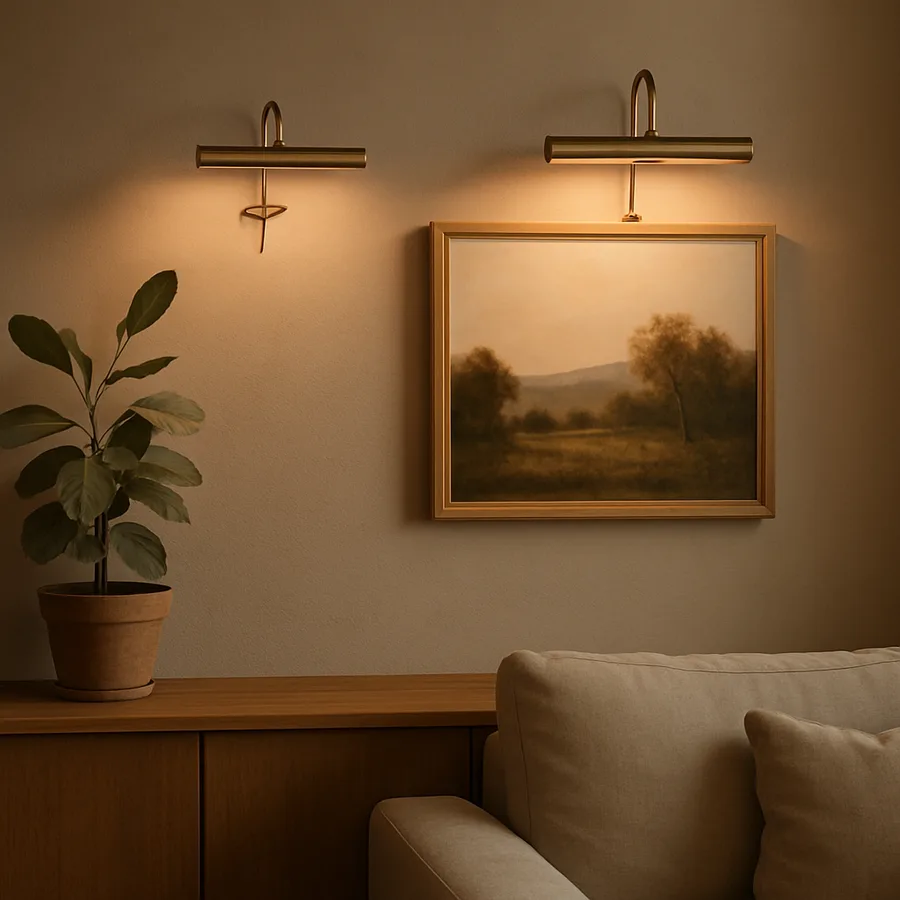
The decision between mounting a picture light directly on the frame of an artwork or on the wall above it sounds minor and is anything but. The two approaches produce noticeably different visual results, demand different installation skills, and impose different constraints on the artwork itself. A frame-mounted light moves with the piece if you ever rearrange, hides its wiring inside the frame's structure, and sits closer to the canvas for tight, focused illumination. A wall-mounted light is independent of the frame, distributes its output across a larger area, and can survive a piece swap without modification. Choosing the right method requires weighing structural, optical, electrical, and aesthetic factors in roughly that order, and this guide walks through each.
The Visual Differences You Should Notice First
The most immediate difference is the angle of incidence on the artwork. A frame-mounted light typically sits 4 to 7 inches above the top of the visible image and projects downward at a steep angle, which lights the upper third of the piece brilliantly and lets the lower third drop into a softer, gradient zone. A wall-mounted light, often 10 to 14 inches above the frame, projects at a shallower angle and produces a more uniform top-to-bottom wash. Neither is right or wrong; they are different artistic choices.
The visible hardware also reads differently. A frame-mounted light sits above the artwork's own border and tends to feel like part of the piece itself, especially when the finish matches the frame. A wall-mounted light sits in the open wall plane above the frame and reads as a fixture, similar to a sconce. In rooms with strong architectural details (paneled wainscoting, picture rails, deep crown molding), a wall mount often complements the existing trim language. In contemporary minimalist rooms, the discreet frame mount tends to disappear more gracefully.
According to a 2023 product report by the American Lighting Association, residential picture-light sales split roughly 60 percent wall-mounted to 40 percent frame-mounted, with the gap narrowing each year as battery-powered frame lights gain popularity. The split reflects installation ease as much as aesthetics; wall-mount fixtures still dominate in homes built before code-friendly battery options matured.
The third visual variable is shadow behavior. Frame mounts cast almost no shadow on the surrounding wall because the source sits flush above the artwork itself. Wall mounts, projecting forward from the wall on a longer arm, often cast a soft fixture shadow on the wall directly above the frame, which can either read as architectural punctuation or as an unwanted streak depending on the wall finish. Smooth, flat painted walls handle the shadow gracefully; heavily textured walls or walls with prominent crown molding sometimes do not.
When Frame Mounting Is the Right Call
Frame mounting wins in three specific situations. First, when the artwork is the centerpiece and you want the light to feel inseparable from it, a frame mount keeps the visual unit (frame, light, painting) together as a single object. Galleries often prefer this for headline pieces because moving the work to a different wall does not require any electrical work; the light goes with it.
Second, frame mounting works well for oversized pieces longer than 48 inches, where a wall-mounted light would need to sit far enough above to look proportionate, sacrificing intensity. A frame mount stays closer and delivers the same lumen count with much higher illuminance at the canvas. The Illuminating Engineering Society generally recommends a target of 200 to 300 lux at the painted surface for accent lighting on canvas, and frame mounts hit this target with smaller, less expensive fixtures.
Third, battery-powered frame lights have become genuinely viable in the last five years. Modern lithium-ion units now deliver 40 to 90 hours of continuous use per charge, recharge in 3 to 5 hours via USB-C, and ship with remote-control dimming. For renters and homeowners who cannot easily run new wiring, this is a transformative product category. A quality battery picture light typically costs between $120 and $280, and avoids the $300 to $700 electrician bill of a hardwired wall mount.
When Wall Mounting Is the Better Choice
Wall mounting wins when the artwork is going to change over time. A renter who rotates pieces, a collector who acquires new work each year, or a homeowner who hosts seasonal or themed art swaps will tire quickly of repositioning frame mounts and dealing with frame screws on each new piece. A wall light installed once handles every subsequent rotation.
Wall mounting is also the right answer when the frame cannot bear the load. Antique frames, ornate gilded frames, and shadow-box frames often have hollow upper rails that cannot accept the screws or grip clips a frame light requires without compromising structural integrity. The American Society of Interior Designers routinely advises against frame mounting on any piece older than fifty years unless a conservator has confirmed the frame's structural soundness.
A third case: sets and pairs. Diptychs, triptychs, and matched grids of small prints look strange with individual frame mounts because the lights themselves create a competing rhythm above the work. A single longer wall-mounted fixture (or two well-spaced wall lights) provides a unified wash that reads the set as one composition. This is also the standard museum solution, which has been refined over decades.
Have you ever stood in front of a beautifully framed piece and felt the framing was working harder than the light? That is the signature of frame mounting on a piece that should have been wall-lit. The eye reads the frame, the picture light, and the artwork as a single visual unit, and a heavy or ornate frame paired with an equally heavy frame-mounted light becomes top-heavy. When in doubt with traditional or formal frames, lean toward the wall-mounted approach so the frame can do its own visual work without competition from the fixture above it.
Weight, Structure, and Frame Compatibility
Modern frame-mounted picture lights weigh between 0.6 and 2.4 pounds depending on length and material, but the load on the frame's top rail is the leverage of that weight times the light's standoff distance. A 2-pound light projecting 6 inches forward applies an effective 12 inch-pounds of moment to the upper rail, which over time can warp thin or hollow rails. Confirm that your frame's upper rail is solid wood at least 0.75 inches thick, or use a wall mount.
Glass-fronted frames add another wrinkle. Most frame lights clip or screw into the upper rail from above, but a few models attach via spring-clip pressure against both rails. If the artwork's glass is not securely retained, the spring pressure can shift the glass mounting and stress the matting beneath. Check fixture instructions and frame compatibility before purchase, especially for archival or museum-quality framing where any movement is unwanted.
Wall mounts have their own structural requirements. A hardwired wall-mounted picture light needs an electrical junction box properly anchored in studs or with a proper old-work box if no stud falls in the right place. Code requires the box to support the fixture's weight plus a 50-pound static load minimum. Have you ever seen a sagging picture light with the cord visibly drooping out of the wall? The cause is almost always a missing or undersized junction box, and it is repairable but tedious.
Wiring, Switching, and Hidden-Cable Strategies
Hardwired wall-mounted picture lights are typically supplied from a junction box hidden behind the fixture and switched via a wall switch or dedicated dimmer. The clean install runs 14/2 cable from the switch leg to the box and lands the fixture's leads inside, with no visible cabling on the wall. Most jurisdictions require this work to be performed under a permit, and the National Electrical Code Article 410 governs fixture supply and clearance.
Frame-mounted hardwired lights require either a hidden cord drop down the wall (which most homeowners find unattractive) or a wall outlet behind the artwork that the cord plugs into. The behind-the-art outlet is the cleaner solution and is achievable with about an hour of work for an experienced electrician, plus a small drywall patch. The outlet should be GFCI or AFCI per local code and should sit at the vertical center of the back of the frame for shortest cord run.
For battery-powered frame lights, no wiring at all is needed, but plan for the recharge ritual. A reasonable schedule is to swap or recharge the unit every two to three months based on typical 4-to-6-hour daily evening use. Some homeowners keep a second unit charged and ready, then swap them on a calendar reminder, which avoids any visible interruption in the gallery's lighting.
Color Temperature, Beam Spread, and Glare Control
Picture lights generally use either small tungsten halogen lamps (older fixtures, warm and high-CRI but hot and inefficient) or LED arrays (newer fixtures, cool-running, energy-efficient, and increasingly high-CRI). For residential gallery use, target 2,700 to 3,000 Kelvin color temperature and CRI 90 or higher; below CRI 90, oil paintings lose chromatic depth and watercolors look flat.
Beam spread on most picture lights is fixed by the fixture's reflector geometry, but you can choose between narrow-spread models (which highlight a focused area and create some falloff toward the edges) and wide-spread models (which provide more uniform illumination across larger pieces). For a piece up to 30 inches wide, a narrow-spread fixture works fine. For pieces 36 inches and wider, look specifically for fixtures advertised as "art-bar" or "long-throw" design.
Glare is the most common complaint about poorly chosen picture lights, and it is almost always caused by a fixture that lets the lamp itself be visible from normal viewing angles. Look for a fixture with a deep shielding hood or an integrated lower lip, both of which keep the lamp source out of sight while letting the light project onto the artwork. Cheap fixtures skip this detail and produce a glaring strip just above the frame that ruins the visual effect.
Dimming behavior is another silent variable. Many entry-level picture lights advertise dimmability but rely on cheap drivers that produce visible flicker below 30 percent output. The result is unusable in the very evening hours when picture lights matter most. Spend the extra $40 to $80 on a fixture with a genuinely dimming-rated driver validated against common residential dimmers, and confirm before purchase that the model dims smoothly to 10 percent or lower. The visual difference at low evening levels is the difference between a curated gallery and a flickering, distracting accent.
Conclusion
The honest answer to frame versus wall mounting is that both methods have a defensible best-use case, and a thoughtful homeowner will pick the right one piece by piece rather than insisting on a single approach for the whole house. Frame mounts win for permanent centerpiece artworks, oversized canvases, and rental situations where battery power is the only path. Wall mounts win for rotating collections, fragile or antique frames, and matched sets that benefit from a unified light source.
The practical decision tree is short. Start by asking whether the piece will move within the next five years; if the answer is uncertain or yes, lean wall-mount. Next, ask whether the frame can structurally and aesthetically accept a clip-on light; if it cannot, the choice is made for you. Finally, weigh the wiring path: is there an accessible junction box location for a wall mount, or is a hidden outlet plus battery unit the cleaner path? Each of these answers narrows the field quickly.
Whichever method you choose, invest in quality optics and proper aiming rather than chasing the cheapest fixture. The visual difference between a $90 builder-grade picture light and a $240 well-engineered fixture is enormous, and it shows up every single evening the artwork is illuminated. The math on art that has been carefully selected and framed but lit with a generic fixture rarely works in the homeowner's favor.
If you have a piece you have been meaning to highlight properly, take the next step this week. Measure the frame's top rail, photograph the wall above it, and decide between frame and wall mount before you shop. The clarity of an upfront choice prevents the most common outcome, which is buying a fixture that does not fit the install context and either returning it or living with a compromise. A decisive choice produces a glow that flatters the work for as long as it hangs.
More Articles You May Like



Comments
Post a Comment