Mid-Century Modern Entryway Furniture and Decor Picks
Why the Entryway Sets the Tone for Your Entire Home
The entryway is the first interior space anyone encounters when they cross your threshold, and it communicates your design sensibility within seconds. In mid-century modern homes, this transitional zone between the outside world and the private interior is treated with particular care because the style's emphasis on clean lines, organic forms, and material warmth demands consistency from the very first step inside. A well-designed mid-century entryway tells visitors they are entering a home where every detail has been considered, where form follows function, and where the aesthetic runs deeper than surface decoration.
Despite its importance, the entryway is one of the most neglected rooms in residential design. Many homeowners focus their budgets and attention on living rooms, kitchens, and bedrooms while leaving the entry as an afterthought, furnished with whatever pieces happen to fit. The American Society of Interior Designers (ASID) has found through client surveys that entryway improvements rank among the highest-impact, lowest-cost changes homeowners can make, with 73 percent of respondents reporting that a well-designed entry positively influenced their overall perception of a home. This article provides specific furniture and decor recommendations to help you build a mid-century modern entryway that performs this critical first-impression function beautifully.
The mid-century modern movement, spanning roughly from the mid-1940s through the early 1970s, produced some of the most iconic furniture designs in history. Names like Charles and Ray Eames, George Nelson, Isamu Noguchi, and Finn Juhl created pieces that remain in continuous production today precisely because they solved functional problems with enduring elegance. Drawing from this rich design heritage gives your entryway access to a vocabulary of forms that have been tested and refined over more than seven decades.
What feeling do you want your entryway to create? For most mid-century enthusiasts, the answer involves a blend of warmth, sophistication, and approachability. The style invites people in rather than intimidating them, using organic materials and flowing forms to create spaces that feel human-scaled and welcoming. With the right selections, even a narrow hallway or compact foyer can achieve this effect without the need for extensive renovation or architectural modification.
Console Tables: The Anchor Piece
The console table is the foundational piece of any mid-century modern entryway, providing both a functional surface for keys, mail, and daily essentials and a visual anchor that establishes the style's character. The ideal mid-century console is long and slim, typically 100 to 130 centimeters wide and no deeper than 35 centimeters, with splayed or tapered legs in solid wood and a clean, unadorned top surface. Walnut is the definitive mid-century wood, prized for its rich chocolate-brown tone and distinctive grain, though teak and rosewood were also widely used during the period.
Among specific pieces, the George Nelson Thin Edge console represents the style at its most refined: a floating slab top on delicate steel legs with walnut veneer that appears to hover above the floor. For a more substantial presence, look for vintage or reproduction consoles with drawer storage, such as models inspired by the Danish designs of Arne Vodder or Kai Kristiansen, which combine slim profiles with concealed compartments for organizing the items that accumulate near the front door. The Smithsonian's Cooper Hewitt Design Museum maintains an extensive collection of mid-century furniture that documents the evolution of these forms and their makers.
When shopping for a console table, pay close attention to proportional fit. The table should be approximately two-thirds the width of the wall it sits against, leaving breathing room on either side. Its height should fall between 72 and 80 centimeters, aligning roughly with standard counter height so that you can comfortably place and retrieve items without bending or reaching. If your entryway is very narrow, consider a wall-mounted floating shelf in walnut or teak as an alternative that provides the same functionality without consuming floor space.
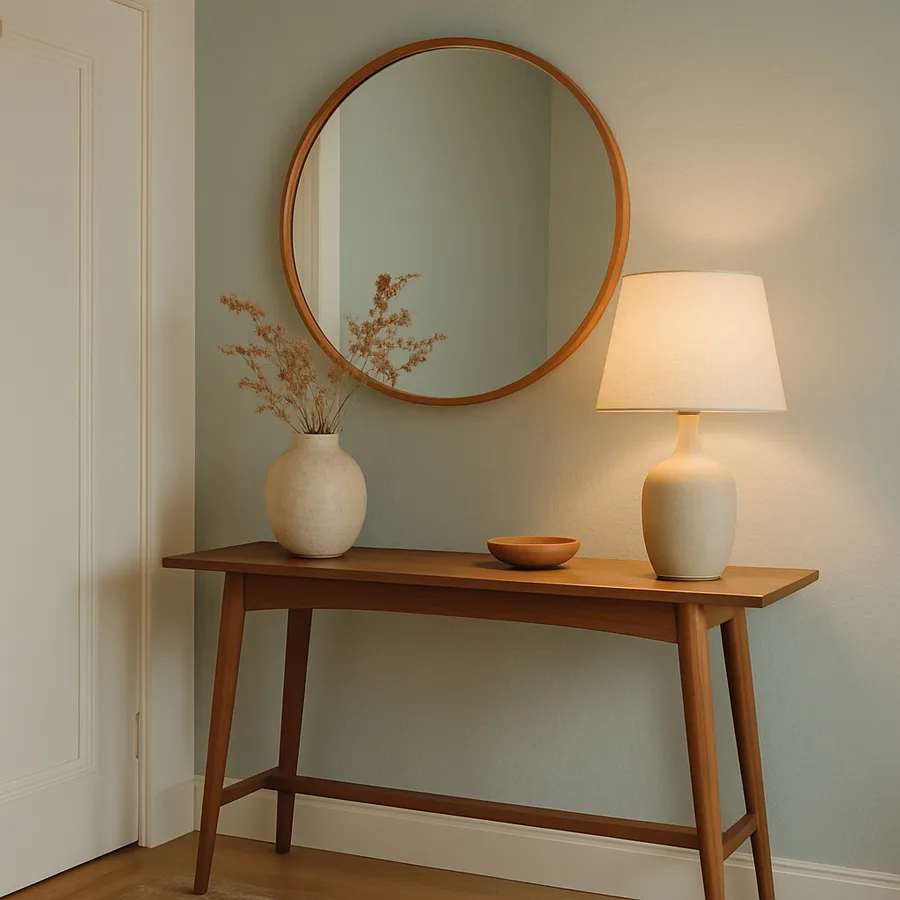
The console's surface should be kept deliberately sparse. A small ceramic tray or bowl for keys and pocket items, a single decorative object like a small sculpture or a potted succulent, and perhaps a table lamp are sufficient. The mid-century approach to surface styling follows the modernist principle that negative space is an active design element; a crowded console looks cluttered rather than curated and undermines the clean-line aesthetic that defines the style. Resist the impulse to fill every available inch and instead let the beauty of the furniture itself carry the visual weight.
Mirrors and Wall Decor: Expanding the Space
A well-chosen mirror does more than provide a last-check reflection before you leave the house; it doubles the perceived depth of the entryway and amplifies both natural and artificial light. The most iconic mid-century mirror shape is the sunburst, with radiating metal spokes in brass or gold-finished wire surrounding a central convex or flat glass. While the sunburst has been widely reproduced and can veer into cliche if not selected carefully, a vintage or high-quality reproduction piece retains its power as a statement element. Look for examples with irregular spoke lengths and a hand-finished quality that distinguishes them from mass-market versions.
For a subtler approach, consider a large round mirror in a thin walnut or brass frame, which provides the same light-amplifying and space-expanding benefits without the decorative exuberance of the sunburst. Round mirrors became a signature of mid-century interiors because their soft geometry contrasts beautifully with the straight lines of console tables and cabinetry. Position the mirror so its center sits approximately 150 centimeters from the floor, ensuring it serves both tall and shorter household members comfortably.
Beyond mirrors, mid-century entryways benefit from one or two pieces of wall art that reinforce the period's aesthetic. Abstract prints by artists associated with the mid-century movement, such as Alexander Calder's lithographs, Paul Klee's geometric compositions, or Japanese-inspired ink paintings that influenced many mid-century designers, work exceptionally well. Frame selections should be simple and period-appropriate: thin black metal, natural wood, or floating-mount techniques that let the artwork stand on its own. Architectural Digest regularly features authenticated mid-century art collections and offers guidance on distinguishing original prints from reproductions.
One wall treatment worth considering is a wood-slat accent wall directly behind the console table. Vertical slats in walnut or white oak, spaced slightly apart to create shadow lines, add warmth, texture, and architectural interest without competing with furniture or art. This treatment references the wood-paneled accent walls common in original mid-century homes and can be installed as a DIY project using pre-milled slat kits now available from several suppliers. The effect is substantial for the investment, transforming a flat, featureless wall into a crafted backdrop.
Seating and Storage: Functional Style
If your entryway has room for seating, a mid-century bench is the most versatile option. The George Nelson Platform Bench, originally designed for Herman Miller, is perhaps the definitive entryway piece: a slatted maple or walnut surface on black steel legs that serves equally well as a seat, a display surface, or a place to set bags and packages. Its open construction keeps the space feeling light, and its proportions work in entries of nearly any size. Original Nelson benches command premium prices on the vintage market, but licensed reproductions from Herman Miller and high-quality alternatives from contemporary makers are widely available.
For entries that require shoe and outerwear storage, look for mid-century-inspired credenzas or cabinets with sliding doors, which conceal contents while maintaining the clean exterior profile the style demands. A low credenza in walnut with cane-front sliding panels combines storage with period-accurate decorative detail and can double as a bench when topped with a slim cushion in a period-appropriate textile. The Better Homes and Gardens entryway planning guides recommend a minimum of 30 centimeters of seat depth for comfortable entry seating, a dimension that most low credenzas easily accommodate.
Coat storage in a mid-century entryway should avoid the bulky hall tree in favor of more sculptural solutions. Wall-mounted coat racks in the style of the Eames Hang-It-All, with colorful wooden balls on a wire frame, combine playful mid-century design sensibility with genuine utility. For a more restrained option, a row of individual brass or walnut wall hooks mounted at consistent intervals provides coat and bag storage without visual clutter. Position hooks at approximately 160 centimeters from the floor for adult use, and consider adding a lower row at 100 centimeters if children live in the household.
Umbrella storage is an often-overlooked detail that contributes to the entry's overall polish. A cylindrical ceramic umbrella stand in white, matte black, or a warm earth tone, or a minimal wire-frame holder in brass or black steel, keeps umbrellas organized and prevents water from pooling on the floor. Small functional objects like these demonstrate the mid-century principle that even the most mundane items deserve thoughtful design, and their presence elevates the entry from a passthrough into a composed room.
Lighting: Setting the Mood at the Door
Lighting in a mid-century modern entryway should accomplish two goals simultaneously: provide sufficient practical illumination for arriving and departing, and establish the warm, inviting atmosphere that characterizes the style. Overhead fixtures are the most common starting point, and the mid-century canon offers an extraordinary range of options. Pendant lights with saucer, globe, or drum shapes in white glass, spun metal, or natural wood are quintessential choices that diffuse light evenly while serving as sculptural elements.
The George Nelson Bubble Lamp series, originally designed for Howard Miller, remains one of the most recognizable and effective mid-century lighting designs. Available in saucer, cigar, ball, and other organic forms, these pendants produce a soft, warm glow through their translucent polymer skin that flatters both people and spaces. For entries with lower ceilings where a pendant might feel intrusive, a flush-mount fixture in brass with a white glass globe or an opal diffuser provides the same quality of light in a more compact profile. The Illuminating Engineering Society recommends a minimum of 150 lux for residential entryways, a level easily achieved with a single well-placed pendant or flush mount supplemented by a table lamp.
A table lamp on the console adds a secondary layer of warm, localized light that enhances the entry's welcoming quality, particularly in the evening. Mid-century table lamp designs run the gamut from ceramic-bodied pieces with textured glazes and fabric shades to minimal metal designs with adjustable arms and cone-shaped shades. Look for lamps that combine organic base materials (ceramic, turned wood, or cast brass) with neutral or warm-toned shades that direct light both up and down. The lamp's scale should be proportional to the console: a lamp that is too large overwhelms the surface, while one that is too small looks insignificant.
Do not overlook the opportunity to use wall sconces flanking the mirror or art above the console. Mid-century sconce designs, particularly those with swiveling arms and conical shades in brass or black enamel, provide targeted light and serve as decorative accents that reinforce the period character. Position sconces at 160 to 170 centimeters from the floor, flanking the mirror at roughly the same width as the console below, to create a balanced, intentional composition. Warm-white LED bulbs in the 2700K range will complement the natural wood tones that dominate the mid-century palette.
Finishing Touches: Rugs, Plants, and Personal Objects
The entry rug or runner is both a practical necessity and a significant design opportunity. Mid-century interiors favor rugs with geometric or abstract patterns in warm, earthy color palettes: burnt orange, olive green, mustard yellow, teal, and chocolate brown are all period-appropriate accent colors that pair naturally with walnut furniture and brass hardware. Flat-woven kilim rugs, vintage Scandinavian rollakans, and contemporary runners inspired by mid-century textile patterns all work well in this context. Size the rug to extend at least 30 centimeters beyond the console table on each side, and choose a low-pile construction that will not catch under the front door.
A single statement plant brings life and organic energy to the mid-century entryway. The style has strong associations with specific plant varieties: the rubber plant (Ficus elastica), snake plant (Sansevieria), fiddle-leaf fig, and monstera deliciosa all feature the bold, sculptural leaf forms that mid-century designers favored. Choose a planter that reinforces the period aesthetic: a ceramic pot in a matte glaze with a geometric profile, a cylinder in walnut-stained wood, or a brass-finished metal container on a wire plant stand. The Houzz plant styling guide suggests placing the plant at the end of the console or in an adjacent corner where it can grow without obstructing the pathway.
Personal objects are what distinguish a styled entryway from a lived-in one. A small framed photograph in a brass or wood frame, a ceramic dish collected from a memorable trip, or a vintage clock in a characteristic mid-century shape all contribute warmth and individuality without cluttering the space. The mid-century emphasis on intentional simplicity means each personal object should be displayed as though it were in a gallery: given space, well-lit, and placed with purpose. Rotate these objects seasonally or as your collection evolves to keep the entry feeling fresh.
Finally, consider the sensory experience beyond the visual. A discreet reed diffuser or a high-quality candle in a ceramic vessel can scent the entry with warm, woody fragrances like sandalwood, leather, or tobacco flower that complement the material palette. A small Bluetooth speaker concealed on the console shelf or in a nearby cabinet can greet you with music when you arrive home, a modern comfort that the mid-century designers, who valued the intersection of technology and domestic life, would certainly have embraced. These invisible details complete the entryway experience and demonstrate that thoughtful design extends beyond what the eye can see.
Conclusion: Crafting a First Impression Worth Remembering
A mid-century modern entryway is not assembled from a checklist of trendy items but composed from a clear understanding of the design principles that made the movement so enduring: clean lines, organic materials, functional beauty, and a respect for the objects and spaces of daily life. Every piece, from the console table to the coat hooks, should earn its place through both utility and aesthetic contribution. When these elements work together, the entryway becomes more than a hallway; it becomes a statement of values and a daily source of pleasure.
The investment required to create a compelling mid-century entryway is surprisingly modest. A quality console table, a well-chosen mirror, a statement light fixture, and a handful of carefully selected accessories are all most entries require. The key is to prioritize material quality and design integrity over quantity, choosing fewer, better pieces rather than filling the space with inexpensive items that will need replacing. According to the National Association of Realtors, entryway improvements consistently deliver strong returns in home value perception, making this one of the most financially sensible style investments a homeowner can make.
Begin by measuring your entryway and establishing the maximum dimensions for a console table and rug. Then visit a reputable mid-century furniture dealer, whether online or in person, and handle the materials before committing to a purchase. The difference between a walnut-veneered particleboard console and a solid walnut piece is immediately apparent to the hand, and that tactile quality will define your experience of the piece for years to come.
Ready to build your mid-century entry? Browse the ASID designer directory to find a professional in your area who specializes in mid-century residential interiors and can source authenticated vintage pieces alongside quality contemporary reproductions tailored to your space and budget.
More Articles You May Like



Comments
Post a Comment