Three-Season Porch Heating With Infrared and Wood Stoves
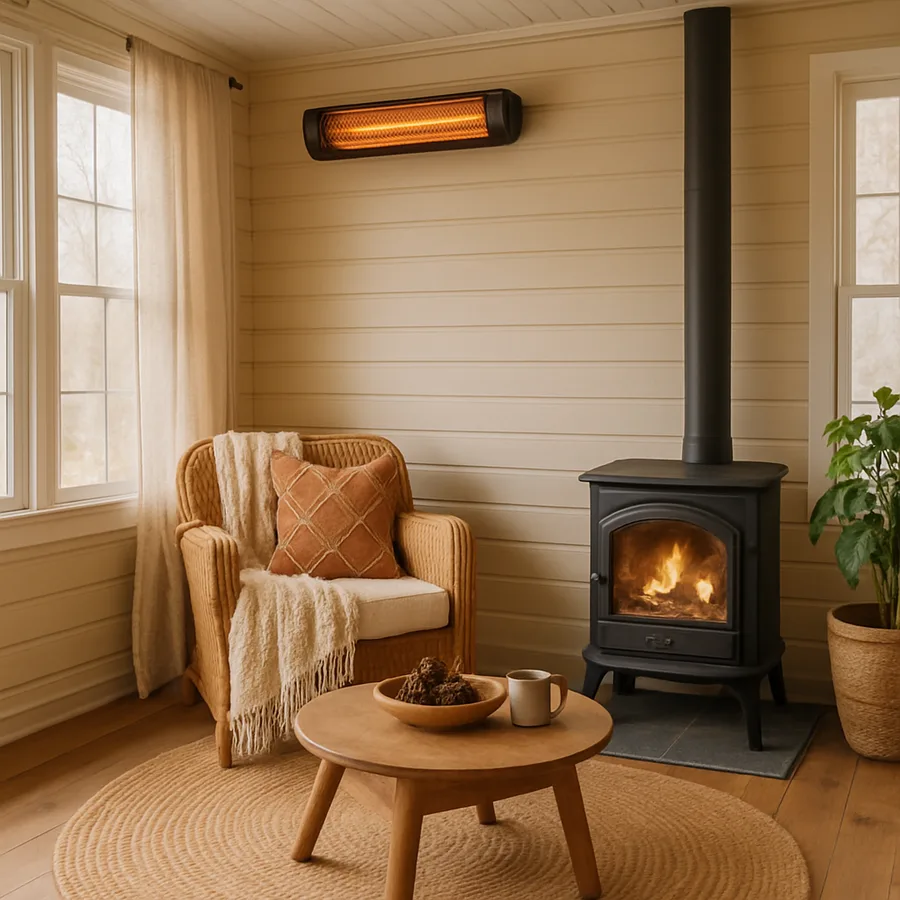
A three-season porch is meant to extend your usable living space into spring and fall, but every year homeowners discover that the porch they enjoyed in October becomes uninhabitable by early November. The walls are typically uninsulated, the windows are single-glazed or screened, and the roof radiates heat skyward at a punishing rate. Conventional forced-air heating cannot keep up, so the question becomes which spot-heating strategy can stretch the season without cooking your energy bill or violating local fire codes. The two leading options for serious porch heating in 2026 are infrared heaters, which warm objects and people directly without trying to heat the air, and wood stoves, which produce a powerful localized heat source plus the irreplaceable ambiance of a real fire. This guide compares them across performance, cost, safety, and code compliance so you can choose with confidence.
Understanding Why Porches Are So Hard to Heat
Standard residential heating systems are designed to warm conditioned, insulated spaces. A typical living room loses heat at perhaps 15 to 25 BTU per hour per square foot. A three-season porch, by contrast, can lose 80 to 150 BTU per hour per square foot in cold weather, and the loss accelerates dramatically the moment the outdoor temperature drops below freezing. The porch is fighting physics it cannot win: thin walls, large glazed surfaces, and air infiltration around screen panels all act as continuous heat exits.
This loss profile is why traditional convective heating fails on a porch. A standard space heater warms the air, but that air is constantly being replaced by cold air leaking through gaps and conducting through glass. You can run a 1,500-watt convective heater all evening and feel almost no effect on a 14-by-18-foot porch in 38-degree weather. The heater is doing its job; the building envelope is just not capable of holding what the heater produces.
The solution is to abandon the goal of heating the whole air volume and instead deliver heat directly to the people and objects in the space. Both infrared heaters and wood stoves do this, though through entirely different mechanisms. Infrared works by radiation, similar to how the sun warms your skin even on a cold day. Wood stoves combine radiation from the iron or steel firebox with convection from the air rising past the unit. Either approach can produce a comfortable seating area in conditions where conventional heating would simply fail.
Infrared Heaters for Porches
Modern infrared porch heaters fall into three families: electric, propane, and natural gas. Electric infrared units in the 1,500 to 6,000-watt range can be ceiling-mounted, wall-mounted, or used as freestanding patio-style heaters. They produce no combustion byproducts, require no fuel storage, and can be controlled with a simple wall switch or remote. The National Electrical Manufacturers Association (NEMA) publishes installation standards for outdoor and damp-location electric heaters that should be followed without exception, particularly the requirement for ground-fault circuit interrupter protection on all 120V and 240V units in screened or partially open spaces.
Gas-fired infrared heaters, whether propane or natural gas, deliver more heat per dollar of operating cost in most regions. A typical commercial-style overhead infrared unit produces 30,000 to 50,000 BTU per hour and can warm a 200-square-foot porch zone effectively even in subfreezing weather. The trade-off is that gas units require proper venting and minimum clearances, and many local building codes restrict their use in screened or partially enclosed structures because of carbon monoxide concerns. Always check with your local building department before specifying a gas infrared heater for a porch, and never install one in a fully enclosed three-season porch without dedicated combustion air and a CO detector.
The advantages of infrared on a porch are significant. Heat is felt almost instantly, the units can be zoned to warm only the seating area rather than the entire porch, and there is no fire-tending or ash management. The disadvantages are equally real. Electric units have high operating costs, particularly in regions where electricity exceeds 18 cents per kilowatt-hour. Gas units involve fuel storage and venting complications. And no infrared heater offers the visual warmth of an actual flame, which for many homeowners is half the point of porch heating in the first place.
Wood Stoves on a Three-Season Porch
A small cast iron or steel wood stove can transform a three-season porch from a chilly waiting room into the most-used space in the house from late September through Thanksgiving and again from March through May. A 25,000 to 40,000 BTU wood stove sized appropriately for the porch will produce comfortable temperatures even when the outdoor air is in the 20s, and the radiant heat from the firebox warms people and surfaces in a way that no electric heater can match. The Hearth, Patio and Barbecue Association (HPBA) reports that wood stove installations grew 22% between 2022 and 2025, with much of that growth in supplemental and outdoor-room applications rather than primary heating.
Code compliance is where wood stove projects either succeed or fail. Every wood stove installation must meet the requirements of NFPA 211, the National Fire Protection Association standard for chimneys, fireplaces, vents, and solid-fuel-burning appliances. NFPA 211 specifies clearances to combustibles, hearth pad construction and dimensions, chimney height and termination, and combustion air requirements. The standard is not optional; it is referenced by virtually every state and local building code in the United States. A porch wood stove installed without these clearances is uninsurable and dangerous.
The clearance requirements deserve attention because they often surprise homeowners. A typical small wood stove needs 36 inches of clearance to combustibles in all directions unless the manufacturer specifies a reduced clearance with NFPA-listed shielding. The hearth pad must extend at least 16 inches in front of the loading door and 8 inches to the sides, and it must be a non-combustible assembly with documented thermal performance. The chimney must terminate at least 3 feet above the roof penetration and 2 feet above any structure within 10 feet horizontally. These dimensions can consume a significant portion of a small porch, so size and place the stove early in your design process, not as an afterthought.
Combustion air is the other critical consideration. A wood stove inside a screened porch with substantial natural ventilation will usually find adequate combustion air through the screens themselves. A wood stove inside a glazed three-season porch with tight-fitting windows almost certainly needs a dedicated outside air kit that delivers combustion air directly to the firebox. Failure to provide adequate combustion air leads to backdrafting, smoke spillage, and elevated carbon monoxide levels. Have you confirmed your porch's air-tightness and consulted a certified chimney sweep before specifying a stove?
Sizing, BTU Calculation, and Zoning
Sizing a porch heater is more art than science because the heat loss varies so dramatically with weather conditions, but a structured approach beats guessing. Start with the porch's volume in cubic feet, multiply by a heat-loss factor appropriate to its construction, and then add 20 to 30% as a safety margin. For a screened porch with a roof and minimal walls, use a factor of 35 to 45 BTU per cubic foot per degree of indoor-outdoor temperature difference. For a three-season porch with single-pane windows and uninsulated walls, use a factor of 25 to 35. For a three-season porch with double-pane windows and some wall insulation, drop to 15 to 25.
Worked example: a 14-by-18-foot porch with an 8-foot ceiling has a volume of 2,016 cubic feet. With double-pane windows and partial wall insulation, multiply by 20 BTU per cubic foot per degree of difference. To maintain an indoor temperature of 65 degrees on a 35-degree day, you need to handle a 30-degree differential, which works out to 1,209,600 BTU per hour at the high end of the calculation. Wait, that number is enormous, but it represents heat loss per hour at peak conditions, not the steady-state requirement once the porch warms up. Sizing rules of thumb suggest selecting a heater rated for 50 to 70% of that calculated peak load for spot heating, since you are not trying to maintain whole-porch comfort, just a comfortable seating zone.
Zoning matters more on a porch than in a house. A single high-output heater placed centrally is almost always less effective than two smaller heaters placed at opposite ends of a long porch, or one heater dedicated to a primary seating area and a smaller secondary unit at a side table or reading nook. Infrared heaters are particularly well-suited to zoning because their heat is directional and can be aimed precisely. Wood stoves are inherently zonal because their heat is concentrated near the firebox, dropping off rapidly with distance. Plan furniture placement around your heat source, not the other way around.
Operating Cost, Fuel, and Real-World Performance
Operating costs vary widely by region and fuel type, but some generalizations hold. Electric infrared heaters are the most expensive to operate per BTU delivered, typically running $0.40 to $0.80 per hour for a 5,000-watt unit at U.S. average residential rates. Propane infrared heaters cost roughly $0.60 to $1.20 per hour for a 40,000 BTU unit, with the wide range reflecting volatile propane prices. Natural gas infrared, where available, runs $0.25 to $0.50 per hour for similar output. Wood stoves are the cheapest to operate if you have access to inexpensive or free firewood, and the most expensive if you buy seasoned hardwood at retail.
Real-world performance depends as much on weather and porch design as on the heater itself. Expect any porch heating system to be most effective in the 35 to 55 degree outdoor temperature range, where it can comfortably extend porch use by hours per day and weeks per season. Below 25 degrees outdoor temperature, even the best heating system struggles in a typical three-season porch, and you should plan to retreat indoors for the deepest cold. The U.S. Department of Energy estimates that adding effective spot heating to a three-season porch can extend its annual usable hours by 600 to 1,000 hours, depending on climate zone and heater type.
Maintenance also factors into total cost of ownership. Electric infrared heaters need almost no maintenance beyond an occasional dusting and a check of mounting hardware. Gas infrared heaters require annual inspection of burners, ignition systems, and fuel lines. Wood stoves need annual chimney sweeping, gasket replacement every two to three years, and ongoing supply of properly seasoned firewood with moisture content below 20%. Burning unseasoned wood is the leading cause of dangerous creosote buildup in residential chimneys, so do not skip the moisture meter.
Safety, Code Compliance, and Insurance Considerations
Porch heating safety is not optional, and it is the area where do-it-yourself enthusiasm causes the most expensive mistakes. The National Fire Protection Association reports that heating equipment is involved in roughly 15% of home structure fires annually, and outdoor and porch installations are over-represented in that statistic because of improper clearances and inadequate venting. Read the manufacturer's installation manual completely before any installation, and follow it without modification. Reduced-clearance installations are permissible only with NFPA-listed shielding products installed exactly as specified.
Permits are required for almost every wood stove installation and for most gas heater installations in residential porches. Electric infrared heaters wired to a dedicated circuit also require an electrical permit in most jurisdictions. Pulling a permit triggers an inspection, which is your best protection against a faulty installation. Inspectors verify clearances, hearth construction, chimney specifications, electrical work, and combustion air provisions. They are not adversaries; they are the last line of defense between your porch project and a serious fire.
Insurance is the often-overlooked finishing piece. Notify your homeowners insurance carrier in writing of any wood stove installation and request a policy endorsement that confirms coverage. Many policies exclude or limit coverage for solid-fuel-burning appliances unless the carrier has been notified and the installation has been documented. Keep copies of permits, inspection reports, manufacturer's installation instructions, and the chimney sweep's annual certification. Should you ever need to file a claim, this documentation will determine whether the claim is paid in full, paid in part, or denied outright.
Conclusion
Both infrared heaters and wood stoves can extend the useful season of a three-season porch significantly, and both have legitimate constituencies among homeowners and remodelers. The choice between them comes down to four practical questions: how much you value the visual experience of a real fire, how much weekend time you are willing to invest in fuel and maintenance, what the local code environment will permit, and how the operating cost math works out in your specific climate and energy market. None of these questions has a universal answer.
If your priority is convenience and clean operation, infrared is almost certainly the right choice. If your priority is the experience of an actual fire and you have access to reasonably priced firewood, a small wood stove will reward the additional effort with an unmatched ambiance and serious heat output even in cold weather. Many homeowners ultimately install both, using infrared for quick warmth on shoulder-season evenings and the wood stove for cold weekends when the porch becomes the main gathering space.
Whichever path you choose, treat the installation with the seriousness it deserves. Get a written quote from at least two installers certified for the technology you are choosing, verify their NFPA and NEMA familiarity, pull all required permits, and notify your insurance carrier before the work begins. The cost of doing it right is modest compared to the cost of doing it wrong, and the difference often comes down to a few hundred dollars in shielding, venting, or electrical work that an experienced installer specifies without prompting.
Ready to extend your porch season? Start by measuring your porch's volume and noting your local winter design temperature, then schedule a consultation with an HPBA-affiliated installer who works on porch projects specifically. A well-chosen and properly installed heater can turn six months of porch use into ten, and that extra time outdoors is worth the planning effort it takes to get there safely.
More Articles You May Like


Comments
Post a Comment