Wrought Iron Balusters vs Wood Spindles: Pros and Cons
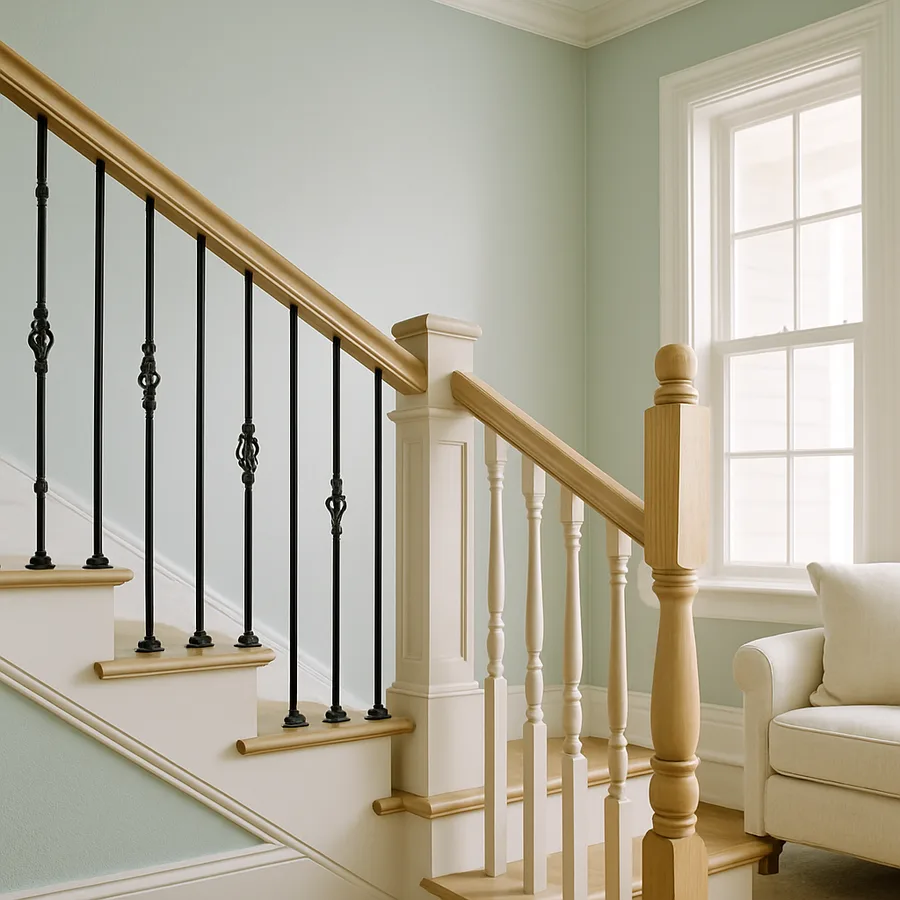
The choice between wrought iron balusters and wood spindles rarely begins as a code or budget question. It begins as a style question. A homeowner walks past a staircase in a magazine, on a real estate listing, or in a friend's renovated home and decides that something about the railing looks right. Once they get into the project, however, every other dimension of the decision floods in. Cost. Maintenance. Resale. Installation difficulty. Compatibility with the rest of the trim. According to a 2025 Houzz Stair Style Report, 38 percent of stair remodels in the United States now mix iron and wood, suggesting that homeowners increasingly refuse to see this as a binary choice.
This article walks through the pros and cons of each material, and then through the hybrid approaches that combine them. Reader question to bring into the comparison: how long do you intend to live in the home? A 25-year horizon weighs durability and finish renewability differently than a five-year flip. Reader question two: what is the rest of the house already saying about itself? An 1890s Queen Anne and a 2024 transitional new-build do not call for the same answer, even when the budget and the code requirements are identical.
Wood Spindles: The Long Default
Wood spindles, sometimes called wood balusters, are the historical default for residential stair railings. They appear on every American architectural style from Federal to Craftsman to mid-century modern, and they remain the most commonly specified stair infill in new construction. The National Wood Flooring Association and the broader hardwood industry have built deep supply chains around stair parts, so a homeowner can walk into a regional millwork shop and walk out the same day with profiles in red oak, white oak, poplar, maple, or cherry that match their existing trim package.
Pros are substantial. Wood is renewable, paintable, stainable, and field-trimmable, which means a contractor can adapt to small variations in stringer height or post spacing without ordering custom parts. The material absorbs the visual language of the surrounding millwork, so a stair feels integrated rather than imposed. Wood spindles cost less per linear foot than most iron systems, often by a meaningful margin in turned profiles. And they are quiet, both literally and visually, in a way that appeals to traditional and transitional aesthetics.
Cons matter too. Wood is softer than iron, which means dents and gouges accumulate over decades of use. Painted finishes chip at the baseplate where shoes and vacuum cleaners contact the spindle, and stained finishes can fade unevenly in stairwells with strong sunlight. Wood spindles also limit the open feeling of a contemporary stair because the visual rhythm of a vertical picket every four inches reads as a closed pattern rather than as transparency.
Wrought Iron Balusters: The Modern Workhorse
Iron stair balusters were a high-end specialty fifty years ago. Today, they are a mainstream option produced in large volumes by suppliers like House of Forgings, Stair Parts USA, and L.J. Smith. The category includes both true forged iron and powder-coated steel, with the latter dominating the residential market on cost and consistency. Profile options range from plain bars and basket twists to elaborate scrolls and gothic patterns, and finishes include satin black, oil-rubbed bronze, antique nickel, and custom color matches.
Pros include extraordinary durability, with most powder-coated steel balusters carrying ten- to fifteen-year finish warranties when properly installed. Iron resists denting, scratching, and the seasonal humidity swings that crack and split wood. The material accepts a wide variety of decorative profiles in both contemporary and traditional design vocabularies, which is why iron balusters now appear in farmhouse, transitional, modern, and Mediterranean homes with equal frequency. They also allow for a more open visual rhythm because thinner iron sections satisfy the 4-inch sphere code requirement with less visual weight than the equivalent wood profile.
Cons are real. The base of each baluster usually has to be epoxied into the tread or a shoe rail, which makes future renovations more invasive than removing wood spindles from a screw-in pocket. The American Society of Interior Designers notes that decorative iron profiles can age out of style faster than plain ones, so homeowners who want longevity often select the simplest profile available. Iron is also colder to the touch in unheated stairwells, which some occupants notice and dislike. And damaged powder-coat finishes are not field-repairable to the same standard as wood, which means a deep scratch typically requires a baluster replacement rather than a touch-up.
Cost Comparison Across the Project
Material cost alone misleads. A wood spindle in poplar can be specified for less than three dollars apiece, and a basic powder-coated iron baluster in satin black can be specified for around eight to twelve dollars apiece. On a stair with forty balusters, the headline difference is several hundred dollars. In context of a complete stair remodel, however, that difference often disappears against the cost of the handrail, newel posts, treads, finishing labor, and code-compliance work.
Installation labor can offset or amplify the gap. Wood spindles are screwed or pinned into a top and bottom rail and finished as part of the trim package, which means a finish carpenter can complete a forty-baluster wood stair in roughly one day. Iron balusters require drilling top and bottom holes, epoxying the bases, and verifying plumb on each piece, which often runs to a day and a half on the same scope. Field experience reported by NAHB members suggests installed cost differences of 15 to 35 percent in favor of wood for like-for-like new construction, narrowing significantly on remodels where existing pockets can be reused.
According to a 2024 cost report published by NAHB, the average finished stair railing in a custom home now ranges from 90 to 220 dollars per linear foot installed, with iron-baluster systems clustering at the higher end and stained wood spindle systems clustering at the lower end. Painted poplar wood spindles fall closer to the middle. These figures vary widely by region, but the relative ranking is stable across most U.S. markets.
Durability, Maintenance, and the 25-Year View
Reader question: what does the railing look like in twenty years? For wood spindles, the answer depends on the finish. A clear-coated stained spindle will accumulate visible patina, with darker areas where hands have rested at the bottom of the stair and lighter areas under direct sun. A painted spindle will need to be touched up every five to seven years and fully repainted every fifteen to twenty. Both are normal life-cycle maintenance items that most homeowners absorb without complaint.
For iron balusters, the answer depends on the powder-coat quality. A factory-applied two-stage powder-coat from a reputable supplier will hold its color and surface integrity for fifteen to twenty years on an interior stair, after which the most exposed pieces may begin to dull. Touch-up paint can extend the life, but a full refinish requires removing the affected balusters, sandblasting them, and re-coating, which is significantly more involved than repainting wood.
The American Institute of Architects notes in its detailing guidance that the choice of finish matters more than the choice of material for long-term durability. A poorly finished iron baluster can fail faster than a well-finished wood spindle, and a poorly finished wood spindle can absorb moisture and warp in a way that no finish can correct. Reading the manufacturer's published warranty closely is more useful than reading marketing copy. For an excellent overview of finish best practices, see published commentary from the American Institute of Architects.
Code Compliance and Safety Considerations
Both wood spindles and iron balusters have to satisfy the same residential code requirements. The IRC requires that no opening in the guard allow passage of a 4-inch sphere, which on a typical stair translates to an on-center spacing between balusters of roughly 4 inches minus the baluster thickness. For a 1-1/4 inch wood spindle that means roughly 5-1/4 inch on-center spacing. For a 1/2 inch square iron baluster that means roughly 4-1/2 inch on-center spacing. The math should be done on every project, not estimated from prior projects.
The handrail above the balusters must satisfy the IRC graspability rule, with a circular cross-section between 1.25 and 2.0 inches in diameter, or an equivalent profile, mounted between 34 and 38 inches above the nosing line. Both wood and iron systems can satisfy this requirement when paired with a code-compliant handrail, but neither material is itself the handrail. Designers who blur the distinction risk plan-review comments and field changes.
The International Code Council publishes interpretive bulletins on stair guard infill that are worth reviewing before committing to a design. Reader question: have you confirmed the local stair guard rules with your building department? Some jurisdictions have adopted amendments to the IRC that affect spacing and load requirements in ways that diverge from the model code text. Calling the building official before drawing the railing is far cheaper than redrawing it after a permit comment.
Hybrid Designs and the Best of Both
The fastest growing pattern in residential stair design is the deliberate mix of materials, with wood handrails and newel posts paired with iron balusters as infill. This approach delivers the warmth and integration of wood at the most-touched surfaces, the durability and visual openness of iron at the infill, and a cost profile that often comes in below either pure system. Architectural Digest has covered the trend extensively, framing it as a refinement rather than a compromise.
Hybrid systems do require coordination. The bottom rail or shoe rail has to be detailed for iron, the top rail has to be detailed for the iron tenons, and the newel posts have to be sized for both the wood handrail attachment and any decorative iron paneling. Designers who treat the hybrid as a serious specification, with shop drawings showing every transition, get clean results. Designers who pull individual parts from a catalog without a drawing usually produce installations that look almost right but do not photograph well.
The hybrid approach also offers a useful exit strategy. A homeowner who installs iron balusters today can replace them with different iron profiles in a decade if their taste changes, because the holes in the rails are standardized at most regional millworks. Wood spindles can be swapped in the same way, but require more invasive removal because they are typically tenoned into the rails rather than dropped through holes. The hybrid keeps the customization door open for the next owner as well as the current one.
Conclusion
The honest answer to the wood-versus-iron question is that both materials can deliver a beautiful, durable, code-compliant stair railing, and the better choice depends on the architecture of the rest of the home, the homeowner's tolerance for ongoing maintenance, and the budget available across the entire project rather than for the railing alone. A plain wood spindle in a Craftsman bungalow looks correct, and an iron baluster in the same context can look forced. The opposite is true in a transitional new-build with a great-room stair facing a window wall.
Cost is real but rarely decisive. The all-in installed cost difference between a comparable wood and iron stair railing usually amounts to less than three percent of a complete stair remodel budget, and shrinks further when finish replacement schedules are factored across a 25-year ownership. Maintenance is also real but predictable, with both materials requiring periodic attention that most homeowners absorb without surprise once they understand what to expect.
The hybrid approach is increasingly the default for designers working at the intersection of warmth and durability. A wood handrail and wood newel posts deliver the welcoming surface where hands and eyes spend most of their time, and iron balusters deliver the durable, visually open infill that satisfies code and resists wear. Coordinated through complete shop drawings, this combination produces stairs that age gracefully and read as intentional rather than improvised.
Want to compare options for your home? Photograph your existing stair from three angles, sketch the railing length and post locations, and book a one-hour consult with a stair specialist or interior designer who will price both options against your trim package and timeline. That conversation, more than any internet comparison, will tell you which material belongs in your home.
More Articles You May Like



Comments
Post a Comment