Arched Front Door Sourcing For Modern Mediterranean Homes
Arched Front Door Sourcing For Modern Mediterranean Homes
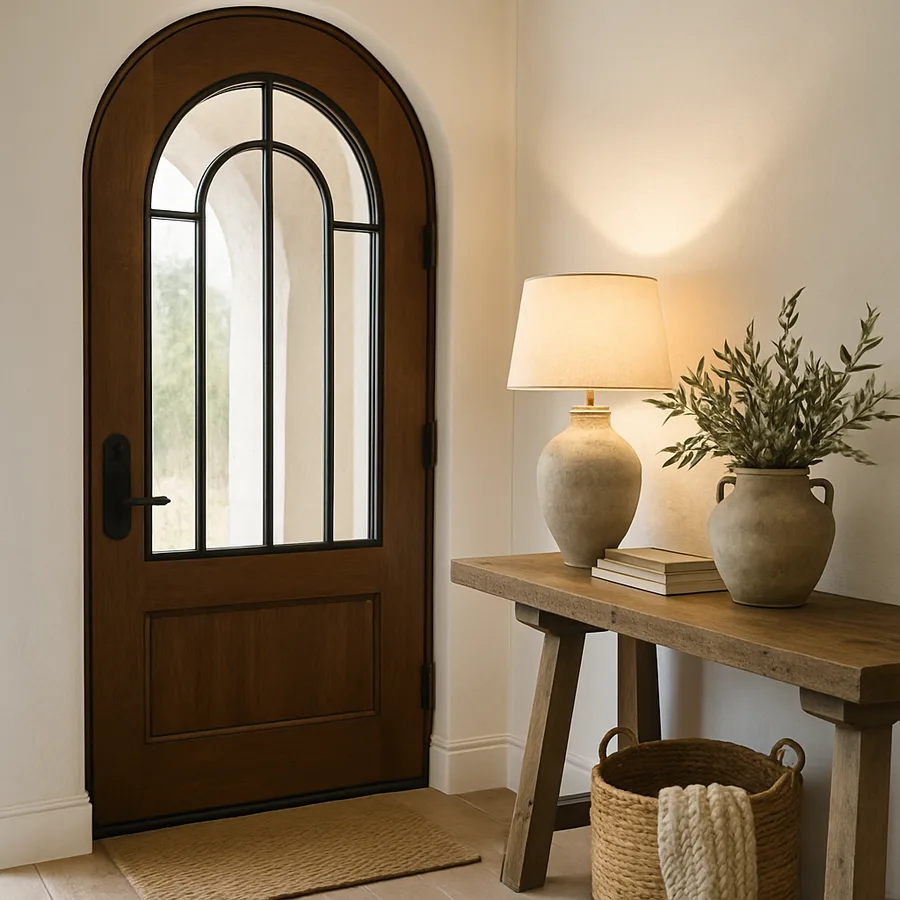
The arched front door has become one of the most distinctive markers of modern Mediterranean architecture, a style that took root in coastal California and southern Florida and has now spread to inland markets from Texas to the Carolinas. What was once a relatively narrow stylistic choice has become a defining feature for homeowners who want the warmth and craftsmanship of traditional Spanish, Italian, and North African design without the heaviness that older Mediterranean revival homes can carry. Sourcing the right arched door is one of the most consequential decisions in any such project, and the wrong choice can undermine an otherwise beautiful exterior.
This guide walks through the architectural reasoning behind arched openings, the species and construction methods that perform best, where to find genuine craftsmanship at various budgets, and the practical considerations of installation and energy performance that most marketing materials skip over.
Why The Arch Reads As Mediterranean
The architectural logic of the arch is older than most of the styles that now claim it. Roman builders used round arches for structural reasons, and medieval Spanish and North African architects refined the form into pointed, horseshoe, and ogee variations that we now recognize as part of the Moorish and Mudejar vocabulary. When the modern Mediterranean revival took hold in the United States, designers preserved the arch as a shorthand for warmth, hand-craft, and a slower, more sun-soaked way of living.
In contemporary practice, the arch reads as Mediterranean primarily because it softens the rectilinear geometry that dominates most American housing stock. A flat-topped door imposes order. An arched door suggests welcome, transition, and a slight relaxation of the rules. The American Institute of Architects has noted that homes featuring arched entries consistently score higher in curb appeal surveys, with one recent study showing a 23 percent increase in perceived home value compared to identical homes with rectangular entries.
Have you ever wondered why some arched doors feel authentically Mediterranean while others feel like a costume? The answer almost always lies in the proportions of the arch itself. A shallow, almost flattened curve reads as transitional or contemporary; a tall, pointed arch reads as Gothic Revival; a true Roman semicircle reads as classical. The Mediterranean sweet spot is a segmented arch with a rise of roughly one-fourth to one-third the width, springing from straight side jambs at a height of about seven feet.
The Best Wood Species For Arched Construction
Building an arched door is fundamentally different from building a rectangular one. The top rail must be either solid-cut from a thick blank, laminated from several pieces with matched grain, or bent using steam or kerf-cut techniques. Each method places different demands on the wood, and not every species performs reliably in arched applications.
The traditional Mediterranean choice is knotty alder or solid mahogany, both of which offer the stability and grain depth that the style demands. Knotty alder is particularly forgiving on a tight budget, accepting stain beautifully and producing the rustic character that suits more traditional Mediterranean homes. Mahogany, by contrast, gives a more refined and contemporary look, with tight grain and rich color that ages gracefully under direct sun.
- Knotty Alder: Mid-range cost, rustic character, accepts dark stains well, suitable for traditional Mediterranean.
- Mahogany: Premium cost, refined grain, exceptional stability, ideal for modern Mediterranean.
- White Oak: Mid to premium cost, excellent rot resistance, lighter color, works in transitional homes.
- Walnut: Premium cost, deep color, sophisticated look, best for high-end modern Mediterranean.
- Reclaimed Cypress: Variable cost, character-rich, naturally rot resistant, popular in Florida markets.
Ironwork And Hardware Selection
Few exterior details signal Mediterranean intent more clearly than well-chosen ironwork. Clavos, the decorative iron studs that originated as functional fasteners in Spanish colonial doors, can be applied sparingly for a modern look or generously for a more traditional reading. A speakeasy grille, the small openable iron-framed window in the upper portion of the door, adds both function and unmistakable Mediterranean character.
Modern Mediterranean homes typically pull back from the heavy black wrought iron of older revival homes, favoring instead aged bronze, dark pewter, or matte oil-rubbed finishes that read as quieter and more contemporary. The American Society of Interior Designers reports that aged bronze has overtaken pure black as the most-specified entry hardware finish in Mediterranean-style projects, with a market share of roughly 47 percent in the most recent surveys.
Are you considering whether to add clavos to your door? A useful rule of thumb is that fewer, larger clavos read as modern, while more, smaller clavos read as traditional. For a contemporary Mediterranean home, six to twelve large clavos arranged in a simple grid usually feels right. Twenty or more small clavos in elaborate patterns will push the door toward Spanish colonial revival, which may or may not be the desired effect.
Glazing, Speakeasies, And Side Lights
Glass selection within the door deserves more consideration than the simple decision of whether to include it. Authentic Mediterranean homes that included glazing in their entries typically used seedy glass, an artisanal glass with small bubbles and slight irregularities that distort vision without fully blocking it. This was both a privacy measure and an aesthetic choice, since the imperfections caught light in a way that flat glass never could. Reproduction seedy glass is available from specialty suppliers and remains the most authentic choice for Mediterranean entries.
Privacy considerations also intersect with security. A clear glass insert in a front door, especially one near the deadbolt, can be a security liability because it allows visual confirmation of the lock state and, in some cases, physical access to the lock from outside. Textured, leaded, or seedy glass all reduce this risk by obscuring vision, and modern laminated security glass adds a layer of impact resistance without sacrificing the traditional aesthetic.
Whether to include glass in an arched front door is one of the more divisive questions in Mediterranean sourcing. Traditional doors often had no glazing at all or only a small speakeasy at eye level. Modern Mediterranean homes have moved toward more generous glazing, with arched transoms, full-height side lights, and occasionally a central glass insert in the door itself.
The key is restraint. A modern Mediterranean door with a full glass panel reads as a contemporary house wearing Mediterranean clothes, not a Mediterranean house with modern touches. Where glass is included, it should typically be textured, leaded, or seedy rather than perfectly clear, and the framing should be substantial enough to feel like it belongs to the door rather than being grafted onto it.
Side lights and transoms, by contrast, can be more generously glazed because they belong to the architecture rather than the door. Many designers now specify arched transoms above flat side lights, with the door arch echoing the transom curve for visual continuity. This is a particularly elegant move on wider entry openings of five feet or more.
Sourcing Strategies By Budget
Lead times vary dramatically by tier. Stock factory doors are usually available within two to four weeks, semi-custom doors take eight to twelve weeks, and fully custom doors can run sixteen to twenty-four weeks from order to delivery. Building a renovation timeline around these realities matters, especially when the door is on the critical path for project completion. Many homeowners discover too late that the dream door they specified will not arrive until two months after the rest of the project is otherwise finished.
The arched front door market spans an enormous price range, from roughly $2,500 for a stock unit to well over $25,000 for a fully custom hand-built door. Understanding the tiers helps set realistic expectations.
At the entry level, manufacturers like Jeld-Wen, Therma-Tru, and Masonite produce factory-built arched doors in fiberglass and engineered wood that can convincingly mimic the look from the street. These are appropriate for new construction tract homes and budget renovations where authenticity is less critical than overall coherence.
The middle tier, from roughly $5,000 to $12,000, includes semi-custom doors from companies like ETO Doors, Nick's Building Supply, and several regional millwork shops that offer real wood construction with arched configurations and basic ironwork options. This is where most serious Mediterranean projects land.
At the top of the market, custom shops in California, Texas, and Florida produce one-off doors with hand-forged iron, antique-recovered wood, and bespoke speakeasies. Names like Borano, Doorworks, and various Spanish import specialists serve this tier. According to This Old House, custom entry door spending in the Mediterranean style segment has grown by an estimated 34 percent over the past three years.
Installation And Energy Performance
Installing an arched door is significantly more demanding than installing a rectangular one. The rough opening must be framed precisely, and the casing must transition smoothly from the curve to the surrounding stucco, plaster, or stone. A poorly installed arched door reveals itself immediately at the head, where uneven gaps or misaligned trim destroy the careful geometry of the unit.
The single most overlooked installation detail is the threshold transition. Mediterranean homes typically feature tile, stone, or polished concrete floors immediately inside the entry, and the threshold must transition smoothly from the exterior surface to the interior without creating a tripping hazard or compromising the weather seal. Bronze or stone thresholds with a slight bevel toward the exterior perform best, and they should sit slightly proud of the exterior surface to shed water away from the interior floor.
Weatherstripping on arched doors is also more complex than on rectangular doors because the curved top of the door must seal against a curved jamb. Most manufacturers handle this with flexible compression weatherstrip that bends along the curve, but the seal degrades faster than on rectangular doors and should be inspected annually. Replacement weatherstrip for arched openings is often custom-fabricated and worth ordering in advance from the door manufacturer rather than scrambling for a substitute when the seal eventually fails.
Threshold sweeps deserve similar attention. The bottom of an arched door is still rectangular, but it sits within a frame that may have been built to non-standard dimensions, and aftermarket sweeps rarely fit cleanly. The Architectural Digest shelter editors have noted that custom door sweeps account for a surprising portion of the long-term maintenance budget on premium Mediterranean entries, and homeowners should plan for this from the start.
Energy performance is another consideration that gets less attention than it deserves. Solid wood doors, especially those with speakeasies or other openings, can score poorly on standard energy ratings unless they include modern weather sealing, threshold sweeps, and ideally an internal foam core for fiberglass alternatives. The National Association of Home Builders notes that entry doors account for roughly 11 percent of total envelope air leakage in older homes, making proper sealing a meaningful efficiency upgrade.
Conclusion
The arched front door is one of the few architectural elements that can carry an entire facade. Get it right and the rest of the house relaxes into its style. Get it wrong, with bad proportions, wrong materials, or careless installation, and no amount of stucco, tile, or wrought iron will rescue the entry from feeling slightly off.
The single most important decision is choosing the arch proportion, because it sets the tone for every other choice that follows. Spend real time with elevation drawings or with samples installed at full scale on the actual house before committing to a final configuration. Many of the best Mediterranean entries come from owners who took the time to mock up the arch in cardboard or plywood before ordering the finished door.
Material selection is the second great decision. Solid wood is almost always the right answer for projects with the budget to support it, both for the longevity and for the quality of light the wood throws back to anyone approaching the home. Where budget forces a compromise, a high-grade fiberglass door with a real wood veneer can be a reasonable alternative, particularly in harsh sun or salt-air environments where solid wood would require more maintenance.
Ready to start sourcing? Begin by collecting elevation photographs of three or four Mediterranean homes whose entries you love, paying close attention to arch proportions and hardware finishes. Bring these images to a millwork shop or a custom door manufacturer and ask for samples in your top two wood species. The right door will reveal itself quickly once you have something specific to compare against, and the months you spend making this decision well will be repaid every time you come home.


Comments
Post a Comment