Pergola Roof Material Options From Polycarbonate to Slatted Wood
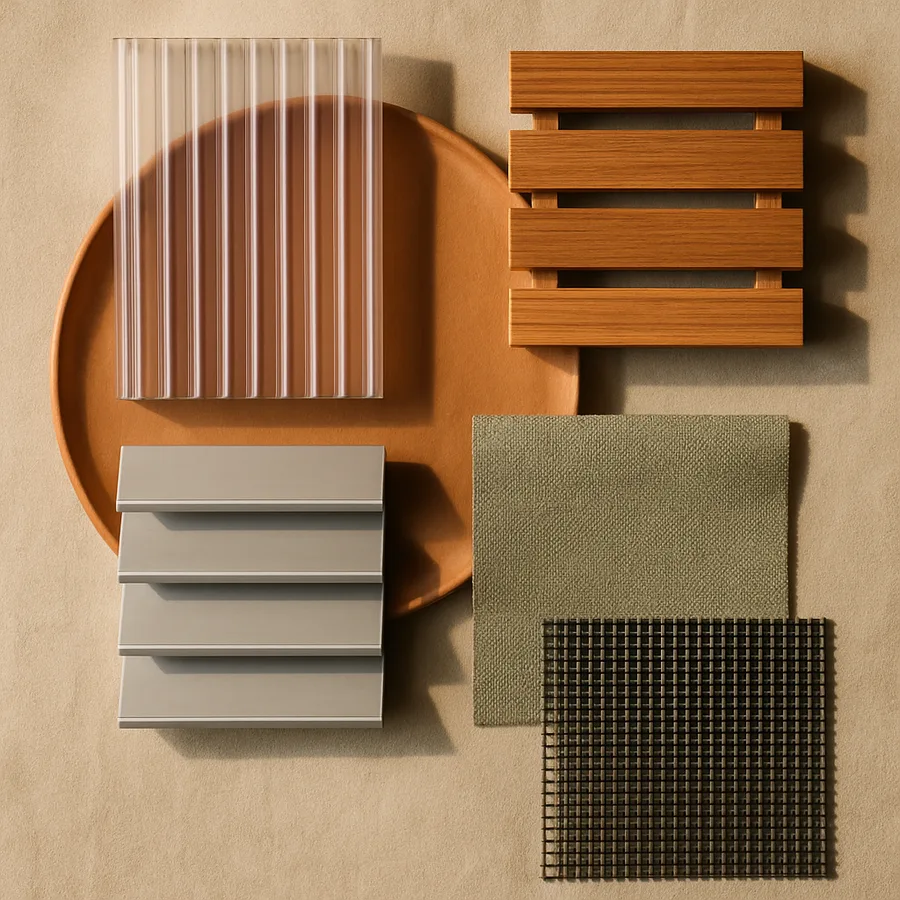
The roof you choose for a pergola changes almost everything about how the structure feels underneath. A bare lattice that throws striped shadows on a stone patio creates a very different mood than a sealed polycarbonate canopy that lets you grill in a thunderstorm. Roof material also drives load calculations, drainage planning, and how the pergola ages over a decade of sun and rain. Before you commit to lumber dimensions or footing depths, the roofing decision deserves a careful pass.
This guide walks through the most common pergola roof options and the trade-offs that actually matter once the structure is in service. We will cover slatted wood, polycarbonate panels, retractable fabric, motorized aluminum louvers, steel mesh shade screens, and living plant canopies. The goal is not to crown one winner but to match the roof to your climate, your budget, and the way you actually plan to use the patio.
Slatted Wood: The Classic Pergola Look That Still Wins on Style
Slatted wood is what most people picture when they hear the word pergola. Parallel rafters or cross-battens cast linear shadows that move across the patio through the day, and the warm tone of cedar, redwood, or ipe softens an otherwise hard masonry surface. Western Red Cedar and Pacific Coast Redwood remain the two most common species in residential builds because both contain natural extractives that resist decay without pressure treatment chemicals.
The functional truth, however, is that slatted wood provides only partial shade. A common spacing of 2x2 battens placed two inches apart blocks roughly half the overhead sun at noon, and that fraction drops as the sun moves toward the horizon. According to research summarized by the American Society of Landscape Architects, open-batten roofs can reduce surface temperatures on patios below by 10 to 15 degrees Fahrenheit compared to unshaded paving, but they offer no protection from direct rain or wind-driven leaves.
Maintenance is the second consideration. A clear penetrating oil or pigmented stain typically lasts two to three years on horizontal pergola members before needing recoat, and untreated softwood will silver and check over time. Builders accredited by the National Association of Home Builders generally recommend kiln-dried lumber and stainless or hot-dipped galvanized fasteners to prevent the iron staining that ruins so many cedar projects.
Slatted wood is the right call when shade is welcome but not critical, when the architectural character of the home leans traditional or craftsman, and when the homeowner is comfortable with a recoat ritual every few years. Have you mapped how the sun actually crosses your patio in July? That question often decides whether 2x2 battens will give you enough relief or whether you need to layer a fabric or polycarbonate solution on top.
Polycarbonate Panels: All-Weather Coverage Without the Glass Hazard
Polycarbonate has quietly become the workhorse of the modern pergola. The material is a thermoplastic resin that comes in either solid sheets or twin-wall corrugated panels, and the better grades carry UV-stabilizing layers that prevent the yellowing that plagued early installations. The clear-glass alternative is impractical at residential scale because of weight, snow load, and shatter risk, while polycarbonate offers up to 200 times the impact resistance of glass at a fraction of the weight.
For pergolas, the most common choice is 10mm twin-wall polycarbonate in clear, opal, or bronze tints. Twin-wall has internal ribs that trap a thin air layer, giving it modest insulation and reducing condensation drip on the underside. The opal tint diffuses sunlight into a soft glow rather than the stripes you get from slats, which photographers love but some homeowners find too uniform. Bronze tint blocks roughly 65 percent of incoming solar heat while still admitting daylight, a useful spec in southern climates.
Installation is straightforward but unforgiving of shortcuts. Panels should be fastened with EPDM-gasketed screws through pre-drilled oversized holes that allow the polycarbonate to expand and contract with temperature swings. The International Code Council publishes minimum slope and fastener spacing guidance for plastic glazing in residential applications, and most jurisdictions require a slope of at least one-quarter inch per foot for proper drainage. Skipping the slope is the single most common cause of leaks at the head wall flashing.
The honest weakness of polycarbonate is acoustics. Heavy rain on a poly roof is loud, somewhere between a snare drum and a steady hiss depending on panel thickness. Some manufacturers now offer acoustic-dampening inner films that reduce this by several decibels, but it remains a real consideration for anyone planning to dine or take phone calls under the canopy.
Retractable Fabric Canopies: Flexible Shade on Demand
A retractable fabric canopy gives you the option that no fixed roof can match: full sun when you want it, full shade when you do not. The mechanism is usually a track-mounted system with sliding wave panels of acrylic or PVC-coated polyester, operated by a hand crank, motor, or smart-home controller. Better residential systems integrate wind, rain, and sun sensors that retract or deploy the fabric automatically.
The fabric itself is the spec to scrutinize. Solution-dyed acrylic from manufacturers like Sunbrella or Dickson typically carries a 10-year fade warranty and resists mildew because the color is locked into the fiber rather than printed on the surface. PVC-coated polyester is heavier and fully waterproof when seams are heat-welded, but it tends to feel more commercial and reads slightly less elegant in residential settings. According to data published by the National Association of the Remodeling Industry, retractable shade systems consistently rank in the top three add-ons that homeowners report being most satisfied with after a deck or patio remodel.
Wind is the limiting factor. Most residential retractable canopies are rated to remain deployed in winds up to roughly 28 miles per hour, which corresponds to a strong breeze on the Beaufort scale. Above that threshold the fabric should be retracted to prevent damage to the tracks and the structure. If your patio sits in an exposed location with frequent gusts, a wind sensor with auto-retract is not optional.
Cost is the other reality. A quality motorized retractable system typically runs three to five times the price of a comparable slatted wood roof, and any motorized component eventually needs service. Homeowners who choose retractable canopies generally do so because the flexibility solves a specific problem, such as a south-facing patio that is unusable from noon to four in summer but wonderful for breakfast in shoulder season.
Motorized Aluminum Louvers: The Premium All-Weather Pergola
Motorized louvered roofs, sometimes marketed as bioclimatic pergolas, sit at the top of the residential market. Powder-coated aluminum blades pivot between fully open, fully closed, and any angle in between, controlled by a wall switch, remote, or smartphone app. Closed, the system sheds rain through integrated gutter channels in the perimeter beams. Open, the louvers act much like a slatted wood roof but with a much cleaner, more modern profile.
The engineering inside these systems is genuinely impressive. Premium European brands use marine-grade 6063-T6 aluminum with reinforced internal ribs, and structural snow-load ratings of 40 to 60 pounds per square foot are common. Motors are typically rated for 20,000 cycles or more, which works out to several open-and-close events every day for two decades. Powder coating in 60 to 80 micron thickness over a chromate primer is the spec to look for if you want the finish to last.
What you give up with louvered systems is warmth, both literal and visual. Aluminum reads as architectural and contemporary, which suits modern homes beautifully but can clash with traditional architecture. The interior ceiling, viewed from below, shows the underside of the louvers and the perimeter gutter channels rather than the warm grain of a wood rafter. Lighting design becomes critical because the closed roof creates a darker volume than the open frameworks of slatted wood.
Permitting for aluminum louvered pergolas can be more involved than for traditional structures because the closed configuration is technically a roof for code purposes. Many jurisdictions require engineered drawings stamped by a licensed engineer, and electrical inspection for the integrated motor and control systems. Budget several weeks for permits before ordering, and confirm that the manufacturer provides the structural calculations your inspector will request.
Steel Mesh and Shade Sail Combinations: Industrial Texture, Soft Shadow
Steel mesh and shade sail roofs are the choice for homeowners who want industrial texture without the heaviness of a closed canopy. Welded steel mesh, often a 50 by 50 millimeter grid in galvanized or powder-coated finish, mounts as a flat plane across the rafters and creates a quiet diagonal shadow pattern. Layered with a knitted shade-cloth sail on top, the same structure can deliver up to 90 percent UV blockage while still feeling open and breezy.
The two-layer approach has a practical logic. The mesh provides structure and a place to attach climbing plants if you want to soften the look over time. The sail handles the actual shade and can be removed in winter to admit more light. Knitted shade cloth, unlike woven fabric, does not unravel when cut and allows wind to pass through, which dramatically reduces uplift loads on the structure compared to a solid canopy.
Color choice in shade fabric is more consequential than most homeowners realize. Darker fabrics absorb more solar energy and re-radiate heat downward, while lighter colors reflect more but can create glare. A neutral sand or charcoal in the 320 GSM weight class is a reliable compromise that holds up well visually and blocks most UV without making the patio feel like a cave. Tensioning matters too: sails should be installed with a slight curve in two directions, not pulled flat, so wind and rain shed cleanly off the surface.
The tradeoff is rain. Standard shade sails are not waterproof and are not intended to be. Water passes straight through the mesh weave, which is what allows them to handle wind, but it also means the patio below is wet during any meaningful rainfall. Pair this roof type with permeable paving or good slope design so the patio drains rather than puddles.
Living Roofs: Climbing Plants as the Canopy
A living roof on a pergola turns the structure into a piece of garden architecture. Vines trained over the top create a canopy that filters light through actual leaves, drops fragrant flowers in season, and can lower the air temperature beneath by several degrees through evapotranspiration. The visual effect is unmatched by any built material, and the sound of leaves in a light breeze adds a sensory dimension that polycarbonate and aluminum cannot.
The most reliable choices in temperate climates are wisteria, grape, climbing hydrangea, Boston ivy, and star jasmine. Each has different growth habits, attachment mechanisms, and pruning requirements. The Royal Horticultural Society publishes detailed pruning calendars for each, and following them is the difference between a controlled green ceiling and a tangled mass that strangles the structure within a few years. Wisteria in particular is famous for tearing apart undersized pergolas; it requires a structure with rafters at least 2x10 in dimension.
Time is the honest cost. A living roof takes two to four growing seasons to establish meaningful coverage, and the first summer offers almost no shade. Many homeowners pair a living roof with a temporary shade cloth for the first year or two, removing it as the vines fill in. Watering, feeding, and seasonal pruning add maintenance hours that purely architectural roofs do not require, and falling leaves and flowers create cleanup work on the patio below.
For those willing to play the long game, a living roof rewards the investment. Mature grape or wisteria pergolas become legacy features that increase home value and create the kind of outdoor room that gets described in real estate listings as a defining feature of the property. Are you the kind of gardener who enjoys seasonal pruning, or would the maintenance feel like a chore? The answer determines whether a living roof is romance or regret.
Conclusion: Choosing the Right Roof for Your Pergola
The right pergola roof is the one that matches how you actually use the space, not the one that looks best in catalog photography. A homeowner who wants to host dinners regardless of weather should look hard at polycarbonate or motorized louvers, while a gardener who wants a green retreat will find a living roof more satisfying than any fabricated material. Climate matters too: hot dry regions reward reflective surfaces, while cooler maritime climates can lean into open structures that maximize the limited sun.
Budget should be evaluated across the full life of the structure, not just at installation. A slatted cedar roof costs less up front but requires recoating every few years, while a powder-coated aluminum louvered system costs significantly more but may need almost no maintenance for a decade. Fabric systems sit in the middle on both axes, with the wear life of the canopy itself usually being the determining factor in long-term cost.
Whatever you choose, the roof is the element that locks in everything else about the pergola. Footing depth, rafter dimensions, and lighting plan all flow downstream from the roofing decision, so it pays to take the time to walk through each option in detail before lumber gets ordered. Talk to your contractor and your local permitting office before finalizing the design, and ask to visit a built example of any system you are considering so you can see and hear how it performs in real conditions.
Ready to start your pergola project? Sketch your patio dimensions, note the sun path through the day, and use the trade-offs in this guide to narrow the field to two finalists. From there, request fixed-price quotes for both options and compare not just installation cost but expected maintenance over the next decade. The best pergola roof is the one you stop thinking about because it just works, season after season.
More Articles You May Like



Comments
Post a Comment