Thanksgiving Decor Storage Containers For Yearly Reuse
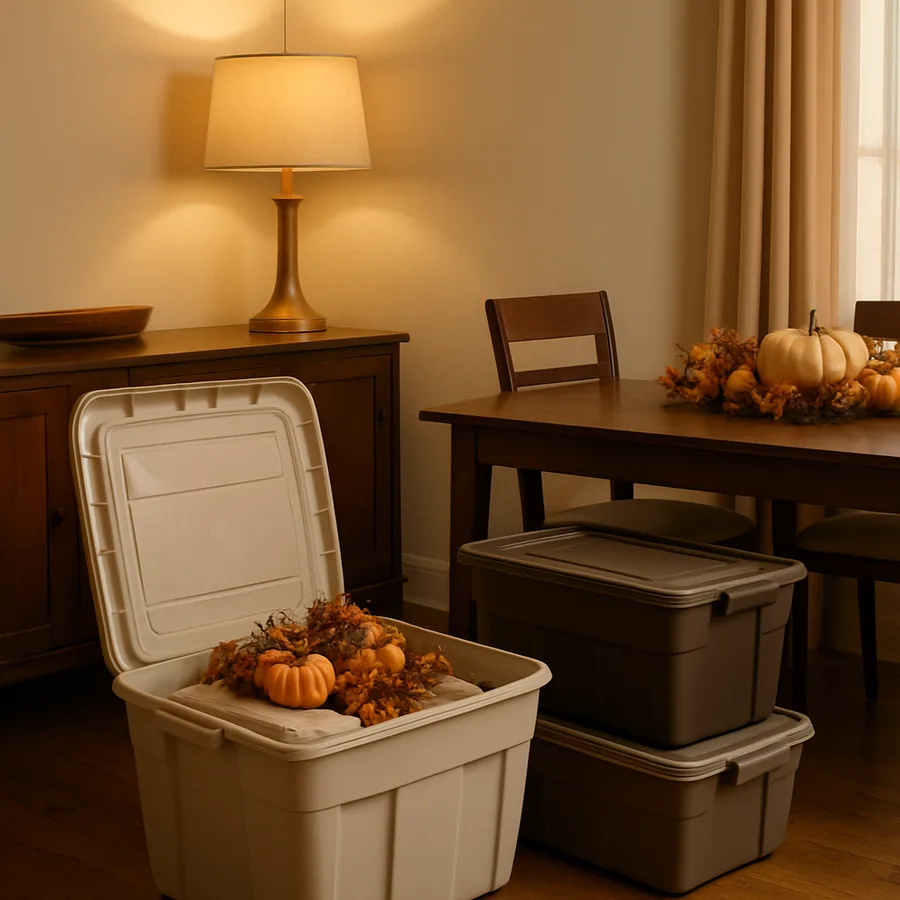
Thanksgiving sits in a peculiar position on the holiday calendar. It arrives quietly between the high-volume seasons of Halloween and Christmas, and its decor reflects that in-between identity. The pieces tend to be more refined than Halloween, more grounded than Christmas, and built around table settings rather than tree displays. This means Thanksgiving collections often include a heavy concentration of linens, ceramics, glassware, and centerpieces, exactly the categories most vulnerable to damage during long storage. The right containers, deployed thoughtfully, transform Thanksgiving decor from a yearly headache into a graceful annual ritual.
According to a recent survey by the American Society of Interior Designers (ASID), Thanksgiving table decor is now the fastest-growing segment of the holiday home market, growing nearly 11 percent year over year. Industry analysis from the National Retail Federation suggests Americans now spend over four billion dollars annually on Thanksgiving decor and tableware. That investment deserves storage that protects it for the eleven months it spends out of sight, and the cost of doing this right is a tiny fraction of replacement.
Why Thanksgiving Decor Demands Specialized Storage
Thanksgiving decor is unique in its emphasis on the dining experience. Where Halloween focuses on yard and porch and Christmas focuses on the tree and mantel, Thanksgiving lives almost entirely on the table. This shifts the storage profile dramatically. Households accumulate cloth napkins, table runners, tablecloths, place cards, ceramic turkey platters, glass goblets, candle holders, faux-leaf garlands, miniature pumpkins, and centerpiece bases. Each of these has different storage needs, and packing them together without thought leads to predictable damage.
Linens are particularly vulnerable. A linen tablecloth folded the same way for ten months develops permanent creases that show on Thanksgiving Day no matter how aggressively you iron. Cloth napkins stored against scented candles or wax leaves can absorb odors that take weeks to dissipate. Glass goblets stored loose in a deep bin shift during transport and chip their rims. Ceramic centerpieces with delicate finishes can rub against each other and lose their patina. None of these failures is dramatic enough to throw the item away, but each diminishes the experience year after year.
Have you ever pulled out your favorite Thanksgiving runner and felt the heart sink as you noticed a permanent fold line right across the center? That is what poor storage looks like. The fix is not buying new linens but rather buying or building containers that respect the unique needs of each decor category. Editors at House Beautiful emphasize that storage choices made in November shape how every future Thanksgiving feels.
Container Choices for Different Decor Categories
The right container depends entirely on what is going inside. Generic clear plastic bins work well for hard decor like ceramic platters, candle holders, and centerpiece bases, but they are poor choices for linens and fragile glassware. Building a Thanksgiving system means assembling a small collection of category-specific containers that match the items they hold.
For linens, breathable fabric storage cubes or acid-free archival boxes prevent the moisture and odor problems associated with airtight plastic. Roll tablecloths and runners around cardboard tubes rather than folding them flat. The cardboard tube method, recommended by professional organizers certified through the National Association of Productivity and Organizing Professionals (NAPO), prevents permanent creasing and lets linens come out of storage looking fresh. A single closet shelf can hold multiple rolled linens stacked horizontally, occupying minimal space.
For glassware, divided wine boxes are the budget-friendly champion. The cardboard cells protect each glass individually and the boxes stack neatly. For higher-end stemware, dedicated stem storage cases with padded compartments prevent rim chips and can be stored vertically without compromising protection. The Container Store stocks several formats specifically designed for holiday stemware, and the modest investment pays off the first time a wine glass survives storage that would otherwise have chipped it.
Centerpieces and Floral Arrangements
Centerpieces are the showpieces of Thanksgiving table decor and they often involve the most fragile and oddly shaped items in the entire collection. A traditional centerpiece might combine a wooden trough or ceramic vase, faux floral stems, miniature pumpkins, decorative branches, and pillar candles. Stuffing this composition into a single bin guarantees damage. The better approach is to disassemble each centerpiece and store the components separately.
Faux floral stems and branches store best vertically in tall narrow containers. A repurposed umbrella stand works beautifully for this purpose, protecting petals and leaves from compression. Decorative branches can lean upright in the same vessel without crowding. Editors at Architectural Digest note that the difference between vertical and horizontal floral storage is dramatic over a five-year span, with vertical-stored stems retaining nearly twice the visual quality.
Miniature pumpkins, gourds, and decorative orbs can store loose in a divided box or wrapped individually in tissue paper inside a single bin. Pillar candles need their own care because heat can warp them severely. Store candles upright in a cool spot, never stacked horizontally and never in an attic. According to data from the Department of Energy, attic temperatures regularly exceed 130 degrees Fahrenheit in summer, well above the warping point for most decorative candles.
Labeling Systems for Easy Reuse
Containers without good labels create their own kind of chaos. The most effective Thanksgiving labeling combines three elements. The first is a clear category label visible from the front of every bin or container. The second is a contents inventory taped inside the lid. The third is a setup-order indicator that tells you which container to open first when you start decorating.
The setup-order indicator is the often-overlooked secret of fast holiday transitions. Number your containers in the order you will deploy them. Container 1 might be table linens, since they go down first. Container 2 might be plate settings. Container 3 might be centerpiece components. By the time you get to container 6, the table is fully set. Stack containers in reverse order so the first container needed is on top. This single piece of organization can cut Thanksgiving setup time in half.
NAPO professional organizers recommend going one step further and creating a master document that maps every container number to its full contents with photos. For households where multiple family members participate in setup, this master document removes the bottleneck of one person knowing where everything lives. Anyone can pick up the document, find a container, and contribute. This is especially valuable in the busy days leading up to a major hosted Thanksgiving meal.
Climate and Location Considerations
Thanksgiving decor is more sensitive to climate than many other holiday collections because of the prevalence of linens, candles, and electronics in modern displays. Where you store these containers matters substantially. Conditioned interior spaces, like closets, under-bed zones, or finished basements, are far better than attics or unconditioned garages. The temperature stability protects linens from mildew and candles from warping, while keeping electronics functional year over year.
If conditioned space is limited, prioritize the most vulnerable items for it. Linens and candles must live indoors. Glassware and ceramics can tolerate cooler garages but should be elevated off the floor. Hard plastic and resin decor can live in attics provided temperature swings are not extreme. The goal is to match the storage environment to the durability of the items inside, never the other way around.
Adding silica gel packets to every container is a small investment with significant returns. Silica absorbs ambient humidity and prevents the slow accumulation of moisture that destroys fabric and metal items over many years. Cedar blocks repel moths and other fabric pests, particularly important for linen and napkin storage. According to Better Homes and Gardens, refreshing silica and cedar annually is one of the highest-return organizational habits available, costing under ten dollars per year for a typical household.
Building Reuse Into the System
The phrase "for yearly reuse" deserves special attention because it points to the core philosophy of good Thanksgiving storage. Containers should be built once and reused for many years, even decades, not replaced annually. This requires choosing durable materials, building maintenance into the system, and resisting the urge to expand the collection beyond what your storage can sustainably hold.
Heavy-duty containers cost more than thin disposable bins but last fifteen to twenty years rather than two or three. The math heavily favors the durable choice. A 25-dollar storage bin used for 20 Thanksgivings costs 1.25 dollars per year. A 6-dollar bin replaced every two seasons costs 3 dollars per year and contributes to landfill waste. The premium option is also the economical option over any meaningful time horizon.
Build an annual maintenance ritual into your post-Thanksgiving cleanup. Before packing, inspect each container for cracks, broken latches, or damaged seals. Replace anything failing now rather than discovering the problem next November when you are already busy with display setup. Have you ever found a cracked bin lid the moment you needed to use it? An annual inspection prevents this small but real source of holiday stress.
Conclusion
Thanksgiving storage is the holiday system that most rewards thoughtfulness. Because the decor is concentrated in linens, glassware, and centerpieces, small choices about containers, labels, and climate produce outsized differences in how each year unfolds. A household that invests one weekend in building the right system at the right scale will harvest the benefits for the next two decades. The math of organizational investment has never been more favorable.
The deeper benefit is harder to quantify but more meaningful. When your Thanksgiving decor comes out of storage looking exactly as it did the year before, when your linens fall flat without creases and your centerpieces assemble in minutes, the holiday itself feels lighter. The hours you would have spent fighting your storage become hours spent cooking, gathering, and being present with the people who matter. This is the real return on good organizational systems.
Building this system does not require a single perfect weekend. Start with the most vulnerable items first, your linens or your stemware, and upgrade their storage this year. Next year, expand to centerpieces. The year after, complete the system with hard decor and outdoor pieces. Within three seasons you will have a full reuse-grade Thanksgiving storage system that runs effortlessly. This week, identify the single category in your Thanksgiving collection most damaged by current storage, and commit to upgrading just that category before the season turns. Each step compounds, and the holidays only get easier from here.
The Sustainability Case for Reuse-Grade Storage
Beyond personal benefits, reuse-grade Thanksgiving storage carries environmental implications worth naming directly. Decor that gets damaged in poor storage becomes landfill waste, and the replacements consume new resources, packaging, and shipping emissions. A household that replaces 20 percent of its Thanksgiving collection annually because of storage damage contributes substantially more waste than one that protects its decor and reuses it for decades. The math of sustainability and the math of personal economics point in the same direction.
Industry data from the Environmental Protection Agency suggests that decorative goods contribute meaningfully to seasonal landfill spikes, with significant peaks observed in the weeks following major holidays. Much of this waste is preventable through better storage and longer reuse cycles. Investing in heavy-duty containers, dedicated linen storage, and divided glassware boxes is among the lowest-effort ways to reduce a household's seasonal waste footprint while also saving money over time.
The cultural dimension matters too. Decorations passed down across generations carry stories that new replacements cannot replicate. The grandmother's hand-painted gravy boat, the great-uncle's carved wooden cornucopia, the inherited linens stitched by hand decades ago, all of these survive only when storage protects them across the years. A reuse-grade container system is, in this sense, a vehicle for family heritage. The dollars spent on a good bin become an investment in continuity that ripples forward to children and grandchildren who will gather around the same table long after we are gone.
For households without inherited heirlooms, the principle still holds. The pieces you buy and use mindfully today become the heirlooms of tomorrow. A handmade ceramic pitcher purchased on a memorable trip, a set of linen napkins commissioned from a local maker, a hand-thrown turkey platter discovered at a regional craft fair, all of these accumulate meaning over many seasons of use. Storage systems that protect them ensure that meaning compounds rather than evaporates with each replacement cycle. Buying with the intention of decades-long use, then storing accordingly, is one of the quiet hallmarks of an intentional home.
More Articles You May Like


Comments
Post a Comment