Holiday Wreath Storage Boxes That Prevent Crushing
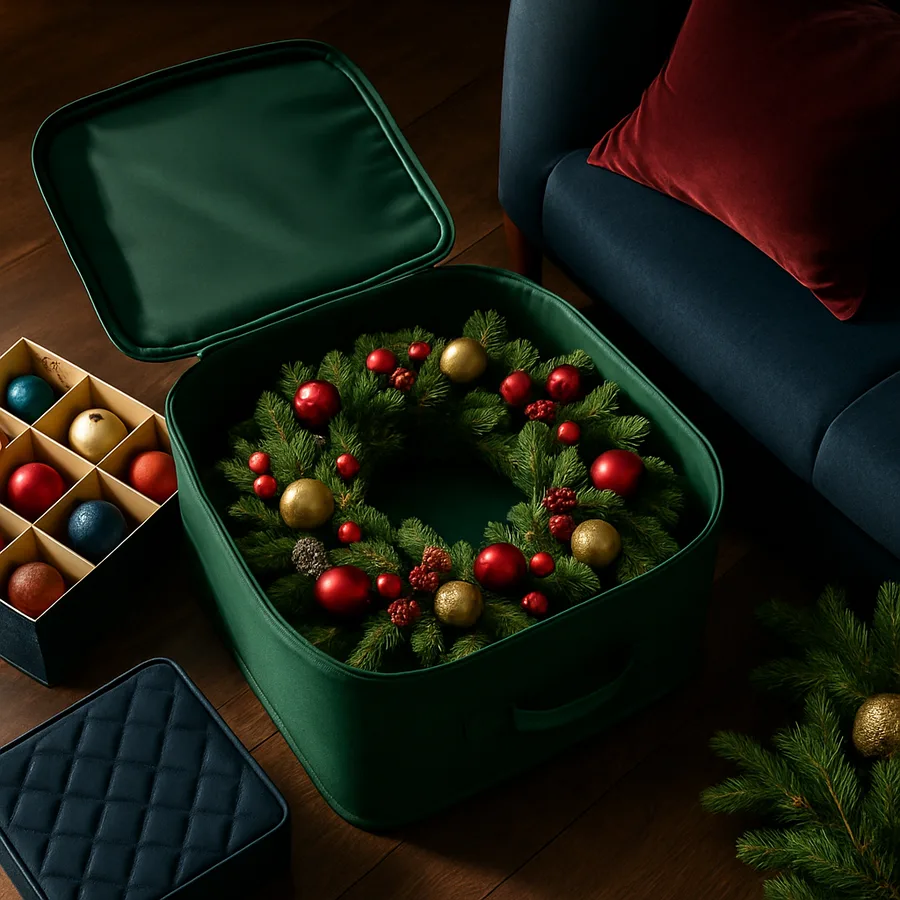
Every January, after the magic of the holidays fades and the tree comes down, a frustrating ritual begins in millions of homes: figuring out where to put the wreath. You bought a beautiful eucalyptus and pinecone piece in November, hung it proudly, and now it has to survive eleven months in an attic, basement, or garage without losing its shape. The unfortunate truth is that most wreaths get squashed flat because they were jammed into a trash bag, balanced on a closet shelf, or stacked under heavier seasonal bins. By the time the next December rolls around, the bow is mashed, the berries have snapped off, and the shape has gone from a perfect circle to a tired oval. The right holiday wreath storage boxes can completely change that outcome and protect your investment year after year.
This guide walks through what actually causes crushing, the structural features that matter when you shop, and how to build a system that works whether you have one wreath or fifteen. We will cover material trade-offs, climate considerations, hanging versus flat storage, and the small organizational habits that keep decorations looking new. Have you ever pulled out a wreath in late November only to find half its embellishments have migrated to the bottom of the bin? Or wondered why your artificial wreath looks fluffy at the store but flat at home? Those problems trace back to storage choices, and they are entirely solvable.
Why Wreaths Crush in the First Place
The fundamental enemy of any wreath is compression. Whether the frame is wire, grapevine, or foam, the foliage, ribbons, and ornaments attached to it stick out perpendicular to that frame. When something rests on top of the wreath, even something light, the pressure transfers through those decorations and crimps the underlying greenery. Over a long storage season, that crimp becomes permanent. According to the National Association of Productivity and Organizing Professionals, more than 70 percent of households cite seasonal item storage as their single largest organizational pain point, and decorations that lose their shape are among the most commonly replaced items year after year.
Compression is not the only culprit. Heat fluctuation in attics expands and contracts plastic frames, while basement humidity can warp wire and rust ornament hooks. Pests are drawn to natural materials like dried citrus, cinnamon sticks, and wheat. UV exposure through a garage window can fade a red velvet bow into a dusty pink within a single summer. A proper storage box addresses all of these threats simultaneously, not just the obvious crushing risk.
The third factor people overlook is handling damage. Every time a wreath is moved, carried by its lights or ribbon, or shoved against another box, decorations break loose. A rigid container that is easy to grab, label, and stack reduces handling friction and keeps the wreath from being repositioned five times per year. Less handling means less breakage, full stop.
Hard-Sided Boxes Versus Soft Bags
The most common storage option on the market is a soft zippered bag with a clear vinyl window and two handles. These are inexpensive, fold flat when empty, and typically run between fifteen and twenty-five dollars. They work well for thin wreaths under twenty inches in diameter that have minimal ornamentation. The problem is that they offer almost no structural protection. If anything heavy lands on top, the bag collapses and crushes the wreath.
Hard-sided boxes are the gold standard for any wreath you want to keep for more than a season or two. Look for telescoping designs that adjust to fit different wreath sizes, since most households accumulate a range over the years. The American Society of Interior Designers recommends archival-quality storage for any decorative item valued over fifty dollars, and that guidance applies cleanly to high-quality wreaths from boutique makers. Polypropylene shells are ideal because they resist moisture, do not off-gas, and survive freezing temperatures without becoming brittle.
If you are debating between the two formats and storing in a climate-controlled closet, a soft bag is acceptable for budget reasons. If you are storing anywhere with temperature swings, however, the hard box pays for itself within two seasons by preventing replacements. Reader question: how often do you actually access your wreath storage? If the answer is once a year, the modest extra cost of a rigid container becomes negligible amortized over a decade.
Sizing, Depth, and the Geometry of a Wreath
The biggest mistake shoppers make is buying a box rated to the outer diameter of their wreath without accounting for depth. A twenty-four-inch wreath that has been heavily decorated with pinecones, ornaments, and berry sprays may protrude five or six inches off the frame. If you stuff it into a box rated for three-inch depth, you are recreating the original crushing problem inside a fancier container. Always measure both the diameter and the deepest decoration before buying.
Telescoping boxes solve part of this puzzle by extending in two dimensions. The better units include foam discs at the top and bottom that cradle the wreath without applying point pressure to any specific decoration. Some premium models from organizing brands include a central post that the wreath rests against, holding it perfectly vertical and preventing any contact between the box walls and the foliage. According to research published by the Container Recyclers Association, products with internal support structures last roughly three times longer than flat-bottom equivalents under repeated stacking loads.
For unusually large or sculptural wreaths, do not try to force a standard box. Custom flat boxes from archival storage suppliers are worth the investment for heirloom pieces, dried botanical arrangements, and anything with delicate embellishments like glass icicles or porcelain birds. The cost is higher, but a single bespoke box will outlast a dozen cheap replacements.
Hanging Storage as an Alternative Approach
If floor and shelf space is at a premium, hanging storage is one of the most underused solutions in the home organizing world. A heavy-duty over-the-door hook combined with a simple drawstring fabric cover allows a wreath to hang in a closet exactly the way it hung on the door, with no compression at all. The fabric cover keeps dust off without applying any inward pressure, and the wreath hangs by its original loop or hanger.
For garages and basements, mounting two parallel hooks on a wall stud creates a vertical wreath storage zone. Each wreath gets its own peg and breathable cotton or muslin cover. This approach is favored by professional holders because it makes inventory visible at a glance and eliminates the digging-through-bins step entirely. The Association of Professional Organizers has documented that visible storage systems reduce time-to-decorate by an average of forty-five minutes per household during peak setup weeks.
Hanging storage does require some setup labor and wall real estate, so it is best suited to dedicated craft rooms, walk-in closets, or finished basements. If you live in a humid climate, add a moisture absorber packet inside each cover to prevent any condensation issues. Reader question: have you ever considered turning the back of a closet door into a seasonal storage hub? It is one of the highest-leverage moves in any small home.
Climate, Pests, and Long-Term Material Care
Where you store the box matters as much as the box itself. Attics and garages routinely swing from below freezing to over one hundred degrees Fahrenheit across a single year, and natural materials like dried oranges, cinnamon, and pinecones suffer in both extremes. Heat dries them out and makes them brittle; cold humidity introduces mold spores. The Insulation Industry Association reports that average attic temperatures in the southern United States exceed one hundred forty degrees during peak summer hours, which is well above the safe threshold for most decorative materials.
If you must store in an uncontrolled space, choose all-artificial wreaths and skip anything organic. For natural or mixed wreaths, a finished interior closet, a climate-controlled storage unit, or a basement that maintains forty to seventy percent relative humidity year-round is far safer. Add silica gel packets inside hard-sided boxes to absorb residual moisture, and replace them every two to three seasons.
Pest control deserves dedicated attention. Cedar blocks, lavender sachets, and bay leaves all repel moths and beetles without the harshness of chemical mothballs. Avoid storing wreaths near food, cardboard collections, or pet bedding, all of which attract rodents that will happily nest inside a soft bag. Inspect each wreath before packing and again when unpacking, and address any pest signs immediately.
Building a Labeling and Inventory System
Storage boxes are only as useful as your ability to find what is inside them. A simple inventory system pays dividends every December. Use waterproof labels on the outside of each box noting the wreath size, location used (front door, mantle, kitchen window), and any special notes about repairs or replacements needed. Color-coded dot stickers can indicate priority levels, with red for the most-used pieces and green for backups or specialty wreaths used only occasionally.
For larger collections, a digital inventory accessed through a notes app or simple spreadsheet eliminates duplicate purchases and helps you remember which wreath is in which box without opening each one. Photograph each wreath on the day you store it, and keep that photo in a shared family album labeled by year. This becomes a surprisingly useful reference when planning future decorations or insuring a high-value collection.
Place the most frequently used wreaths in the most accessible storage zone. The largest, most ornate piece may be your favorite, but if it only comes out for one specific weekend, it does not deserve the prime real estate at eye level. Reserve that spot for the everyday seasonal pieces and bury the specialty items deeper in the rotation.
Conclusion
Protecting a wreath through eleven months of off-season storage is one of those small home-care disciplines that separates households who replace decorations every year from those who build a lasting collection. The principles are not complicated: use hard-sided containers when possible, size them generously to account for embellishment depth, control the climate, and label everything so future-you does not have to play archaeology in the attic. A modest upfront investment in proper holiday wreath storage boxes typically saves several hundred dollars in replacement costs over a decade, while preserving the sentimental wreaths that mean more than any new purchase ever could.
The deeper benefit is one of seasonal calm. When December arrives and the decorating window opens, you want to feel anticipation, not dread. Pulling out a perfectly preserved wreath and hanging it within minutes is a small but real pleasure that compounds over years. Compare that to the alternative of opening a crumpled trash bag and discovering a flattened mess that needs an emergency trip to the home store. The boxes do not just protect the wreaths; they protect the time and energy you bring to the holiday itself.
Start with one or two high-quality hard-sided boxes for your most valuable wreaths this year, then expand the system gradually. Add cedar blocks, silica packets, and clear labels. Move long-term storage out of the attic if your climate is harsh, and consider hanging storage if you have closet space to spare. Within two or three seasons, you will have a working system that feels effortless. The next time you take down a wreath, take an extra five minutes to store it properly, and your December self will thank you every year going forward.
If you found this guidance helpful, consider auditing the rest of your seasonal storage with the same lens. Tree skirts, ornament collections, garlands, and outdoor lighting all deserve the same thoughtful approach. A weekend spent upgrading containers and building an inventory pays off in calmer holidays, longer-lasting decorations, and a home that supports rather than fights the rhythms of the season. Browse our other organizing guides for room-by-room walkthroughs, and start building the holiday storage system you actually deserve. Resources from the National Association of Productivity and Organizing Professionals and the American Society of Interior Designers offer additional frameworks for seasonal decor management worth exploring.
More Articles You May Like


Comments
Post a Comment