Teen Bedroom Wall Storage Without Damaging Paint for Renters
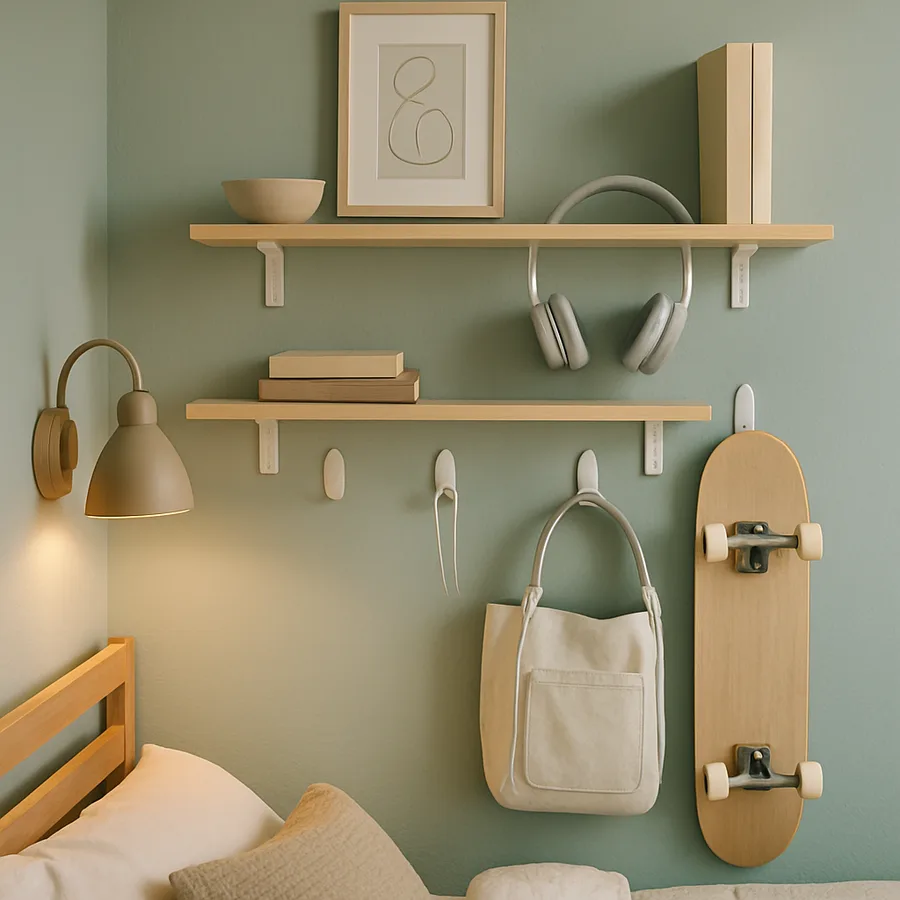
Renting a home with a teenager creates a constant low-grade tension between the teen's need to express identity through their bedroom and the lease clause that promises forfeiture of the security deposit if the walls show damage. Most parents respond by saying no to anything that requires a hole in the wall, which leaves teen bedrooms feeling unfinished, cluttered, and frustrating. The truth is that there is now an entire ecosystem of renter-friendly wall storage that delivers real performance, holds real weight, and leaves no trace when the lease ends. The era of damage-free wall storage has matured to the point where renters can build genuinely stylish, highly functional bedrooms without ever picking up a drill.
This guide is a practical playbook for parents and teens who rent. It walks through the realistic load capacities of the major damage-free systems, the best fixture types for each storage need, and the small details that determine whether a wall installation survives an entire school year or peels off the wall during a heat wave. Done correctly, the renter teen bedroom can rival or exceed an owner-occupied teen bedroom for storage and personality, with the bonus that everything packs up cleanly when life moves on.
Understanding What Renter-Friendly Actually Means
Most rental leases distinguish between normal wear and tear, which the landlord absorbs, and tenant-caused damage, which comes out of the security deposit. Small nail holes from picture hanging are usually classified as normal wear in most jurisdictions, but lease language varies significantly and some landlords charge per hole. The genuinely safe path is to assume zero holes are acceptable and design accordingly. This is the strictest interpretation, and it forces creative solutions that often turn out to be better than the drill-a-hole alternatives anyway.
Damage-free does not mean weightless. Modern adhesive and tension-based systems can hold remarkable loads when matched correctly to wall type and surface conditions. Smooth painted drywall with a satin or eggshell finish is the friendliest surface for adhesive products. Textured walls, freshly painted walls within thirty days of paint, glossy walls, and walls with multiple paint layers built up over decades all reduce adhesion reliability. Knowing your wall surface is the first and most important step before buying any adhesive product.
The American Society of Interior Designers (ASID) has tracked the rise of damage-free hardware as the renter share of the residential market has grown, and the design industry now treats removable solutions as a legitimate first-tier choice rather than a compromise. Have you ever taken down a wall hanging only to peel off a square of paint with it? That single experience teaches the lesson better than any guide can: surface preparation and product selection matter more than brute strength of adhesive.
Adhesive Mounting Strips and Hooks
Adhesive mounting strips with hook-and-loop closures are the workhorse of damage-free wall storage. The category is dominated by a single brand name, and the hook varieties range from small jewelry hooks rated for half a pound up to heavy-duty hooks rated for seven and a half pounds. Larger picture-hanging strip pairs can hold framed art up to sixteen pounds when used in matched sets. These ratings are honest, but they assume ideal conditions: clean walls, proper application, and full cure time before loading.
Application technique determines success more than product choice. Clean the wall with rubbing alcohol on a microfiber cloth and let it dry completely. Remove the protective film carefully. Press the strip to the wall and the corresponding strip to the item, then press them together against the wall with firm pressure for a full thirty seconds per pair. The most common failure mode is impatience: hanging an item within the first hour of installation, before the adhesive has fully cured. Wait at least one full hour before hanging, and let the loaded item rest undisturbed for the next 24 hours before adjusting.
For frequently used hooks, the bigger consideration is the load cycle. A hook that holds a backpack rated at five pounds will fail prematurely if the backpack is repeatedly slung onto it with force that briefly exceeds the rating. Use hooks rated at roughly double the typical static load to account for these dynamic spikes. Place hooks for heavy items at the height where the item naturally hangs without needing to lift and drop, which reduces shock loading. Better Homes and Gardens (BHG) has covered renter wall storage extensively, and the consistent advice is to overspec rather than underspec the hook rating relative to the item being hung.
Tension Rod and Pegboard Systems
Tension rods between two walls or between a wall and a ceiling create a load-bearing horizontal line without any hardware penetrating any surface. A tension rod across a closet alcove instantly becomes a clothing rod. A tension rod across a window alcove becomes a curtain support. A vertical tension pole between floor and ceiling becomes a structural anchor for shelves, hooks, and grids. Modern tension hardware is rated for impressive loads when properly tensioned, and the technology has advanced significantly in the past few years.
Pegboard systems take the tension or adhesive base and add a modular attachment surface. A pegboard hung from adhesive picture-strip pairs or supported by a tension frame turns a blank wall into an infinitely reconfigurable storage surface. Hooks, baskets, shelves, and clips clip directly into the pegboard holes without additional fasteners. This is the system used by professional craft workshops and tool storage rooms, scaled down for teen bedrooms. The flexibility means the storage layout can evolve as needs change without any new wall installations.
For teens with significant collections of small items, whether craft supplies, makeup, gaming peripherals, or sports equipment, the pegboard approach scales beautifully. A two-foot-by-four-foot pegboard panel can host dozens of attachment points, and visually it reads as intentional and grown-up rather than cluttered. Architectural Digest has profiled multiple teen bedrooms that use pegboard as a primary organizational element, and the photographs show how the system can look polished when the colors and accessories are coordinated. Has your teen complained that they have nowhere to put the random small items that accumulate? A pegboard is almost always the answer.
Floating Shelves Without Wall Anchors
Real floating shelves traditionally require deep wall anchors that leave significant repair work behind. The damage-free alternatives have improved dramatically in the past few years. Adhesive floating shelves rated for five to ten pounds are now widely available and look nearly identical to their drilled counterparts. Tension-mounted shelves between two walls in alcoves or between a wall and a vertical tension pole can hold significantly more weight, often twenty to thirty pounds per shelf when properly installed.
The trick to making damage-free shelves look intentional rather than improvised is to commit to a shelf system rather than installing one orphan shelf. Three or five shelves arranged in a deliberate composition above a desk or beside a bed read as built-in even when each is held up by adhesive. Match the shelf material to the rest of the room's furniture finish, whether that is warm wood, matte black, or off-white, so the shelves disappear into the architecture rather than calling attention to themselves.
Load distribution matters enormously. A single heavy book at one end of a shelf creates a torque that adhesive cannot resist for long. Distribute weight evenly across the shelf and keep the heaviest items closest to the wall side rather than the front edge. The Illuminating Engineering Society and various engineering bodies have published guidance on cantilever load distribution that applies just as much to a six-dollar adhesive shelf as to a custom hardwood installation. Avoid loading any damage-free shelf to its maximum rated weight and instead aim for roughly seventy percent of the rating to allow margin for the inevitable occasional overload.
Art and Display Without Nails
Wall art is where most teens want to express the most personality, and where most renter-friendly compromises feel the most painful. The damage-free art-hanging ecosystem has expanded enough that almost any framed piece, canvas, or poster can be hung securely without nails. Picture-hanging strip pairs handle frames up to sixteen pounds, which covers nearly everything a typical teen would hang. For larger or heavier statement pieces, multiple pairs can be combined to spread the load across the wall.
For unframed posters and prints, removable putty in the corners is a classic solution but it tends to leave grease marks on certain paint finishes. Better alternatives include adhesive-backed gallery clips, magnetic poster rails, and washi-tape borders that frame the print while attaching it to the wall. Washi tape in particular has become a renter favorite because it removes cleanly from most paint finishes after months of being attached. Test any tape on a hidden patch of wall for a full week before committing to a major application, because some paint finishes are more sensitive than others.
Picture rails offer the most elegant damage-free art solution. A picture rail mounted with adhesive strips along the top of a wall lets posters and small framed pieces hang from cords or chains, with no individual hole for each piece. The look is gallery-grade and pieces can be rearranged endlessly without any new installation work. The American Academy of Pediatrics (AAP) has noted that bedroom personalization meaningfully impacts adolescent sense of agency and ownership in their environment, and even renter-imposed limits should not prevent the teen from having significant control over the visual character of their walls.
Over-the-Door and Behind-the-Door Storage
Doors are the most underutilized vertical surface in a typical bedroom. Over-the-door hook racks, organizers, and shelves attach with hooks that fit over the top edge of a standard interior door, requiring no holes anywhere. The behind-the-door space is often deep enough to host shoes, accessories, jewelry, hats, bags, and even small electronics in pocket organizers. This is square footage that costs nothing in terms of room layout and contributes nothing to clutter when used well.
The over-the-door solution that most often gets ignored is the full-length mirror. Mounting a mirror on the back of the closet door or the bedroom door eliminates the need for floor space dedicated to a mirror and provides the full-body view that teens use multiple times per day. Adhesive-mounted mirrors are now widely available and rated for the kind of door movement they will encounter. The visual benefit of having a real mirror inside the bedroom is significant, both for outfit selection and for the spatial perception of the room itself.
For teens whose closet doors are louvered or paneled in ways that prevent over-the-door hardware, consider a vertical organizer that hangs from the closet rod instead. Hanging shoe shelves, hanging cubbies, and hanging accessory bags all use the existing rod as a support point and require no wall installation at all. The National Association of Home Builders (NAHB) has published research showing that bedroom storage capacity, more than absolute square footage, drives renter satisfaction with a unit, and over-the-door solutions are among the highest-leverage ways to expand that capacity.
Conclusion: The Renter Teen Bedroom Can Be Better Than Most
The myth that renting limits teen bedroom personality is exactly that, a myth. With careful product selection and patient installation technique, a renter can build wall storage that is genuinely as functional and as visually polished as anything that requires drilling. The damage-free hardware ecosystem has matured to the point where the only real limitation is imagination, and the modular, reversible nature of these systems is actually an advantage when life inevitably changes.
Start with the surfaces. Confirm the wall paint is in good condition and clean every spot where any adhesive will land. Match each storage need to the right product category, whether that is picture-hanging strips for art, tension rods for clothing, pegboard for small items, or over-the-door organizers for shoes and accessories. Commit to a coherent finish palette so the renter-friendly hardware reads as intentional rather than improvised. Within a single weekend, the bedroom can transform from a frustrating compromise into a fully realized teen space.
This week, walk through your teen's bedroom and identify the three biggest storage frustrations. Match each one to the renter-safe solution from this guide and pick the easiest of the three to install first. Build momentum from a small win, and the rest of the room will follow within a few weekends. Renting is not a constraint on creating a great teen bedroom; it is simply a design parameter that calls for a different toolkit, and that toolkit is now better than ever.
More Articles You May Like



Comments
Post a Comment