Picture Rail Molding for Hanging Art Without Wall Damage
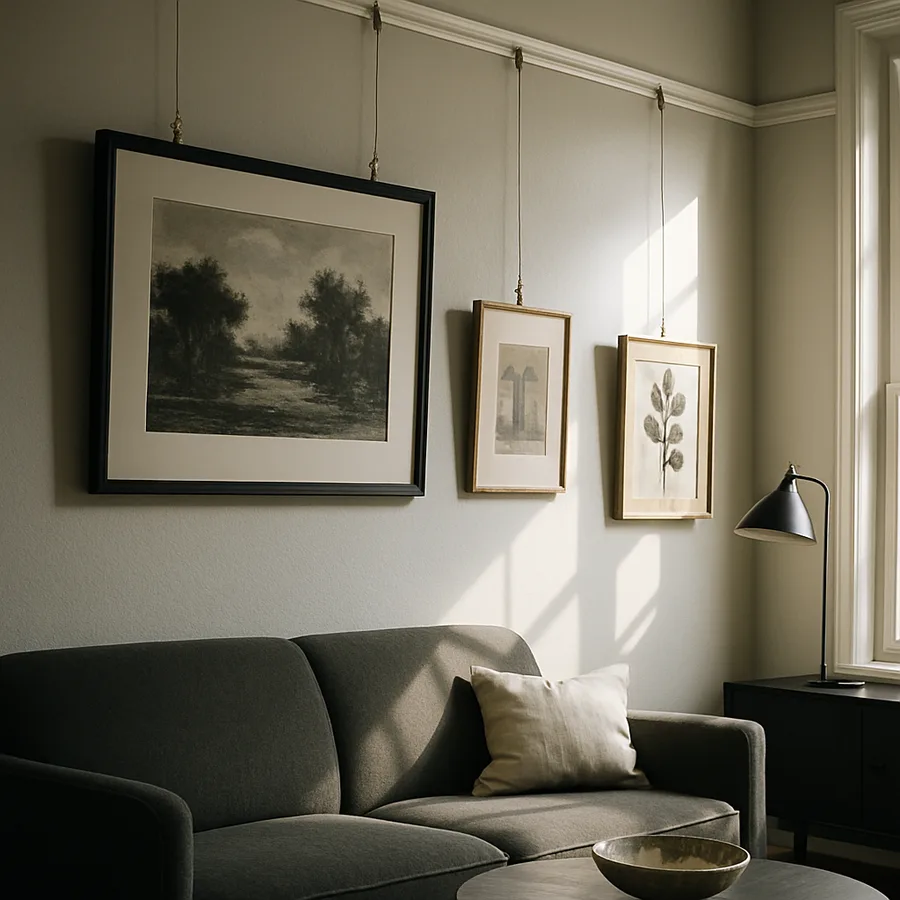
Renters, collectors, and preservation-minded homeowners share one persistent frustration: the desire to display meaningful artwork without leaving a constellation of nail holes, anchor scars, and spackle patches behind. Picture rail molding answers that frustration with a quietly elegant solution drawn directly from Victorian and Edwardian interior tradition. A slim horizontal strip mounted near the ceiling supports specialty hooks that grip the rail's profile, allowing wires or chains to suspend frames without touching the plaster below. The system is reversible, infinitely adjustable, and surprisingly sophisticated when paired with the right palette.
The American Institute of Architects has long documented the resurgence of historical millwork in adaptive-reuse projects, and the National Association of Home Builders reports that millwork upgrades now appear in roughly 38 percent of mid-range remodels documented in their annual Cost vs. Value survey. That cultural pull toward craft is precisely why picture rail systems feel newly relevant. Whether you live in a 1908 Craftsman bungalow or a contemporary loft, the rail solves a real problem while adding architectural interest that feels considered rather than decorative.
The Historical Roots of the Picture Rail
The picture rail appeared in British and American homes during the late nineteenth century, when plaster walls were considered too valuable, and too fragile, to be punctured for the casual rotation of household art. Wealthy homeowners often owned dozens of paintings, prints, and engravings, and the rail allowed butlers and housekeepers to rearrange compositions seasonally without summoning a tradesman to repair the wall surface. Architectural Digest has covered the revival of this detail in several restoration features, noting that authentic profiles still survive in many pre-war townhouses across Boston, Philadelphia, and Brooklyn.
The rail itself sits roughly twelve inches below the ceiling line, though older homes with taller ceilings often place it lower to align with the top of door casings or transoms. The space above the rail historically received a contrasting paint or wallpaper treatment, sometimes called the frieze, which framed the artwork below visually and concealed any imperfection in the plaster cornice above. This three-zone wall composition (dado, field, frieze) became a defining feature of Aesthetic Movement and Arts and Crafts interiors.
So why does this Victorian relic still matter today? Because the underlying logic, mounting hardware once and accepting that art collections evolve, applies just as strongly to a millennial first-time buyer as it did to a Gilded Age industrialist. The system protects the wall, simplifies redecoration, and visually elevates whatever you choose to hang.
Preservation societies have also pushed the rail back into mainstream consciousness. The National Trust for Historic Preservation has documented the rail in nearly every restored Victorian, Edwardian, and Arts and Crafts house museum in its portfolio, and several state-level preservation grants explicitly cover the reinstallation of original picture rails when they have been removed by mid-century renovations. That institutional respect has trickled down into mainstream remodeling guidance, and contractors who once dismissed the rail as fussy detailing now stock the profile in their standard catalogs. The cultural pendulum has swung firmly back toward articulated walls.
Choosing the Right Profile and Wood
Modern picture rail moldings are sold in profiles ranging from a delicate three-quarter inch flat strip to ornate two-inch cap moldings with carved bead detail. The defining feature is a small upper lip or curl that the picture hook clips over. Without that lip, the molding is just a chair rail mounted high, and no specialty hook will engage with it. This Old House has published useful comparison galleries that show the silhouette differences clearly, and most lumberyards stock at least two stock profiles even if they do not advertise them.
For wood selection, primed poplar remains the most common choice for painted applications because it accepts paint cleanly and resists warping in conditioned interiors. Stained or clear-finished installations typically use red oak, white oak, or quartersawn oak in Craftsman homes, and walnut or cherry in higher-end projects. Avoid finger-jointed pine for stained work because the joints telegraph through clear coats. The National Association of the Remodeling Industry (NARI) recommends acclimating any millwork inside the installation room for at least 48 hours before cutting to prevent post-installation movement.
Polyurethane and high-density polymer profiles have entered the market in the past decade and deserve consideration for high-humidity rooms or any installation in a basement, sunroom, or coastal property where wood movement is a chronic concern. The polymer profiles cost slightly more than primed poplar but eliminate warping risk entirely, and they accept paint as cleanly as wood when properly primed with a bonding primer. The compromise is that the polymer profiles cannot be stained, so they only suit painted installations. For most homeowners in conditioned interiors, primed poplar remains the best balance of cost, workability, and visual authenticity.
Determining the Correct Mounting Height
Mounting height is the question that trips up most first-time installers. The traditional rule places the rail between ten and sixteen inches below the ceiling, with taller ceilings allowing for greater drop. In a standard nine-foot ceiling, twelve inches is a safe default. In a ten-foot ceiling, sixteen to eighteen inches reads more proportionally, and in older homes with eleven-foot ceilings the rail can drop to align with the door casing for a deeply traditional effect.
Why does this matter so much? Because mounting too high makes the rail visually disappear into the cornice line, defeating its decorative purpose, while mounting too low cuts the wall awkwardly and leaves too much blank plaster above. Reader question: what if your ceilings are uneven? Snap a level chalk line first, then trust the line over the ceiling. A rail that follows a sagging ceiling will look worse than one that runs dead straight against an obviously crooked surface.
Use a stud finder to locate framing, and fasten the rail with two-and-a-half inch finish nails or trim screws every sixteen inches. Construction adhesive on the back face adds shear strength without compromising removability if you eventually pull the rail. The rail should feel rock-solid when you tug downward, because each linear foot may eventually carry several pounds of suspended artwork.
Hook Hardware, Wire, and Suspension Methods
The picture rail hook is the unsung hero of the entire system. Authentic brass S-hooks remain the most common, sized to clip over the rail's lip and hold a wire, chain, or monofilament loop. Specialty restoration suppliers stock reproduction hooks in polished brass, antiqued brass, oil-rubbed bronze, and matte black. For modern interiors, sleek nickel or stainless steel hooks read intentional rather than nostalgic. Plan for one hook per ten linear feet of rail as a starter inventory and expand as your collection grows.
Suspension wire choice changes the entire visual register. Braided picture wire in an antique brass tone disappears against most painted walls and adheres to historical precedent. Black coated wire reads contemporary and gallery-like. Clear monofilament suggests a museum aesthetic where the art appears to float, but it can yellow with age and is rated for lower weights than braided steel. Decorative chain in brass, copper, or blackened steel adds architectural punctuation in eclectic interiors and works particularly well for heavier mirrors or framed textiles.
For weight calculations, a single brass hook on standard rail typically supports 20 to 30 pounds, with two hooks per piece doubling that capacity. Reader question: can you hang something genuinely heavy? Yes, but distribute the load across three or more hooks and use steel cable rather than braided wire. The American Society of Interior Designers (ASID) consumer guides note that roughly 70 percent of reported picture-rail failures involve undersized or worn hooks rather than the rail itself, which is why hardware choice deserves more thought than most homeowners give it.
Paint, Finish, and Wall Composition
Color treatment makes or breaks the finished installation. The traditional approach paints the rail in the same color as other trim in the room, typically white, cream, or off-white in classical interiors, and a deeper saturated tone (charcoal, oxblood, forest green) in moodier contemporary spaces. Painting the rail to match the wall makes it nearly invisible, useful when you want the artwork to dominate. Painting it as a contrasting band creates the three-zone composition that Victorian designers prized.
The wall above the rail (the historical frieze) can receive several treatments. Continuing the wall color upward and across the ceiling reads modern and minimal. Painting only the frieze in a deeper tone produces a cozy, library-like enclosure. Wallpapering the frieze with a small-scale pattern (Morris and Company reproductions remain perennially popular) introduces craft and warmth without overwhelming the room. National Trust historic-house data shows that frieze treatments correlated with parlor and dining room formality through the early twentieth century.
For the rail itself, a satin or semigloss finish wears better than flat paint because the upper edge collects dust over time and benefits from a wipeable surface. Use a high-quality acrylic enamel and apply two coats with light sanding between, allowing 24 hours of cure before hanging anything heavy. The investment in finish quality pays off for decades.
Styling Compositions and Common Mistakes
The aesthetic flexibility of picture rail systems is what makes them genuinely useful rather than merely historical. A single oversized canvas suspended from two visible chains reads bold and gallery-like. A symmetrical pair of botanical prints flanking a window references English country house tradition. A salon-style cluster of mismatched frames in varied sizes evokes a curated collection accumulated over years. Because everything adjusts in seconds, you can experiment endlessly without committing to a single arrangement.
Common mistakes are easy to avoid once named. Hanging frames so high that the wires form long visible diagonals fights the eye and looks haphazard. Mixing too many wire colors and hook finishes creates visual noise. Using rail hooks that are too small for the molding profile causes them to slip, which is dangerous for both the artwork and anyone standing below. And skipping the level entirely produces a rail that drifts visibly downhill over the run of a long wall.
The most overlooked consideration is the relationship between rail spacing and frame proportion. A rail that runs uninterrupted across a 24-foot great room can look insubstantial if used to hang a single small print. In long rooms, plan for clusters or groupings that punctuate the rail at intervals corresponding to furniture below. The rail should feel like a deliberate compositional armature, not a tightrope strung between two walls.
Lighting also matters more than most homeowners anticipate. A picture rail composition that reads handsomely under natural daylight can disappear under harsh overhead downlighting or look unflattering under warm-tone lamp light. Plan for at least one adjustable picture light or wall sconce per major composition, ideally on a dimmer, so that the artwork remains legible across the day. Galleries and museums obsess over lighting because the same artwork can read transcendent or invisible depending on the light striking it; the same logic applies in domestic interiors and is one of the easiest ways to elevate a picture rail installation from competent to memorable.
Conclusion: A Quietly Powerful Architectural Detail
For a relatively modest material investment (typically 200 to 600 dollars in trim and hardware for an average room) picture rail molding delivers outsized returns in flexibility, wall preservation, and architectural depth. Renters benefit from a removable system that protects security deposits. Owners gain a restoration-credible detail that boosts perceived craftsmanship. Collectors get a curatorial tool that respects the artwork.
The system rewards patience during installation and creativity during use. Take the time to source a profile with an authentic lip, mount it dead-level at a height that suits your ceiling, and invest in quality hooks and wire. The first arrangement will likely feel tentative, but within a few rotations you will develop an intuitive sense of how the suspension geometry works in your particular room.
Across decades, the rail will quietly accumulate stories. The framed concert poster that dominated your twenties will give way to the wedding portrait, then the children's painted handprints, then the inherited landscape from a grandparent's estate. Through all of those rotations, the plaster behind stays smooth and untouched, ready for the next chapter. That continuity is the gift that picture rails have offered homeowners for more than a century.
Ready to bring this detail into your own home? Visit a local architectural salvage yard or specialty millwork supplier this weekend, request samples of two or three rail profiles, and hold them against your wall at the proposed height before ordering. For deeper guidance on historic wall details, consult the resources at This Old House, the American Institute of Architects, and the National Association of the Remodeling Industry, then commit to an installation date and start curating the collection your walls deserve.
More Articles You May Like



Comments
Post a Comment