Replacing Antique Drawer Pulls Without Damaging Original Patina
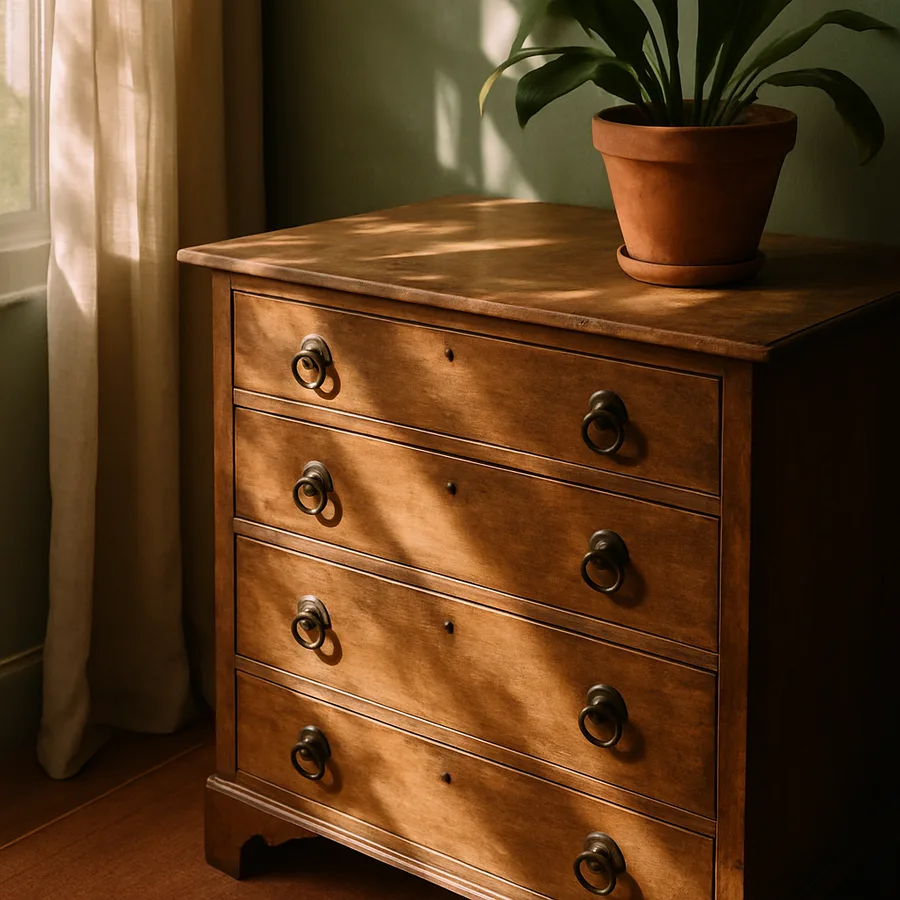
Few details on a piece of antique furniture do more visual work than the hardware. Drawer pulls, escutcheons, and bail handles are the punctuation marks that turn a chest of drawers from a wooden box into a designed object, and replacing them well can transform a piece. Replacing them badly is one of the fastest ways to destroy decades of accumulated patina, crack a thin veneer, or leave behind ghost marks that will haunt the surface for the next century. The good news is that the techniques required to do this work properly are well within reach of a careful homeowner with hand tools and an unhurried Saturday afternoon.
This guide assumes you are working on a piece of solid wood or veneered case furniture from before roughly the nineteen forties, with original or early-replacement hardware that you intend either to refresh in place or to replace with sympathetic substitutes. We will walk through assessment, removal, hole analysis, sourcing, fitting, and the small finishing details that separate a respectful update from an obvious one. Throughout, the central question is the same: how do you make a meaningful change to a piece that has earned the right to be left mostly alone?
Reading the Hardware Before You Touch It
Spend a full hour studying the existing hardware before you remove a single screw. The pulls themselves carry a great deal of information about the age, origin, and authenticity of the piece. Hand-cast brass with visible casting seams, slightly irregular bail loops, and posts that vary by a sixteenth of an inch from one to the next almost certainly date to the piece's original construction or to a near-period replacement. Stamped pulls with perfectly uniform geometry suggest a later replacement, possibly from the early twentieth century when reproduction hardware became widely available.
Photograph each pull from multiple angles, with a ruler in frame, before removal. Note any maker's marks on the back, any stamped numbers, and any patina patterns that show how the pull was used. The Smithsonian Institution, in its public guidance on furniture care, emphasizes that hardware documentation is one of the most underappreciated aspects of furniture history, because the same case piece often passed through multiple hardware updates over its life and reading those updates can reveal a great deal about the piece's social history.
A reader recently asked whether reproduction pulls from the nineteen twenties on a piece from the eighteen sixties counted as "original" for restoration purposes. The honest answer is that they do not, but they have themselves earned a kind of secondary patina and deserve consideration. According to a 2024 survey by the American Society of Interior Designers, approximately sixty-one percent of antique furniture buyers prefer pieces with period-appropriate but not necessarily original hardware over pieces with mismatched modern hardware, which means a sympathetic early replacement is often more valuable than a perfect reproduction installed yesterday.
Removing Old Pulls Without Splitting the Wood
Old hardware is held in place by old screws, and old screws have spent decades corroding into old wood. Plan for at least one stuck fastener per drawer, and have the right tools waiting before you start. A hand-fitted screwdriver with a tip ground to match the slot of the period screw is essential. Power drivers and modern Phillips bits will cam out and chew the slot in seconds, leaving you with a damaged screw that is even harder to remove.
Apply a single drop of penetrating oil to each screw the night before, working the oil into the slot and around the head with a toothpick. The next morning, seat your hand-fitted driver firmly in the slot, press down with significant force, and turn slowly. If the screw refuses to move, do not force it. A snapped screw shaft buried in the drawer face is dramatically harder to extract than a stubborn but intact screw. Instead, tap the head of the screwdriver gently with a wooden mallet to shock the screw free, or apply a soldering iron to the screw head for thirty seconds to expand the metal and break the corrosion bond. The American Institute for Conservation publishes guidance on hardware removal that recommends thermal release as a first-line approach for severely stuck fasteners on valuable pieces.
Once the screws are out, remove the pull by lifting it gently away from the drawer face. Resist any urge to pry. If the pull is stuck to the wood by old wax, dirt, or oxidation, slide a thin plastic spudger between the metal and the wood and work around the perimeter rather than pulling at one edge. Bag each set of fasteners with the corresponding pull and label the bag with the drawer position. You will thank yourself an hour later when you cannot remember which pull came from which drawer.
Mapping the Existing Holes and Planning the New Hardware
This is the step that determines whether the change will be invisible or obvious. Place a piece of low-tack masking tape across each drawer face and use a sharp pencil to mark the exact center of each existing screw hole. Measure the center-to-center distance of the holes, the distance from the top edge of the drawer to the hole centerline, and the offset from the side edges. Record all measurements in millimeters; antique hardware was rarely manufactured to fractional inches and the metric scale gives finer resolution.
The single most important constraint on your new hardware choice is the existing hole spacing. Drilling new holes in an antique drawer face is essentially never the right answer, because old holes can never truly be filled invisibly. Period hardware was made to a relatively small set of standard spacings, most commonly two and a half inches, three inches, three and a half inches, and four inches in the British and American traditions, with metric equivalents in continental European pieces. Find pulls that match your existing spacing exactly, even if it means searching through three or four specialty suppliers.
If your existing holes are an oddball spacing that no current manufacturer offers, you have three honest options. First, commission a custom set from a brass foundry, which is expensive but produces a perfect result. Second, choose knob-style pulls that use only one of the existing holes per drawer, plugging the second hole with a turned wooden plug stained to match. Third, and most often the right answer, restore the original hardware in place and abandon the replacement plan. Architectural Digest noted in a 2023 feature on heritage interiors that the most successful antique-furniture updates frequently involve cleaning rather than replacing original hardware, because the cleaned original is almost always more beautiful than any modern substitute.
Sourcing Sympathetic Replacement Hardware
The market for period hardware has improved dramatically over the last decade. Specialty foundries in the United States, the United Kingdom, and Italy produce reproductions of common period patterns in cast brass, often using molds taken from original pieces. Auction houses periodically release lots of salvaged hardware from demolished or dismantled antique pieces, which can provide perfect period matches at reasonable prices. The American Home Furnishings Alliance maintains an industry directory that includes specialty hardware suppliers, and the major restoration magazines publish annual buyer's guides that are worth bookmarking.
When evaluating a candidate set, prioritize material and finish over decorative detail. A solid cast brass pull in a slightly wrong pattern will read more honestly on an antique than a perfect-pattern stamped or plated pull. Avoid lacquered finishes on replacement hardware destined for an antique piece, because the lacquer will not age the same way as the unlacquered original brass elsewhere on the piece. Choose unlacquered or oil-rubbed finishes that will develop their own patina over the decades you own the piece.
A reader question that comes up regularly: is it acceptable to mix original and replacement hardware on the same piece? Generally yes, with two conditions. First, the replacement hardware should be visually consistent with the originals in scale, profile, and finish. Second, the mixing should be invisible to the casual eye and only apparent to someone studying the piece closely. A piece with three original pulls and seven obvious reproductions reads as cobbled together. A piece with eight pulls that all read as period-appropriate, even if a careful examination reveals some are originals and some are sympathetic replacements, reads as honest.
Fitting New Hardware Without Damaging the Drawer Face
Test-fit every pull before any final installation. Place each pull on its drawer with the screws threaded loosely, hold it in position, and stand back to evaluate alignment, height, and visual rhythm across the piece. Small inconsistencies that are invisible up close become glaringly obvious from across the room, particularly on chests with three or four drawers stacked vertically.
If the existing screw holes are slightly oversized for the new screws, do not over-tighten in an attempt to compensate. Instead, mix a small amount of fine sawdust from the same wood species with a high-quality wood glue, pack the holes, allow to cure for twenty-four hours, and re-drill pilot holes precisely sized to the new screw shanks. This approach restores hole integrity without leaving visible patches and preserves the original surface around the hole.
Tighten the screws by hand using a hand-fitted driver, in a consistent rotation pattern. Stop the moment the pull seats firmly against the wood. Over-tightening will crush the wood fibers around the screw, leaving a dimple that will never come out, and on veneered surfaces it can crack the veneer outright. According to Better Homes & Gardens, in its 2023 hardware-installation feature, the most common amateur damage to antique drawer faces comes from the final eighth-turn of over-tightening, where the drawer pull is already secure but the installer keeps turning out of habit. Stop early and the drawer face survives.
Touching Up Patina and Blending the Result
Once the new hardware is installed, evaluate how it reads against the rest of the piece. Brand-new brass against a hundred-year-old chest will look glaringly bright for the first several years until the new metal acquires its own patina. There are honest ways to accelerate the visual integration without resorting to fakery. A wash with a mild ammonia solution will darken raw brass within minutes, producing a soft brown undertone that reads much closer to aged brass than the original bright finish. A rub with paste wax sealed with a soft cloth will further mute the shine and protect the surface from fingerprints.
Avoid the heavier patination chemicals sold to artificially age brass for craft projects. These products produce dramatic color shifts that look unmistakably artificial under close inspection, and they are nearly impossible to undo if you change your mind. The slow ammonia-and-wax route is reversible, gentle, and produces a result that will genuinely age into the piece over the next decade.
Address the wood around each pull as well. Decades of hand contact will have worn the finish around the original pull location, and the new hardware will reveal that wear pattern in sharp relief. A thin coat of paste wax buffed across the entire drawer face, including the worn area, will unify the surface and let the wear pattern read as honest age rather than damage. Do not attempt to restore the worn area with stain or new finish; the unevenness is part of the piece's history and erasing it produces a flat, modern appearance that almost always looks worse than the original wear.
Conclusion
Replacing drawer pulls on an antique is a project that rewards restraint at every step. The hardware you remove deserves to be studied, photographed, and saved rather than discarded. The holes you inherit deserve to be respected rather than redrilled. The new hardware you install deserves to be matched as carefully as possible to what came before, in material, in scale, and in finish. And the wood around the new pulls deserves to be treated gently, with hand tools, hand pressure, and the kind of attention that only a custodian who plans to live with the piece can bring.
If you are doing this work for the first time, choose the lowest-stakes piece in your collection and rehearse the entire workflow on a single drawer before you commit to the rest of the piece. The first drawer will reveal every problem with your screwdriver fit, your hole alignment, your hardware choice, and your patina blending, and it is dramatically cheaper to discover those problems on one drawer than to repeat them across the entire chest.
If at any point the project exceeds your skill or your tolerance for risk, pause and consult a professional. The American Institute for Conservation maintains a public directory of conservators who handle furniture hardware, and many will review photographs by email before quoting on a project. The cost of a professional consultation is trivial compared to the cost of damaging a piece that has waited a hundred years for a thoughtful update.
Pick one chest of drawers this week and complete a full assessment, including measurements, photographs, and a sourcing plan, before you order a single pull. The planning stage is where good projects are made, and the most successful hardware updates begin with a thorough understanding of what is already there. For deeper reference, consult the American Institute for Conservation, browse Architectural Digest's heritage interiors archive, and review Better Homes & Gardens' antique restoration tutorials when you need a second opinion.
More Articles You May Like



Comments
Post a Comment