Smart Toilet Features From Heated Seats to Self-Closing Lids
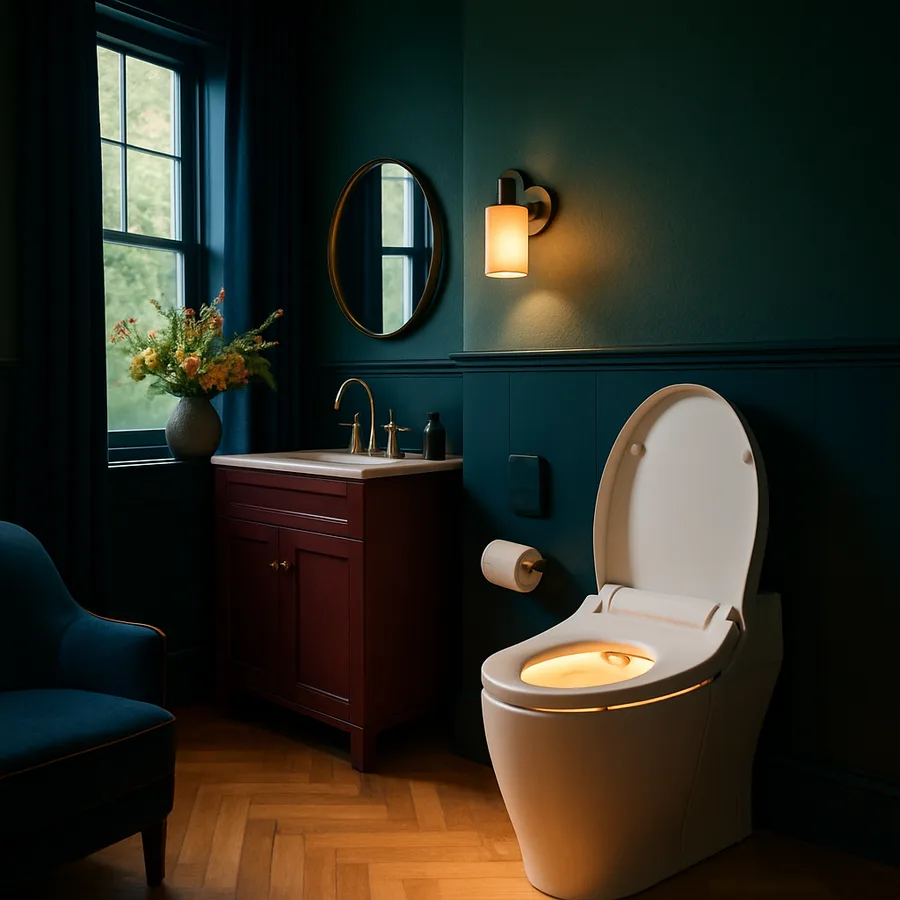
For most of the twentieth century, a toilet was a fixture without features. It flushed, it refilled, and that was the entire user experience. Over the last decade, a quiet revolution has reorganized the category. The same fixture now offers heated seats that warm to body temperature in seconds, integrated bidet wands with adjustable water pressure and temperature, self-closing lids that descend silently after each use, automatic deodorizers, motion-activated night lights, and even built-in air dryers. The contemporary toilet, especially in mid-to-upper price tiers, has more in common with a piece of consumer electronics than with the porcelain bowl that hung in the same spot a generation ago.
The catch is that "smart toilet" is no longer a single product category. It spans a wide spectrum, from a simple seat with a heating element to a fully integrated unit with a dedicated electrical circuit, a tankless flush system, and a remote control. Choosing well requires understanding which features deliver real daily value, which are pleasant but optional, and which add complexity without enough payoff to justify the cost. This guide walks the spectrum from the most universally useful upgrades to the niche additions, with an eye toward what actually changes how the bathroom feels to use.
Heated Seats: The Most Loved Upgrade for Good Reason
Of all the smart toilet features available today, the heated seat is the one that owners describe as "I cannot believe I lived without this." The seat contains a low-wattage heating element that maintains the seat surface at a user-selectable temperature, typically between roughly 90 and 105 degrees Fahrenheit. In a cold tile bathroom in January, the difference between a 60-degree porcelain seat and a 95-degree warmed seat is the difference between a small daily flinch and quiet comfort.
The technology itself is mature. Most heated seats draw between 30 and 60 watts in steady state, less than a typical incandescent bulb, and roughly 200 to 300 watts during initial warm-up. Annual electricity cost runs in the range of fifteen to forty dollars depending on local utility rates and whether the seat is left on continuously or scheduled to warm during typical waking hours. Many models include occupancy sensors that warm the seat only after a person enters the bathroom, reducing standby energy use significantly.
For aging-in-place projects and for households with anyone who has circulatory or arthritis-related sensitivity to cold, a heated seat moves from comfort into the territory of genuine quality-of-life improvement. The AARP Livable Communities framework lists thermal comfort as a meaningful contributor to bathroom usability for older adults, and a heated seat is one of the simplest, lowest-friction ways to deliver that comfort. Have you ever delayed a midnight bathroom trip because the seat was cold? A heated seat removes that small friction entirely.
Integrated Bidet Wands: The Feature With the Biggest Hygiene Payoff
An integrated bidet, sometimes called a washlet, replaces toilet paper for the cleansing step with a stream of warm water from a wand that extends from the rear of the seat. The wand is self-cleaning, retracts when not in use, and offers user-adjustable temperature, pressure, position, and oscillation. Water is supplied either from a small heated reservoir inside the seat or from an instantaneous heater that warms the supply line on demand. The user controls the wand from a side panel or a wireless remote.
The hygiene argument for a bidet is straightforward: water cleans more thoroughly than dry paper, which is why many medical and post-surgical recovery protocols specifically recommend a bidet during healing. The environmental argument is also significant. The National Resources Defense Council has cited toilet paper production as a major driver of boreal forest pressure, and a household that switches to bidet-primary cleansing typically reduces toilet paper consumption by 75 to 90 percent. For a family of four, the savings on tissue alone can offset the cost of a mid-range integrated bidet seat in roughly three to five years.
Setup is more involved than for a heated seat alone, because most integrated bidets require both a water supply T-fitting at the toilet shutoff valve and a grounded electrical outlet within reach of the seat. In existing bathrooms, the outlet is often the limiting factor. The Plumbing-Heating-Cooling Contractors Association and the International Association of Plumbing and Mechanical Officials both recommend a dedicated GFCI-protected outlet behind the toilet for any integrated bidet installation, and many local codes now require it. Plan for an electrician's visit if the bathroom does not already have a properly placed outlet.
Self-Closing Lids and Soft-Close Seats
The self-closing lid is the feature most likely to be dismissed as a gadget and most likely, after a year of ownership, to be quietly missed when visiting any other bathroom. The mechanism uses either a damped hinge with an internal silicone fluid chamber or, on more advanced models, a small motor that lowers the lid after a preset delay. The result is the same: the lid descends in a smooth, silent two-to-three-second arc, with no slam, no pinched fingers, and no risk of waking the rest of the household at three in the morning.
The motorized version adds a feature that the damped version cannot: automatic opening on approach. A motion sensor detects the user entering the bathroom, raises the lid, and is ready before the user arrives. After flushing and a brief delay, the lid lowers itself again. For households with shared bathroom habits across multiple users, the auto-open auto-close cycle quietly resolves the perennial debate about who left the lid up. It also reduces the number of surfaces touched during a bathroom visit, a small but real hygiene benefit.
Soft-close seats, the simpler cousin of the self-closing lid, use the same damped-hinge mechanism on the seat itself. The seat lowers gently rather than dropping freely. This is the lowest-cost smart-toilet upgrade available, often built into mid-range two-piece toilets at no premium, and it should be on every shortlist regardless of how many other features are included. The price difference compared to a non-damped seat is negligible, and the noise reduction at night is meaningful.
Air Dryers, Deodorizers, and Other Air-Handling Features
Once an integrated bidet is on the seat, the next logical addition is the warm air dryer. The dryer uses a small heating element and fan to dry the user after the bidet wand has finished, typically over a thirty-to-sixty-second cycle. Reviews of the feature are mixed: some users find that it fully replaces toilet paper and pat-dry behavior, while others use it to take the wash from "wet" to "damp" and finish with a small amount of paper. The energy use is modest, comparable to a hair dryer running for a fraction of a minute, and there is no plumbing implication.
Built-in deodorizers are another air-handling feature that has matured considerably. A small fan inside the seat draws air from the bowl through a charcoal filter and exhausts it through a vent at the back of the seat. The result is a noticeable reduction in bathroom odor during use, with no perfumes or chemical sprays involved. The charcoal filter is typically user-replaceable on a six-to-twelve-month schedule, and the fan operates only while the seat is occupied. For shared bathrooms or for a primary bath that opens directly into a bedroom, the deodorizer is a feature that is appreciated more than expected after a few weeks of ownership.
Some premium models extend air handling further with a pre-misting feature that lightly coats the bowl with water before each use, reducing the surface area where waste can adhere and making the post-flush rinse more effective. According to a study cited by the U.S. Environmental Protection Agency through its WaterSense program, well-designed bowl wash systems can reduce visible residue significantly without increasing total flush water volume, because the pre-mist water is reused as part of the next flush cycle.
Night Lights, Ambient Sound, and Other Sensory Touches
The motion-activated night light is one of those features that sounds trivial on a spec sheet and turns out to be quietly useful in practice. A small LED inside the bowl rim illuminates the water in a soft blue, green, or amber glow when the room is dark and motion is detected. The light is bright enough to navigate the bathroom safely without flipping a wall switch, but dim enough to avoid waking the user past the point of falling back asleep. For households with small children, older adults, or anyone with disrupted sleep, the night light is a concrete safety feature: most bathroom falls happen at night, and any reduction in the need for full overhead lighting is a measurable safety improvement.
Ambient sound features are more divisive. Some premium models include a small speaker in the seat that plays a masking white-noise track during use, ostensibly for privacy in shared homes. Others integrate a Bluetooth connection that can play music from the user's phone. These features are pleasant for some users and pointless for others, and they are not worth paying a meaningful premium for unless they happen to be bundled with features that are.
The remote control or side panel itself deserves consideration. Cheap remotes feel cheap, with mushy buttons, vague iconography, and labels that wear off within a year. Quality remotes have positive button feedback, clear icons, and durable backlighting. If possible, hold the remote in person before purchasing, because a feature-rich toilet with an unpleasant remote becomes a feature-rich toilet that nobody wants to fully use. What matters most to you in a daily-use control: button feel, icon clarity, or remote-versus-side-panel placement?
Power, Plumbing, and Reliability Realities
The single most important practical fact about smart toilets is that they are appliances, and like all appliances, they fail in ways that simple porcelain fixtures do not. A heated seat with a faulty thermistor, a bidet wand with a clogged spray head, or a motorized lid with a stripped gear are all real failure modes. Most are covered under manufacturer warranty for one to five years, but after that period, repair or replacement is on the owner. Choose brands with strong U.S. service networks, available replacement parts, and clear technical support, rather than the lowest-priced import on a marketplace listing.
Power is a real consideration. An integrated bidet typically requires a dedicated 15-amp GFCI circuit within reach of the seat, ideally roughed in during initial bathroom construction. Retrofit installations frequently rely on extension cords run along the floor, which is a code violation in most jurisdictions and a genuine safety hazard. According to surveys aggregated by the Plumbing-Heating-Cooling Contractors Association, improper electrical setup is the most common cause of bidet seat warranty claims, and most failures could have been prevented with a properly placed outlet during installation.
Water filtration matters too. The fine spray nozzles in bidet wands are sensitive to mineral deposits, and households with hard water often see flow degradation within two to three years. A simple in-line water filter at the supply T-fitting, replaced annually, can extend wand life significantly. If your home has hard water and you are planning a smart toilet, plan for the filter at the same time. The cost is modest and the reliability payoff is large.
Conclusion: Buying the Features That Earn Their Keep
The smart toilet category rewards a clear-eyed inventory of which features genuinely improve daily life and which are demonstration-floor showmanship. For most households, the order of value is consistent. Soft-close seats and lids belong on every toilet, full stop. Heated seats are the next clear winner, especially in cold climates and for users with any circulatory sensitivity. Integrated bidets are transformative for users willing to learn the new routine, and the toilet paper savings alone often justify the upgrade within five years.
Beyond those three, the calculus depends on the specific household. Self-closing motorized lids are excellent for families with mixed habits and for hygiene-conscious users. Built-in deodorizers shine in primary bathrooms and en-suite layouts. Night lights are quiet safety features that pay off for any household with disrupted nighttime bathroom use. Ambient sound, in-bowl music, and color-changing mood lights are pleasant extras that should not drive the purchase decision on their own.
One feature that deserves a special note: the dual-flush actuator, often available even on simple two-piece toilets, is the smart-toilet feature with the highest water-savings impact. A WaterSense-rated dual-flush toilet typically uses 0.8 gallons for liquid waste and 1.28 gallons for solid waste, and over the life of the toilet, the savings versus a single-flush model can total tens of thousands of gallons. If only one upgrade is in the budget, the dual flush is often the most quietly impactful choice.
Before placing an order, walk through the bathroom with the spec sheet in hand and confirm three things: there is a properly placed GFCI outlet within reach of the seat, the supply line has room for a T-fitting, and the toilet's bowl shape and rough-in match the existing waste flange. If any of those three is missing or unclear, talk to a licensed plumber and electrician before committing to a model. Done with care, a smart toilet upgrade is one of the most universally appreciated bathroom investments available, and one that quietly raises the daily quality of life of everyone in the household for the next fifteen to twenty years.
More Articles You May Like


Comments
Post a Comment