Shoe Storage Cubbies Under Open Tread Staircases
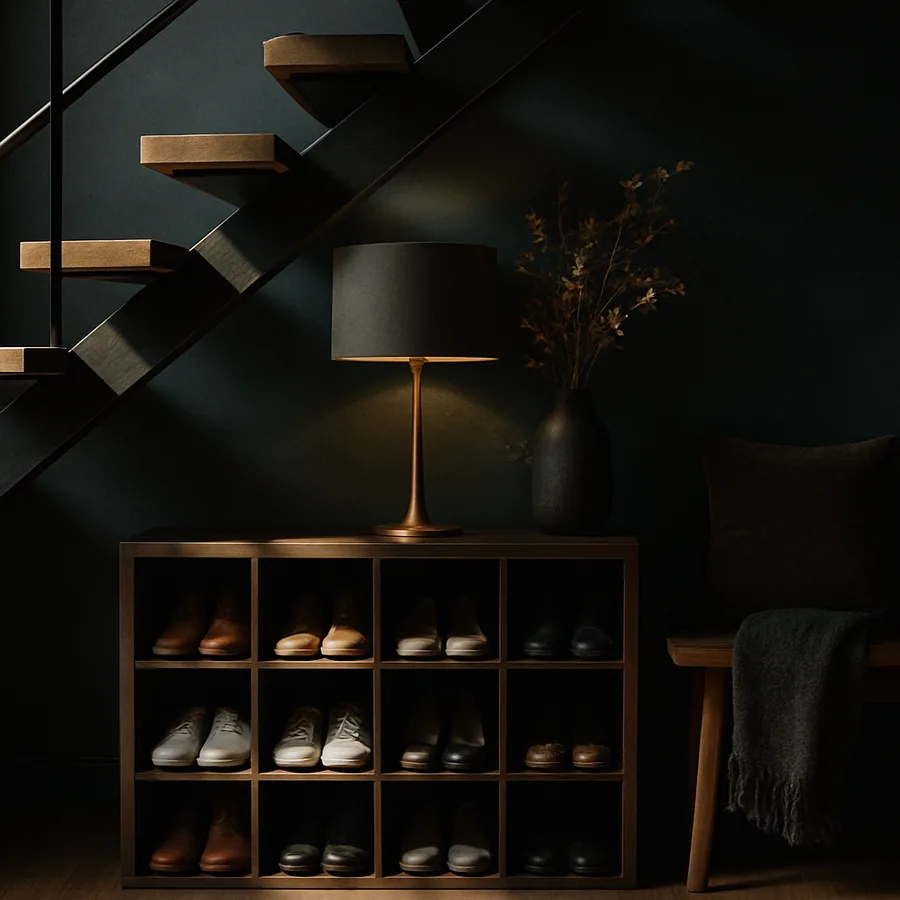
The open tread staircase is one of the defining architectural moves of contemporary residential design, prized for the way it lets light pass through a vertical circulation core and visually expands modest entry footprints. But that visual openness comes with a practical cost: the space beneath the stairs can no longer be enclosed as a traditional storage closet without killing the very feature that justified the open treads in the first place. The clever solution gaining traction with designers and homeowners is the under-stair shoe cubby system, a low-profile open or semi-open storage strategy that uses the cavity for daily-rotation footwear without sealing it off behind walls. The American Society of Interior Designers (ASID) flagged entryway optimization as one of the most-requested 2025 renovation categories, and footwear management consistently ranks at the top of homeowner pain points in those entry redesigns.
What makes shoe storage under open treads particularly tricky is that everything is visible. There is no closet door to hide a jumble. The system has to be beautiful enough to be permanent visual furniture, durable enough to survive daily abuse from feet and weather, and ventilated enough to manage the moisture and odor that footwear contributes to entryways. This article walks through the design and engineering decisions that separate a successful conversion from one that becomes the household clutter magnet you wish you could hide. We cover sizing, layout strategies, materials and finishes, ventilation and odor control, lighting integration, and the budget envelope that real homeowners face.
Why Open Treads Demand a Different Storage Strategy
A closed staircase with risers and a solid wall beneath gives you complete control over what people see. Open treads remove that privacy. Light, sightlines, and views pass through the stair from the side, the front, and often from above when there is a landing. Anything you place beneath has to be considered from at least three viewing angles, and it has to look intentional from each one. This is why simply pushing a generic shoe rack under the stairs almost always fails visually.
The solution is to design the storage as a piece of architecture that completes the staircase rather than as furniture parked beneath it. A low bench with integrated cubbies, a horizontal slatted screen, or a series of stacked open boxes in matched material and finish reads as part of the stair design rather than as visual clutter. The National Kitchen and Bath Association (NKBA) member designers have written about this principle in entryway-focused features, emphasizing that the most successful open-tread storage solutions match the stair material exactly or contrast it deliberately, never split the difference.
Have you ever walked into a beautiful modern home and felt your eye immediately catch on a chaotic pile of shoes near the door? That visual snag is what good under-stair shoe storage eliminates. The American Society of Interior Designers (ASID) Outlook documents have noted that entry first impressions disproportionately influence guest perception of the entire home, which is exactly why footwear management matters more here than elsewhere in the house.
Sizing the Cubbies to Real Family Footwear
The most common sizing mistake is treating all shoes as one category. A men's size 13 work boot, a women's mid-calf riding boot, and a child's sandal occupy radically different volumes, and a one-size-fits-all cubby wastes space on small footwear and forces large footwear into awkward orientations. The fix is a graduated cubby system with at least three height tiers: a tall row for boots, a medium row for sneakers and dress shoes, and a shallow row for sandals, slippers, and children's shoes.
Practical dimensions, drawn from cabinet maker rules of thumb and verified against real footwear collections: a tall boot cubby should be at least 14 inches tall by 12 inches wide by 14 inches deep. A standard sneaker cubby works at 8 inches tall by 12 inches wide by 13 inches deep. A flat shoe cubby can drop to 5 inches tall. Plan two to three cubbies per household member for daily-rotation shoes, with overflow handled elsewhere. Better Homes and Gardens (BHG) has published entryway storage surveys finding that families typically keep five to nine pairs of daily-use shoes near the door even when they own two or three times that many total pairs.
Width is constrained by the cavity but also by usability. A cubby wider than 14 inches often collects two pairs of shoes piled on top of each other, which defeats the organization. Subdivide wider cavities into individual cubby slots with vertical dividers. The math gets satisfying when you stack a tall boot row across the bottom, a wider sneaker row in the middle, and shallow flats on top, with the geometry following the staircase slope from low at the front to tall at the back wall.
Materials That Survive Wet Boots and Daily Abuse
Shoe storage punishes materials in three specific ways: water from rain and snow, grit from outdoor surfaces, and impact from boots being shoved in carelessly. Standard cabinet-grade plywood with a paint finish will fail within a year if any of those exposures are routine in your climate. The materials that hold up are moisture-resistant MDF or marine-grade plywood with a sealed urethane or polyurethane finish, or solid hardwood with multiple sealer coats on every face including the underside.
The cubby floor needs the most protection because that is where water pools and grit accumulates. A common professional approach is to install a removable washable tray in each cubby, often a low-profile silicone or rubber boot tray sized to the cubby footprint. These trays lift out for cleaning, contain spills, and dramatically extend the life of the underlying wood. The Whole Building Design Guide and several cabinet maker associations recommend specifying replaceable wear surfaces in any storage that holds wet or dirty items, exactly because the wear is concentrated and predictable.
Edge finishing matters more than you might expect. Raw plywood edges absorb moisture and discolor within months. Specify edge banding or a hardwood edge strip on every exposed cubby edge, and seal the back and bottom of the millwork even if those surfaces will not be visible after installation. The National Association of the Remodeling Industry (NARI) has noted in member guidance that cabinetry failures in entryway and mudroom applications most commonly originate at unsealed edges and joints exposed to moisture cycling.
Ventilation, Odor Control, and Drying Wet Shoes
Wet shoes need air movement to dry, and footwear odor is almost entirely a moisture and bacteria problem. A sealed cubby that traps moisture is the worst possible environment for both shoe longevity and household air quality. The design principle to follow is open or semi-open construction on the back and sides of each cubby, allowing air to circulate around every stored pair. Slatted shelves with a quarter inch gap between slats outperform solid shelves dramatically for drying time.
If your entry sees serious wet weather, consider a heated drying element. Low-watt boot dryers designed for residential mudrooms are widely available and many models mount discreetly inside cubbies, gently warming the air to accelerate drying without damaging leather or membrane footwear. The Energy Star program has reviewed several entryway drying products for residential use, and the modern generation operates at low enough wattage to leave on continuously through wet seasons without meaningful cost impact.
Odor control combines ventilation with periodic deep cleaning. Activated charcoal sachets, available cheaply, sit in cubbies and absorb the volatile compounds that produce shoe odor. Replace them every three to six months. A monthly wipe-down of cubby interiors with a diluted vinegar solution removes the bacterial film that produces persistent smells. The American Lung Association has noted that entryway air quality measurably affects whole-house indoor air, particularly in tightly sealed modern homes, which makes managing entryway moisture and odor a health consideration as well as a comfort one.
Lighting the Cubbies Without Killing the Open Look
One of the great advantages of open tread staircases is the way light moves through them. Adding storage beneath should not turn the cavity into a dark cave that swallows that light. The lighting strategy that preserves the openness uses warm low-output linear LEDs mounted under each tread or along the back of each cubby row, washing the storage with soft illumination that complements rather than competes with overhead light.
Color temperature matters here as much as in any room. Choose warm white in the 2700K to 3000K range for residential entryways. Cool white reads as institutional and fights the welcoming feel that entries should project. The American Lighting Association consumer guidance reinforces this temperature recommendation for residential public-facing spaces and notes that lower color temperatures also reduce glare in mirrored or polished surfaces, which matters because many modern entryways include reflective floor or wall finishes.
What about motion activation? In an entryway, motion-activated cubby lighting can feel magical for guests but annoying for residents who pass through dozens of times per day. The middle ground is a manual rocker switch positioned at adult-shoulder height near the door, with a separate dimmer for evening levels. Reserve motion sensors for hidden zones like coat closets if you have them adjacent.
Integrating Bench Seating, Hooks, and Daily Flow
The most successful under-stair shoe cubby systems do not stop at storage. They integrate bench seating at the right height for putting shoes on, hooks above for jackets and bags, and sometimes a small drawer for keys and dog leashes. The cubby system becomes a complete entry choreography rather than a single-function cabinet. Bench seat heights between 17 and 19 inches feel comfortable for most adults; lower heights work for households with young children but become awkward for taller adults.
Daily flow is the test of whether the design actually works. Walk through your morning departure routine mentally and physically. Where do you sit to put on shoes? Where do you grab the jacket? Where do you set down keys and bag? The cubby system should support each of those steps without forcing detours. The Houzz remodeling community has published dozens of completed entryway case studies and the consistently highest-rated examples are those where bench, cubby, and hook positions match the user's actual sequence of actions.
Storage near but not in the cubby system rounds out the entry. A small drawer for chargers and lip balm, a hook for the dog leash that does not double as a jacket hook, a basket for incoming mail, and a tray for keys all reduce the pressure on the shoe storage to absorb miscellaneous overflow. When the cubbies hold only shoes and the adjacent storage holds everything else, both systems perform measurably better in daily use.
Conclusion
An under-stair shoe cubby system designed for an open tread staircase is one of the most visible and high-traffic renovations a homeowner can take on, and its success depends on treating the storage as architecture rather than as a functional afterthought. Match the cubby design to the stair geometry, size each tier to real footwear in your household, choose materials that survive moisture and grit, and ventilate generously to manage drying and odor. The combination produces an entry that performs daily without ever apologizing for the storage that makes it work.
The most common failure mode is overbuilding for shoes the household does not actually own. A precise inventory of the daily-rotation footwear, multiplied by household size, gives you the right cubby count. Overflow shoes belong elsewhere, ideally in a closet or storage room behind a door. Resist the urge to expand cubby capacity beyond the daily rotation because every empty cubby becomes a magnet for non-shoe clutter that defeats the visual discipline of the system.
Climate considerations deserve early planning. If you live anywhere with snow, salt, or extended rainy seasons, integrate boot trays, ventilation, and a drying capacity from the beginning rather than retrofitting after the wood starts failing. The cost of these features at construction is a fraction of replacing damaged millwork two years later, and the everyday benefit during wet weather is substantial. Talk through your specific climate exposures with the contractor or designer building the system.
Ready to start? Pull out every pair of daily-use shoes in your household and arrange them on the floor in a rough grid. Measure the longest, the widest, and the tallest. Sketch your stair cavity to scale and overlay the cubby grid. Within an hour you will know what configuration fits and how many tiers you need. From there, get two or three quotes from local cabinet shops or finish carpenters and ask specifically about moisture-rated materials and edge sealing details. For inspiration and reference reading, the Better Homes and Gardens entryway archives include real-home case studies with photos and floor plans, the Houzz photo library lets you filter by stair type and storage style, and the NKBA trends reports cover broader storage design principles that apply directly to entryway projects.
More Articles You May Like



Comments
Post a Comment