Linen Closet Door Alternatives: Curtains, Barn Doors, and Open Shelving
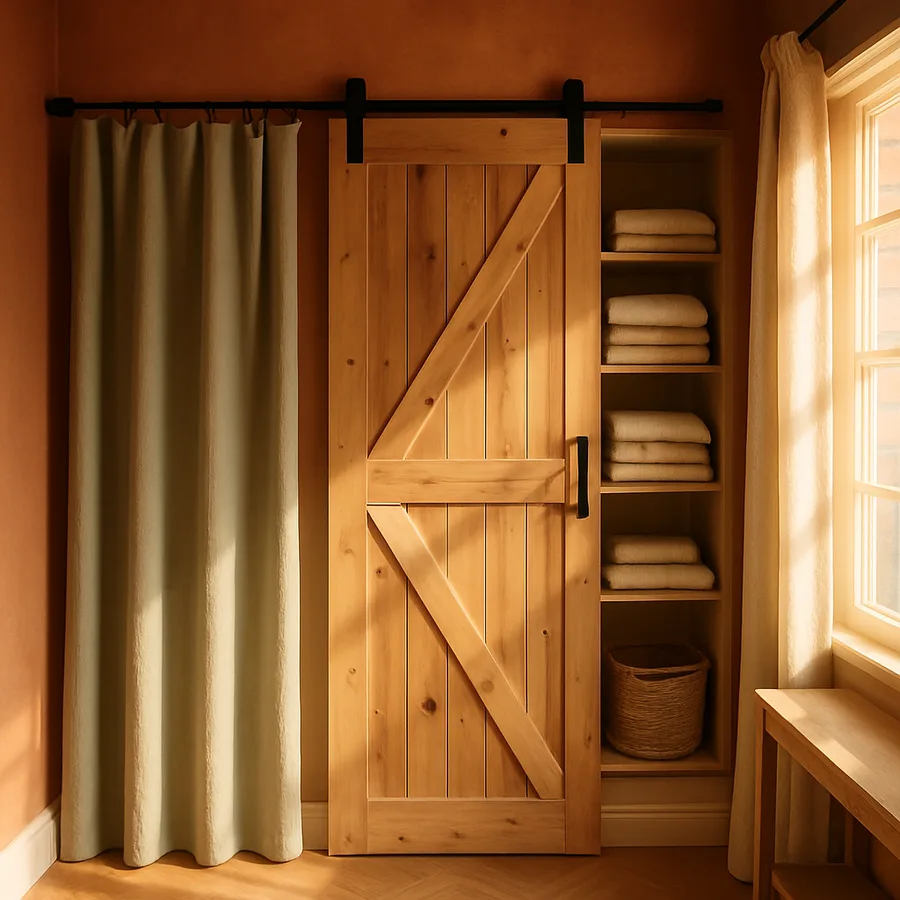
The standard hinged linen closet door is one of the most quietly frustrating pieces of residential carpentry in American homes. It swings into hallway traffic, it eats wall space you would rather use for a towel bar, and it hides contents so completely that you forget what you own. Over the last decade, homeowners and designers have moved steadily toward alternatives, and the range of options has expanded beyond the obvious. According to a 2023 Houzz home renovation study, door replacement and removal projects grew 34% between 2019 and 2023, with linen and utility closets leading the category.
This article compares the three most popular linen closet door alternatives, covering their real-world costs, installation complexity, clearance requirements, and the aesthetic payoff each option delivers. It also walks through the hybrid solutions that have become popular in transitional and farmhouse-style interiors, where a fabric panel might combine with a partial open shelf to create something that looks custom without the custom price. By the end, you should be able to look at your own hallway and know which option fits your traffic patterns, your style, and your budget.
Why the Standard Hinged Door Falls Short
The hinged closet door is a product of mid-century tract housing, where hallways were narrow and door swings were treated as free space. In a typical 36-inch hallway, a 30-inch hinged door consumes roughly 7 square feet of swing arc, which is often the difference between a hallway that feels generous and one that feels cramped. Designers who specialize in small-space renovation routinely identify door swings as the single largest source of wasted square footage in homes under 1,500 square feet.
Beyond the spatial problem, hinged doors create a psychological barrier to good housekeeping. Professional organizers affiliated with the National Association of Productivity and Organizing Professionals (NAPO) have noted that closets hidden behind solid doors accumulate clutter 40 percent faster than visually accessible storage, simply because out-of-sight items are rarely audited. If you have ever opened a linen closet after six months and discovered three half-used bottles of laundry detergent and a pillowcase from a bed you no longer own, you know the pattern.
Have you ever counted how many times a day you bump into your linen closet door? For a family of four, the answer is often twelve to twenty openings and closings, each costing a few seconds and adding friction to routine tasks. A door that folds away, slides aside, or disappears entirely removes that friction in a way that quickly becomes addictive.
Curtain Panels: The Lowest Cost, Highest Flexibility Option
Replacing a linen closet door with a fabric curtain is the renovation that costs the least and changes the most. For roughly $40 to $120 in materials, a homeowner can remove the existing door slab, fill the hinge mortises, and install a decorative rod with a lined curtain panel. The visual result softens the hallway, adds a layer of textural warmth, and eliminates the swing arc entirely. Real Simple has published multiple small-space features highlighting this conversion as one of the highest-impact weekend projects available to renters and homeowners alike.
Fabric choice matters more than beginners expect. A lightweight unlined linen curtain looks beautiful but offers almost no dust protection for towels and sheets. A cotton canvas or linen-blend panel with a cotton lining gives the fabric enough weight to hang cleanly while keeping dust off your linens. For households with pets or heavy HVAC circulation, a blackout-weight lining doubles as a dust barrier and extends the interval between wash cycles from every three months to roughly every six months.
The traverse rod versus tension rod decision is worth thinking through. Tension rods require no drilling and are ideal for renters, but they can slip if overloaded. A mounted rod with proper wall anchors, installed about 4 inches above the closet opening and extending 4 to 6 inches past each side of the frame, gives the curtain a generous full-coverage drape. The Interior Design Society has featured this extended-rod technique in multiple residential design showcases because it visually enlarges the closet opening and makes the hallway feel taller.
Barn Doors: Modern Farmhouse Meets Real Clearance Math
Barn doors surged in popularity during the 2010s thanks to the modern farmhouse aesthetic, and for a linen closet they can solve the swing-arc problem beautifully while adding a strong architectural focal point. A barn door slides along an exposed overhead track, typically in stainless steel, matte black, or oil-rubbed bronze, and comes to rest against a wall stop on either side of the opening. No swing arc, no hinges, no wall-space loss to a door leaf.
The catch is wall clearance. A barn door needs a clear run of wall at least as wide as the door itself, and ideally 2 to 4 inches wider, beside the closet opening. If your linen closet sits between two other doorways, a light switch, or a window, a conventional barn door will not fit. Bypass barn doors, which stack two narrower panels on parallel tracks, can solve this for openings 48 inches wide or more, but for standard 30-inch openings you usually need a single panel with a 32-inch clear run beside it. The American Institute of Architects has published guidance on residential sliding-door clearance that emphasizes this same constraint.
Budget matters too. A quality barn door kit from Rustica, Real Sliding Hardware, or The Home Depot runs between $300 and $900 installed, with custom-width doors reaching $1,500 for reclaimed wood or glass panels. That is roughly ten times the cost of a curtain conversion. The payoff is durability and a strong sculptural presence in the hallway, which can work beautifully in a farmhouse, industrial, or transitional interior but feels out of place in a strictly traditional or strictly modern home. Architectural Digest has covered both the pros and cons of the barn door trend, noting that 75% of designers surveyed in 2024 still recommend barn doors for utility closets but warn against using them in formal spaces.
Open Shelving: When You Commit to the Display
Removing the door entirely and living with open linen shelving is the option that terrifies most homeowners and delights the minority who try it. Done poorly, open shelving turns a hallway into a visible laundry hamper. Done well, it reads as a styled vignette, with neatly folded towels, stacked baskets, and the occasional decorative object creating an intentional composition that reads as thoughtful rather than cluttered.
The key to making open linen shelving work is commitment to a folding standard. Every towel, every sheet set, every washcloth must fold to an identical dimension so the stacks read as clean horizontal bands of color. The KonMari Method's file-folding technique, popularized by Marie Kondo, works particularly well for open shelves because each item stands upright with a visible spine. Martha Stewart's home team has advocated for this approach for decades, pairing file-folded linens with natural fiber baskets for visual texture.
Color discipline helps too. A palette of white, cream, and one accent color, such as sage or navy, photographs beautifully and feels intentional. A mix of mismatched towels in every color of the rainbow looks chaotic no matter how carefully you fold. Have you considered rotating your colorful towels to the primary bathroom and keeping only neutrals in the linen closet? This simple swap has transformed many open-shelving conversions that initially looked messy. The Container Store's 2022 home organization survey found that open shelving users who standardized to three or fewer colors reported 52% higher satisfaction with their closet than those who kept mixed palettes.
Hybrid Solutions: Partial Doors, Cafe Curtains, and Screens
The most interesting recent innovation in linen closet design is the hybrid door, where part of the closet is hidden and part is displayed. A common configuration is a lower cabinet door that hides the bottom 40 inches of the closet, paired with open shelving above, letting you tuck cleaning supplies and a vacuum cord reel out of sight while keeping towels and sheets on display. This approach works especially well in closets that double as laundry storage, because the messy zone of laundry baskets and detergents stays concealed while the display zone stays photogenic.
Cafe curtains, which cover only the upper or lower half of the opening, are another hybrid that originated in mid-century European kitchens and has migrated to American linen closets in recent years. A bottom-half curtain on a tension rod at counter height can hide unattractive plastic bins while keeping the upper shelves visible and airy. The Interior Design Society has featured this approach as a rental-friendly solution that requires zero drilling.
Freestanding folding screens and rattan room dividers offer a third hybrid path, particularly in open-plan spaces where a full closet renovation is not possible. A two- or three-panel screen can be positioned in front of an open closet opening to conceal contents without permanent installation, and the screen itself becomes a decorative object when folded against the adjacent wall during cleaning. Ikea and West Elm both sell screens in the $150 to $400 range that work well for this purpose.
Choosing the Right Option for Your Hallway and Lifestyle
The right door alternative depends on four variables: the width of your hallway, your tolerance for visible storage, your budget, and the architectural style of your home. A narrow hallway under 36 inches benefits most from a curtain or a barn door because it eliminates the swing arc. A wider hallway can accommodate a hinged door comfortably, which means the alternative should be driven by style and function rather than clearance.
Households with young children should think carefully about safety. Barn doors with exposed tracks can pinch fingers if not fitted with soft-close dampers and anti-jump hardware. The Consumer Product Safety Commission has issued guidance on sliding-door finger-pinch hazards, and most modern barn door kits now include anti-collision bumpers and floor guides that address these concerns. If you have toddlers, an open shelving solution with a simple child lock on a lower bin might actually be safer than a heavy sliding door.
Finally, think about resale value. Real estate data from Zillow suggests that renovated closets consistently improve perceived home value, with open shelving and barn doors each adding between $500 and $2,000 in perceived value on entry-level homes. Curtain conversions are nearly invisible in listing photos, which is a feature for sellers who want to stage a home but a drawback for those who hope the renovation itself will attract buyers.
Conclusion
Every linen closet door alternative starts with the same simple observation: a solid hinged door is rarely the best tool for the job. Curtains deliver the most flexibility for the least money, barn doors deliver architectural drama for a larger investment, and open shelving delivers a daily visual reward for households willing to commit to folding discipline. Hybrid solutions split the difference and often produce the most satisfying final result because they match the nature of each zone of the closet to the right level of visibility.
Before you commit to a path, spend a few days paying attention to how you actually use the closet. Count the daily openings, measure the hallway clearance, and photograph the opening from three angles. These small data points will save you from regret, which is especially important with higher-investment options like barn doors that are harder to reverse. NAPO-certified organizers and residential designers often offer one-hour consultations in the $100 to $200 range that can run you through these tradeoffs for your specific space.
If you have been staring at a tired, chipped hallway door for years, this is a renovation that pays off almost immediately in both daily usability and home enjoyment. Pick the option that matches your budget and your style, block out a Saturday, and reclaim your hallway. The upgrade costs less than a weekend trip for a family of four and you will notice the improvement every single day you walk past it.
More Articles You May Like



Comments
Post a Comment