Built-In Desk Nooks Under Staircases for Compact Homes
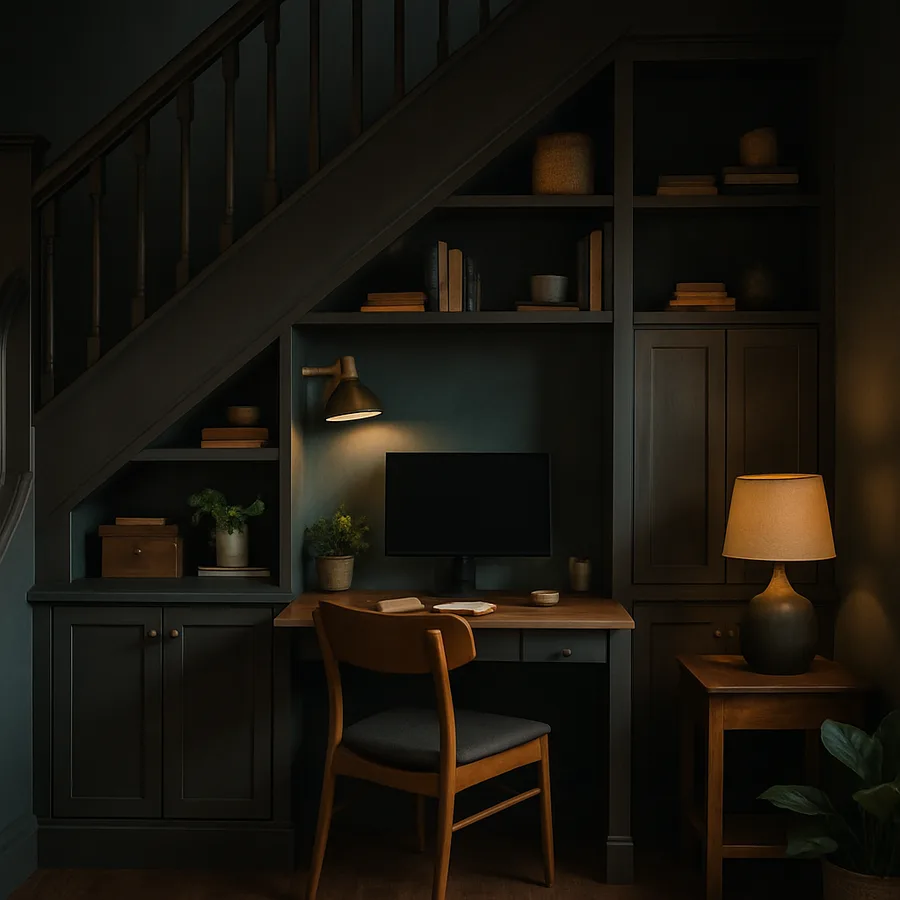
Unlocking the Most Wasted Space in Your Home
The triangular void beneath a staircase is one of the most consistently underutilized areas in residential architecture. In a typical two-story home, this space spans roughly thirty-five to fifty square feet of floor area, yet in the majority of houses it serves as nothing more than a closet stuffed with vacuum cleaners and seasonal decorations, or it sits behind a sealed wall contributing nothing at all to the home's livable square footage. For homeowners in compact houses, apartments, or townhomes where every square foot carries a premium, converting this dead zone into a functional built-in desk nook reclaims space that has been hiding in plain sight and transforms it into a workspace that is both architecturally interesting and genuinely productive.
The appeal of an under-staircase desk nook extends beyond simple space recovery. The alcove created by the stair structure provides a natural sense of enclosure that many people find conducive to focused work, similar to the way a library carrel or a high-backed booth in a restaurant creates a psychological bubble of concentration within a larger open space. Research published by the Environmental Design Research Association (EDRA) has demonstrated that partially enclosed workspaces produce measurably higher levels of sustained focus compared to fully open environments, with study participants reporting approximately 23 percent less distraction in semi-enclosed settings. An under-staircase nook delivers this enclosure organically through the architecture itself, without requiring the construction of walls or partitions that would fragment an open floor plan.
The structural reality of staircase construction makes the under-stair space uniquely suited to built-in furniture because the stair stringers, the angled structural members that support the treads, create a rigid framework that can support shelving, desktop surfaces, and cabinetry without additional framing in most cases. A qualified carpenter or contractor can attach a desk surface directly to the stringer framing and the adjacent wall studs, creating a floating desktop that appears to emerge seamlessly from the architecture rather than sitting as a separate piece of furniture within it. This integration is what elevates an under-staircase desk from a clever space hack to a genuine architectural feature that adds both function and character to the home.
Before dismissing your under-staircase space as too small, too dark, or too awkwardly shaped for a desk, consider that the minimum functional requirements for a productive single-person workspace are surprisingly modest. A desktop surface twenty to twenty-four inches deep and thirty-six to forty-eight inches wide accommodates a laptop, a compact external monitor, and essential desk items. Seated headroom of thirty-six inches at the front edge of the desk is sufficient for comfortable upright posture in a standard desk chair or stool. Many under-staircase spaces exceed these minimums by a considerable margin, particularly in homes with standard thirty-six-inch-wide staircases and typical seven-inch rise per tread, which generates a sloped ceiling that provides over sixty inches of headroom at the tallest point and gradually diminishes toward the back. The key is measuring your specific space and designing the desk to maximize function within the geometry you have rather than assuming the space is inadequate based on a casual visual assessment.
Measuring and Planning the Nook's Geometry
Every under-staircase space is defined by three critical measurements that determine what kind of desk nook is feasible: the total horizontal depth from the wall beneath the highest stair to the point where the ceiling slope meets the floor, the height at the intended desk position measured from the floor to the underside of the stair stringer at the point where you plan to sit, and the width of the alcove from side wall to side wall or from side wall to the open edge of the staircase. These three dimensions define the usable envelope within which your desk, chair, storage, and lighting must fit, and accurate measurement is the non-negotiable first step that prevents costly design errors downstream.
The sloping ceiling is the defining design constraint that makes under-staircase desk nooks both challenging and architecturally distinctive. In a standard residential staircase with a seven-inch rise and eleven-inch run per tread, the ceiling slopes at approximately thirty-two to thirty-five degrees, which means headroom decreases by roughly seven inches for every eleven inches you move deeper under the stairs. This geometry naturally divides the space into zones of decreasing height: a tall zone at the front where you sit, a medium zone behind the desk surface suitable for shelving, and a low zone at the back where only drawers, cabinets, or pull-out storage can fit. Designing the nook to place the right function in the right height zone is what transforms an awkward triangle into an efficient workspace that feels intentional rather than forced.
The desk surface should be positioned in the zone where seated headroom is most comfortable, typically where the ceiling height is between forty-two and fifty-four inches above the finished floor. Standard desk height of twenty-nine to thirty inches means the seated user's head will be approximately eighteen to twenty-four inches above the desk surface, requiring a minimum ceiling height of forty-seven to fifty-four inches at the seated position for comfortable upright posture. Positioning the desk slightly forward of center within the alcove, toward the taller end of the slope, maximizes headroom while still allowing the deeper, shorter space behind the desk to serve as storage. A mock-up using a folding table and a chair placed in the actual space for an hour of real work is the most reliable way to confirm that the planned desk position feels comfortable rather than cramped before any construction begins.
The National Kitchen and Bath Association, whose spatial planning guidelines apply broadly to built-in residential workspaces, recommends a minimum of thirty inches of knee clearance width beneath any built-in desk surface and twenty-four inches of knee clearance depth from the front edge of the desktop to the back wall or any obstruction. These minimums ensure that a standard office chair or stool fits comfortably beneath the surface and that the seated user can position their legs without hitting the desk structure or the wall behind it. Under-staircase nooks that cannot meet these knee clearance minimums may be better suited to a standing-height work surface or a display shelf rather than a seated desk, and it is better to discover this during the planning phase than after construction is complete.
Desktop Materials and Construction Approaches
The desktop surface in an under-staircase nook must be custom-sized to fit the specific dimensions of the space, which rules out off-the-shelf desk furniture in most cases but opens the door to materials and finishes that give the nook a built-in quality no freestanding desk can match. Solid hardwood planks in walnut, white oak, or maple are the premium choice for built-in desk surfaces, offering warmth, durability, and a natural grain pattern that makes the desktop a visual focal point within the alcove. A single slab of hardwood, oiled or lacquered to a smooth finish, installed on concealed wall-mounted brackets creates a floating desktop effect that maximizes visual openness and makes the nook feel larger than it is. Solid hardwood desktops typically cost between fifteen and forty dollars per linear foot depending on species and thickness, making a forty-eight-inch desktop a one-hundred-to-two-hundred-dollar material investment before installation.
Butcher block countertop material, available at most home improvement stores in standard twenty-five-inch depths and various lengths, provides a cost-effective alternative that delivers a similar warm wood aesthetic at roughly sixty to seventy percent of the cost of custom-milled hardwood. Butcher block can be cut to length and depth with standard woodworking tools, sanded to a smooth finish, and sealed with polyurethane or hardwax oil for a durable work surface. The laminated construction of butcher block, with narrow strips of wood glued edge-to-edge, is actually more dimensionally stable than a single wide plank, meaning it is less likely to warp or cup over time in the variable humidity conditions that under-staircase spaces sometimes experience. For a budget-conscious project that still achieves a high-end built-in appearance, butcher block is the most popular material choice among the renovation community on Houzz.
The mounting method for the desktop determines both its visual weight and its structural capacity. Floating bracket installation uses heavy-duty concealed shelf brackets that anchor into wall studs and support the desktop from below without any visible legs or supports. This method creates the cleanest visual line and maximizes knee space beneath the surface, but it limits the desktop to lighter-duty use because the cantilevered support has inherent load limits. A floating desktop on quality brackets can typically support seventy-five to one hundred pounds distributed across its surface, which is adequate for a laptop, monitor, books, and desk accessories but may not satisfy users who lean heavily on the desk or place unusually heavy equipment on it. For heavier loads, a single desk leg at the outer front corner combined with rear wall mounting provides both visual lightness and robust structural support.
Custom cabinetry built into the under-staircase nook alongside the desktop represents the highest level of integration and the most complete use of the available space. A cabinetmaker can construct a single unified piece that includes the desk surface, upper shelves that follow the stair slope, lower drawers or cabinets that fill the diminishing height toward the back, and integrated cable management channels that keep cords contained within the millwork. This approach transforms the entire under-staircase area into a cohesive built-in unit that looks like an original architectural feature of the home rather than a retrofit addition. Custom cabinetry typically costs two thousand to five thousand dollars for an under-staircase nook depending on materials, complexity, and local labor rates, but it adds permanent value to the home and delivers a level of polish that assembled furniture and DIY shelving cannot replicate.
Lighting Solutions for a Naturally Dark Space
Under-staircase spaces are inherently light-deprived because they sit beneath a solid structural element that blocks overhead light and are typically recessed into the interior of the home away from windows. Without deliberate lighting design, even the most beautifully constructed desk nook will feel like a cave, discouraging extended use and straining the eyes of anyone who tries to work there for more than a few minutes. Effective lighting for an under-staircase desk nook requires at minimum two layers: task lighting that illuminates the work surface directly, and ambient lighting that brightens the alcove as a whole to prevent the uncomfortable contrast between a bright desk and dark surroundings.
LED strip lighting mounted to the underside of a shelf or the bottom of the stair stringer directly above the desk provides excellent task illumination without requiring a desk lamp that consumes surface area the compact nook can ill afford. A warm white LED strip rated at 2700K to 3000K with a CRI of 90 or above produces comfortable, accurate light for reading and screen work, and a dimmer switch allows brightness adjustment for different tasks and times of day. The strip should run the full width of the desk and be positioned eight to twelve inches above the work surface for even illumination without hot spots or harsh shadows. Concealing the strip behind a thin wood or aluminum lip prevents the bare LED chips from being visible to the seated user, which eliminates the glare that exposed strip lighting can produce at close range.
Ambient lighting for the alcove can take several forms depending on the nook's construction. Recessed puck lights installed in the stair soffit above the desk provide downward ambient light that brightens the entire nook without any fixture protruding into the limited headroom. Small wall sconces mounted on the side walls of the alcove add warmth and decorative interest while providing lateral light that reduces shadows cast by task lighting alone. If the nook is open at one end rather than enclosed on three sides, a floor lamp positioned just outside the alcove opening can wash the space with borrowed ambient light from the adjacent room. The goal is to create a lighting environment where the nook feels like an inviting, well-lit workspace rather than a dark recess you have to duck into.
Natural light, when available, transforms the character of an under-staircase desk nook from functional to genuinely pleasant. If the staircase is adjacent to an exterior wall or near a window, orienting the desk to face toward the natural light source brings daylight into the alcove and provides the visual relief of an exterior view during work breaks. Installing a small window in the wall beneath the stairs, if the wall is exterior and the structural framing allows it, is a renovation worth considering for nooks that will see daily use. Even a fixed, non-opening window measuring twelve by eighteen inches admits enough daylight to meaningfully brighten the space and connect the nook's occupant to the outdoors. Where structural windows are not feasible, a strategically placed mirror on the wall opposite the nook opening reflects ambient room light into the alcove and creates a sense of expanded space that counteracts the enclosure of the sloping ceiling above.
Storage Integration That Follows the Stair Slope
The graduated ceiling height of an under-staircase space creates a natural storage hierarchy where tall items occupy the highest zone, medium items fit the middle zone, and flat or shallow items store in the lowest zone near the floor. Designing storage to follow this hierarchy extracts maximum utility from every cubic inch of the triangular volume. Open shelves mounted along the sloping stringer, with each shelf shorter than the one below it to follow the angle, create a stepped display that accommodates books, decorative objects, and reference materials while showcasing the architectural geometry that makes the nook visually distinctive. These graduated shelves are both functional storage and a design feature that celebrates the staircase structure rather than hiding it.
The low-ceiling zone at the deep end of the under-staircase space, where headroom drops below twenty-four inches and is unsuitable for any seated or standing use, is ideal for pull-out drawer units or rolling file cabinets that slide out into the taller area when access is needed. A custom pull-out unit built to match the sloping ceiling profile fits flush within the space when closed and rolls or slides forward on tracks when open, providing deep storage for files, supplies, and equipment without permanently occupying any of the usable desk area. This approach treats the deepest, shortest section of the under-staircase void as a concealed storage room rather than wasted space, and a well-designed pull-out unit can hold a surprising volume of materials in a space that would otherwise serve no purpose at all.
Vertical storage on the exposed side wall of the nook, if one side is open to the room rather than enclosed by a wall, offers accessible storage that does not intrude on the desk surface or the limited floor area. A narrow bookshelf, a pegboard panel, or a series of wall-mounted bins on the open side wall keeps supplies visible and within arm's reach while maintaining the clean desk surface that a compact workspace demands. The Architectural Digest small-space design features consistently highlight vertical wall storage as the most effective strategy for compact workspaces because it exploits a dimension, the wall height, that floor-constrained spaces cannot expand horizontally. In an under-staircase nook where floor and desk space are fixed by geometry, wall-mounted storage is the primary avenue for adding capacity without adding clutter.
Does your under-staircase nook need to hide its office function when not in use? Some homeowners prefer that the desk nook blend invisibly into the surrounding architecture when they are not working, particularly in homes where the staircase is in a prominent living area visible to guests. Pocket doors, bifold panels, or a simple curtain hung from a ceiling-mounted track can conceal the entire nook behind a finished surface that matches the adjacent wall treatment. When the doors or curtain are open, the full desk nook is revealed and ready for work. When closed, the under-staircase area returns to a clean architectural surface that gives no indication of the workspace hidden behind it. This concealment approach is especially popular in open-concept homes where the staircase sits within the main living space and a visible desk would disrupt the room's residential character.
Making a Small Nook Work for Daily Professional Use
A common concern about under-staircase desk nooks is whether a compact, enclosed workspace can genuinely support the demands of a full professional workday rather than serving only as a spot for quick email checks and bill paying. The answer depends on three factors that determine whether the nook functions as a productive workspace or an uncomfortable novelty: adequate seated headroom that allows natural upright posture, sufficient desk surface for the user's specific work tools, and proper ventilation that prevents the enclosed space from becoming stuffy during extended use. When these three requirements are met, an under-staircase nook can and does serve as a primary workspace for focused individual work, as demonstrated by the thousands of successful installations documented across interior design platforms and home renovation portfolios.
Ventilation deserves particular attention because enclosed alcoves trap body heat and exhaled air in a way that open rooms do not, and a warm, stale workspace rapidly degrades both comfort and cognitive performance. The American Society of Heating, Refrigerating and Air-Conditioning Engineers (ASHRAE) recommends a minimum of fifteen cubic feet per minute of fresh air per person for occupied spaces, and an under-staircase nook that lacks connection to the home's HVAC system may not meet this threshold during extended occupancy. A small, quiet desk fan that circulates air between the nook and the adjacent room addresses the problem at minimal cost, and for fully enclosed nooks, a compact inline vent fan connected to the home's ductwork provides mechanical ventilation that maintains fresh air without relying on the occupant remembering to turn on a fan.
The chair or stool you select for the nook must fit the constrained dimensions without sacrificing seated comfort for work sessions lasting an hour or more. Standard office chairs with tall backs, headrests, and wide armrests are often too large for under-staircase spaces where headroom and width are limited. Compact task chairs without armrests, low-profile ergonomic stools, or saddle-style seats that encourage active sitting in less vertical space are better suited to the nook's geometry. The seated user's head should clear the sloping ceiling by a minimum of four inches to allow natural movement without the psychological discomfort of feeling like the ceiling is pressing down. If your preferred seating positions your head closer than four inches to the ceiling, lower the desk height slightly or reposition the desk forward into a taller part of the alcove to recover the needed clearance.
Personalizing the nook with elements that make it feel like a chosen workspace rather than a leftover space is the final step that determines whether you actually enjoy working there. A small piece of art on the back wall, a plant that thrives in low light such as a pothos or snake plant, a desk pad in a color you love, and a quality desk lamp that makes you happy when you turn it on all contribute to a workspace that invites you to sit down and begin working rather than one you endure because it was the only available option. The psychological dimension of workspace satisfaction is real and measurable, and a nook that feels personalized and intentional supports better work and longer, more comfortable work sessions than one that feels like an afterthought regardless of how well the physical dimensions are engineered.
Conclusion: Turning Dead Space into Your Favorite Room
The area beneath your staircase has been waiting to become something more useful than a storage closet or a sealed void behind drywall. A built-in desk nook transforms this architectural leftover into a workspace with a character and intimacy that conventional rooms rarely achieve, wrapping the occupant in a cozy alcove that promotes focus while consuming zero additional floor space from the home's living areas. The sloped ceiling that seems like a limitation is actually the feature that gives under-staircase nooks their distinctive appeal, creating a sheltered, den-like quality that many people find ideal for concentrated work.
The practical requirements for a successful nook, including accurate measurement, appropriate desk height, layered lighting, slope-following storage, and adequate ventilation, are all achievable at moderate cost through either professional installation or skilled DIY work. The investment ranges from a few hundred dollars for a simple floating desktop with task lighting to several thousand for a fully custom built-in unit with integrated cabinetry, and even the budget end of that spectrum produces a workspace that functions well and adds genuine value to the home.
If you have been looking for a home office solution in a compact house where dedicating an entire room is not feasible, walk over to your staircase, kneel down, and look at the space beneath it with fresh eyes. Bring a tape measure, note the height at various points along the slope, and imagine a desk surface at the position where your head clears the ceiling comfortably. That simple exercise is often all it takes to see the potential that has been hiding beneath your feet every time you walk upstairs, waiting to be unlocked into the most characterful workspace in your home.
More Articles You May Like



Comments
Post a Comment