Shared Kids Bedroom Layouts for Two Siblings With Personal Zones
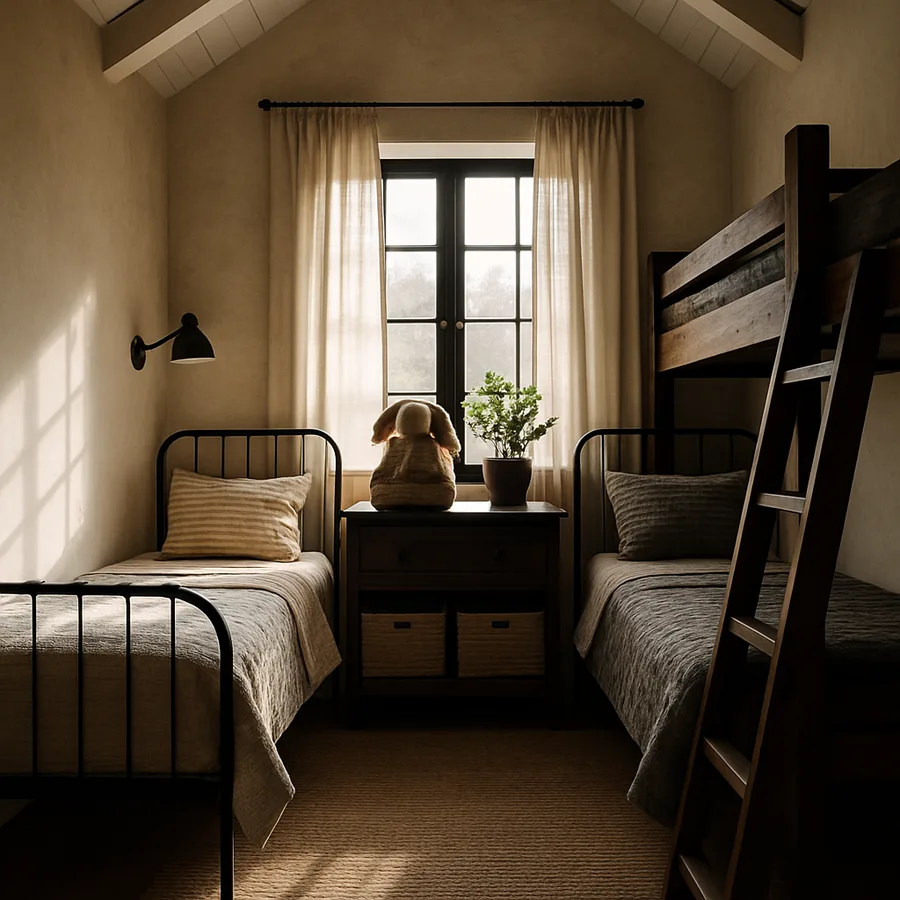
Sharing a bedroom with a sibling can be one of the great formative experiences of childhood, or one of the great daily aggravations, and the design of the room is the single biggest variable in which way it goes. According to the National Association of Home Builders, roughly 38 percent of American families with two or more children have at least two kids sharing a bedroom at some point during the school years, a figure that has risen steadily as urban housing becomes more compressed. The question is not whether sharing works; it is how to lay out the room so each child has a defensible, personal territory inside a shared space.
This guide focuses on layout, not styling. The principles below come from family-design specialists, child psychologists writing on territoriality and autonomy, and observed patterns in homes where sibling sharing has worked for years. Whether your two children are close in age, far apart, same gender, different genders, or have very different temperaments, the layout principles are largely the same. The styling can and should differ between the two zones, but the underlying spatial logic is consistent.
The Psychology of Personal Zones in a Shared Room
Children, particularly between ages four and twelve, develop a strong sense of personal territory as part of healthy identity formation. Studies in environmental psychology have repeatedly shown that children given a defensible, personal zone within a shared room report higher satisfaction with the sibling relationship, sleep more consistently, and exhibit fewer property-related conflicts than children sharing a fully merged room. The zone does not need to be large; what matters is that it is clearly the child's own.
The American Academy of Pediatrics notes in its sibling-relationship guidance that conflicts in shared rooms most often originate not from the sharing itself but from the absence of a clear "mine versus ours versus yours" structure. A room with three storage zones (yours, mine, shared) and three activity zones (yours, mine, shared) tends to produce far fewer disputes than a room where everything is technically shared but practically contested. Designers call this principle spatial legibility: a child should be able to walk into the room and know, without thinking, which surfaces and zones are theirs.
The legibility comes from physical cues, not labels. A different paint color above each bed, distinct bedding, individually owned shelves, and a clear midline (whether a rug edge, a furniture piece, or a real divider) all signal ownership. The goal is not separation; siblings sharing a room derive enormous social benefit from proximity. The goal is clarity: shared time and shared space happen by choice, not by default conflict.
Symmetrical Layouts: The Twin-Wall Approach
The most reliable shared-room layout is the symmetrical twin-wall configuration: two beds against opposite long walls, headboards aligned, with a shared zone running down the middle. This works best in rooms that are at least 11 feet wide; below that, the beds are too close and the middle zone becomes a corridor rather than a real space.
Each child gets a clearly defined wall: their bed, a bedside surface, a wall-mounted shelf or pegboard for personal items, and ideally a personalized headboard or accent wall behind the bed. The middle zone holds shared elements: a play rug, a low bookshelf, a single dresser if floor space requires it, or a long table that doubles as homework and craft surface. BHG editorial has frequently highlighted this symmetrical layout for its visual calm and ease of management.
The trick to making the twin-wall layout sing is treating each side as a complete personal universe. Identical bed frames are fine and often desirable for a clean look, but the styling on each side should differ enough to feel personal: different bedding, different art, different accent colors. Avoid the mistake of perfectly mirrored twin styling that erases individual identity in pursuit of visual harmony. Children read the message loud and clear when their side looks like their sibling's side; the room belongs to the household, not to them.
L-Shaped Layouts for Narrower Rooms
When the room is narrower than 11 feet, symmetrical twin-wall configurations create traffic and visual conflict. The better solution is an L-shaped layout: one bed along the long wall and the other perpendicular, sharing a corner. This consolidates the sleeping zones into an L and frees the remainder of the room for shared activity.
The shared corner is the design challenge. A tall corner unit between the two heads (a bookshelf, an armoire, or a custom built-in) creates visual separation, blocks the view from one bed to the other, and provides storage. Without a corner divider, both children see each other directly when lying down, which significantly impacts sleep onset and increases late-night talking. The American Academy of Pediatrics has noted that visual separation between sleeping siblings improves sleep latency by an average of 15 to 20 minutes per night, particularly important for school-age children.
The remaining floor space, typically about 50 to 60 percent of the room, becomes the shared activity zone. Place a single dresser against one wall, a low shared table for crafts or homework, and a play rug. Avoid filling the floor with toys; shared rooms work best when toys are stored in closed bins along the perimeter and brought out for play, then put away. Visual quiet is a key feature of well-designed shared rooms; cluttered floors trigger conflicts over whose mess is whose.
Bunk and Loft Configurations to Save Floor Space
When floor space is genuinely tight (rooms under 100 square feet) or when both children want substantial play space, a bunk bed or paired loft beds can recover 30 to 40 square feet of usable floor. The trade-off is that personal zones become harder to delineate, since both children are stacked in the same vertical column.
The most successful bunk arrangement for personal zones treats each bunk as a private bedroom. The top occupant gets a wall-mounted shelf, a personalized fabric panel on the wall, a clip-on reading light, and a small fabric pocket organizer attached to the inside guardrail. The bottom occupant gets a curtain or a fabric canopy across the front of the bunk for privacy, a wall-mounted shelf at sitting height, and their own light. This converts a single bunk into two distinct personal spaces stacked vertically, each with its own enclosure cues.
Paired single loft beds along opposite walls is another option in rooms with tall ceilings. Each child gets a loft platform with a desk and reading nook beneath, identical in form but distinct in styling. This layout works particularly well for siblings two or more years apart, because the under-loft cavity gives each child a private room within the room. The CPSC and the NAHB both note that bunk and loft configurations are increasingly common in new construction precisely because they enable single-room sharing in homes with smaller bedroom footprints.
Storage Strategies That Reduce Sibling Conflict
Storage is where shared rooms most commonly fall apart, and the failure pattern is consistent: a single dresser, a single closet, a single toy bin, and constant negotiation over whose stuff goes where. The fix is structural separation of personal and shared storage.
Each child needs three personal storage zones: a clothing zone (their own dresser drawers or their own half of a shared closet), a keepsake zone (a shelf or bin for items they do not want others touching), and a current-use zone (a bedside surface or low shelf for the books, toys, or projects they are actively engaged with). The keepsake zone is the most important and most overlooked. Children of all ages need a place where their personal possessions are protected from a sibling's touch, and the absence of this zone is the leading cause of "she touched my stuff" conflict.
Shared storage handles everything that genuinely belongs to both children: shared toys, shared books, shared art supplies. Place these in clearly labeled bins along a single wall, ideally at child height. Avoid the temptation to over-share; many items that adults assume should be shared (LEGO sets, art kits, special books) actually function better as personal possessions with clear loaner protocols. Better Homes and Gardens has frequently published on the "library model" for shared toys, where shared items are checked out from a central shelf and returned at the end of the day, reducing chronic loss and conflict.
Lighting, Sound, and Scheduling Considerations
Two children sharing a room rarely keep identical schedules. One stays up reading later, the other wakes earlier; one wants the room cooler, the other warmer. Layout and design choices can mitigate these conflicts considerably.
Lighting should be zoned and personal. Each child should have a bedside light they control independently, ideally a clip-on or wall-mounted reading lamp with a directional shade that does not spill onto the sibling's side. Overhead room lighting should be on a dimmer so a parent can drop the room to a soft glow during transition periods. Smart bulbs with individual control via app or voice assistant work well for tween and teen siblings who can manage them. The American Academy of Pediatrics emphasizes that children need progressively dimming light in the 30 to 60 minutes before sleep to support natural melatonin onset; a single shared overhead light makes this difficult to coordinate.
Sound is the other major variable. Soft surfaces (rugs, curtains, fabric headboards) absorb sound dramatically better than hard floors and bare walls. A shared room with hardwood, painted walls, and minimal soft surfaces will amplify every cough, page turn, and whispered conversation. A shared room with a 6-by-9 area rug, fabric headboards, and a curtained closet will feel acoustically quiet enough for one child to read while the other sleeps. Consider individual white noise machines or shared low-volume white noise to mask differential bedtime activity. The BHG editorial team has consistently recommended white noise as a "second mattress" for shared sibling rooms because the acoustic improvement is so disproportionate to the cost.
Adapting the Layout as Children Grow
A shared room that works perfectly when both children are six and eight will need adjustment when they are nine and eleven, and again when they are twelve and fourteen. Plan for the redesign rather than treating each shift as an emergency. The most reliable approach is to revisit the layout annually, ideally at the start of summer, when the children are home and can participate in the conversation about what is working and what is not.
Common transition points include: the move from toddler beds to twin beds (typically around age 4 to 5, requires reassessment of bed placement), the shift from shared toys to individual hobbies (typically around age 7 to 9, requires more personal storage), the introduction of homework requirements (typically around age 6 to 7, may require a shared desk or two small personal desks), and the early teen privacy shift (typically around age 11 to 13, may require physical room dividers, curtained beds, or a transition to separate rooms if the layout allows).
Listen to the children. Sustained complaints about a sibling's habits, sudden withdrawal, or escalating conflict over specific items often signal that the layout has stopped serving the family. Small adjustments (a new shelf, a relocated dresser, a privacy curtain on one bed) can buy years of additional comfort. Large adjustments (re-orienting beds, adding a divider, splitting the closet) may be necessary every two to three years. Better Homes and Gardens editors note that families who treat the shared room as a living, evolving space report dramatically higher satisfaction than families who set it up once and resist change.
Conclusion: Designing a Shared Room That Builds Connection
A well-designed shared bedroom does not just make sibling cohabitation tolerable; it actively strengthens the relationship by removing the structural sources of conflict. When each child has a clear personal zone, when storage is structured into mine, yours, and ours, when lighting and sound respect different schedules, and when the shared zones invite collaboration rather than competition, siblings tend to spend more positive time together and less negotiating territory.
The biggest mistakes we see are over-merging (everything is shared, nothing is personal) and over-separating (a divider down the middle that turns the room into two unfriendly cells). The right balance is a clearly personal third for each child, a clearly shared third in the middle, and design cues that make the boundaries legible without being hostile. This is fundamentally a layout problem, solvable with measurement and intention before any furniture is purchased.
Have you mapped out personal versus shared zones in your children's room, or is everything currently in one shared pile? And do both children have a keepsake zone where their personal possessions are protected from a sibling's reach? Sign up for our shared-room design newsletter for downloadable layout templates by room dimension, including the symmetrical, L-shaped, and bunk variants discussed here. Two siblings sharing a room well is one of childhood's underrated gifts, and the design of the room is what makes the gift sustainable.
More Articles You May Like



Comments
Post a Comment