Bunk Bed Room Layouts That Actually Give Kids Their Own Space
The Real Problem With Most Shared Bedrooms
Parents who have two or more children sharing a bedroom know the tension well. One child wants the lights off while the other is still reading. One needs quiet study time while the sibling blasts music from a tablet. Shared bedrooms are a practical necessity in millions of homes across the country, yet the default approach of shoving two beds against opposite walls rarely addresses the fundamental issue: children need a sense of personal territory. Without it, sibling conflicts escalate, sleep quality drops, and the room becomes a space neither child truly claims as their own. The challenge is not simply fitting two bodies into one room but making each child feel like they have a domain that belongs to them alone.
According to the U.S. Census Bureau, approximately 26 percent of children in the United States share a bedroom with at least one sibling, a figure that has remained relatively stable over the past two decades even as average home sizes have increased. This statistic highlights a persistent reality that families face regardless of income bracket or geographic region. Shared sleeping arrangements are not going away, which means the design industry has a responsibility to offer solutions that go beyond the bare minimum of fitting furniture into a rectangular box.
The American Society of Interior Designers (ASID) has noted in multiple residential design surveys that children's rooms rank among the top five spaces parents prioritize during renovations or new builds. Yet the conversation around shared rooms often stalls at surface-level decorating advice rather than addressing spatial planning in meaningful ways. How do you give a nine-year-old and a six-year-old genuine privacy in a room that measures twelve feet by ten feet? The answer lies in rethinking the bunk bed not as a space-saving compromise but as the structural backbone of a room layout that creates distinct personal zones.
What separates a well-designed shared bedroom from a frustrating one is intentionality. Every inch of floor space, wall space, and vertical space needs to serve a purpose. The bunk bed itself becomes more than sleeping infrastructure; it becomes a room divider, a storage solution, and an anchor point around which the rest of the layout revolves. When parents approach the design with this mindset, the results can feel remarkably spacious and personal even in rooms that barely exceed one hundred square feet.
L-Shaped and Perpendicular Bunk Configurations
The traditional stacked bunk bed places one child directly above the other, which saves floor space but creates an inherently hierarchical arrangement. The child on top gets the adventurous perch while the one below lives in a shadowy cave. L-shaped bunk configurations solve this by positioning the two beds at a right angle, with one bed extending along one wall and the other along the adjacent wall. This layout opens up the area beneath the upper bunk for a desk, a reading nook, or a small wardrobe, and it gives each child a different directional orientation that subtly reinforces the feeling of separate spaces.
Perpendicular arrangements work particularly well in rooms that are closer to square than rectangular. By anchoring the beds in a corner, the remaining floor area forms a single large open zone rather than two cramped strips along opposite walls. Designers at Houzz have documented hundreds of L-shaped bunk room projects in their ideabook galleries, consistently noting that this configuration scores highest in parent satisfaction surveys because it balances openness with defined sleeping zones. The corner where the two beds meet can be reinforced with a shared nightstand or a small built-in shelf that serves both children without belonging exclusively to either.
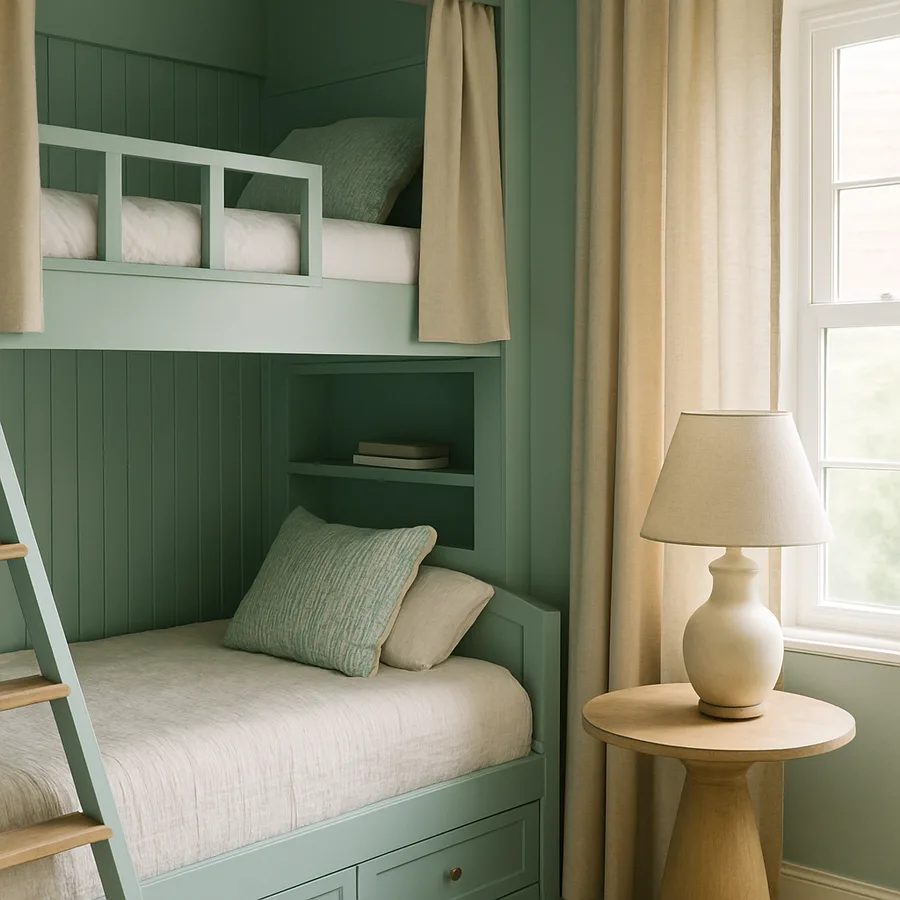
One practical advantage of the L-shape is that it naturally accommodates a curtain or fabric panel on the lower bunk without making the space feel claustrophobic. Because the lower bed is tucked under only one section of the upper frame rather than the full length, air circulation improves and the child sleeping below retains a clear sightline to the rest of the room. This matters more than many parents realize. Children who feel enclosed or trapped in a lower bunk often resist bedtime, and a layout that preserves openness on at least two sides of the lower bed can significantly reduce that resistance.
The structural requirements for an L-shaped bunk are slightly more involved than a standard stacked unit. The corner post must bear the load of the upper bunk cantilevering in two directions, which typically requires either a solid hardwood post or a steel support column concealed within a wooden sleeve. Custom builders can integrate this support into the room's architecture, making it look like a natural column rather than an afterthought. For families who prefer ready-made options, manufacturers like Maxtrix and Room & Board offer modular L-shaped systems that can be reconfigured as children grow.
Using Curtains, Canopies, and Visual Dividers
Physical walls are not the only way to create a sense of separation. Curtains mounted on ceiling tracks or bunk bed frames offer one of the most cost-effective and flexible methods for giving each child a private retreat within a shared room. A simple set of blackout curtains on a tension rod can transform a bunk into a personal cocoon where a child reads, daydreams, or falls asleep without visual distraction from the sibling above or below. The act of pulling a curtain closed is psychologically powerful for children; it signals a boundary that they control, and that sense of agency is central to feeling at home in a shared space.
The National Association of Home Builders (NAHB) reported that flexible room dividing solutions have seen a 34 percent increase in builder installations over the past five years, driven largely by demand in children's rooms and home offices. Ceiling-mounted curtain tracks are the most popular option because they require no floor space and can be configured in straight lines, curves, or L-shapes to match the room's geometry. When open, the curtains stack neatly against the wall and the room feels fully connected. When closed, each bunk becomes a private pod. This dual-mode functionality is what makes curtains superior to permanent partitions in rooms where flexibility matters.
Canopies offer a softer alternative that works especially well for younger children. A fabric canopy draped from a ceiling hook or a frame attached to the bed creates a tent-like enclosure that feels playful rather than isolating. Have you noticed how children naturally build blanket forts and claim small enclosed spaces as their own? Canopies tap into that same instinct, providing a sense of shelter that does not require construction or permanent modification to the room. They also add a decorative layer that allows each child to express personal style through fabric choice, color, and pattern.
For families who want something more structured than fabric but less permanent than drywall, open shelving units positioned between sleeping areas serve a dual purpose. A bookcase that stands four feet tall creates a visual barrier at seated height while still allowing light and air to flow freely above. Each child can personalize their side of the shelf with books, toys, and decorative objects, reinforcing the boundary as something they own rather than something imposed on them. The key is choosing a unit that is sturdy enough to resist tipping, anchored to the wall with anti-tip hardware, and proportioned so it divides without darkening either side of the room.
Built-In Storage That Defines Personal Territory
Storage is where shared bedroom layouts most frequently fail. A single shared dresser or a communal closet forces children into constant negotiation over drawer space, shelf real estate, and hanging room. Built-in storage integrated into the bunk bed structure eliminates this friction by giving each child dedicated compartments that are physically attached to their sleeping area. Drawers built into the bed platform, cubbies recessed into the headboard wall, and shelves mounted within arm's reach of each pillow create micro-territories where personal belongings stay organized and undisputedly owned.
The staircase-style bunk bed has become one of the most popular designs for maximizing storage within the bed footprint. Instead of a ladder, the child accesses the upper bunk via a set of steps, and each step doubles as a deep pull-out drawer. A typical four-step staircase yields four drawers, each large enough to hold folded clothing, shoes, or toys. Better Homes & Gardens (BHG) has featured multiple staircase bunk builds in its annual kids' room roundups, consistently recommending them for rooms under 120 square feet where every cubic inch of storage counts. The staircase also provides a safer ascent than a vertical ladder, which is a practical benefit that parents of younger children appreciate.
Headboard walls offer another opportunity to embed personal storage into the architecture of the room. A recessed shelf running the length of the bunk at pillow height gives each child a place for a water bottle, a book, a small lamp, and a few treasured objects. This shelf becomes a bedside table that consumes zero floor space, and because it is built into the wall behind each specific bunk, there is no ambiguity about whose shelf is whose. Electricians can run low-voltage wiring through the wall cavity to provide individual USB charging ports and reading lights at each bunk level, further reinforcing the sense that each sleeping zone is a self-contained unit.
Closet division deserves equal attention. If the room has a single closet, installing a vertical divider down the center with a label or color code for each child prevents the daily argument over encroaching hangers. Adjustable closet systems from organizations like the Association of Closet and Storage Professionals allow the configuration to evolve as children grow, raising hanging rods, adding shoe racks, or swapping shelves for drawers without replacing the entire system. When each child knows exactly where their belongings live, the shared bedroom begins to function like two rooms that happen to share a roof.
Lighting and Color Strategies for Individual Identity
Lighting is one of the most overlooked tools for creating personal space within a shared room. A single overhead fixture controlled by one switch forces both children onto the same schedule, which is a recipe for conflict. Individual reading lights mounted at each bunk level, controlled by switches within arm's reach of each child, hand back a critical piece of autonomy. The child on the upper bunk can read until nine while the child below sleeps in darkness, or vice versa. This simple change resolves one of the most common complaints parents report about shared bedrooms.
Wall-mounted LED strip lights with dimming controls offer a modern solution that children find particularly appealing. A warm-toned strip running along the underside of the upper bunk's frame provides soft ambient light for the lower sleeping area without spilling upward. A separate strip along the upper bunk's headboard wall does the same for the child on top. Each strip can be connected to an independent dimmer or even a color-changing controller, allowing children to set their zone to a hue that matches their mood. The American Lighting Association recommends warm white temperatures between 2700K and 3000K for children's sleeping areas, as cooler tones can interfere with melatonin production and delay sleep onset.
Color is equally powerful as a space-defining tool. Painting each child's wall zone in a different color or shade creates an instant visual boundary that requires no furniture or construction. This does not mean the room needs to look like a patchwork quilt. Two complementary tones from the same color family, such as a soft sage and a muted teal, can define separate territories while maintaining a cohesive room palette. The Architectural Digest design team has noted that two-tone children's room schemes photograph particularly well because they demonstrate intentionality without visual chaos.
Bedding and textile choices reinforce these color zones at the most personal scale. When each child selects their own duvet cover, pillow shams, and throw blanket, the bunk becomes a canvas for self-expression. Even children who share identical bed frames and mattress sizes will perceive their sleeping area as uniquely theirs when the textiles differ. Parents sometimes worry that mismatched bedding will look messy, but the reality is that a shared room designed around individual expression feels more alive and more loved than one styled for catalog perfection. The goal is not a showroom; it is a space where two developing humans feel equally valued.
Floor Plan Templates for Common Room Sizes
A ten-by-ten room, which is one of the most common children's bedroom dimensions in American homes built after 1990, presents a tight but workable canvas. In this footprint, an L-shaped bunk anchored in one corner leaves approximately 45 square feet of open floor space, enough for a small desk, a narrow bookcase, and a clear path to the door. The desk should sit under the lofted section of the L-shape, positioned so the seated child faces the wall rather than the room, which reduces visual distraction during homework. A Houzz editorial survey found that 68 percent of parents rated a dedicated homework station as more important than play space in rooms for children over age seven, a priority that should guide layout decisions for school-age siblings.
Rooms measuring twelve by ten feet gain an additional twenty square feet that transforms the layout possibilities. The extra two feet of depth along one wall accommodates a parallel bunk arrangement where both beds run along the longer wall with a built-in nightstand divider between the headboards. This side-by-side sleeping layout is less common than stacked bunks but offers significant advantages for families with children of similar ages who resist the top-versus-bottom dynamic. Each child sleeps at the same height with an identical view of the room, which eliminates the perceived inequality that stacked bunks can create.
For the fortunate families with rooms exceeding 150 square feet, the design palette expands to include a loft bed with a ground-level twin positioned perpendicular to it. This arrangement dedicates the space beneath the loft to a full activity zone: a desk, a beanbag reading area, or even a small couch. The ground-level twin sits against the opposite wall with its own flanking shelves and personal lighting. The room's center remains open, functioning as a shared play area that neither child dominates. This layout most closely replicates the feel of two separate rooms within a single space.
Regardless of room size, the doorway and window positions dictate the layout more than the square footage does. Never place a bunk bed in front of a window, as building codes in most jurisdictions require unobstructed egress windows in sleeping rooms for fire safety. Similarly, the path from each bunk to the bedroom door should be clear of obstacles, with no furniture that a child might trip over during a middle-of-the-night bathroom trip. Mapping these fixed constraints first and then fitting the bunk configuration around them produces layouts that are both safe and spatially efficient.
Age-Specific Considerations and Safety Standards
The Consumer Product Safety Commission (CPSC) maintains strict guidelines for bunk bed construction that every parent should review before purchasing or building. Federal regulation 16 CFR 1213 requires upper bunk guardrails on both sides of the bed, with a gap no larger than 3.5 inches between the mattress surface and the bottom of the guardrail. The CPSC also recommends that children under six years of age never sleep on an upper bunk, a guideline supported by injury data showing that approximately 36,000 bunk-bed-related injuries are treated in U.S. emergency departments each year, with the majority involving falls from the upper level.
For families with children under six, a low bunk or trundle configuration provides the space-saving benefit of bunks without the fall risk. Low bunks stack the beds with only 24 to 30 inches of vertical separation, keeping the upper mattress surface below four feet from the floor. Trundle beds eliminate vertical stacking entirely, storing the second bed inside a pull-out drawer beneath the primary frame. Both options work well in rooms where ceiling height is limited or where parental anxiety about upper bunk safety is a deciding factor. As children grow and demonstrate the coordination to safely use a ladder, the configuration can evolve into a full-height bunk arrangement.
Tweens and teenagers present a different set of requirements. Privacy becomes paramount, and the sense of personal space that a six-year-old achieves with a canopy requires more substantial solutions for a thirteen-year-old. Full-length curtains, solid headboard partitions, and even half-walls built between lofted sleeping platforms become appropriate at this stage. The American Society of Interior Designers recommends consulting with adolescents directly during the design process, noting that children over ten who participate in room layout decisions report significantly higher satisfaction with shared sleeping arrangements than those whose rooms are designed without their input.
Weight capacity is a practical concern that gains importance as children age. Most commercially manufactured bunk beds are rated for 200 to 250 pounds on the upper level, but a teenager who weighs 150 pounds and sits up abruptly or shifts position during sleep generates dynamic loads that exceed static weight. Parents should verify that the bed frame meets or exceeds ASTM F1427 voluntary safety standards, which test for both static load capacity and impact resistance. Solid hardwood frames with steel reinforcement brackets at all joints provide the most reliable long-term strength, and they are worth the premium over particleboard alternatives that may loosen over years of nightly use.
Putting It All Together: Your Shared Room Action Plan
Designing a bunk bed room that gives each child genuine personal space is not a single decision but a sequence of deliberate choices that build on each other. Start by measuring the room precisely, noting window positions, door swing direction, closet depth, and outlet locations. Sketch two or three bunk configurations on graph paper before committing to a furniture purchase, and test each layout by taping the bed footprint on the floor with painter's tape to see how the remaining space feels when you walk through it. This low-cost simulation prevents the expensive mistake of buying a bunk system that technically fits but leaves the room feeling cramped or poorly balanced.
Next, involve the children. Ask each child what matters most to them about their sleeping area. One might prioritize a reading light and a shelf for books. The other might want a small mirror and a hook for a backpack. These preferences are not trivial; they are the details that transform a functional layout into a space that feels personally meaningful. Children who feel heard during the design process take better care of the room and experience fewer conflicts with their sibling over shared territory. The investment of a thirty-minute conversation with each child pays dividends in daily harmony.
Budget realistically for the full scope of the project. The bunk bed frame is only the starting point. Individual lighting, curtain tracks or canopies, storage inserts, bedding for each child, and possibly paint or wallpaper for personal wall zones all contribute to the final result. A well-executed shared bedroom project typically costs between eight hundred and three thousand dollars depending on whether you choose off-the-shelf furniture or custom built-ins. Spreading the project over several weekends makes the workload manageable and allows adjustments based on how the children respond to each addition.
If you are ready to transform your children's shared room from a source of daily friction into a space that both kids genuinely enjoy, start with the bunk configuration that best fits your room dimensions and your children's ages. Measure today, sketch tomorrow, and build over the coming weeks. The result will be a room where two children sleep, study, and dream in a space that respects both their togetherness and their individuality. Share your layout challenges or successes in the comments below; other parents navigating the same puzzle will thank you for it.
More Articles You May Like



Comments
Post a Comment