Pool House Changing Room Layouts With Outdoor Shower Access
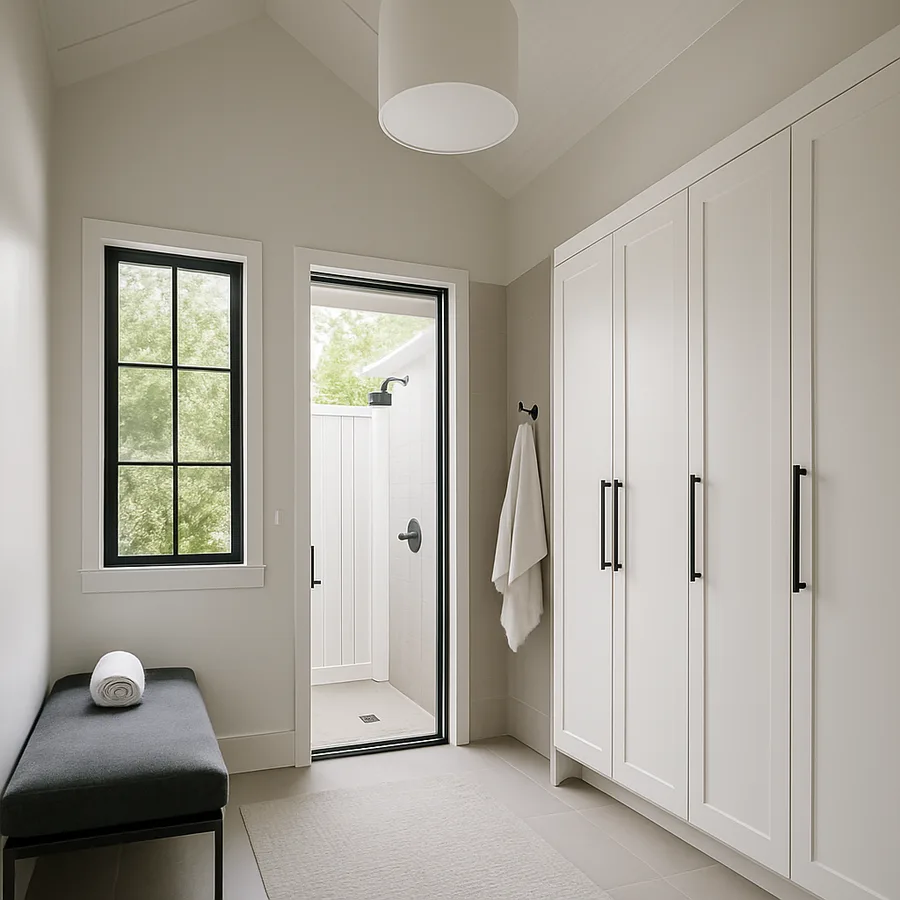
A well-planned pool house changing room is more than a closet with a bench. It is a transition zone between water and home, a damp microclimate that has to handle bare feet, dripping swimsuits, sandy towels, and the occasional sunscreen-streaked bench. When you pair that interior with an outdoor shower, the layout becomes a small piece of choreography. Guests arrive from the deck, rinse off chlorine, peel off wet trunks, and then move into a private space where they can dress comfortably without tracking pool water across your living room floor.
According to the Association of Pool & Spa Professionals (APSP), residential pool installations have remained strong, with the Pool & Hot Tub Alliance reporting that more than 10.7 million U.S. households own a residential swimming pool. As more homeowners invest in their backyards, the supporting structures around those pools, especially changing rooms, are getting smarter, more weatherproof, and far more design-forward. This guide walks you through the layouts, materials, and detailing decisions that turn a basic pool house corner into a genuinely useful changing suite.
Designing the Footprint: How Big Should a Pool House Changing Room Be?
Most pool house changing rooms work best between 50 and 90 square feet per stall. That gives you room for a bench, a hook wall, a small bin, and a person standing comfortably with a towel wrapped around them. The American Institute of Architects (AIA) often recommends planning around real human movement clearances, and a tight 36-inch dressing zone in front of a bench will feel cramped the moment two kids try to share it after a swim. If your pool sees frequent group use, plan for at least two stalls plus a shared vestibule with hooks and a mirror.
Before you finalize dimensions, ask yourself: how often will more than two people change at once, and do you want a fully private stall or a curtained alcove? Families with school-age kids almost always benefit from two doored stalls plus a separate toilet room, while empty-nesters who entertain adult guests can usually get away with one private stall and a generous open dressing bench. The National Association of Home Builders (NAHB) notes that flexible, multi-use outdoor structures consistently rank among the highest-return outdoor improvements, so a slightly larger footprint usually pays off.
Ceiling height matters too. A 9-foot ceiling lets steam escape quickly, especially when the changing room shares a wall with an indoor shower. Anything under 8 feet starts to trap humidity, accelerate mildew growth on grout lines, and warp wood trim. If you are renovating an existing pool house with a low ceiling, build in passive vents at the top of every wall and consider a continuous ridge vent in the roof. Architectural Digest has covered several pool houses where the ceiling was raised by even a foot to dramatically improve drying performance.
Outdoor Shower Placement and Plumbing Logic
The outdoor shower is the workhorse of the entire setup. Place it where guests naturally arrive from the pool, ideally within 12 to 15 feet of the deck so the path stays short and the splash zone is contained. Most homeowners regret tucking the shower around the back of the building because no one uses it. A side wall position with partial privacy screening is the sweet spot. Aim the shower head so the spray hits a tiled or pebble-set drainage pad, not the wood siding, which will cup and silver over within a few seasons no matter how good the sealant.
Plumbing for an outdoor shower should run on a dedicated cold-and-hot supply with a vacuum breaker and a winterization valve if you live anywhere that freezes. The International Association of Plumbing and Mechanical Officials (IAPMO) and the Uniform Plumbing Code both recognize backflow prevention as essential at any exterior fixture. A simple shutoff inside the pool house lets you blow out the lines before the first frost. Tankless water heaters work beautifully here because they only fire when the shower runs, so you are not paying to keep 50 gallons hot for a single afternoon rinse.
Drainage is where most outdoor showers fail. Either you commit to a proper trench drain tied to the sanitary sewer or stormwater system, or you build a deep gravel sump beneath a permeable pad. A 24-by-36-inch concrete or stone pad over an 18-inch crushed-stone bed handles two adults rinsing off easily without saturating the surrounding lawn. If your soil drains poorly, a French drain feeding away from the pool house foundation is non-negotiable. According to the Environmental Protection Agency (EPA), even moderate landscape runoff can carry chlorinated water into nearby plant beds, so directing greywater intentionally protects both your foundation and your perennials.
Privacy Without Claustrophobia
The hardest part of a pool house changing room is the privacy balance. Guests want enough enclosure that they feel comfortable changing, but a sealed box gets dark and stuffy fast. Solid lower walls with louvered or slatted upper sections solve this beautifully. Cedar slats spaced at three-quarter-inch gaps let air move freely while completely blocking sightlines from anyone seated below. Frosted glass transoms above a six-foot wall section are another approach, especially in modern pool houses where you want daylight and no one wants to see the rafters.
For the outdoor shower, think in layers. A horizontal slat wall on the public-facing side, a planted screen of bamboo or arborvitae on the neighbor side, and a self-closing gate with a simple latch creates real privacy without a single solid panel. The American Society of Landscape Architects (ASLA) publishes guidance on layered screening that holds up well for residential pool zones. Have you ever stepped into an outdoor shower and immediately felt exposed to a second-story window across the property line? That is the question to answer in the design phase, not after the framing goes up.
Inside the changing stalls, doors should swing outward or be sliding barn-style so that a slipped foot or a dropped towel does not jam the door against the bench. Install a magnetic catch rather than a latching mechanism so a child who panics inside can simply push the door open. Privacy curtains should be marine-grade, mildew-resistant, and weighted at the bottom so the breeze through the louvers does not lift them. ASID has shared case studies on resort-style residential changing rooms that lean heavily on this layered privacy approach rather than fully enclosed boxes.
Materials That Survive Daily Wet Use
Material selection in a pool house changing room is not where you cut corners. Wet swimsuits, chlorine drips, sunscreen oils, and constant humidity will destroy ordinary residential finishes within a single season. Floors should be slip-resistant porcelain tile with a Coefficient of Friction (COF) of at least 0.42 when wet, which is the threshold the American National Standards Institute (ANSI) uses for bathroom and pool deck surfaces. Avoid honed marble, polished travertine, and most natural stone unless it has been specifically rated for wet barefoot traffic.
Walls behind the shower and bench should be tile, fiber-cement panel, or sealed cedar tongue-and-groove, never standard drywall. Even moisture-resistant green board will eventually fail in this environment. For benches and hook walls, teak and white oak finished with a marine-grade penetrating oil hold up beautifully and develop a soft silver patina over time. According to the Forest Stewardship Council (FSC), sustainably harvested teak is increasingly available, and the cost premium is offset by a service life that often exceeds 20 years in wet exterior conditions.
Hardware deserves equal attention. Specify marine-grade 316 stainless steel hooks, towel bars, and door hinges. Standard 304 stainless will spot and pit within two summers when chlorine spray reaches it. Brass develops character but will turn dark and rough quickly in this microclimate, so use it only where you genuinely want the patina. Cabinet pulls, mirror frames, and even screw heads should all be specified as marine-grade if they live within ten feet of the shower.
Lighting, Ventilation, and Comfort Details
Daylight should do most of the work in a changing room. A single south- or west-facing transom window above the bench transforms the space from utilitarian to genuinely pleasant. For evening use, layer a wet-rated overhead fixture with a low warm sconce near the mirror so guests can see what they are doing without harsh shadows. Damp-rated LED strips tucked under a floating bench add a soft glow at floor level that reads as resort luxury without costing much.
Ventilation is a hidden hero. A through-wall exhaust fan rated for bathroom or sauna use, vented directly outside, will pull humidity out fast enough to prevent mildew on grout and finishes. Pair it with a passive intake vent low on the opposite wall and the air will move continuously even when the fan is off. The Home Ventilating Institute (HVI) recommends sizing exhaust at roughly 1 CFM per square foot of enclosed wet space, with a minimum of 50 CFM for any fan that runs intermittently.
Comfort details turn a functional changing room into something guests actually compliment. A small heated towel bar takes the chill off in shoulder seasons. A built-in wall niche for shampoo and body wash keeps the shower floor clear. A sand brush or boot scraper at the entrance reduces the grit tracked inside. And a single full-length mirror, mounted just inside the door at adult sightline, lets guests check their hair before they walk back into the house.
Storage Strategies for Towels, Goggles, and Sunscreen
The most-used items in a pool house are towels, goggles, sunscreen, and a basket of pool toys. Open shelving with rolled towels works visually but gets dusty and damp fast. A better solution is a deep upper cabinet with louvered doors that breathes while protecting fresh towels from humidity, paired with open hooks below for wet towels in transit. Plan on roughly two towels per regular swimmer plus six to eight extras for guests, which usually translates to three feet of vertical hook space and a single deep cabinet shelf.
Goggles, swim caps, and ear plugs benefit from a small drawer or labeled basket near the entrance so they do not migrate into the main house. Sunscreen and lip balm need a cool, shaded spot because heat dramatically shortens their shelf life. The American Academy of Dermatology (AAD) notes that sunscreen exposed to high heat can lose effectiveness well before its printed expiration date, so a small ventilated cabinet is preferable to a sunny windowsill. Have you ever reached for the bottle on the way to the pool only to realize it expired two summers ago? A clear, organized storage zone prevents that exact moment.
For families, a bin system labeled by family member keeps swimsuits and goggles from tangling. Add a tall narrow cabinet for pool noodles, kickboards, and inflatables so they are not leaning against the shower wall. A wall-mounted drying rack near the outdoor shower lets wet suits drip-dry outside before they ever come inside, which dramatically reduces mildew load in the changing room itself.
Conclusion: Build the Changing Room You Will Actually Use
A great pool house changing room rewards careful planning at every scale. Get the footprint right, give the outdoor shower a logical and well-drained location, layer privacy without sealing the space into a damp box, specify materials that thrive in wet barefoot use, and ventilate aggressively. None of these decisions are individually expensive, but together they separate a changing room you tolerate from one that genuinely makes pool days easier and more enjoyable for years.
The best designs also anticipate how use changes over time. Children grow up, guests get older, and your own habits evolve. A changing room with flexible storage, a generous bench, and weatherproof finishes will adapt as your household does. The National Kitchen and Bath Association (NKBA) consistently emphasizes that wet-area spaces should be designed for the next decade of life, not the current moment, and that principle applies just as strongly to a pool house as to a primary bathroom.
Finally, do not underestimate the small touches. A folded stack of fresh towels, a single clear hook for the swim bag, a heated bar for chilly evenings, and a clean floor underfoot are what guests remember long after they have forgotten the square footage. These details cost almost nothing relative to the structure itself, but they are what make a changing room feel like part of the resort experience rather than an afterthought. Have you mapped out where each of those touches lives in your design yet?
Ready to start planning? Walk your backyard at the time of day you most often use the pool, mark out the changing room footprint with stakes and string, and stand inside it for ten minutes. Note where you want the shower, where you want light, and where you want privacy. Then bring those notes to a licensed designer or builder who works with pool houses regularly, and use this guide as your shared starting vocabulary. Your future self, soaking wet and reaching for a dry towel, will thank you.
More Articles You May Like



Comments
Post a Comment