Recessed Medicine Cabinets vs Surface Mounted Storage Comparison
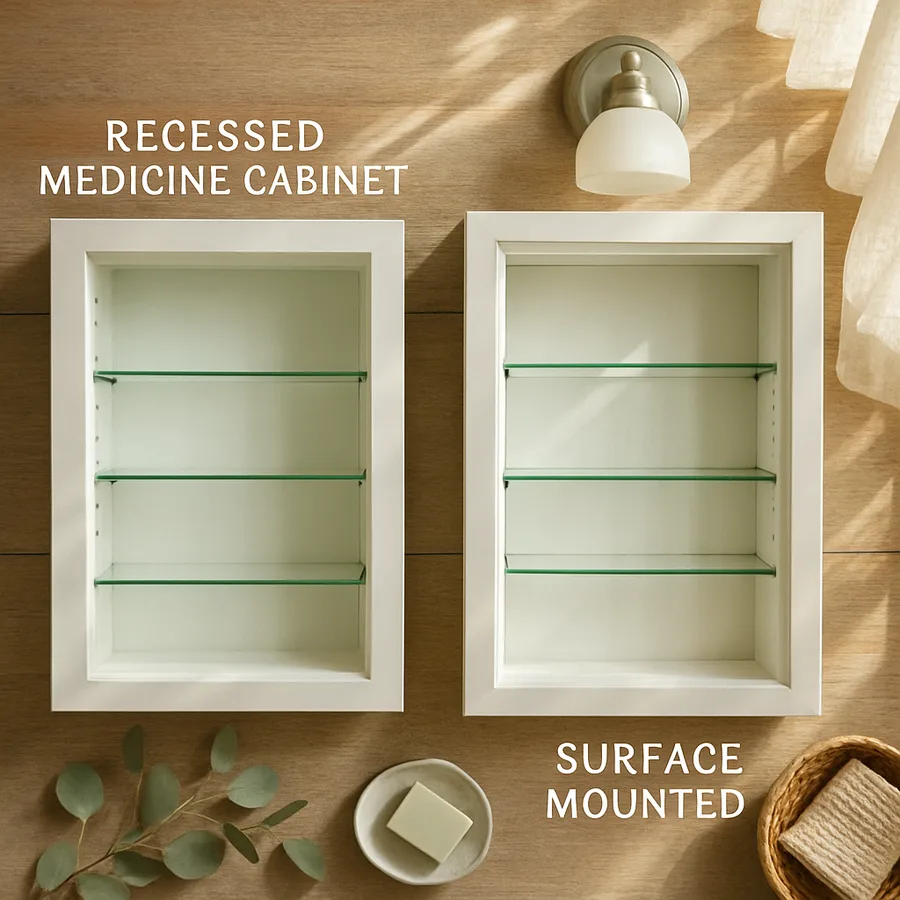
The medicine cabinet is one of the most quietly consequential decisions in any bathroom remodel. It anchors the vanity wall, dictates how light bounces across the mirror, and determines whether you can stash a tall shampoo bottle without dislocating a shoulder. Yet most homeowners default to whichever style their contractor pulls from the supplier catalog, never weighing the structural and visual trade-offs between a recessed cabinet set into the wall cavity and a surface mounted cabinet bolted to the drywall.
The choice is not merely aesthetic. Recessed installation requires opening the wall, navigating studs, and sometimes rerouting plumbing or wiring, while surface mounted units project into the room and change how the vanity feels at arm's reach. According to the National Kitchen and Bath Association, bathroom storage is the second most-cited renovation regret after lighting, with roughly 38 percent of homeowners reporting they wish they had specified a different cabinet style after living with their choice for two years. This guide walks through every factor that should inform that specification, from rough-in dimensions to resale signal, so the decision feels obvious rather than reluctant.
Understanding the Structural Difference
A recessed medicine cabinet is engineered to sit inside the wall, with only its door and trim flange visible from the room. The cabinet box typically projects three to four inches deep into the wall cavity, fitting between standard 16-inch on-center studs that frame a roughly 14.5-inch interior bay. A surface mounted cabinet, by contrast, sits entirely outside the wall plane, attaching with screws driven into studs or heavy-duty drywall anchors. It can be five to six inches deep without any framing modification because the wall does the supporting, not the housing.
This structural distinction cascades into every other consideration. Recessed cabinets demand a clear wall cavity, which means verifying that no plumbing stack, electrical home run, or HVAC duct occupies the space behind the proposed location. Surface mounted cabinets ignore the wall's interior entirely and only require that the studs behind the drywall can hold the cabinet's loaded weight, which the NKBA recommends calculating at twice the empty cabinet weight to account for fully stocked shelves.
The framing question matters most in older homes. Houses built before the 1970s often used true two-by-four lumber in non-standard spacing, and homes with plaster-and-lath walls present a different demolition profile than modern drywall. A recessed install in a plaster wall is roughly 40 percent more labor-intensive than the same install in drywall, according to estimating data published by remodeling industry trade groups. Surface mounting sidesteps this entirely, which is why retrofit bathroom projects so often default to the projecting style.
Visual Profile and Spatial Perception
The most striking difference is what your eye registers when you walk into the bathroom. A recessed cabinet reads as part of the wall itself, especially when its trim is painted to match. The mirror appears to float at the same plane as the surrounding surface, and the room feels more architecturally resolved. This is the look favored in spec-sheet hotel bathrooms and luxury condominium projects, where every protrusion is interrogated for whether it earns its visual cost.
A surface mounted cabinet projects between four and six inches into the room. In a small bathroom, this projection can shrink the perceived width of the vanity zone, particularly above a shallow vanity where the cabinet edge competes with the user's reflection at toothbrush distance. The surface mounted look can read as either intentional and craft-forward or as bulky and dated, depending on the trim style, the door reveal, and how the cabinet relates to flanking sconces. Have you noticed how often hotel bathrooms feel more spacious than your own at the same square footage? Cabinet projection is part of that calculation.
Lighting interaction is the other visual variable. With a recessed cabinet, sconces mounted on either side of the mirror sit at the same plane as the cabinet door, casting clean side-light across the face. With a surface mounted cabinet, the sconces effectively sit behind the cabinet's leading edge, which creates a slight shadow gradient on the lower jaw and chin. Stylists who work on grooming-product photography routinely specify recessed cabinets for this exact reason, because the lighting plane is uninterrupted.
Cost and Labor Differences
The unit price of a recessed cabinet is typically eight to twelve percent higher than a comparable surface mounted model from the same manufacturer, reflecting the tighter tolerances on the box and the integrated trim flange. The bigger spread shows up in installation labor. A surface mounted retrofit is genuinely a one-hour job for a competent handyperson with a stud finder, a level, and a drill. A recessed retrofit involves drywall demolition, stud avoidance or selective notching, blocking installation, drywall patching, prime, paint, and the cabinet set itself, which together routinely run four to six labor hours.
Below is a quick framework for thinking about total installed cost, not just the cabinet sticker:
- Cabinet unit: $180-$900 surface mount, $220-$1,100 recessed
- Wall opening and prep: $0 surface, $150-$400 recessed
- Blocking and framing: $0 surface, $80-$220 recessed if studs require notching
- Drywall patch and paint: $0 surface, $90-$250 recessed
- Cabinet hang labor: $75-$150 surface, $150-$300 recessed
For new construction or down-to-studs renovations, the cost gap nearly disappears because the framer is already opening the wall. This is why production builders working in tract homes default to surface mount but custom builders working on architect-drawn baths default to recessed. The question is not which is cheaper in absolute terms but which earns its cost premium given the project phase and the aesthetic ambition. The NKBA's planning guidelines emphasize that storage decisions made during framing cost a fraction of what they cost during finish work.
Plumbing, Electrical, and Wall Cavity Realities
The single most underestimated obstacle in a recessed install is what already lives inside the wall. The vanity wall in a typical American bathroom carries the cold and hot supply lines to the faucet, the drain stack venting up through the roof, and the home-run electrical for the vanity light circuit and any dedicated outlet. In bathrooms with a shower on the far side of the vanity wall, the shower mixing valve plumbing also runs vertically through the same cavity.
The relevant code reference is the National Electrical Code, which restricts how close conductors can run to the back of a recessed cabinet box and requires protection plates on studs that are notched to accommodate plumbing in front of an electrical run. NFPA's documentation on residential bathroom wiring covers the specific GFCI and arc-fault requirements that govern any outlet placed inside or beside a recessed cabinet. Surface mounted cabinets sidestep almost all of this because nothing is buried behind the cabinet body.
If your wall cavity is congested, you have three options: relocate the cabinet to a different stud bay, specify a shallow recessed model that projects only two and a half inches deep, or accept a surface mounted unit. Designers working on tight Manhattan bathrooms increasingly specify surface mount for exactly this reason, because the stack and supply pipes leave no usable cavity. Are you renovating a bathroom where the toilet's wet wall sits on the same plane as the vanity? If so, the recessed option may already be off the table without your knowing it.
Capacity, Organization, and Daily Use
Practical storage volume is where many recessed-versus-surface debates are decided at the breakfast table. A surface mounted cabinet, freed from the constraint of fitting between studs, can be wider, deeper, and taller than its recessed counterpart. A typical recessed cabinet offers an interior depth of three and a quarter inches, which holds a standard mouthwash bottle on its side but not upright. A typical surface mounted cabinet offers four and a half to five inches of interior depth, which accommodates the same bottle vertically and leaves room for a contact lens case or razor in front.
Width is similarly constrained. A single-door recessed cabinet is usually 14 to 16 inches wide because that is the available stud bay. To exceed that, the cabinet either spans two bays with a stud demolished and re-blocked, or it accepts a king stud assembly that frames the wider opening. Surface mounted cabinets routinely come in 24, 30, and 36-inch widths without any wall modification, which translates to roughly 60 percent more linear shelf storage at the larger sizes.
Daily use also benefits from depth. Tall items like sunscreen tubes, vitamins, and aerosol shave cream live happily in surface mounted cabinets and require gymnastic placement in recessed ones. The trade-off is that deep cabinets create the front-row, back-row problem where items in the back become invisible. Designers solve this with stepped or tiered interior shelving, available in higher-end models from manufacturers that publish detailed interior elevations on their spec sheets.
Resale Value and Design Longevity
Real estate professionals and renovation appraisers consistently rate recessed medicine cabinets as the higher-value spec at resale, primarily because they signal a more thorough renovation. The visual signal of a flush cabinet face, sitting within the same plane as the surrounding wall, communicates that the renovation went down to the studs rather than skating across the surface. This is a small detail that buyers absorb subliminally during a walkthrough.
Design longevity is the other factor. A surface mounted cabinet with strong horizontal lines and a frameless door can read as contemporary in 2026 and dated by 2034, the way that bombe-front vanities and shell-shaped sinks once seemed inevitable and now look like time stamps. A recessed cabinet, because it disappears into the wall, ages with the wall and depends entirely on the door style for its visual signal. Replacing a door is an order of magnitude cheaper than replacing the entire cabinet, which means the recessed approach is more graceful as taste evolves.
That said, surface mount has its own resale virtue in a specific scenario. In an older home being lightly refreshed for sale, demolishing a wall to set a recessed cabinet rarely returns its cost. A high-quality surface mounted unit with an oversized mirror reads as a deliberate design choice and avoids the half-finished feel of a renovation that ran out of budget. The right answer depends entirely on the project's ambition envelope.
Conclusion
The choice between a recessed and a surface mounted medicine cabinet is one of those decisions that looks small on a punch list and turns out to be foundational to how the bathroom feels every morning. Recessed cabinets reward projects with framing access, congestion-free wall cavities, and a willingness to absorb the labor premium for a flush, architectural look that ages slowly. Surface mounted cabinets reward projects with constrained wall cavities, retrofit scope, or a desire for maximum interior storage at the lowest installed cost.
The framework worth carrying into the showroom is this: define the project's ambition first, then test whether the wall cavity can support the recessed answer the ambition implies. If you are remodeling down to the studs in a primary bath that anchors a long-term home, the recessed cabinet earns its cost. If you are refreshing a guest bath or working in a building where the wall hides plumbing and conduit you cannot relocate, the surface mounted cabinet is the honest choice rather than the compromised one. There is no universally correct answer, only a correct answer for your specific wall, budget, and timeline.
Before signing off on a cabinet spec, walk into the bathroom at the time of day you actually use it, hold a piece of cardboard cut to the projected cabinet face at the proposed location, and live with the mockup for at least 24 hours. Pay attention to whether you bump it, whether it shadows the sink, and whether the projection bothers you when you reach for the medicine. If you are working with a designer, ask them to show you both options rendered to scale rather than describing them verbally, because cabinet projection is impossible to perceive accurately from a tape measure alone. The bathroom you live with for the next decade is worth a thoughtful afternoon today.
More Articles You May Like



Comments
Post a Comment