Butler Pantry vs Walk-In Pantry Layout and Storage Differences
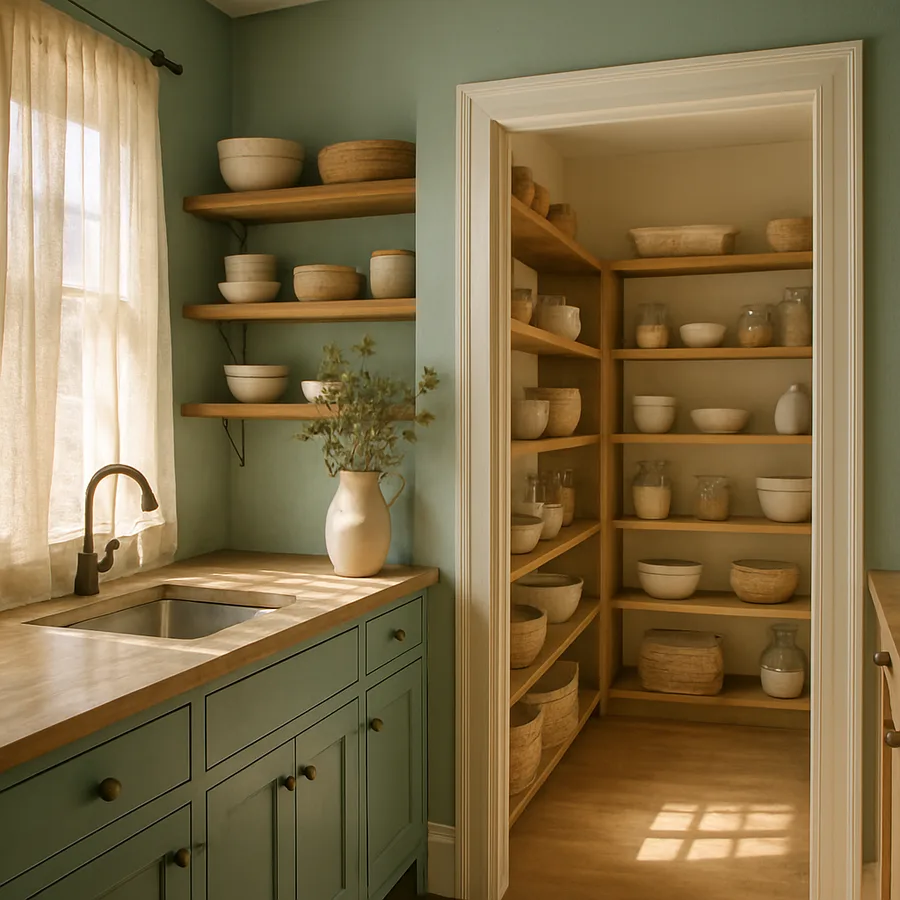
The decision between a butler pantry and a walk-in pantry reshapes how a kitchen actually functions on a Tuesday night, on Thanksgiving morning, and on the day you list your house. These two spaces solve different problems even though they often share a wall with the cooking zone, and confusing them is one of the most common planning mistakes designers see in remodels. A butler pantry is a transitional corridor with countertop work surface, usually positioned between kitchen and dining room, while a walk-in pantry is a closed storage room that prioritizes shelving over prep area. Understanding that difference before drawings are finalized prevents the painful realization, six months after move-in, that you built the wrong room.
This guide breaks down the layout dimensions, storage geometry, plumbing and electrical implications, resale considerations, and budget realities of each. By the end you should be able to answer the question that homeowners often pose to their architect midway through schematic design: do I need a place to stage food and serve, or do I need a place to hide bulk groceries? The answer is rarely the same household to household, and getting it wrong wastes between forty and one hundred and twenty square feet of conditioned floor area on the wrong-shaped room.
Defining the Two Pantry Types Clearly
A butler pantry originated in nineteenth-century English country houses as the staging room where the head butler prepared trays, polished silver, and held warm dishes between the kitchen and the formal dining room. Modern interpretations preserve the corridor geometry: a galley-style space three to five feet wide, eight to twelve feet long, with upper and lower cabinets on at least one wall and a continuous countertop run. The countertop is the defining element. Without prep surface it is no longer a butler pantry, just a passage with cabinets.
A walk-in pantry by contrast is a fully enclosed room, typically four to six feet deep and five to ten feet wide, with shelving on three walls and a single door. Floor area inside ranges from twenty to sixty square feet, and the function is bulk dry-goods storage rather than active food preparation. According to the National Kitchen and Bath Association (NKBA), pantries appeared in roughly seventy percent of new kitchen designs surveyed in their most recent trends report, and walk-in versions outpaced butler versions by nearly two to one in single-family construction.
The two spaces are not mutually exclusive. High-end builds increasingly include both, with the butler pantry serving as the visible, finished link to the dining room and a back-of-house walk-in handling the unsightly bulk inventory. The National Association of Home Builders (NAHB) lists walk-in pantries as one of the top ten most-wanted features in homes priced above the median, with butler pantries appearing more selectively in homes designed for entertaining.
Layout and Dimensional Rules That Govern Each
Butler pantry geometry follows kitchen work-aisle standards. A clear walking lane between facing cabinet runs needs at least forty-two inches according to NKBA planning guidelines, and forty-eight inches if two people will pass while one is working at the counter. Counter depth holds at the standard twenty-five inches with a fifteen-inch upper cabinet above, leaving roughly eighteen inches of vertical clearance between countertop and the bottom of the wall cabinets. That clearance is critical because it determines whether you can store and use a stand mixer, an espresso machine, or a toaster oven on the counter without removing it.
Walk-in pantries follow closet planning rules instead. Shelf depth on the perimeter walls runs twelve to sixteen inches for canned and packaged goods, with an aisle of at least thirty-six inches in front. If the room is large enough to support a U-shape with shelving on three walls, the aisle widens to forty-four inches so that a person can turn around with a grocery bag in each hand. Have you ever tried to bring a Costco-sized box of cereal into a pantry where the door swings inward against a shelf? That single planning error renders a third of the storage inaccessible.
Door placement deserves its own paragraph. Butler pantries usually have two openings, one to the kitchen and one to the dining room, and these are most often cased openings or pocket doors rather than swinging panels. Walk-in pantries have a single door that should swing outward into the kitchen, never inward, to preserve interior shelving wall area. Pocket doors solve the swing problem entirely and are worth the extra framing cost in tight floor plans.
Storage Capacity and Shelf Geometry Compared
A typical butler pantry of forty square feet provides roughly twenty-four linear feet of countertop-adjacent storage when you count uppers, lowers, and the counter itself as a staging surface. That sounds like a lot until you remember that lower cabinets are mostly inefficient deep boxes that swallow bakeware and force you to kneel to find the slow cooker. Drawer banks improve this dramatically, and a well-planned butler pantry replaces conventional doored lowers with three or four tiers of full-extension drawers running the length of the countertop.
A walk-in pantry of the same forty square feet provides closer to forty-five linear feet of shelving when you stack five shelves high on three walls. The geometry is simply more efficient for storing boxes, cans, and jars. The American Society of Interior Designers (ASID) has documented that walk-in pantries store approximately sixty percent more dry goods per square foot than equivalent butler pantry footprints, primarily because vertical wall area is used continuously rather than being broken up by countertop and appliance zones.
Shelf depth needs to vary within a single walk-in pantry. The bottom two shelves should run sixteen to eighteen inches deep to hold small appliances, large cereal boxes, and stacks of paper goods. Middle shelves at twelve to fourteen inches handle canned goods and most packaged dry goods without forcing items into a second row that disappears from view. Top shelves at ten to twelve inches keep rarely-used items visible. The National Association of the Remodeling Industry (NARI) recommends labeling the front edge of shelves where contents change frequently, and reports that homeowners who add labeling waste roughly thirty percent less expired food than those who do not.
Plumbing, Electrical, and Appliance Considerations
Butler pantries routinely include a secondary sink, a beverage cooler or wine refrigerator, an under-counter ice maker, and sometimes a second dishwasher for glassware. That equipment list drives substantial mechanical infrastructure. Plumbing rough-in for a sink and ice maker adds two to four thousand dollars to construction cost, depending on the distance to existing supply and drain lines. Electrical loads add a dedicated twenty-amp circuit for each major appliance, plus a fifteen-amp circuit for countertop receptacles spaced no more than four feet apart per the National Electrical Code.
Walk-in pantries need electrical only for lighting and for one or two receptacles to power a charging zone for handheld vacuums or to support a chest freezer if the room is large enough. The lighting load is the more interesting design problem. The Illuminating Engineering Society (IES) recommends a minimum of thirty foot-candles at the working plane in residential storage spaces, which generally translates to one four-inch LED downlight per twenty square feet of floor area, supplemented by under-shelf strip lighting on at least the lowest two shelves to eliminate cave-effect shadows.
Ventilation rarely gets discussed but matters in both pantry types. A butler pantry with a coffee maker and toaster needs either a dedicated exhaust fan or open communication to the main kitchen ventilation, otherwise grease and steam build up in the upper cabinets. A walk-in pantry holding root vegetables, onions, or any climate-sensitive dry goods benefits from a small intake louver in the door and a passive return path to keep the room near the conditioned set point of the rest of the house. Neither requirement is expensive but both are easy to forget at framing.
Cost, Construction, and Project Timeline
Butler pantry construction in a remodel typically runs between fifteen and forty thousand dollars depending on cabinet quality, countertop material, and the appliance package. The cabinetry alone can absorb sixty percent of that figure if custom millwork or inset doors are specified. Countertops add another two to eight thousand depending on whether the choice is quartz, stone, or a more exotic material. The appliance package, if it includes a beverage cooler and second dishwasher, can easily exceed five thousand dollars before installation.
Walk-in pantries are dramatically cheaper. A fully built-out walk-in with custom adjustable shelving, motion-sensor lighting, and a paneled door usually lands between three and eight thousand dollars. The savings come from eliminating countertop, cabinetry, plumbing, and most appliances. The room becomes essentially a finished closet with quality shelving. Houzz remodel cost surveys consistently show walk-in pantries delivering one of the highest cost-to-satisfaction ratios of any kitchen-adjacent project, with the walk-in pantry recovering an estimated eighty-five percent of cost at resale according to Houzz renovation studies.
Construction timeline differs as well. A butler pantry coordinated with a kitchen remodel adds roughly two weeks to the project schedule because of cabinetry lead time, plumbing and electrical inspections, and countertop templating. A walk-in pantry adds three to five days, mostly for framing and drywall, with shelving installation happening near the end of the punch list. If your remodel is on a tight calendar before a holiday or a move-in date, the walk-in pantry is the safer schedule choice.
Resale Value, Buyer Preference, and the Hybrid Approach
Real estate listing data consistently shows walk-in pantries as the more universally desired feature. A butler pantry signals a home built for formal entertaining, which appeals to a narrower buyer pool. A walk-in pantry reads as practical, daily-use storage that any family of any composition will appreciate. NAHB buyer preference studies have repeatedly placed walk-in pantries in the top three most-wanted kitchen features across all age cohorts, while butler pantries score highest only among move-up buyers in homes above two million dollars.
The hybrid approach has emerged as the dominant solution in homes between three and six thousand square feet. The kitchen opens to a butler pantry corridor with sink, beverage cooler, and prep counter, which then opens at its far end into a walk-in storage room. The corridor handles entertaining and beverage service while the back room holds bulk groceries, small appliances, and paper goods. Total floor area for the combined arrangement runs eighty to one hundred and twenty square feet, which is a meaningful claim on a floor plan but delivers two distinct functional zones.
One question worth asking yourself before choosing: do you cook from raw ingredients more than four nights a week, or do you assemble prepared foods? Heavy raw-ingredient cooks benefit disproportionately from walk-in pantry storage because they buy in larger quantities and rotate ingredients faster. Assembly cooks who shop more frequently benefit more from butler pantry counter space because their inventory is smaller but their staging needs are higher. Honest answers to that question have rerouted more than a few schematic floor plans late in design.
Conclusion: Choosing the Right Space for Your Household
The choice between butler pantry and walk-in pantry is fundamentally a choice between staging area and storage volume. Households that entertain formally, host holidays for extended family, or maintain a coffee and beverage program at home will get more daily value from a butler pantry. Households that cook frequently from raw ingredients, shop in bulk, or simply want to remove visual clutter from the main kitchen will get more value from a walk-in. Neither is universally better, and the worst outcome is building one when the household actually needed the other.
Budget should not be the deciding factor in isolation but it does narrow the field. If your kitchen renovation budget tops out below a hundred thousand dollars, a walk-in pantry returns more functional improvement per dollar than a butler pantry. If the budget supports both, build both, with the butler pantry as the visible refined corridor and the walk-in as the working back-of-house. If the budget supports only one and the household leans toward formal entertaining, the butler pantry justifies its premium.
Before signing off on schematic drawings, walk through a typical week of cooking and entertaining in your head and identify where current friction lives. Is the friction at the staging surface during a dinner party, or at the cabinet door when groceries arrive on Saturday morning? The answer tells you which room to build. Engage a kitchen designer credentialed by NKBA early in schematic design to model both options against your specific household patterns before construction documents are finalized. The two-hour conversation up front prevents the wrong-room regret that no amount of post-construction reorganization can fix.
Finally, do not assume your existing kitchen footprint determines your pantry type. A small kitchen can support a generous walk-in if you borrow square footage from an adjacent closet or laundry. A large kitchen can support a butler pantry by extending into a former breakfast nook. The pantry decision should be made on functional needs first, with floor plan adjustments made to accommodate the right answer, not the other way around.
More Articles You May Like



Comments
Post a Comment