Recessed Can vs Pendant Light Hallway Choice Compared
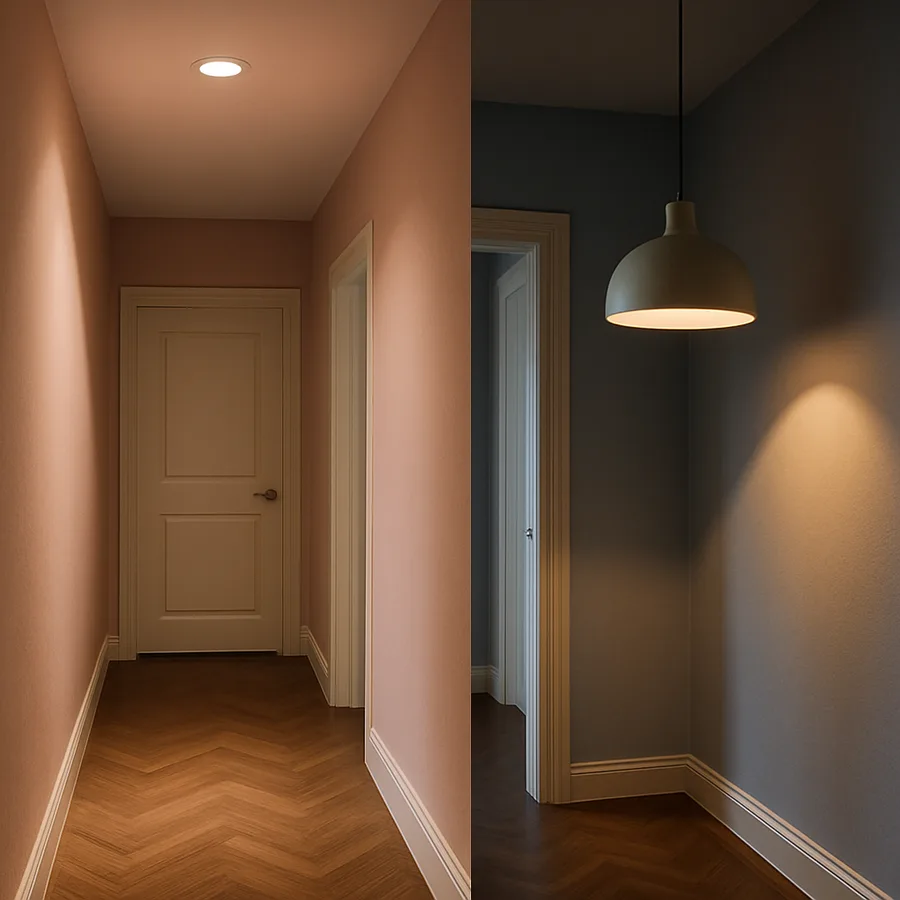
The decision between recessed can lights and pendant fixtures defines the personality of a hallway more than any paint color or rug. Cans disappear into the ceiling and let the architecture speak, while pendants drop into the corridor and become the star of the show. Both approaches can be brilliant, and both can fall flat in the wrong context. The trick is matching the fixture type to the hallway's role, scale, and the home's design language.
According to a recent American Lighting Association consumer survey, roughly 70 percent of newly built homes default to recessed cans in hallways, but renovation projects show a noticeably higher rate of pendants and decorative fixtures, around 35 percent. That gap suggests homeowners learn over time that hallways can carry more visual weight than the builder grade assumes. This guide compares the two approaches across every meaningful dimension so you can make a confident, informed choice for your own corridor.
How Each Fixture Type Actually Performs
A recessed can light, sometimes called a downlight or pot light, sits flush in the ceiling and projects a focused beam downward. Modern LED cans range from a 30-degree narrow spot to a 120-degree wash, with most hallway applications landing between 60 and 90 degrees. The light reads as architectural and quiet, and the fixture itself becomes nearly invisible. The Illuminating Engineering Society classifies a typical 4-inch downlight at 8-foot mounting height as appropriate for general residential corridor illumination at standard spacing.
A pendant fixture, by contrast, hangs from the ceiling on a rod, chain, or cord, and is meant to be seen. Pendants throw light both downward and upward, depending on the shade type, and they introduce a sculptural element at eye level or above. A series of small pendants down a long hallway creates rhythm. A single dramatic pendant at the entry to a hallway creates a focal point. Either way, the fixture itself is part of the design conversation.
From a pure photometric standpoint, recessed cans are more efficient at delivering measured floor-level lux. From a quality-of-light standpoint, pendants often produce a softer, more atmospheric corridor, especially when the shade diffuses light to the walls and ceiling. Have you ever stood in a hallway lit only by recessed cans and felt that something was missing, even though the floor was perfectly bright? That missing piece is usually wall and ceiling brightness, which a pendant naturally provides.
Ceiling Height And Scale Considerations
Ceiling height is the first hard constraint. The National Association of Home Builders guideline allows a fixture to hang as low as 7 feet above the finished floor in a circulation space, but most designers prefer 7 feet 6 inches or higher for comfort. In a hallway with 8-foot ceilings, that gives you about 6 inches of room for a pendant body before it starts feeling oppressive.
A flush or semi-flush pendant in that range can work beautifully. A full-drop pendant or chandelier almost always cannot. If your ceilings are 9 feet or higher, the pendant options open dramatically, and you can comfortably hang a 12 to 18-inch fixture body without feeling cramped. Cathedral or vaulted hallway ceilings invite even bigger statements, often sized to one-third the ceiling height for proper proportion.
Recessed cans care less about ceiling height and more about ceiling depth. You need at least 4 to 6 inches of clear plenum above the finished ceiling to fit the housing, and IC-rated housings are required when insulation contacts the fixture. In retrofit projects with shallow joists or finished space above, low-profile LED disc lights solve the depth problem and are visually similar to traditional cans from below.
Cost Comparison: Materials, Labor, And Lifecycle
On a per-fixture basis, builder-grade recessed cans are the cheaper option, often 30 to 50 dollars for the housing and trim. Designer-grade cans with quality optics, a high CRI rating, and a name-brand driver run 100 to 250 dollars each. A typical hallway needs three or four cans, so the total fixture budget for recessed lighting lands between 100 and 1,000 dollars depending on quality.
Pendants vary far more widely. A simple metal dome pendant from a big-box retailer might cost 60 dollars, while an artisan glass or ceramic pendant from a designer studio can run 1,500 dollars or more. Multiply that by the number of pendants in your hallway plan and the budget swings considerably. Unique pendants from custom makers featured in Architectural Digest can comfortably exceed 5,000 dollars per fixture for high-profile projects.
Labor costs also differ. Recessed cans require cutting ceiling holes, running wire, and installing the housing, which an electrician typically charges 75 to 150 dollars per fixture in retrofit conditions. Pendants in an existing junction box are simpler, often 50 to 100 dollars per drop. New runs for either type cost more, especially through finished ceilings or tight joist bays. Over a 25-year LED lifespan, both options are essentially comparable in lifecycle cost, with the bigger differentiator being driver quality and dimmer compatibility.
Design Language And Architectural Style
Style is where the two approaches diverge most sharply. A minimalist or contemporary home with clean ceilings and crisp shadow gaps almost always reads better with recessed cans, sometimes even with trimless flush-cut openings that disappear completely into the drywall. A traditional, transitional, or layered home benefits from the visual weight and material expression of pendants, which add age and personality.
Mid-century modern hallways often live in the middle, with surface-mounted flush ceiling drums or a single oversized pendant at a key moment. Industrial and loft-style spaces lean into exposed track or pipe-mounted pendants that read as part of the structure. Coastal and farmhouse styles love woven, glass, or rattan pendants that catch sunlight and shadow throughout the day. The American Society of Interior Designers consistently emphasizes that fixture choice should reinforce, not contradict, the architectural language of the space.
What about mixing the two? A mixed approach is one of the most successful strategies in long hallways. Use recessed cans for the workhorse general illumination, and add one or two pendants at key moments such as the entry to the hallway, a niche, or above a console table. The cans handle the photometric job, and the pendants handle the design statement. Both layers can be on separate dimmers for full scene control.
Maintenance, Cleaning, And Longevity
Recessed cans are nearly maintenance-free. Modern LED downlights are sealed units with integrated drivers, and a quality fixture from a name-brand manufacturer carries a 5 to 10-year warranty against failure. When the LED finally dims out at 50,000 hours or more, the entire trim is replaced rather than relamped. Cleaning is limited to dusting the trim every six months with a microfiber cloth.
Pendants demand more upkeep. Glass shades attract dust, fingerprints, and over time, an oily film from kitchen and bath humidity that drifts through the hallway. Open-shade pendants with exposed bulbs need the bulb itself dusted regularly, or it begins to dim noticeably. Fabric or paper shades collect more dust and may yellow over time, especially with halogen or higher-wattage incandescent sources. Plan on a quarterly cleaning routine if you choose pendants, and budget for occasional shade replacement.
Bulb access is the other practical consideration. A 12-foot vaulted hallway with pendants hanging 8 feet up requires a tall ladder or a hook pole for any bulb change. Recessed cans at the same ceiling height are no easier to reach, but the longer LED lifespan means you do it less often. The American Lighting Association notes that homeowner satisfaction with pendants drops sharply if access is difficult and maintenance becomes a chore.
Energy, Code, And Safety Factors
Both fixture types meet modern energy codes when specified with quality LED sources. A typical residential hallway with three to five fixtures running an average of 4 hours per day uses between 30 and 80 kilowatt-hours per year, a small fraction of total household consumption. The Illuminating Engineering Society nonetheless recommends dimmers and occupancy sensors to trim that further, especially in homes with motion-controlled night settings.
Code clearances differ. Recessed cans must maintain manufacturer-specified clearance from insulation unless rated IC, and any can installed in a closet or directly over a tub must be rated for that condition. Pendants must hang clear of any pathway with at least 7 feet of head clearance, more if a tall person regularly uses the hallway. Both types require GFCI protection in damp locations and must comply with the National Electrical Code as adopted by your local jurisdiction.
Safety in a hallway is more than code. Glare control matters. A bare bulb pendant at eye level can blind a child or a guest descending a staircase, and a high-output recessed can with no diffuser can produce uncomfortable shadows on faces. Choose fixtures with frosted lenses or shielded sources, and avoid placing any fixture directly in the line of sight from a room threshold to the hallway end.
Choosing The Right Approach For Your Hallway
The decision tree is simpler than it appears. Start with ceiling height. Under 7 feet 6 inches, recessed cans or low-profile flush mounts are the safer bet. Between 7 feet 6 inches and 9 feet, semi-flush or small pendants become viable, but cans still work beautifully. Above 9 feet, full pendants and even small chandeliers become possible without feeling cramped.
Next, consider the home's architectural style. Contemporary and minimalist homes default to cans, traditional and transitional homes default to pendants, and the spectrum in between can mix the two. Then, think about budget. If your fixture budget is under 500 dollars total, cans deliver more for the money. If you have 1,500 dollars or more to spend on hallway lighting, a designer pendant or a mixed scheme becomes a legitimate option.
Have you considered who else uses the hallway and how they feel in it? A long hallway in a family home benefits from the consistent, glare-free coverage of recessed cans plus a single welcoming pendant at the entry. A short, dramatic hallway in an entertaining-focused home leans into pendants that become the conversation starter as guests arrive. Both are correct. The difference is in the role the hallway plays in daily life.
Conclusion
Recessed cans and pendants are not opposites. They are tools, each with strengths and weaknesses, and the best hallways often use both. A clear-eyed assessment of ceiling height, architectural style, budget, and lifestyle will steer the decision in nearly every case. When in doubt, lean toward the option that supports the home's existing design language rather than fighting it.
If you are renovating, this is the right moment to upgrade. Adding a junction box for a future pendant during a drywall replacement costs almost nothing, and roughing in additional cans is a fraction of what it would cost as a future retrofit. Even if your final scheme leans heavily on cans, having the option for one or two pendants gives the design room to evolve over time.
The fixtures themselves matter, but so do the controls. A hallway with quality LED sources and a smooth dimmer outperforms a hallway with expensive fixtures and a basic toggle switch. Spend the extra fifty dollars on a high-quality dimmer compatible with your specified driver, and the daily experience of the hallway will reward you for years.
Ready to make your own choice? Walk your hallway at every time of day, photograph it from each end, and use those images to evaluate fixture mockups before you commit. A digital rendering or a simple paper cutout taped to the ceiling at the proposed pendant height can save you a costly mistake. When you are ready to specify, browse fixtures through the American Lighting Association directory or consult an ASID-affiliated designer for a tailored recommendation.
Further reading is available from the Illuminating Engineering Society, the American Lighting Association, and Architectural Digest.
More Articles You May Like


Comments
Post a Comment