Walnut vs Oak Hardwood Choice for Living Room Floors Compared
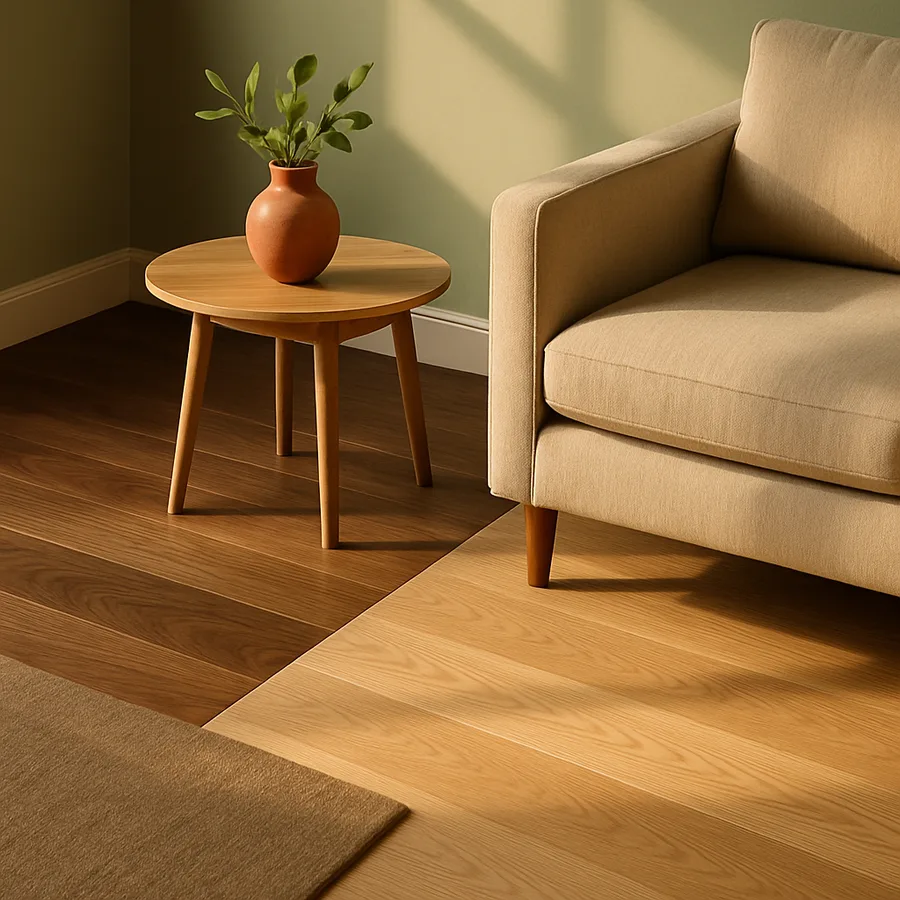
When a homeowner narrows a hardwood selection down to walnut versus oak, the decision usually has less to do with raw performance and more to do with how the floor will read in the room. Both species are domestic, both refinish well, and both are stocked by every reputable hardwood dealer in North America. What separates them are the things that show up on day one and the things that emerge over twenty years of living on the surface.
This comparison walks through the practical differences that matter for a living room: color and how it ages, hardness and dent resistance, grain personality, plank availability, cost trajectory, and the design vocabularies each species supports. The goal is not to crown a winner but to give you the language to choose the right species for the room you are actually building.
Color, Tone, and the Way Each Species Ages
Walnut's signature is a deep chocolate-to-cocoa heartwood with occasional purplish undertones and lighter sapwood streaks. The wood arrives at the home dark, and over the first year or two of UV exposure it actually lightens, mellowing toward a warmer, slightly amber brown. This is the opposite of cherry, which darkens, and the opposite of most people's intuition.
Oak runs the other direction. Red oak carries a pinkish cast that warms toward honey over time. White oak is more neutral, with subtle olive or gray-green undertones that have made it the darling of contemporary interior designers. Both oaks darken slightly with age but accept stains far more uniformly than walnut, which is one reason designers reach for white oak when they want a specific custom color.
If you are designing around a fixed palette, ask yourself how the floor will look in three years, not three days. Walnut's lightening can pull a moody scheme toward something warmer than intended. Oak's predictable aging makes it easier to plan around, particularly for clients who want the room to look the same a decade from now.
Hardness and Realistic Dent Resistance
The Janka numbers tell a story that surprises people. American black walnut tests at roughly 1,010 lbf, meaningfully softer than red oak at 1,290 lbf or white oak at 1,360 lbf. In a high-traffic living room, that gap shows up. Walnut dents more readily under chair legs, dropped objects, and pet claws than either oak.
That does not disqualify walnut. It does mean the species rewards a few habits: felt pads on every furniture leg, a strict no-shoes policy or quality entry rugs, and tolerance for the patina that develops in traffic lanes. Many walnut owners come to value the marks as character. According to research summarized by the National Wood Flooring Association, dent accumulation is highly user-dependent, and a careful household can keep either species looking close to new for decades.
For families with large dogs, frequent entertaining, or children in the running-and-dropping years, oak's harder surface is the more forgiving choice. For couples with adult households and a design-led aesthetic, walnut's softer surface is rarely a deal-breaker. Are you the kind of homeowner who notices every mark, or the kind who sees patina as part of the story? That question matters more than the Janka spread.
Grain Character and Plank Format
Oak's grain is open, expressive, and varied. Plain-sawn oak shows the dramatic cathedral arches that most people picture when they think of hardwood. Rift-and-quartered oak presents straight, parallel lines with a quieter rhythm. Both formats are widely available, and the species accepts wire-brushing and hand-scraping beautifully.
Walnut's grain is tighter, with a subtler figure that reads as understated luxury rather than rustic warmth. The wood is also less uniform than oak: heartwood and sapwood vary noticeably, and many premium walnut floors are specified as "select" or "rustic" grades to embrace that variation rather than fight it. Wide planks (7 to 10 inches) suit walnut particularly well because the calmer grain does not compete with the broader visual real estate.
The American Hardwood Export Council reports that wide-plank walnut has gained share in premium residential specifications over the last decade, while oak continues to dominate the broader market by volume. If you want a floor that telegraphs craftsmanship and quietness, walnut delivers. If you want the broadest range of textures and finishes at every price point, oak is the deeper bench.
Cost, Availability, and Sourcing
Walnut runs significantly more than oak at almost every grade and width. Expect a premium of 40 to 80 percent for comparable plank dimensions, and more for wide-plank or character-grade material. The cost reflects slower growth, lower yield per log, and growing international demand. Black walnut trees are also more selectively harvested than oak, and supply tightens during periods of strong export demand.
Oak is the workhorse. Domestic supply is abundant, the species is grown across most of the eastern United States, and the price has been more stable than walnut over the last decade. FSC certification is widely available for both species, but verifying chain of custody is easier with oak simply because more mills offer it as a default.
If your project is sensitive to cost, oak almost always wins on a per-square-foot basis without sacrificing quality. If you are willing to allocate the upgrade budget to the floor (rather than to cabinetry, lighting, or finishes), walnut returns a different kind of value: a surface that reads as luxurious without needing to announce itself.
Refinishing and Repair Behavior
Both species are excellent refinishing candidates. Solid walnut and solid oak boards typically tolerate six to ten sand-and-refinish cycles over a service life that often exceeds a century. Engineered versions with a 4 to 6 mm wear layer support two to four refinishes, depending on the depth of damage being addressed.
Walnut's softer fiber sands more easily than oak, but it is less forgiving of aggressive grits and over-sanding at edges. Stain uptake on walnut is also less uniform than on oak, so most refinishing projects on walnut keep the floor at its natural color or apply only a clear penetrating oil. Oak accepts a much wider range of stains, including the popular fumed, limed, and reactive finishes that have dominated design publications recently.
For homeowners who anticipate periodic color updates, oak is the more flexible canvas. For those who want to install the floor once, finish it naturally, and let it age, walnut delivers a quieter, more consistent result.
Design Pairing and Resale Perception
Walnut pairs especially well with brass, wool, leather, and warm whites. It anchors a moody, library-style living room and softens the lines of contemporary furniture without competing for attention. Designers featured by the American Society of Interior Designers frequently specify walnut for projects targeting a refined, residential warmth that feels rooted rather than trendy.
Oak is the more flexible pairing partner. White oak in particular slots into Scandinavian, Japandi, modern farmhouse, transitional, and traditional schemes with minor finish adjustments. Red oak supports warmer, more traditional vocabularies and remains underrated in markets where buyers fixate on white oak. Both species signal quality at resale, though premium markets sometimes assign walnut a slight aspirational edge.
What does your living room need to do? If it is the room where the family decompresses and the floor needs to support changing color schemes over the years, oak is the safer call. If the living room is a statement space and the floor is part of that statement, walnut earns the upgrade. Order substantial samples of both species before committing, and live with them in your actual lighting for at least a week.
Conclusion
Walnut and oak are both excellent living-room floors, and the choice rarely comes down to performance alone. Walnut delivers a quieter grain, a deeper natural color, and a luxurious presence that designers have been chasing for the last decade. Its softer fiber means more careful living and a higher upfront cost, but the surface ages with a warmth that few other domestic species match.
Oak offers a harder surface, a broader stain vocabulary, more abundant supply, and a more predictable aging curve. White oak's neutrality has made it the contemporary default, while red oak remains a value-driven choice that performs identically in mechanical terms. Either oak species supports a wider range of finishes and pairs with a broader furniture palette than walnut.
The right answer depends on how you actually live. Active households with pets and children usually do better with oak. Adult households focused on a specific design vision often find walnut worth the premium. Whichever way you lean, source from a certified mill, verify the moisture content before installation, and budget for proper acclimation. Schedule a consultation with a hardwood specialist and request large samples in your home's lighting before placing the order.
Installation, Acclimation, and Subfloor Realities
Both walnut and oak install identically on the contractor's side of the equation: nail-down or glue-down for solid product, and floating, glue-down, or nail-down for engineered. The differences emerge in handling. Walnut's softer fiber dents more easily during installation, which means that careless handling at the jobsite can introduce the very marks the homeowner is paying to avoid. Experienced installers know to pad their nail guns and to lift planks rather than slide them across already-laid boards.
Acclimation periods are similar for both species, typically 72 hours in the actual installation environment with HVAC running. Walnut's slightly higher dimensional movement coefficient means that improper acclimation produces more visible gapping in winter than oak in the same conditions. Homes with strong seasonal humidity swings benefit from whole-house humidification regardless of species, but walnut owners notice the absence of humidification more quickly than oak owners.
Subfloor flatness specifications are the same for both species: typically 3/16 inch over 10 feet for nail-down installation, tighter for glue-down or floating engineered. Self-leveling compound is the standard remedy, and most quality installations include moisture meter documentation showing both subfloor and flooring product within 2 percent of each other before installation begins.
Climate Performance and Humidity Sensitivity
Walnut and oak both tolerate the indoor humidity range that most homes maintain (30 to 50 percent relative humidity), but their behavior at the edges of that range differs slightly. Walnut's tangential shrinkage coefficient is marginally higher than white oak's, which means a walnut floor will gap slightly more in a dry winter and crown slightly more in a humid summer than an identically installed oak floor in the same conditions.
For homes in dry mountain or desert climates, both species benefit from whole-house humidification during winter months. For homes in humid coastal or southern climates, dehumidification keeps both species within their happy range. The difference is rarely large enough to drive species selection, but homeowners with extreme climate exposure sometimes notice walnut's reactivity more than oak's.
Sustainability and Sourcing Verification
Both walnut and oak can be sourced sustainably, but the verification path differs. American black walnut is grown across the eastern United States in a mix of plantation and naturally regenerated forests, and FSC-certified supply is available though not universal. Domestic oak is more abundantly certified, with major mills offering chain-of-custody documentation as a standard option rather than a premium upgrade.
For homeowners who care about provenance, requesting documentation from the dealer is the simplest verification step. The certification adds modest cost (typically 5 to 10 percent) but ensures that the wood was harvested under credible forest management standards rather than clear-cut from sensitive habitat. The American Hardwood Export Council also publishes regional sustainability data that can support specification decisions when full FSC documentation is not available for a particular mill.
Maintenance Routines and Daily Care
The maintenance routine for walnut and oak is essentially identical, but the consequences of neglect differ slightly. Both species need a microfiber dust mop weekly to remove the grit that scratches any wood floor over time. Both benefit from a damp microfiber pad with a manufacturer-approved hardwood cleaner monthly. Both are damaged by excess water, ammonia-based cleaners, vinegar, and any product not specifically formulated for hardwood.
Walnut shows water marks more readily than oak because the darker fiber contrasts more visibly with the lighter ring left by a spill. Prompt cleanup is the standard rule for any hardwood, but walnut is less forgiving of delayed response. Oak hides minor water marks better because the lighter base color minimizes the contrast, though prolonged exposure damages either species equally.
Furniture protection matters for both species but matters more for walnut because the softer fiber dents more readily under point loads. Felt pads on every furniture leg, wide caster wheels rather than narrow ones, and area rugs in high-traffic zones all extend the service life of either floor. Have you walked your space barefoot to identify where furniture is dragged most often? Those are the spots where protective pads pay back their cost within months.
More Articles You May Like



Comments
Post a Comment