Counter Stool Backless Versus Backrest Style Comparison
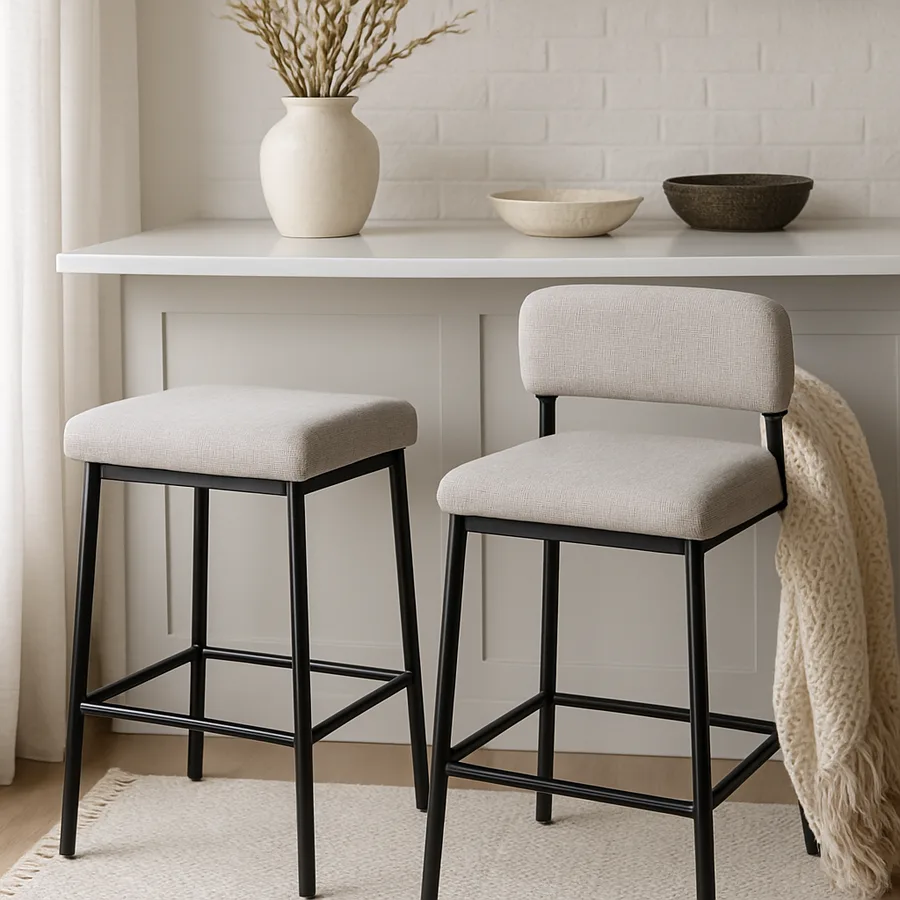
The first time you stand in a showroom and try to choose between a backless counter stool and one with a full backrest, the decision feels almost arbitrary. Both work. Both are everywhere. Both come in finishes that flatter your kitchen. Yet the choice quietly shapes how your room feels every single day, how guests behave when they sit down, and how the island reads from the doorway. Backless stools tuck and disappear; backrest stools anchor and announce. Neither is wrong, and neither is universally right.
This comparison breaks down the trade-offs across comfort, visual weight, ergonomics, storage, family use, and design integration so you can make a confident choice rather than a default one. By the end you will know which style suits your kitchen, your household, and the way you actually live, not just the way you imagine living when you are scrolling through a furniture site at midnight.
The Visual Weight Argument
The single most important difference between these two stools has nothing to do with comfort. It has to do with how much of your kitchen they occupy visually. A backless stool lives below the countertop line. From across the room, you barely see it; the eye reads the slab, the cabinets, and the pendants without interruption. A backrest stool lives above the countertop line. Three or four backs lined up along an island read almost like a row of dining chairs, claiming visual real estate that competes with everything else in the room.
This is why design publications such as Architectural Digest so often photograph minimalist kitchens with backless stools, and why family-forward kitchens routinely feature substantial backed stools that look more like proper chairs. The decision is partly about whether you want the seating to recede or to participate in the room's composition.
Smaller kitchens almost always benefit from backless options because the visual continuity makes the room feel larger. Open-concept great rooms can swing either way, but if the island is the visual centerpiece of the entire ground floor, leaving the slab uninterrupted gives the architecture room to breathe. Have you stood at your front door and tried to picture how four full backrest stools will read against the rest of your sightlines?
Comfort And Dwell Time
Comfort is where backrest stools earn their reputation. A proper backrest, ideally with a slight curve and lumbar support, allows people to settle in for forty-five minutes of conversation, two glasses of wine, or a leisurely Sunday breakfast. A backless stool, no matter how well padded, encourages a shorter visit. Sitters lean their elbows on the counter, perch rather than relax, and tend to leave when their lower back starts asking for support.
Whether that is a feature or a bug depends entirely on how you use the island. If you want guests to linger while you cook, backrests pull people in. If you want to nudge homework finishers off the counter so you can prep dinner, backless stools cooperate beautifully. The American Society of Interior Designers has long pointed out that furniture choices like this one quietly choreograph behavior, often more powerfully than any verbal cue from the host.
The American Home Furnishings Alliance and several ergonomics researchers note that even a low partial backrest, sometimes called a kidney rest or a sweep back, provides roughly seventy percent of the lumbar benefit of a full back while preserving most of the visual lightness of a backless option. This middle path is worth investigating before you commit to either extreme.
Tucking And Storage
Backless stools win the storage conversation hands down. They slide entirely under the countertop overhang, disappearing from the floor plan when not in use. This frees up walking lanes, makes mopping easier, and removes the visual clutter of furniture in small kitchens. Households with active kids, dogs, or frequent rearrangement of the space often find that the ability to clear the floor in two seconds is worth more than they realized.
Backrest stools, by contrast, cannot tuck. The back catches on the counter overhang and forces the stool to live in the room full-time. This permanently reduces the usable floor area around the island and creates a fixed obstacle course for anyone walking past. In a tight galley layout where two adults regularly cook together, even an inch of permanent furniture protrusion can change traffic flow noticeably.
Some manufacturers now offer hybrid designs with a low integrated back that still allows the seat to slide under, though the overhang depth has to be at least fourteen inches for this to work cleanly. The NKBA's planning guidelines note that overhangs below twelve inches preclude any backed seating from tucking, regardless of design.
Ergonomics For Long Sessions And Mixed Ages
Backrests genuinely matter for anyone who uses the island as a workstation. A spouse who answers emails from the counter, a teenager who studies there nightly, or a homeowner who runs a side business from a laptop will all suffer from prolonged backless sitting. Posture collapses, shoulders round forward, and lower back fatigue accumulates by mid-afternoon.
For mixed-age households, backrests also offer a safer mounting and dismounting experience. Older adults can grip the back for stability, and small children feel less likely to tip backward off the seat. A backless stool requires the user to balance throughout the entire transition, which is fine for healthy adults and a real concern for anyone with vestibular issues, mobility limits, or the impatience of a four-year-old.
That said, backless stools are not inherently dangerous. They simply demand more from the sitter. If your household consists of two adults who use the seats for short coffee breaks and quick conversations, the ergonomic difference is negligible. Are you honestly going to spend hours in this seat, or are you choosing for an imagined version of your life?
Material, Upholstery, And Maintenance
The backrest decision affects what you can clean and what will wear. Backless stools, by virtue of having less surface area, accumulate less stain and absorb less odor. A wooden backless stool, properly oiled, can survive decades of daily use with only occasional refinishing. An upholstered backrest stool, on the other hand, presents a vertical fabric panel that catches splatter, grease vapor, and the inevitable smudge from leaning against it after handling raw food.
Performance fabrics, leather, and cleanable vinyls all mitigate the issue, but no upholstered surface in a kitchen will look new at the five-year mark unless you treat it with a level of care most households cannot sustain. The American Society of Interior Designers regularly recommends solid wood, woven cane, or metal backrests for kitchen applications precisely because the maintenance burden of upholstered backs in a cooking environment exceeds what most clients want to commit to. Even the best performance fabrics show wear at the lumbar contact point within a few years of regular use, and the visible compression mark across the backrest can read as fatigue even when the surrounding upholstery still looks fresh.
If you love the look of an upholstered back, consider a removable slipcover or a piped seat cushion paired with a wood or metal back frame. This compromise delivers most of the visual softness with a fraction of the cleaning anxiety.
Cost economics also tilt the choice in subtle ways. Backless stools generally cost less than backrest stools at every price tier, sometimes by twenty to thirty percent. The reason is straightforward: less material, simpler joinery, fewer manufacturing steps. A solid wood backless stool with a sturdy metal base can be produced for half the labor of a comparable backrest model, and that savings flows through to the consumer. For households outfitting four or five seats at once, the difference can run several hundred dollars across the set.
Lifespan, however, often tilts the other way. Backless stools take more abuse from being slid under the counter dozens of times per day, and the seat edges tend to chip, scratch, or wear at the contact points. Backrest stools, which stay in place, often outlast backless ones in heavy-use households simply because they experience less repositioning friction. The American Home Furnishings Alliance has noted that the average residential stool sees roughly fifteen to twenty position changes per day in active households, and that figure compounds dramatically over a decade. Resale value of furniture is famously poor across all categories, but designer-recognized backrest stools tend to retain a slightly higher percentage of their original price than equivalent backless models.
Mixing, Matching, And Final Selection
One of the most flexible choices, and one that designers increasingly recommend, is to mix the two styles deliberately. A pair of backless stools at the working end of an island, where quick perches dominate, paired with two backrest stools at the conversational end, where guests linger, can give you the best of both behaviors. The key is consistency in finish, height, and seat material so the mix reads as intentional rather than scavenged.
Another option is to commit to backless stools for the kitchen island and add a separate banquette or built-in bench nearby for longer dwelling. This separates the two functions architecturally and allows each piece of furniture to do one thing extremely well. Architectural Digest has highlighted this approach in several recent kitchen reveals, particularly in spaces that double as informal dining rooms.
Whichever path you choose, buy the stools after the counter is installed, test them in the actual space if at all possible, and confirm that the swing arc, footrest, and seat depth all match your body and your behavior. The most beautiful stool in the catalog is worthless if your spouse refuses to sit in it after the first month.
Conclusion
Backless and backrest counter stools are not really competing products. They are tools for two different jobs. Backless stools maximize visual lightness, floor flexibility, and easy maintenance, making them the right choice for compact kitchens, design-forward open plans, and households that use the island for short interactions. Backrest stools maximize comfort, posture support, and dwell time, making them the right choice for families that gather at the counter for hours and homeowners who treat the island as a true workspace.
The honest decision starts with how you actually use the space, not with how the room photographs. If your evenings revolve around long conversations at the island while one person cooks and another sips wine, backrest stools will earn their keep within a week. If your island serves as a quick breakfast bar, a homework drop-zone, and a frequently-cleared prep surface, backless stools will reward you every time you mop the floor or rearrange for entertaining.
The mixed approach, with backless stools at one end and backed stools at the other, deserves more consideration than it usually receives. It honors both behaviors, looks intentional when curated carefully, and acknowledges that real life rarely sorts neatly into one category. Choose for the way you actually live, not the way you imagine entertaining when the photographer arrives, and the seating will recede into the room as the supporting cast it was always meant to be.
If you are still torn, take a friend's tape measure, sit at three different stool styles in three different friends' homes this week, and listen to your own back. Your spine is the most honest jury you have. Lean on the National Kitchen and Bath Association planning data, browse the latest kitchen reveals on Architectural Digest, and trust the seat that still feels right twenty minutes in.
Remember that the choice you make now will shape thousands of small daily moments over the next decade or longer. Counter stools are among the most-used furniture pieces in any home, often racking up more cumulative seat time than the formal dining chairs that cost three times as much. Treat the decision with the same seriousness you would bring to choosing the dining set, the sofa, or the bed, because the cumulative impact on daily life is genuinely comparable. The household that picks intentionally lives well; the household that defaults to whatever was available at the showroom often spends years pretending the result is fine.
More Articles You May Like



Comments
Post a Comment