Aquarium Tank Built-In Wall Niche With Hidden Filtration
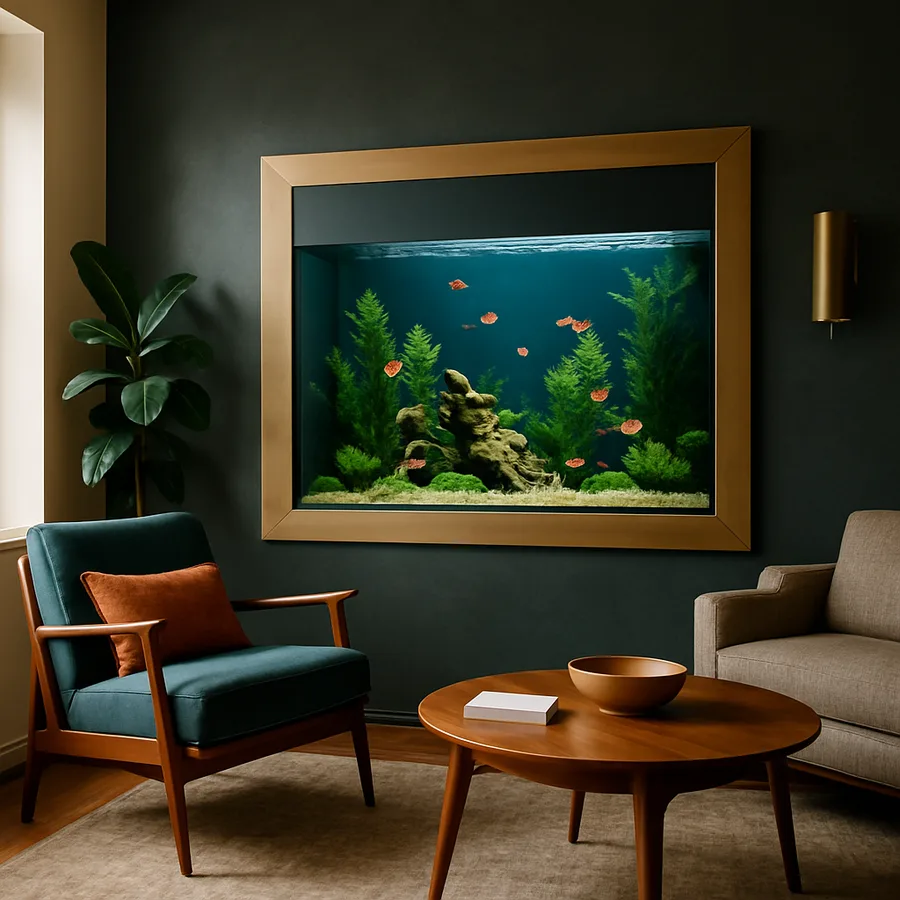
The freestanding glass aquarium that sits on a stamped-steel stand against a living room wall is a fish-keeping solution from a previous decade. It works, the fish do not care, and the homeowner spends years explaining why the orange power cords disappear behind the couch. The built-in wall aquarium answers a different question. It treats the tank as a piece of architecture, frames it like a painting, and pushes every pump, heater, and filter into a service space that the homeowner walks past without noticing. The result is what aquatic-design professionals call a presentation tank: living water as room-sized art, with the machinery that keeps the water alive completely out of view.
The Architectural Difference Between a Cabinet and a Niche
A cabinet aquarium sits inside a piece of furniture; a niche aquarium sits inside the wall itself. The distinction matters more than it sounds. A cabinet uses standard furniture-grade plywood, casters, and a doored base for equipment access, and it can be relocated to another room by two people on a Saturday afternoon. A niche is permanent. The framed opening is part of the wall structure, the equipment lives in the room behind the wall, and the front face of the tank reads as a window cut through architecture rather than an object set against it.
The architectural read is the entire point. A 60-by-24-inch tank set into a wall at viewing height looks like a cropped photograph of a coral reef when the lighting is right, and the optical effect collapses entirely the moment a power cord is visible. Hiding the equipment is therefore not a luxury but the central design problem. Solve it well and the tank disappears into the wall; solve it poorly and the niche becomes a more expensive version of a stand-mounted tank.
The other architectural argument is acoustic. Aquarium pumps, return manifolds, and protein skimmers generate a continuous low-frequency hum that homeowners stop noticing in their own living rooms but that visitors register immediately. Pushing the equipment into a separate service room, often a closet or unfinished basement bay directly behind the display wall, drops the audible sound level inside the living room by ten to fifteen decibels. The tank reads as silent water, which is the read it deserves.
Structural Loads and Framing Requirements
Water weighs 8.34 pounds per gallon, and a modest 75-gallon built-in tank therefore loads its support structure with more than 600 pounds of water alone. Add the rock, sand, glass, and stand and the live load climbs past 900 pounds concentrated on a footprint of roughly 12 square feet. That is significantly more than residential floor framing was designed to carry without reinforcement. The National Association of Home Builders publishes load guidance for residential construction, and any aquarium larger than 50 gallons placed on a wood-framed floor deserves an explicit structural review by a licensed engineer.
The framing problem also extends to the wall itself. A wall niche cuts a header-and-jamb opening through what is often a load-bearing partition, and the new header must carry the load that the removed studs previously carried. For a 60-inch wide opening in a typical 2x6 load-bearing wall, the header is usually a doubled engineered-lumber beam with proper bearing at each end. NAHB's residential structures guidance points to the analytical methods, but the actual design belongs in the hands of the engineer or the licensed contractor.
Have you considered which side of the wall holds the equipment? The service-side framing must be strong enough to support a sump tank, often containing 30 to 50 gallons of additional water, plus pumps, heaters, and a stand for the whole assembly. That side of the wall therefore needs its own structural solution, and the easiest answer is to set the sump on the slab in a basement or on a reinforced platform tied directly into the floor framing. Hanging a sump from wall framing is a bad idea regardless of the framing material.
Hidden Filtration and the Sump Concept
A sump is a second tank, mounted below or behind the display tank, that holds the mechanical and biological filtration equipment along with the heaters, the dosing pumps, and the protein skimmer for marine systems. Water flows from the display tank to the sump by gravity through an overflow box, runs through the filtration media in the sump, and returns to the display tank via a single submersible or external pump. The arrangement keeps every piece of equipment out of the display tank and isolates the noise and heat to the service room.
The benefits compound. The sump dilutes the bioload of the display tank by adding water volume, which stabilizes the chemistry and gives the homeowner more room to make small mistakes without catastrophic consequences. Heaters in the sump never appear in the display, which removes the second-most-common visual failure of cabinet aquariums after the power cord. Top-off systems that replace evaporated water tie into the sump rather than the display, which means the homeowner never reaches into the show tank for routine maintenance.
The plumbing detail that matters most is the overflow, the device that drains water from the display tank into the sump. A poorly designed overflow gurgles, traps air, and floods the floor when the return pump fails. A well-designed overflow runs silent, self-primes after a power outage, and includes a redundant siphon so a single clogged intake does not flood the room. The Herbie and Bean-Animal designs are the two configurations that aquatic-engineering literature recommends, and either implementation requires a careful initial setup followed by no further attention for years.
Lighting, Glass, and the Visual Result
The glass on a built-in aquarium does more than hold water. It is a window, and like any window the optical quality determines whether the view through it reads as art or as a pet enclosure. Standard tempered tank glass works fine for casual installations, but a built-in tank deserves low-iron starphire glass, which removes the green tint that ordinary glass adds to the underwater scene. The price difference for a 60-by-24-inch front pane runs roughly 400 dollars, and the visual difference is approximately the same as the difference between a mid-range and a high-end television.
Lighting determines whether the underwater scene reads as flat or dimensional. The current generation of LED aquarium lights produces light spectra tuned for either freshwater plants or marine corals, and the right unit will simulate sunrise, daylight, sunset, and moonlight with programmable transitions across a 12-hour cycle. The fixture should mount inside the upper soffit of the niche so that no portion of the lighting hardware is visible from the room, and the cabling should run through a chase to the service room.
Reflections on the tank glass are the design failure that ruins more built-in installations than any equipment problem. Bright track lights aimed at art on the opposite wall show up in the aquarium glass at viewing height, and the result is a tank you cannot see clearly during the very hours guests are most likely to be in the room. The fix is to specify low-glare interior lighting in the room with the tank, or to use an anti-reflective glass treatment on the front pane, or both. The American Society of Interior Designers publishes lighting guidance for spaces with reflective surfaces, and following that guidance prevents the most common visual mistakes.
Filtration Media and Water Chemistry
The biological filter inside the sump is a colony of nitrifying bacteria that converts the ammonia produced by fish waste into nitrite and then into the much less toxic nitrate. The bacteria need surface area to colonize, and modern filtration media provide that surface area in compact volumes. Ceramic biomedia, plastic K1 media, and matrix media each provide between 700 and 1,200 square meters of surface area per liter of media, which is two orders of magnitude more than the old gravel-bed filters that dominated home aquariums in the 1990s.
Mechanical filtration removes particulate matter before it decays. A pleated cartridge or a rolling filter mat captures debris from the water column, and replacing or cleaning the mechanical media on a weekly schedule prevents the visible water cloudiness that defines an unmaintained tank. The job takes about three minutes if the equipment lives in the service room and roughly twenty minutes if the homeowner has to disassemble a hang-on filter every week. That ratio is the single best argument for the built-in approach.
Marine systems add a third layer: the protein skimmer, which uses a column of fine bubbles to lift dissolved organic compounds out of the water before they break down into nitrate. A properly sized skimmer in the sump pulls roughly a cup of brown waste from the system every week, and that cup represents waste that would otherwise accumulate in the display tank as algae food. Marine aquarists who skip the skimmer fight algae blooms forever; aquarists who run a skimmer correctly rarely see them. The tradeoff is the modest additional cost of the device and the space it occupies in the service room, both of which are easily accommodated in a properly planned built-in.
Daily Operation and Long-Term Maintenance
A well-designed built-in aquarium asks for less owner attention than a cat. The automatic top-off system replaces evaporated water from a reservoir, the dosing pumps add trace elements on a schedule, and the LED lighting cycles through its programmed day without intervention. The homeowner's only routine task is the weekly or biweekly water change, which involves draining 10 to 20 percent of the system volume from the sump and replacing it with conditioned tap water or, for marine tanks, with mixed saltwater from a separate reservoir. That task takes 15 minutes for freshwater and 30 minutes for marine, and it can be automated entirely with a more sophisticated equipment package.
The fish and coral health monitoring is the part that requires attention rather than time. A weekly five-minute observation of feeding response, swimming behavior, and color tells the experienced aquarist nearly everything that test kits would reveal an hour later, and the test kits exist to confirm what the eye already noticed. Beginners should run weekly water tests for the first six months and reduce to monthly after the system stabilizes, which usually happens between the third and the sixth month of operation.
The American Veterinary Medical Association publishes general guidance on the welfare of fish kept in home aquariums, and the AVMA aquatic animal welfare resources are the authoritative reference for the ethical questions that responsible aquarium ownership raises. The hobby has grown more rigorous over the past decade, and the standards for stocking density, species compatibility, and end-of-life care have all tightened. A built-in tank deserves the same level of care as any other living system in the home.
Cost, Timeline, and the Decision to Commit
A modest 75-gallon built-in installation costs between 8,000 and 15,000 dollars in 2026 pricing for a freshwater system installed in an existing home, including the structural work, the tank, the equipment, and the finish carpentry. A reef aquarium in the same volume runs 50 to 100 percent more because the lighting, the skimmer, and the water-quality monitoring equipment are all considerably more expensive. The numbers climb sharply with tank size; a 200-gallon installation can easily reach 40,000 dollars by the time the project is complete.
The construction timeline runs four to eight weeks for a typical residential built-in. The first week is structural work and electrical rough-in, the second through fourth weeks are plumbing and equipment installation, and the final weeks are biological cycling, fish stocking, and system tuning. The cycling phase cannot be rushed; the bacterial colony in the sump needs time to establish itself, and adding fish before the colony is mature produces ammonia spikes that kill the inhabitants. Patience during this phase is the difference between a thriving display and a series of replacement fish.
Is a built-in the right choice for your home? Three questions clarify the decision. First, will you be in the home long enough to amortize the investment, which usually means at least seven years of expected residence? Second, do you have a service space directly behind the proposed display location, ideally with a floor drain and a dedicated electrical circuit? Third, are you committed to the weekly maintenance cadence, or will the tank become an expensive liability the first time you travel for two weeks? If any of those answers is uncertain, a high-quality cabinet tank is the cheaper and more reversible alternative.
Conclusion
A built-in wall aquarium with hidden filtration is the most ambitious installation that residential aquarium-keeping offers, and the result is the closest thing the hobby produces to genuine living art. The architectural framing presents the underwater scene as a window into another world; the hidden filtration removes every visual reminder that the world is mechanical; and the design discipline required to integrate the structural, plumbing, electrical, and biological systems forces a level of execution that elevates the entire project above what any off-the-shelf product can deliver. Done well, the tank becomes the visual anchor of the room and the most-photographed feature in the home.
The hidden filtration is the engineering miracle that makes the architectural read possible. A sump in a service room handles every function that ordinary aquarium equipment would force into the display tank, and the homeowner experiences the result as effortless living water rather than as a piece of equipment that needs attention. The investment in the sump and the service-room infrastructure pays back every day for the life of the installation, because the daily user experience is fundamentally different from the experience of any visible-equipment aquarium.
What does the next step look like? Start with a measured drawing of the wall you have in mind, then identify the room or closet on the other side and confirm that it can host the equipment. Next, hire an aquarium-specific design-build firm rather than a general contractor; the specialty knowledge for the plumbing, the chemistry, and the lighting matters more than the carpentry, and a firm that has installed twenty residential built-ins will avoid the mistakes that a first-time installer is guaranteed to make. Schedule a consultation with a reputable aquarium installer this month and ask to see three completed residential projects in person before you commit to a contract.
The fish-keeping hobby has produced an enormous amount of equipment, technique, and design wisdom over the past forty years, and the built-in wall aquarium is the architectural application of all of that knowledge. The result is a home feature that no piece of furniture and no amount of art can replicate. Hidden filtration is the technical solution that makes the visual experience possible, and the homeowner who invests in both gets a daily relationship with living water that pays back for as long as the home stands.
More Articles You May Like


Comments
Post a Comment