Pull-Out Trash and Recycling Sorting Bins Behind Cabinet Doors
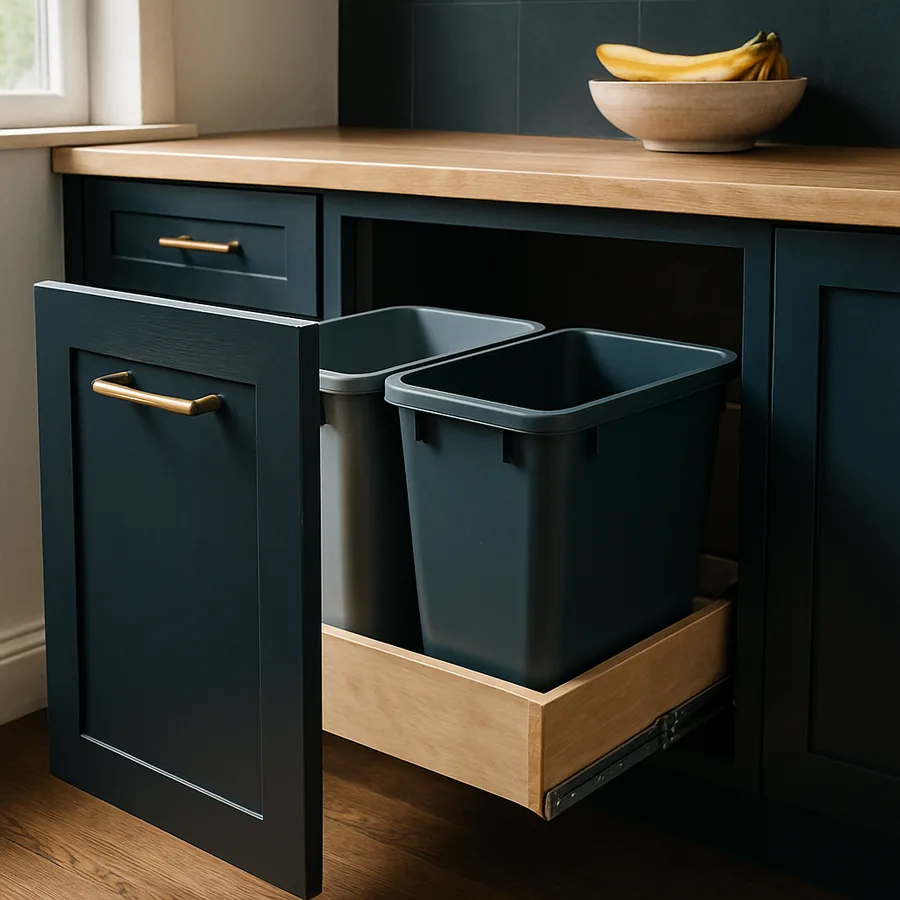
A free-standing kitchen trash can is one of those design compromises that everyone has accepted for so long they have stopped noticing it. It dominates the floor space next to the counter, it broadcasts the contents of last night's dinner every time someone walks past, and it makes recycling sorting either a chore that happens elsewhere or an honor system most households quietly fail. The pull-out under-counter sorting bin system solves all three problems in a single cabinet retrofit, and it is now standard equipment in essentially every new custom kitchen built since 2018.
This article walks through the bin sizing math (single bin, double bin, triple bin, and the specific gallon counts that fit standard cabinet widths), the hardware geometry that supports the unique loading challenges of trash bins, the ventilation and odor management details that separate a system you love from one you regret, and a complete retrofit sequence you can execute in an existing kitchen without replacing the cabinet. According to a market analysis cited by the National Association of Home Builders (NAHB), integrated trash and recycling pull-outs are among the top three most-requested kitchen features in remodel projects, alongside soft-close drawers and induction cooktops.
The Cabinet Math: Bin Count, Gallon Capacity, and Width
Before you order anything, decide how many waste streams your household actually produces. Most American households generate at least three: landfill trash, mixed recycling (paper, plastic, metal), and food scraps for composting if local pickup or backyard composting is in play. Some municipalities, especially in California and the Pacific Northwest, mandate four streams (trash, recycling, organics, glass-only). The EPA's municipal recycling guidelines are a useful first stop to confirm what your local hauler accepts; sorting at the point of disposal dramatically improves diversion rates compared with sorting later.
For cabinet width, the rough math: a single 18-inch wide cabinet holds one tall bin (typically 35 quart, equivalent to roughly 9 gallons). A 24-inch cabinet holds either one extra-large bin (50-60 quart) or two side-by-side smaller bins. A 30-inch cabinet comfortably holds two large bins, and a 36-inch cabinet can hold three medium bins for full three-stream sorting. The National Kitchen and Bath Association (NKBA) recommends sizing the recycling bin equal to or larger than the trash bin, since recycling volume in modern households has surpassed landfill trash by roughly 60 percent on a weekly basis.
Have you ever stood at the curb on collection day and noticed your recycling bin overflowing while the trash bin sits half-empty? That ratio is exactly why over-sizing the recycling slot in the cabinet pays off. Ordering a system with a generous recycling capacity is the single decision that prevents the in-cabinet sorting from getting abandoned three months in.
Hardware: The Unique Demands of a Trash Pull-Out
Trash bins put unusual loads on a pull-out frame. Unlike a kitchenware drawer where the load is centered, a half-full bag of bottles can sit asymmetrically in the bin, putting torque on the slides every time the cabinet is opened. The frame also gets repeatedly slammed open and shut at higher velocity than other drawers, since people in a hurry to dispose of food are not gentle. Standard kitchen drawer slides will fail under this duty cycle within a few years.
What you want is a heavy-duty pull-out frame system rated for at least 110 pounds dynamic load with a documented cycle life over 80,000 openings. Blum's Tandem heavy-duty slides and Häfele's purpose-built waste-bin pull-out frames both meet this bar. The Häfele units in particular include a dampening mechanism that absorbs the slamming-shut energy that destroys lesser hardware. You can review their full waste system specifications at the Häfele kitchen waste catalog.
Door mounting is the other hardware decision. Some pull-outs attach to the cabinet door, so the door swings open as the frame extends (a "door-mount" system). Others have a separate front panel that pulls out independently, with the door opening first ("frame-mount"). Door-mount systems are simpler and cheaper but require careful hinge alignment to keep the door from binding. Frame-mount systems are more forgiving and slightly more expensive but offer a stronger feel and better long-term reliability. For a kitchen used by multiple household members, frame-mount is the safer specification.
Ventilation and the Odor Question
The single biggest worry homeowners express about hidden trash storage is odor. The closed cabinet traps food smells, the smell builds up between empty-out cycles, and opening the cabinet becomes an unpleasant experience. The good news is that this problem is fully solvable with three simple details, and once those details are in place, the in-cabinet system actually smells better than a free-standing can did.
First detail: ventilation. The cabinet needs at least 4 square inches of vent area to the outside of the cabinet, ideally to a toe-kick vent grille at the bottom of the cabinet base. The grille can be a simple stainless mesh insert; the goal is air movement, not appearance. The EPA specifically recommends ventilated waste storage in their indoor air quality guidance, since stagnant food waste can produce volatile organic compounds.
Second detail: bin material. Plastic bins absorb odors over time. Stainless steel bins do not. The cost premium for stainless is modest (roughly $30 to $50 per bin) and the long-term odor difference is dramatic. After three years of daily use, a plastic bin will smell even when empty; a stainless bin rinses clean.
Third detail: the lid. A bin without a lid lets odor escape continuously into the cabinet. A lid that requires manual operation (lift to open) gets bypassed when hands are full. The right answer is a hinged lid integrated into the pull-out frame itself, which lifts automatically as the frame extends. Häfele, Blum, and Rev-A-Shelf all offer this geometry, and once you have used it you will never go back to a manual lid.
Bag Management and Sizing the Liners
Standard kitchen bag sizes do not always match standard pull-out bin sizes, and a mismatched bag is a daily small frustration. Tall kitchen bags (13 gallon) fit most 35-quart bins. The 50-60 quart bins typically need 16-20 gallon bags. Some pull-out systems include a bag retainer ring that grips the bag's lip and keeps it from falling into the bin during use, which is a small detail that pays off every time you scrape a plate.
For households with children or anyone with mobility limits, look for pull-outs that include a foot-pedal extension rod or a knee-bump opener. Hands-free opening dramatically increases the chances that messy items actually make it into the bin instead of onto the counter. The ASID universal-design standards specifically recommend hands-free waste opening in any kitchen designed for aging-in-place.
One reader question I see often: should you separate the bag holder from the bin, so the bag hangs in a frame rather than lining the bin? It is an option, and it makes bag changes faster, but it also makes the system louder (bottles clattering in a bag without bin walls to dampen). Most homeowners who try the bag-only frame go back to bin-with-bag within a few months.
The Retrofit: Converting an Existing Cabinet
If you have an existing cabinet of suitable width with a single hinged door, the retrofit is straightforward. Empty the cabinet, remove any existing shelves, and measure the interior carefully. Pay particular attention to two dimensions: the inside width at the narrowest point (face frame interior), and the depth from the back of the door to the rear wall.
Order the pull-out system sized for those dimensions, not the nominal cabinet size. A "24-inch" cabinet often has an interior width closer to 22 inches once the face frame is accounted for, and ordering a 24-inch pull-out will yield a system that does not fit. Most reputable manufacturers publish a sizing matrix on their websites; double-check yours against the actual measurements.
Installation is typically two to four hours. Mount the slides to the cabinet floor and side walls, attach the pull-out frame to the slides, mount the door to the frame (for door-mount systems) or attach the front panel (for frame-mount), drop in the bins, and add the toe-kick ventilation grille if your cabinet base does not already have one. Test the deployment with the bins empty before loading anything; you want to confirm the door clears the adjacent cabinet face on full open.
Cost and the Long-Term Value Argument
A quality dual-bin pull-out system from a top-tier manufacturer runs $250 to $550 for hardware. Premium triple-bin systems with auto-opening lids reach $700 to $900. Add $50 to $100 for stainless bins if you choose to upgrade from the included plastic ones, and $40 to $80 for the toe-kick ventilation grille. Total project cost in materials is typically $400 to $1,100 depending on tier.
Labor for a hired installer is typically two to four hours, or $200 to $400. A confident DIYer can complete the install in a Saturday morning. Total project cost lands between $600 and $1,500 installed, which is comparable to the cost of replacing a single appliance and arguably has more daily impact on kitchen quality of life than most appliance upgrades do.
The resale argument: per the NAHB, kitchens with integrated waste and recycling pull-outs consistently score higher in buyer surveys than kitchens without, and appraisers note the feature in comp listings. The investment is recouped at sale and enjoyed daily until then.
For households with pets, an additional consideration: the cabinet door becomes a barrier between curious noses and food waste, which is a meaningful improvement over an open trash can in any home with a determined dog or counter-surfing cat. The integrated lid that lifts as the bin extends adds a second barrier. Together they reduce the daily incidence of "the dog got into the trash" calls dramatically. Some pet owners add a child-safety latch as a third layer, which works exactly the same way against pets as it does against toddlers.
Cleaning is the topic homeowners ask about second-most often after odor. The good news is that an integrated bin system is significantly easier to clean than a free-standing one. The bins themselves lift out of the pull-out frame and can go straight into the dishwasher (if stainless) or into a utility sink for a quick wash. The pull-out frame stays in place; wipe it down with a damp cloth and a mild kitchen cleaner monthly. The cabinet interior gets a similar wipe-down quarterly. Total time is about ten minutes a month, far less than the equivalent maintenance on a free-standing can that has to be lifted, drained, and washed in place.
Conclusion
The transition from a free-standing trash can to an integrated pull-out sorting system is one of those upgrades that delivers value on every axis homeowners care about. Counter and floor space recovered, recycling sorting habits actually sustained, kitchen aesthetics dramatically improved with no exposed waste container, odor managed better than the open-air can ever could, and a meaningful resale signal sent to future buyers. There is essentially no argument for keeping the free-standing can other than inertia.
The retrofit is well within the reach of a homeowner with a drill, a level, and an afternoon. The hardware market has matured to the point where multiple manufacturers offer reliable, well-engineered systems at every price tier from budget to luxury. Whether you are doing a full kitchen remodel or simply upgrading a single cabinet in an otherwise finished kitchen, the pull-out trash and recycling system is one of the few choices that has no real downside and a long list of upsides.
If your free-standing trash can is still occupying the floor space next to your counter, consider this your nudge. Walk over to the cabinet you most often stand near while cooking, open the door, and ask whether that is the natural home for waste sorting in your kitchen. If yes, take the interior measurements right now and start comparing pull-out systems this evening. The recycling rate in your household, the look of your kitchen, and the daily friction of disposing of food waste are all about to get measurably better. Order the hardware this weekend and give yourself one fewer thing to step around in your own kitchen.
More Articles You May Like



Comments
Post a Comment