Hidden Laundry Closets Behind Bifold Doors in Hallways
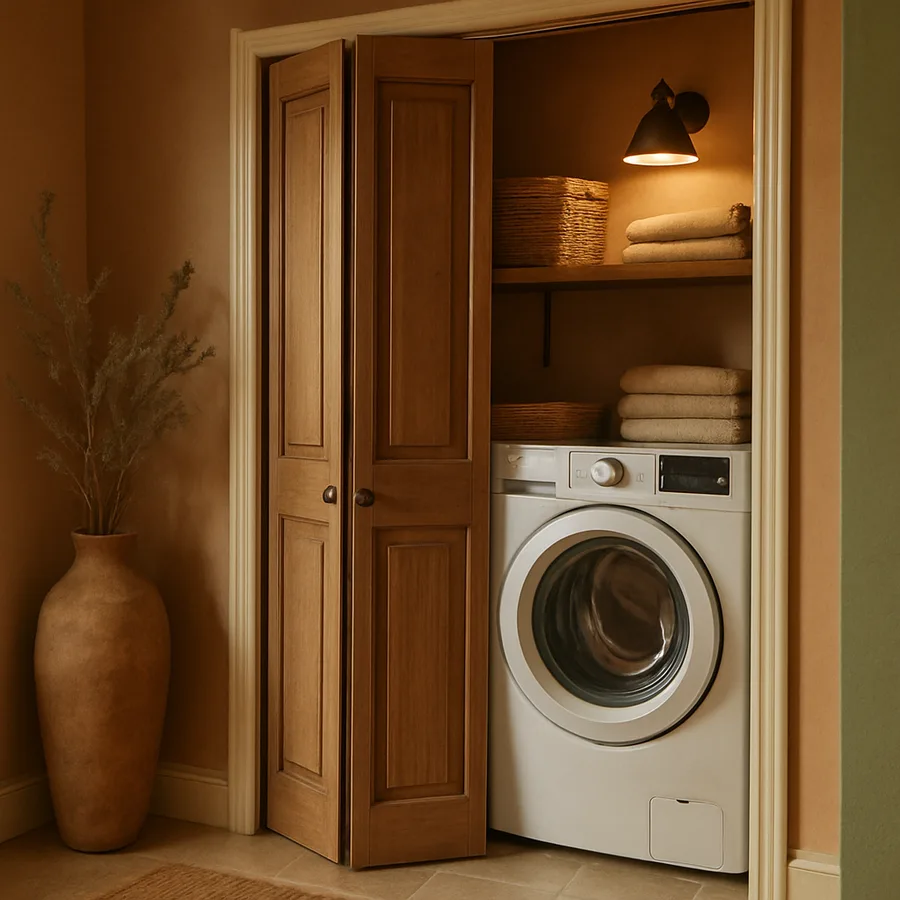
The Appeal of Concealed Laundry in Shared Living Spaces
Not every home has the luxury of a dedicated laundry room with four walls and a door. Millions of apartments, condominiums, and smaller houses rely on hallway closets to house their washer and dryer. The challenge is that a hallway is a shared transition space, visible from bedrooms, bathrooms, and living areas. An exposed washer and dryer in an open alcove looks utilitarian at best and messy at worst, especially mid-cycle when detergent bottles, lint, and stray socks accumulate on every surface.
Bifold doors solve this problem with elegant simplicity. They fold flat against the sides of the closet opening, provide full access to the machines when open, and present a clean, unbroken surface when closed. Unlike hinged doors that swing into the hallway and block foot traffic, bifold panels collapse within the width of the opening itself. This makes them the most space-efficient concealment option for hallway laundry installations.
According to the National Association of Home Builders (NAHB), approximately 22% of American homes place laundry equipment in a hallway closet rather than a dedicated room. That figure is significantly higher in urban markets where floor plans prioritize living space over utility space. For these homes, the bifold door is not merely a design choice but a functional necessity that determines how gracefully the laundry area integrates with the rest of the home.
The design community has embraced the hidden laundry closet as a legitimate interior design solution rather than a compromise. Featured projects on Houzz and in shelter magazines demonstrate that a well-designed laundry closet behind bifold doors can be as attractive and functional as a full laundry room, provided the details of ventilation, noise management, and interior organization are handled correctly.
Planning the Closet Dimensions and Machine Configuration
The minimum closet width for a side-by-side washer and dryer is 60 inches, accommodating two 27-inch-wide machines with three inches of clearance on each side and between the units. Most hallway closets fall short of this width, which is why stacked configurations are the standard for hidden laundry closets. A stacked washer-dryer unit or a stackable pair fits in a closet as narrow as 32 inches, freeing the remaining width for shelving, a hamper, or additional storage.
Closet depth must accommodate the machine plus supply connections and exhaust ducting behind it. Front-load washers and dryers typically require 30 to 33 inches of depth from the back wall to the front of the machine. Add two to four inches for hoses, electrical connections, and the dryer vent duct, and the minimum closet depth reaches 34 to 37 inches. Compact European-style units designed for apartment use can reduce this requirement to 28 to 30 inches total depth.
Height matters for stacked configurations. A stacked washer and dryer pair stands approximately 75 to 80 inches tall, leaving minimal clearance in a closet with a standard 96-inch ceiling. That remaining space above the machines is valuable for a shelf that holds detergent, fabric softener, and cleaning supplies. Plan for at least 12 inches of clearance above the top machine to install a practical shelf and still access items stored on it.
Have you verified that your hallway closet meets these minimum dimensions? Measure the interior width, depth, and height before selecting machines or planning door installations. A closet that is even two inches too narrow will prevent proper machine installation and create ongoing headaches with maintenance access. Measure at multiple heights, as older homes often have walls that are not perfectly plumb, and the narrowest point determines the usable width.
Choosing and Installing Bifold Doors That Perform
Standard bifold doors from home improvement retailers come in widths from 24 to 36 inches per pair and heights of 80 inches. For a hallway laundry closet, a 48-inch or 60-inch wide opening typically requires two pairs of bifold panels that meet in the center. The panels fold outward on a top-mounted track, and each pair is connected by a pivot hinge at the jamb side and a guide pin at the top track. Quality hardware makes the difference between doors that glide smoothly and doors that stick, derail, and frustrate.
Upgrade from the basic hollow-core bifold panels that ship as builder-grade to solid-core or MDF panels for meaningful noise reduction. Hollow-core doors transmit sound freely, meaning the spin cycle and dryer tumble will be clearly audible throughout the hallway even with the doors closed. Solid-core bifold panels reduce sound transmission by 10 to 15 decibels compared to hollow-core alternatives, a difference that is clearly perceptible to the human ear. The American Society of Interior Designers (ASID) recommends solid-core doors for any concealed utility closet that opens onto a living space.
Track quality determines long-term performance. The aluminum track and nylon roller systems found in premium bifold hardware sets operate quietly and resist the warping that causes cheap steel tracks to bind. Johnson Hardware and Knape and Vogt both manufacture bifold systems rated for heavy residential use that maintain smooth operation for decades. Replace the stock track included with budget doors; the upgrade costs under $30 and prevents the most common bifold door complaint, panels that jump off the track.
For a more finished appearance, consider paneled or louvered bifold doors that match the trim style of adjacent bedroom and closet doors in the hallway. Consistency in door style across a hallway makes the laundry closet visually indistinguishable from a linen closet or bedroom closet, which is the entire point of concealment. Paint the bifold panels the same color as the hallway trim for maximum camouflage, or select a contrasting color that acknowledges the doors as a deliberate design element.
Ventilation: The Most Critical Technical Requirement
A concealed laundry closet generates heat, humidity, and dryer exhaust that must be managed properly to prevent mold growth, machine overheating, and indoor air quality problems. The dryer requires a dedicated exhaust duct that vents to the building exterior. This is a non-negotiable code requirement in every jurisdiction. Never vent a dryer into the closet interior or into the hallway, regardless of whether the dryer is gas or electric. Gas dryers produce carbon monoxide, making interior venting life-threatening, and electric dryers produce moisture that will cause mold within weeks.
The exhaust duct should be rigid or semi-rigid metal, not the flexible vinyl or foil ducting that was common in older installations. The Consumer Product Safety Commission (CPSC) has linked flexible vinyl dryer ducts to increased fire risk and recommends rigid metal ducting for all installations. Keep the duct run as short and straight as possible; each 90-degree elbow in the duct adds the equivalent of five feet to the effective duct length, reducing airflow and increasing lint accumulation.
Beyond dryer exhaust, the closet itself needs air circulation. When both machines run simultaneously in an enclosed space, the ambient temperature inside the closet can rise 15 to 20 degrees above the surrounding room temperature. This heat buildup shortens machine lifespan and can trigger thermal shutoff switches that interrupt cycles. Install a louvered vent panel in the closet door or wall to allow passive airflow, or add a small in-wall exhaust fan wired to the closet light switch.
Is your dryer vent currently running through an interior wall to an exterior outlet? Verify the full duct path and check for kinks, sags, or crushed sections that restrict airflow. A restricted vent forces the dryer to work harder, increases drying times, raises energy costs, and creates a fire hazard from accumulated lint. Annual vent cleaning is recommended by the CPSC and should be part of your routine home maintenance regardless of whether the dryer is in a closet or a dedicated room.
Noise Management Strategies for Hallway Installations
Sound control is the second major technical challenge of hallway laundry closets. Washing machines in spin mode can produce 70 to 75 decibels, equivalent to a vacuum cleaner running continuously. That noise level is disruptive in a hallway adjacent to bedrooms, especially during evening hours. A multi-layered approach to noise reduction makes the difference between a hidden laundry closet that works around the clock and one that can only operate during daytime hours.
Start with the machines themselves. Modern front-load washers with direct-drive motors and brushless technology operate significantly quieter than older belt-driven models. Samsung, LG, and Bosch all manufacture compact washers rated below 50 decibels during spin cycles, which is comparable to a quiet conversation. Investing in a quieter machine is the single most effective noise reduction strategy and often costs less than retrofitting acoustic treatments into the closet structure.
Anti-vibration pads placed under each machine foot absorb mechanical vibration before it transfers into the floor and wall structures. Vibration that reaches the framing propagates through the entire hallway as a low-frequency hum that is difficult to block with surface treatments alone. Rubber or neoprene pads rated for washing machine use cost $20 to $40 for a set of four and reduce structure-borne noise by 25 to 50 percent according to manufacturer testing data.
Adding mass to the closet walls further dampens airborne noise. A second layer of 5/8-inch drywall applied over the existing wall surface, with a bead of acoustic caulk between the layers, creates a mass-loaded barrier that blocks mid-frequency and high-frequency sounds. This treatment is most effective on the wall shared with an adjacent bedroom. If full wall treatment is impractical, focus on the upper half of the shared wall, where sound from the dryer and upper machine in a stacked configuration is most intense.
Interior Organization to Maximize Every Inch
A hallway laundry closet has no wasted space to spare. Every square inch of the interior must be organized to hold supplies, facilitate workflow, and maintain the tidy appearance that justifies concealment behind bifold doors. The wall space above a stacked washer-dryer is the primary storage zone, and a single shelf spanning the full closet width holds essential supplies within arm's reach of the machines.
Side walls, often overlooked, provide vertical storage for narrow items. A mounted broom holder or utility hook strip on the side wall keeps ironing boards, drying racks, and cleaning tools organized without consuming shelf space. Magnetic strips or small bins attached to the side of the machines themselves can hold dryer sheets, lint rollers, and stain treatment pens right where they are needed most during the loading and unloading process.
A pull-out hamper system that fits between the machines and the closet wall, or beneath a shelf, keeps dirty laundry contained and out of sight when the doors are closed. Several manufacturers produce hamper units specifically dimensioned for laundry closets, with frames that mount to the closet wall and fabric bags that lift out for transport to the machines. The National Kitchen and Bath Association (NKBA) recommends integrated hamper solutions as a standard specification for any closet-based laundry installation.
Keep the closet floor clear except for the machine footprints. Items stored on the floor beside the machines create tripping hazards, block access for maintenance, and prevent the bifold doors from closing fully. If floor-level storage is necessary, use a narrow rolling cart that can slide in and out of the gap beside the machines. When the bifold doors close, everything inside should be contained, upright, and orderly so that opening the doors to start a load does not greet you with visible clutter.
Conclusion: A Hidden Laundry Closet Can Be Both Practical and Polished
Concealing your washer and dryer behind bifold doors in a hallway is a design strategy that works beautifully when the technical details are handled with care. Ventilation, noise management, and interior organization are the three pillars that determine whether a hidden laundry closet is a successful space-saving solution or a source of ongoing frustration. Address all three during the planning phase, and the result is a laundry installation that disappears completely when not in use.
The bifold door itself deserves more attention than it typically receives. Solid-core panels, quality track hardware, and a finish that matches the hallway trim transform a utilitarian closure into an architectural element that blends seamlessly with its surroundings. The goal is for guests to walk past the closet without any idea that a fully functional laundry station sits behind it.
For homeowners in apartments and compact homes, this approach is not a compromise but a deliberate and effective use of limited space. The same square footage that would sit idle as a coat closet or linen closet can house the appliances that serve your household every single day. With the right machines, proper venting, and thoughtful organization, a hallway laundry closet performs just as well as a dedicated laundry room at a fraction of the footprint.
Assess your hallway closet this week: measure the interior dimensions, check the location of your dryer vent, and evaluate the existing door hardware. With those three data points in hand, you can plan a hidden laundry installation that keeps your hallway clean, your machines accessible, and your home looking polished from every angle.
More Articles You May Like



Comments
Post a Comment