Privacy Fence Designs for Backyard Without Looking Like a Prison
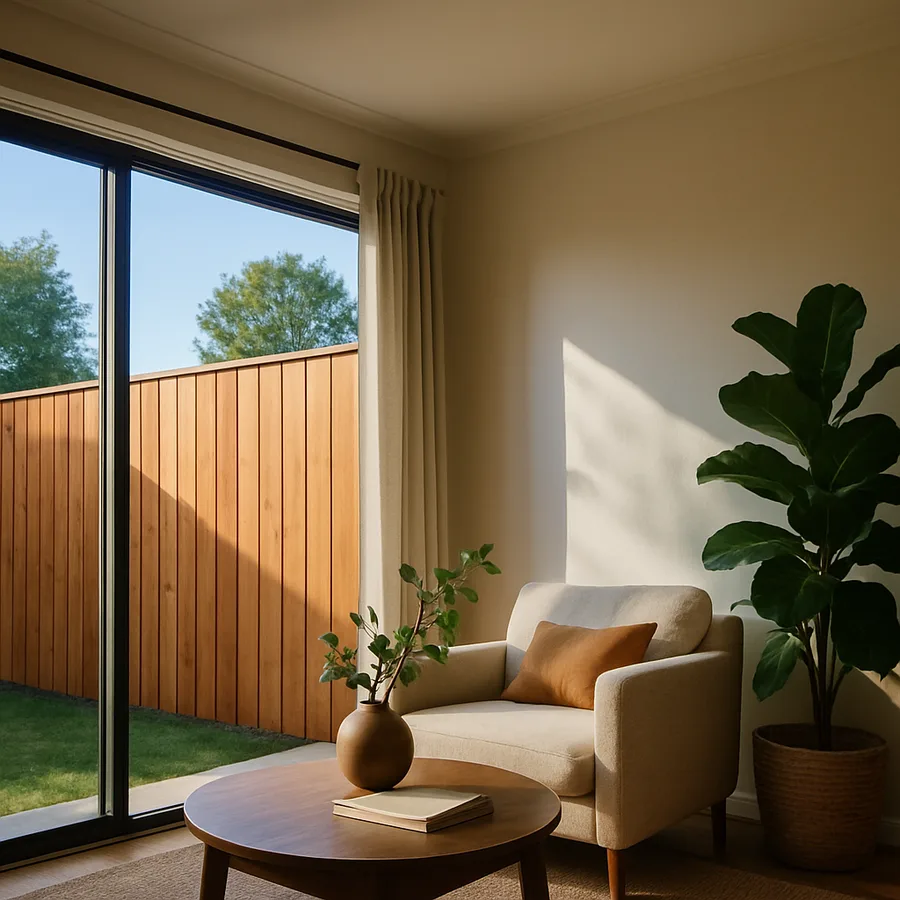
Most homeowners describe their privacy fence in two words: tall and solid. Then they build one and discover that solid eight-foot panels behind a small lawn produce the spatial feel of a recreation yard, not a private retreat. The problem is rarely the height; it is the lack of articulation, scale breaks, and softening that turns a wall into something the eye accepts as part of a garden rather than something it processes as a barrier.
This guide covers the design moves that consistently make tall fences feel residential instead of institutional. The strategies pull from landscape architecture, residential carpentry, and homeowner survey data published by the National Association of Home Builders, which reports that privacy is the single most-cited reason for fence installation, ahead of pets, security, and pool code combined. Privacy is the goal; what we are pushing against is how privacy gets executed.
Why Tall Solid Fences Read as Institutional
A continuous, opaque, eight-foot vertical surface has very few cues that tell a viewer "garden" and many that tell a viewer "perimeter." The cues missing are visual rhythm at human scale, depth changes, and material transitions. The cues present are uniformity, height-to-eye-distance ratios that block the horizon, and a hard line where the fence meets the lawn.
The brain reads enclosure intensity by ratio, not by absolute height. A six-foot fence ten feet from a patio feels far more enclosing than an eight-foot fence twenty-five feet away. Pull the fence farther from where you sit, and you can build it taller without it crowding you. This is the first move every successful private backyard makes: it does not maximize fence height, it maximizes effective distance.
The second factor is uniformity. A 60-foot run of identical pickets at identical spacing reads as a wall. The same 60-foot run broken into four panels with subtle changes in board direction, post cap style, or material reads as a series of garden screens. Scale breaks every 8 to 12 feet are what landscape architects use to dissolve perceived length, and the principle works for fences just as well as for hedges.
Material Choices That Soften Without Sacrificing Privacy
Wood remains the most adaptable privacy material because you can shape it freely. Western red cedar, redwood, and thermally modified ash all weather to silvers and grays that disappear visually next to plants in a way that pressure-treated yellow pine does not. Black-stained cedar, in particular, recedes against green foliage and can make a fence appear thirty percent farther away than a natural-finish version of the same fence.
Composite and aluminum fences have improved enough that they no longer announce themselves the way early generations did. Composite slats can be specified in widths and spacings indistinguishable from milled cedar at a viewing distance of more than ten feet. Aluminum vertical bars with deeply colored powder coats vanish into shadow when planted with bamboo or upright junipers behind them. The trade-off is cost: expect 60 to 120 percent more for premium composite or aluminum versus quality cedar.
Living elements blur the man-made edge. A tight-clipped hornbeam or beech hedge planted just inside a fence becomes the visual surface; the fence becomes a structural backbone that nobody sees after year three. The American Society of Landscape Architects has published case studies showing that mixed fence-and-plant assemblies provide better acoustic privacy than fence alone, because foliage scatters higher frequencies that solid fence simply reflects. ASLA resources include several residential examples worth studying before finalizing a design.
Height Tactics, Stepping, and Code Realities
Most municipalities cap rear-yard fence height at six feet, with side and front-yard limits often lower. Going higher requires a variance, a setback compromise, or creative interpretation of definitions. Lattice toppers are one workaround: many codes count the solid portion only, so a six-foot solid fence with a 24-inch open lattice cap can deliver a true 96 inches of visual screen while remaining compliant. Lattice that is at least 50 percent open by area generally qualifies in most jurisdictions, but verify locally.
Stepping the fence height with the grade is one of the most overlooked tactics. A run that climbs a slope in 16-inch steps, with each section the same height relative to its own grade, reads as architecture rather than a wall. A fence built level across a slope, by contrast, exposes more material at the low end and creates a heavy, fortress feel exactly where you want lightness.
The other height tool is the tiered fence: a six-foot solid section closest to the patio, a four-foot semi-transparent section at the property line, and a planted buffer in between. You see only the closer fence; the visual distance is bigger than the lot. Have you ever felt that a small backyard somehow felt twice as big as expected? This kind of layered enclosure is usually the reason. The International Code Council documents typical residential fence and barrier requirements in ICC publications that builders rely on for permit review.
Patterns and Detail Work That Read as Residential
Pattern is what separates a fence from a wall. Even on a fully solid privacy fence, small variations register at conversational distance. A shadowbox or board-on-board pattern alternates boards on opposite sides of the rails so that no through-line of sight exists, but the surface gains a subtle vertical rhythm and a slight three-dimensional depth. From inside, you see boards on your side; from outside, the neighbors see theirs. Both surfaces look better than a flat-board privacy fence.
Horizontal slat fences have replaced vertical pickets in much of contemporary residential design because the horizontal lines visually compress height and stretch width, exactly the proportional move that a tall fence around a small lawn benefits from. Slat width matters: 1x4 cedar slats with a quarter-inch reveal read as fine and crafted, while 1x6 with no reveal reads heavier and more institutional.
Cap rails, post tops, and finishing trim are the carpentry equivalent of jewelry. A flat-cut top rail with no cap looks unfinished. A simple bevel cap, a hat-style post top, or a top board oriented with a slight overhang transforms the same fence. Two stats: NADRA contractor surveys show that posts with finished caps last three to five years longer because end-grain water absorption is dramatically reduced, and that fences with a top cap rail report 20 percent fewer warped boards over a decade. The little details earn their cost in both visual return and material lifespan, which is why custom carpenters charge a small premium for them and competent contractors include them as standard rather than upcharge add-ons.
Material transitions are another scale-break tool. A run that pairs a stone or brick base course with a wooden upper section instantly reads as residential because the eye recognizes the architectural language of foundation and wall. The base does not need to be tall: even an 18-inch dry-stacked stone base under a five-foot wood fence breaks the otherwise unrelieved verticality and adds a hand-built character that no all-wood fence can match. The other transition that works reliably is wood to metal, where a steel frame supports timber slats. The frame disappears in shadow and reads as honest structure, while the timber reads as warmth.
Planting Strategies That Make a Fence Disappear
The fence designs that homeowners describe as "the best decision we ever made" almost always include intentional planting between the fence and the seating area. The plants are not decoration; they are the surface the eye lands on. The fence becomes the dark structural background, like the wall behind a painting.
Four planting categories handle 90 percent of residential cases. Tall ornamental grasses like switchgrass, miscanthus, and feather reed grass reach four to seven feet, move in the breeze, and turn brilliant copper in fall. Upright evergreens like emerald arborvitae and slim hinoki cypress provide year-round screening at the property line and can be planted in narrow strips. Climbing structures with clematis, climbing hydrangea, or trained espalier turn the fence itself into a planted wall. Specimen trees like Japanese maples or serviceberry break up the long horizontal of the fence with a single sculptural form near the patio.
Spacing matters as much as species. A common mistake is planting in a single straight row parallel to the fence, which only adds another linear element. Planting in staggered groups of three at varying distances from the fence creates depth, hides the edge, and gives the eye somewhere to rest before it reaches the perimeter. Have you noticed that some yards feel layered while others feel flat even though both have similar plant counts? The depth answer is almost always grouping versus rows.
Lighting, Sound, and the Final 10 Percent
The features that move a fence design from good to great rarely show up in a daytime photo. Low-voltage downlight mounted on the fence post tops washes the inside face of the fence at night and turns the surface into a lit feature rather than a dark wall. Up-lighting key plants in the buffer planting reverses the daytime reading and makes the planting itself the visual subject after sunset. The fence recedes into shadow, the plants glow, and the yard reads as a room.
Acoustic privacy is the side benefit nobody talks about until they realize they have it. Solid fences reflect sound; they do not absorb it. Adding a hedge in front, a thick planted buffer, or a vine-covered fence reduces sharp echo and softens neighbor conversation, traffic, and HVAC noise. The reduction is not dramatic in decibel terms but the change in perceived noise is significant because higher frequencies are what we hear most clearly.
Built-in elements anchor the fence into the rest of the garden so that it stops being a separate object. A built-in bench running along part of the fence with a planter at one end, a small water feature against the fence, or a single architectural light fixture at a key spot all do this work. Each one says "this is part of the garden" rather than "this is the perimeter of the property."
Conclusion
A privacy fence does not have to feel like a containment wall. The difference between an institutional run of pickets and a private garden room is a series of small, deliberate moves: increase the distance between fence and seating area whenever possible, break up long runs with scale changes every 8 to 12 feet, choose materials and finishes that recede visually, and put plants between you and the fence so that the fence becomes background rather than foreground. None of these moves are individually expensive; combined, they are the difference between a yard you tolerate and a yard you actually live in.
The mental model that helps most homeowners is to stop thinking of the fence as a single object and start thinking of it as one layer in a stacked privacy system. The outer layer is the property-line fence, the middle layer is planting, and the inner layer is the seating area itself. Each layer does part of the work, and the eye reads the assembly as a garden, not a wall. According to NAHB consumer studies, homeowners who invested at least 25 percent of their fence budget in adjacent planting reported significantly higher satisfaction with the finished result than those who spent the same total amount on a taller fence with no planting.
If your current backyard already has a tall, plain privacy fence and budget for a complete rebuild is unrealistic, the highest-leverage investments are paint and plants. A dark, matte paint or stain on the existing fence will recede instantly. Three groups of three layered plants in front will hide the lower half of the visual surface. A simple cap rail can be retrofitted in a weekend. Together, these changes can transform a fence already in place without permits, demolition, or property-line negotiations with neighbors.
Start by walking your yard at the time of day you actually use it. Stand where you sit, look at where the fence runs, and decide which sections you see most often. Those are the priority sections for planting, lighting, and detail work. The sections behind the garage, behind the shed, or along the side yard you walk through twice a week can be plain, tall, and cheap. Save the design budget for the views you live with every day, and the fence will stop reading as a perimeter and start reading as the edge of a room.
More Articles You May Like


Comments
Post a Comment