Pre-Fab Backyard Office Pods Compared to Custom Built Sheds
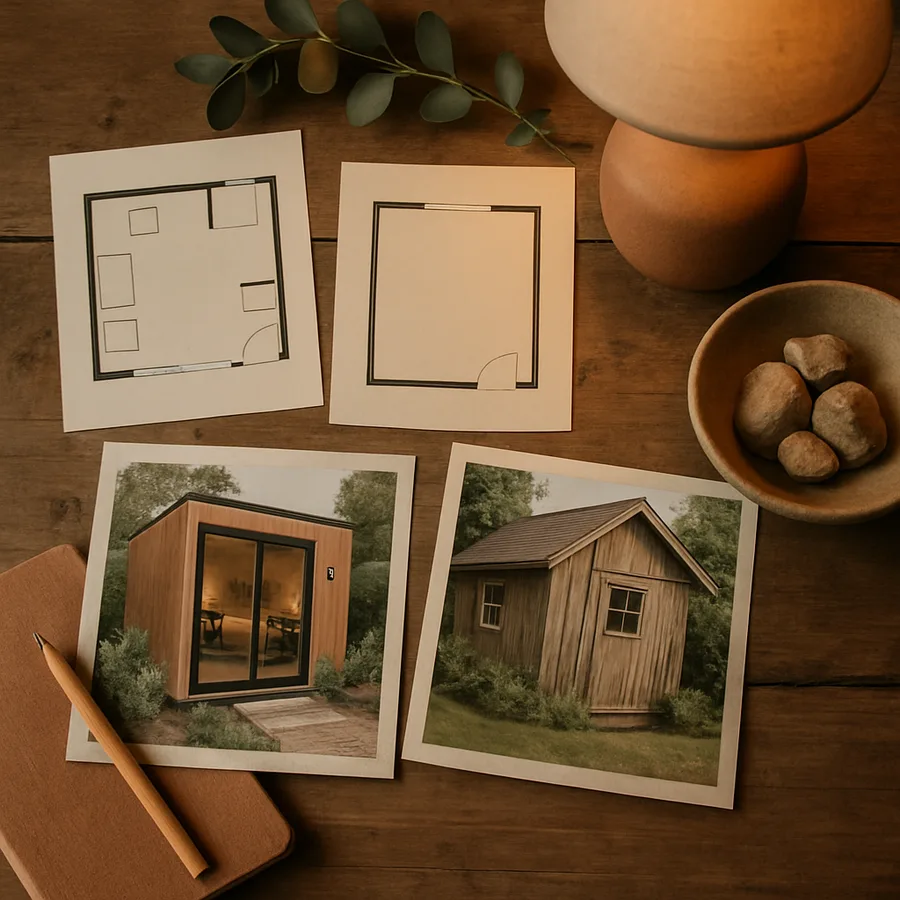
The backyard office category has split cleanly into two camps. On one side, a wave of pre-fabricated office pods from manufacturers in the United States, Canada, and Europe arrives on a flatbed and lands on prepared piers in a single day. On the other side, locally built custom sheds and studios rise on site over four to twelve weeks, designed for a specific yard and finished to a specific taste. Both approaches can produce excellent buildings, and both can produce expensive disappointments. The difference comes down to a handful of decisions made before you sign a contract.
This comparison walks through the meaningful tradeoffs across cost, timeline, code compliance, customization, performance, and resale value. The goal is not to crown a winner but to help you match the right approach to your site, your budget, and the way you actually plan to use the building. According to the National Association of Home Builders, the accessory dwelling and accessory office category has grown by more than 30% annually for several recent years, and the prefab subcategory has captured a meaningful share of that growth without displacing custom builders.
How The Two Categories Actually Differ
It is tempting to lump every prefab pod and every custom shed into two homogeneous buckets, but the categories are wider than that label suggests. A prefab can mean a fully finished volumetric module that arrives complete with electrical, mechanical, and finishes, or a flat-packed kit that requires assembly on site over several days. A custom build can mean a contractor working from a stock plan with minor modifications, or a fully bespoke structure designed by an architect for a specific lot.
The most useful distinction is between controlled-environment fabrication and on-site construction. Prefab pods are built indoors under predictable conditions, with consistent quality control, and shipped as a finished or near-finished assembly. Custom builds happen outdoors, exposed to weather, with variable labor quality and longer schedules. Both processes can produce excellent buildings; the difference is in how the risks and tradeoffs distribute across the project.
Customers who choose prefab usually prioritize speed, predictability, and a contemporary aesthetic. Customers who choose custom usually prioritize site-specific design, integration with existing architecture, and the ability to tweak details late in the process. Neither motivation is wrong, but conflating them produces unhappy outcomes. A homeowner who wants a building that looks like a piece of the existing home will rarely be satisfied with a sleek glass-fronted pod, and a homeowner who wants their building installed in a single afternoon will be exhausted by a sixteen-week custom build.
Cost Comparison Across Realistic Scopes
Headline pricing for backyard office pods often looks dramatically lower than the all-in cost a custom builder will quote, but the comparison is rarely apples to apples. A published pod price typically covers the building itself, basic electrical pre-wiring, and standard finishes. It usually excludes site preparation, foundation work, electrical service from the main panel, mechanical equipment, permit fees, and delivery beyond a base radius. By the time those line items are added, the gap narrows considerably.
For a fair comparison, build out a complete scope: a 100 to 150 square foot building, a poured pier or slab foundation, a 30 to 60 amp subpanel feed from the main service, a small mini-split, basic interior finishes, and all permit and inspection fees. A turnkey prefab in that scope typically lands between $28,000 and $65,000 depending on brand, finish level, and shipping distance. A locally built custom shed of the same scope usually lands between $30,000 and $80,000, with the spread driven by finish quality and the local labor market.
The wider price band on the custom side reflects two realities. Custom labor varies dramatically by region and contractor; a builder in a high-cost coastal market may price the same scope at twice what a builder in an inland city would charge. Custom finishes also span a much wider range than prefab options; a custom shed with painted drywall and laminate flooring costs a fraction of one with plaster walls and engineered hardwood. The National Association of Home Builders publishes regional cost-of-construction data that helps calibrate expectations for your specific market.
Timeline And Disruption
The single biggest practical difference between the two approaches is how long the project takes from signed contract to functional building. Prefab timelines typically run 6 to 14 weeks from order to install, with most of that time spent in the factory queue and only a few days of on-site work. Custom timelines typically run 10 to 24 weeks from contract to substantial completion, with the entire span spent on or near your property.
The on-site disruption profile differs dramatically. A prefab install compresses noise, debris, and contractor traffic into a single intense window. Foundation prep and utility runs happen in the weeks before delivery; the building itself drops into place in a few hours; final hookups take a day or two. Neighbors notice the project once and then it is done. A custom build spreads the same total disruption across several months, with daily comings and goings, ongoing material deliveries, and the construction debris that inevitably accumulates on a small lot.
Weather affects each path differently. A prefab built indoors is unaffected by rain or cold during fabrication, but installation requires a dry day with good crane access. A custom build can stretch significantly when winter weather, summer storms, or supply chain delays push back framing or roofing days. Two reader questions worth thinking about: how disruption-tolerant is your household, and is there a season in your region when on-site construction would be especially miserable?
Code Compliance And The Permit Conversation
One of the persistent myths in the prefab category is that buying a factory-built pod somehow exempts you from local permitting. It does not. Every habitable accessory structure must comply with local zoning, setback, height, and use requirements regardless of how it was built, and any structure with electrical or mechanical systems will trigger permits in nearly every jurisdiction.
What prefab can offer is a head start on code compliance. The best manufacturers design their buildings to meet the energy and structural requirements of the International Residential Code and provide stamped engineering drawings on request. Some manufacturers maintain pre-approved plan sets in specific cities or states, which can shave weeks off the permit timeline. The International Code Council publishes the model code language that most jurisdictions adopt, and a manufacturer that can show clear documentation of compliance with the current cycle is a stronger partner than one that hands you a brochure and a bill.
Custom builders work in the opposite direction. They start with your local code as the constraint and design within it, often handling permits as part of their service. A good custom builder will know the inspectors at your local building department personally and can often anticipate questions before they are asked. The American Institute of Architects maintains state-by-state guidance on accessory structures that can help you and your contractor navigate the local landscape. The bottom line is that both paths can satisfy code, but the work distributes differently across the project team.
Performance Over Twenty Years Of Use
The most important comparison is not what either type of building costs to install but how it performs across two decades of daily use. A backyard office is not a temporary structure; it should weather, age, and continue to serve its owner long after the initial enthusiasm has settled into routine.
Prefab buildings benefit from controlled fabrication conditions, which generally produces tighter envelopes, more consistent insulation, and fewer moisture issues than field construction. The best manufacturers blower-door test every unit before shipping and warranty their envelopes for ten years or more. The downside is that prefab buildings are harder to modify after delivery; if you decide three years in that you want to add a window or change the roof line, you may find the wall construction does not lend itself to field modification.
Custom buildings can be built to any performance standard you specify, but the actual outcome depends entirely on the builder. A meticulous custom builder will produce a tighter, better-detailed building than the average prefab; a careless one will produce a leaky disappointment. The advantage of custom over a 20-year horizon is repairability. A site-built shed framed with standard 2x6 lumber, sheathed with plywood, and clad with conventional materials can be modified, repaired, or extended by any competent local contractor in any year. A proprietary prefab assembly may require manufacturer-specific parts that become harder to source as the company evolves or, in some cases, exits the market.
Resale Value, Appraisal Treatment, and the Real Estate Conversation
Both prefab pods and custom sheds add appraised value when permitted, conditioned, and finished to residential standards, but the treatment varies by appraiser and by market. The Appraisal Institute guidance generally treats accessory buildings as separate components valued through a combination of cost approach and comparable sales. Permitted, finished, conditioned space adds more value than unpermitted or unconditioned space, sometimes dramatically more.
In strong real estate markets, particularly those with high housing prices and tight inventory, a quality backyard office of either type can return 50 to 70% of its construction cost at resale, and in some markets it returns 100% or more by enabling a higher list price. In weaker markets, the return drops, but a permitted accessory structure rarely becomes a liability. According to research summarized by the U.S. Green Building Council, energy-efficient and well-documented accessory buildings are increasingly recognized in appraisal practice, especially in jurisdictions that have adopted green building standards.
Real estate agents in markets with significant remote-work populations consistently report that backyard offices appear in listing photography and marketing copy as a featured selling point. The aesthetic of the building matters here. A sleek modern prefab can be a marketing asset in a contemporary neighborhood and a poor fit in a traditional one; a craftsman-style custom shed can be a selling point in a historic district and feel out of place beside a glass-walled new build. Match the building style to the neighborhood context, and the resale conversation tends to take care of itself.
Conclusion
Pre-fabricated office pods and custom-built sheds are not really competitors. They are two different answers to the same question, and each one suits a different kind of homeowner and a different kind of site. The prefab path offers speed, predictability, controlled quality, and a contemporary aesthetic. The custom path offers site-specific design, material flexibility, easier long-term modification, and integration with existing architecture. Neither one is inherently better.
The decision usually comes down to four questions. How much site-specific customization do you actually need? How much disruption can your household tolerate? How quickly do you want the building functional? And what aesthetic do you want the finished structure to project? Honest answers to those four questions point most homeowners cleanly toward one path or the other, and the indecision that often surrounds these projects usually reflects unclear answers rather than a genuinely close decision.
Whichever path you choose, the fundamentals matter more than the category. Get the foundation right, get the envelope tight, get the electrical permitted and inspected, and choose finishes that will age well. A thoughtfully built prefab and a thoughtfully built custom shed will both deliver a productive, comfortable workspace for decades. A carelessly built example of either type will disappoint you within the first winter. The category label is far less important than the quality of the work and the clarity of the planning that precedes it.
Ready to choose? Make a short list of three prefab manufacturers that ship to your region and three custom builders within an hour of your home. Request quotes on the same scope from all six. The conversations alone, even before you make a decision, will teach you more about the category than any amount of online research, and the bids will give you a defensible basis for the final call.
More Articles You May Like


Comments
Post a Comment