Under-Stair Dog Crate Enclosures Built Into the Wall
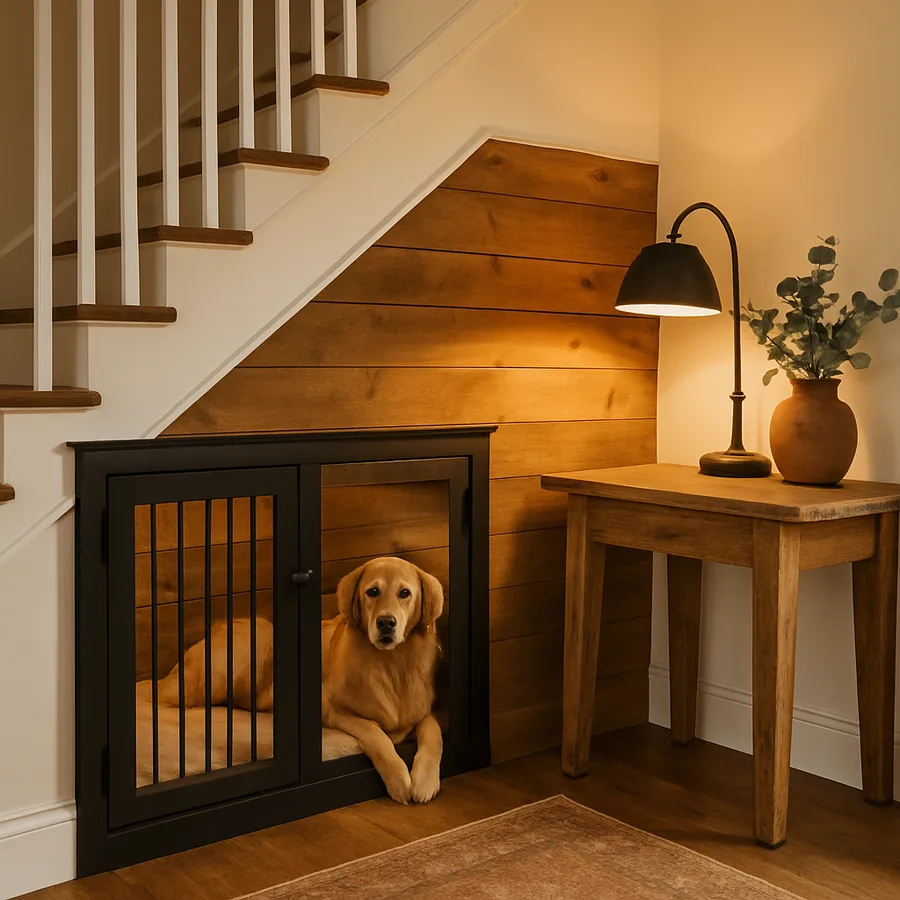
The free-standing wire dog crate has been a fixture of American homes for decades, but the visual and acoustic toll it takes on a living space has driven a fast-growing renovation category: the built-in under-stair dog crate enclosure. Rather than parking a metal cage in the corner of a kitchen or hallway, families are converting the dead triangular cavity beneath their stairs into a permanent canine retreat that disappears into the architecture when closed and provides a calmer, quieter den for the dog when occupied. The American Pet Products Association reported in its 2025 National Pet Owners Survey that 66% of U.S. households now own a pet, with dogs in roughly 65 million homes, and the National Association of Home Builders (NAHB) noted in its 2024 What Home Buyers Really Want study that a dedicated pet space ranks among the top emerging amenity requests from buyers under 45.
The shift from utilitarian crate to integrated millwork is more than an aesthetic upgrade. Veterinary behaviorists have long emphasized that a properly sized den-like enclosure helps dogs self-regulate, recover from overstimulation, and sleep more deeply, all of which a thoughtfully built under-stair enclosure delivers better than any wire crate. This article covers the planning decisions that distinguish a comfortable, safe, code-compliant enclosure from one that becomes a stuffy box your dog refuses to enter: sizing for breed, ventilation, materials selection, door and latch design, lighting, climate control, and the budget realities of building it well.
Why a Built-In Enclosure Outperforms a Free-Standing Crate
The argument for the built-in approach starts with the dog's experience. A wire crate sitting in an open room exposes the dog to every sight, sound, and movement in that room. The dog cannot truly settle because the eyes never get to close on a steady visual field. A built-in enclosure with solid sides, a partial-view door, and acoustic separation from the main living area lets the dog enter a meaningful rest state. Anyone who has watched a dog finally exhale and curl into deep sleep inside a cave-style den has seen the difference firsthand.
The benefits to the household are equally measurable. The under-stair cavity already exists, so the enclosure recovers what was wasted space rather than consuming useful floor area. The wire crate that previously dominated 12 to 16 square feet of kitchen or living room disappears entirely, returning that footprint to human use. Visual clutter drops, traffic flow improves, and the home reads as cared for rather than improvised, which matters both for daily living and for resale appeal.
Have you noticed how often dogs choose to sleep in narrow hallways, beneath dining tables, or behind couches rather than in the open beds purchased for them? That preference for enclosure is hardwired den-seeking behavior, and the under-stair conversion provides exactly the kind of space the dog would have chosen on its own. The American Society for the Prevention of Cruelty to Animals (ASPCA) has published behavioral guidance noting that confinement to an appropriately sized enclosed space, used positively and never as punishment, supports house training and reduces separation anxiety in many dogs.
Sizing the Cavity for Your Breed and Life Stage
Crate sizing rules from the major manufacturers translate directly to built-in enclosures. The dog should be able to stand without ducking, turn around comfortably, and lie fully stretched on its side. For a 25-pound terrier, that means roughly 24 inches deep by 30 inches wide by 24 inches tall. For a 70-pound retriever, you are looking at 36 by 48 by 32 inches minimum. The good news is that most under-stair cavities exceed these dimensions easily once the slope is accounted for. The bad news is that families often build enclosures too large because the cavity is available, and an oversized enclosure undermines the den effect that makes the conversion work.
If you are building for a puppy that will grow significantly, two strategies work. The first is to install a removable plywood divider that shrinks the usable space during the puppy phase and gets removed as the dog matures. This matches the standard guidance from veterinary behaviorists and aligns with house-training best practices documented by the American Veterinary Medical Association (AVMA). The second is to build to the eventual adult size and accept that the puppy will treat the entire space as its territory, which works for some breeds but slows house training for others.
Multi-dog households need extra planning. Two dogs can share an enclosure only if they choose to and only if both have enough space to lie down without contact during sleep. Many multi-dog families find that two smaller adjacent enclosures, separated by a vertical divider, produce a calmer outcome than one large shared cavity. The Houzz remodeling community includes dozens of documented examples of side-by-side under-stair enclosures with shared exterior millwork that read as a single architectural feature from outside.
Ventilation, Climate, and the Stuffy Box Problem
The single most overlooked failure mode in under-stair dog enclosures is inadequate ventilation. A wire crate breathes on every side. A solid enclosure with a single louvered door does not, and a dog inside a poorly ventilated space will pant, refuse to enter, or in extreme cases overheat. The fix is straightforward but must be planned during construction, not added later. Cut passive vents at the top and bottom of at least two walls, screen them to keep insects out, and ensure the total free area meets or exceeds the minimum recommended by HVAC sizing rules of thumb, typically one square inch of vent per cubic foot of enclosure volume.
Air movement matters as much as opening area. A small low-watt computer-style fan wired to a thermostat will keep air circulating during summer months and can be set to engage above 78°F. Do not blow air directly onto the dog; instead position the fan to draw warm air out of the top of the enclosure, which lets cooler air enter through the lower vents naturally. The U.S. Department of Agriculture publishes Animal Welfare Act standards for animal housing that, while written for commercial settings, provide reasonable benchmarks for residential applications, including ambient temperatures between 50°F and 85°F as the safe envelope for most adult dogs.
Climate also drives material choice. The interior surfaces will see drool, occasional accidents, and shed hair, and the underlying structure will be exposed to moisture cycling that can encourage mold if cheap materials are used. Specify moisture-resistant plywood or sealed MDF for the carcass, finish all interior surfaces with a low-VOC paint or sealer rated for kennel applications, and use a removable washable mat or orthopedic pad on the floor rather than carpet. Carpet inside an enclosure is impossible to truly clean and becomes a hygiene problem within months.
Door Design, Latches, and Visibility
The door is where most under-stair dog enclosures express personality, but it also has more functional implications than any other component. A fully solid door turns the enclosure into a sealed box and many dogs will refuse to enter. A fully open wire gate negates the visual privacy that makes the built-in worth doing. The sweet spot for most households is a Dutch-style split door with a solid lower panel and a barred or mesh upper section, or a single-panel door with a generous mesh window centered at the dog's eye height when standing.
Latch hardware needs to balance security and ease of use. Magnetic catches that release with a gentle pull are friendly for daily use but inadequate for dogs that lean into doors looking for an exit. A positive-latching gate hardware rated for animal containment, available from kennel suppliers, gives you confidence that the dog stays in when expected. Double-action latches that require two distinct motions to open are the residential equivalent of childproof catches and prevent accidental release if a small child or guest leans against the door.
Visibility into the enclosure from outside helps both the human and the dog. The dog sees the household and feels included even while resting, and the family can confirm at a glance that the dog is comfortable. Better Homes and Gardens (BHG) ran a feature in 2024 highlighting that the most popular under-stair enclosure designs included at least one viewing window with iron grille or wood spindle work, often styled to match cabinetry hardware elsewhere in the home.
Materials, Finishes, and Hygiene
Material selection inside a dog enclosure is a hygiene decision first and an aesthetic decision second. Every interior surface will eventually need to be wiped down, sometimes urgently, so porous and unsealed surfaces should be eliminated. The structural carcass can be standard cabinet-grade plywood, but the interior should be sealed with a moisture-cure urethane or a kitchen-grade enamel that can be scrubbed without degrading. Avoid latex paints inside the enclosure because they soften and lift when scrubbed repeatedly with cleaning solutions.
The floor is the highest-stress surface. A removable raised platform of food-grade plastic or sealed marine plywood, sized to drop into the enclosure, can be lifted out for deep cleaning and replaced as needed. Cover the platform with a washable orthopedic pad rated for the dog's weight, and keep a second pad on hand for swap-outs during laundry. The American Animal Hospital Association (AAHA) recommends weekly washing of pet bedding to control allergens and skin flora, which is realistic only if the bedding is easy to remove.
Exterior millwork is where the enclosure becomes architecture. Match the surrounding trim profiles, use the same paint or stain as adjacent built-ins, and treat the door as a piece of cabinetry rather than a kennel gate. The most successful under-stair conversions documented by the National Kitchen and Bath Association (NKBA) trends reports earn their keep aesthetically by reading as bench seating, bookcase, or paneled wall first, and revealing their function only when opened. The dog enclosure should not announce itself.
Lighting, Comfort Tech, and the Cozy Factor
Inside the enclosure, lighting should be minimal and dimmable. Dogs sleep better in the dark, so the enclosure should not have permanent overhead lighting beyond a low-output night feature. A small battery-operated puck light on a manual switch, mounted to the ceiling of the enclosure, gives you visibility for cleaning and inspection without disturbing the dog during normal use. Skip motion-activated lighting because it will trigger every time the dog stirs and disrupt sleep cycles.
Comfort tech has expanded the category significantly. Heated pet pads designed for crate use are widely available and most are UL-listed for unattended residential use. A small wall-mounted dog camera that streams to a phone gives anxious owners peace of mind during the workday and helps identify whether the dog is genuinely settling or stress panting. White-noise machines or low-volume calming music played from a small Bluetooth speaker outside the enclosure have been shown in multiple veterinary behavior studies to reduce stress markers in confined dogs, particularly during thunderstorms or fireworks.
What about water and food inside the enclosure? Most veterinary guidance suggests keeping food bowls outside the enclosure to avoid contamination and to associate the space with rest rather than feeding. A small spill-resistant water bowl is appropriate, particularly for dogs who spend extended periods inside, and elevated bowl mounts that screw to the enclosure wall reduce tipping. Keep the floor free of toys that could roll under the dog and disrupt sleep.
Conclusion
A built-in under-stair dog crate enclosure is one of the highest-value renovations a pet-owning household can make, returning unused architectural space to productive use while measurably improving the dog's daily experience and removing the visual intrusion of a wire crate from your living areas. The design discipline that separates great enclosures from disappointing ones comes down to right-sizing for the breed, ventilating generously, choosing surfaces that survive cleaning, and treating the exterior as architecture rather than kennel hardware. Get those four decisions right and the conversion pays off for the full life of the dog and well into resale value afterward.
Safety and code compliance deserve front-of-mind attention. Ventilation calculations, electrical work for any internal lighting or fans, and door hardware that contains the dog without trapping it during an emergency are not optional. A short conversation with a licensed contractor familiar with residential renovation code in your jurisdiction is the single best investment you can make before construction begins, particularly if your stair enclosure also serves any structural or fire-rated function under the International Residential Code.
Behavioral preparation of the dog is the step most homeowners underestimate. A new enclosure is a new environment, and most dogs need a slow positive-association introduction over several days before they will settle in voluntarily. Feed treats inside the open enclosure, drop a worn t-shirt with your scent on the bedding, and never use the enclosure as punishment. The American Society for the Prevention of Cruelty to Animals and the AVMA both publish accessible homeowner guidance on positive crate training that translates directly to a built-in setting.
Ready to start sketching your enclosure? Measure your dog standing, lying, and turning, then take three measurements of your under-stair cavity: front opening height, depth to back wall, and back wall height. Compare the two and decide whether the available space comfortably exceeds your dog's needs by a 30 to 40 percent buffer for movement and bedding. From there, get a written estimate from a local cabinet shop or remodeling contractor and budget for ventilation, electrical, and quality hardware as line items rather than afterthoughts. For deeper reference reading, the NAHB publishes ongoing data on home buyer preferences for pet amenities, the Houzz directory contains hundreds of finished under-stair enclosures with photos and homeowner reviews, and the NARI contractor finder helps locate vetted local remodelers experienced with this specific category of conversion.
More Articles You May Like



Comments
Post a Comment